

Inspected Drops "1992" Mix, Previews Powered by Inspected 3
The London-based independent label Inspected has released some of the most progressive electronic music of the 2010’s from artists like Koan Sound, Culprate, Monuman, COPYCATT. Few if any imprints have pushed the neuro sound so aggressively yet with such nuance. Yesterday, to celebrate the launch of their “1992” merchandise line, they dropped a scorching hot 30-minute mix featuring many of their hits plus remixes/VIPs and unreleased delights.
The London-based independent label Inspected has released some of the most progressive broken beat electronic music of the 2010’s from artists like Koan Sound, Culprate, Monuman, COPYCATT. Few if any imprints have pushed the neuro sound so aggressively yet with such nuance. Yesterday, to celebrate the launch of their “1992” merchandise line, they dropped a scorching hot 30-minute mix featuring some of their best music from the past several years plus remixes/VIPs and unreleased delights.
Deep heads have become accustomed to awaiting Inspected’s Movember drop each year. Some of the most wicked tunes in the game have come from their Powered by Inspected compilations. According to the cheeky vocal sampling in this mix, the unreleased music within is forthcoming this Fall on Powered by Inspected 3. Review tracklists for the first two volumes of this compilation, and you’ll realize big things are in store. Ambitious trainspotters in the comments section of the Youtube upload have compiled an impressive tracklist so far for the 1992 mix.
Tracklist
Vellum - ID
Culprate - Jelly and Ice Cream VIP or remix
Emperor - Jackhammer
Chee - ID
RefraQ - Necromancer
Ekcle - Serene Mont Garde
Sorrow - Want U Back
HELP, Refraq?
Monuman - If You Want
Vorso - Waterfront VIP
HELP
The gnarly garage opener is a highlight, as is the remix or VIP of Culprate’s fantastical “Jelly and Ice Cream”. The sequence in the latter half of the mix featuring Sorrow into an unknown tune into Monuman’s “If You Want” is sublime. Inspected is one of those rare labels that never disappoints. On top of that, they produce bold, fresh merchandise and judging by the marketing strategy and vocal samples on this mix, they’re also a bunch of cut ups to boot.
Those who attended Down to Earth Festival in upstate New York during the weekend of the total solar eclipse in 2017 were treated to a rare Inspected showcase, featuring the North American debut of the label director and DJ Inspector. One can only dream that this will ever happen again in the states. For now, jamming this mix and following for news of Powered 3 is the next best thing.
FOLLOW Inspected: Official / Spotify / Soundcloud / Twitter / YouTube / Facebook / Shop

Cloudchord & Soul Food Horns Switch Tempos on Moon Fortune EP
Cloudchord has maneuvered all over the musical map since he first began releasing about five years ago. The producer and guitarist has proven himself difficult to pigeonhole and marketable in many different contexts, from lo-fi hip-hop and instrumental R&B to future bass and house. Once again he’s linking with Soul Food Horns, and together they’re switching it up to deliver a four-track four-on-the-floor EP Moon Fortune.
Cloudchord has maneuvered all over the musical map since he first began releasing about five years ago. The producer and guitarist has proven himself difficult to pigeonhole and marketable in many different contexts, from lo-fi hip-hop and instrumental R&B to future bass and house. Once again he’s linking with Soul Food Horns and together they’re switching it up to deliver a four-track four-on-the-floor EP Moon Fortune. He’s probably the only producer with releases on both the heavy bass label Gravitas Recordings and the instrumental hip-hop imprint Chlilhop Music, and the only producer to collaborate with the opposite poles of Space Jesus and Emancipator.
Both Cloudchord and Soul Food Horns, a collective of horn players, represent Austin, TX. They first linked up for Koi Pond, a full LP with Chillhop Music, which received a ton of play upon release. This also kicked off Cloudchord’s recent love affair with instrumental and lo-fi hip-hop. Since that release he’s collaborated with lo-fi favorites oatmello, Goosetaf, HM Surf and G Mills and dropped a sultry and appropriately-titled single “Bopatron” featuring Soul Food Horns on Inner Ocean Records.
Cloudchord, whose real name is Derek VanScoten and who in the past has gone by D.V.S., is a versatile collaborator. He can step in for some guitar licks, co-produce, or produce the entire work as he’s done on Moon Fortune. Although these four-on-the-floor songs depart from the producer’s recent hip-hop trajectory, they harken back to some of his earlier work which was disco-influenced. The placement of the horns is so tasteful, the groove so deep. “Flutterby” is utterly smooth where the title track is more fast-paced and pressurized. There’s little not to like about this release. You can access Moon Fortune on all platforms here.
We caught Cloudchord in New York at the Chapel of Sacred Mirrors (CoSM) upstate last summer. Earlier this summer he taught an Ableton music production workshop at CoSM with MALAKAI. This weekend he returns to New York, to Mercury Lounge in Manhattan, for a Sunday evening show with British Columbia natives Moon Tricks. We had the good fortune to catch this duo and their banjo- and harmonia-laced blues bass at Shambhala Music Festival, where they were this year’s BC Artist Spotlight on the Living Room stage. It’s a unique pairing that will surely make for a rare evening of instrumental electronica.
FOLLOW Cloudchord: Spotify / Bandcamp / Soundcloud / Facebook
FOLLOW Soul Food Horns: Soundcloud / Spotify / Instagram / Twitter / Facebook
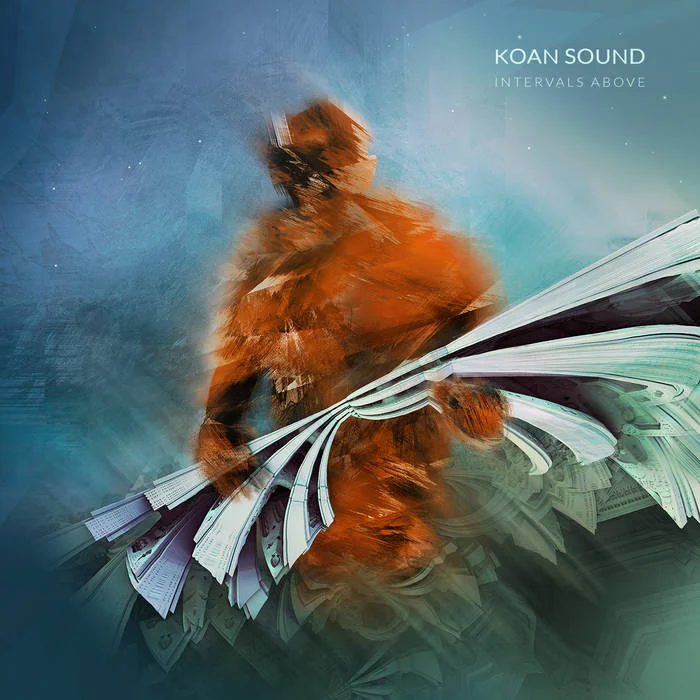
KOAN Sound Levels Up in Potency on Intervals Above EP
With the summer coming to an end, and a series of long-awaited KOAN Sound tour dates locked in throughout the fall, the pair have unleashed a veritable surprise for their fans; Intervals Above, a five track EP filled with audacious fidelity and production nuance. It builds on the production developments found within Polychrome, but channels the classic KOAN timbres with a focus on intensity and raw power.
Nine months ago, KOAN Sound emerged from a three year release hiatus with their genre-bending album Polychrome. It was a fresh dive into the melody-driven side of KOAN Sound’s music, and showcased a bevy of new production skills and sound design techniques that the pair developed during their respite from the public eye. While they have always been at the forefront of underground neuro music and production, Polychrome was a long form reminder that they are still kicking just as fiercely now as they were during their original foray into the world.
With the summer coming to an end, and a series of long-awaited KOAN Sound tour dates locked in throughout the fall, the pair have unleashed a veritable surprise for their fans; Intervals Above, a five track EP filled with audacious fidelity and production nuance. It builds on the production developments found within Polychrome, but channels the classic KOAN timbres with a focus on intensity and raw power. Each track feels sparser in the composition, leaving room for the development of every tone and motif. Intervals Above is a direct, high-impact delivery of KOAN Sound’s elaborate soundscapes and favored musical modes.
“Strident” opens the EP with washed-out synths and a vivacious, glitch-out acoustic string line. It sets the mood like only KOAN Sound can, channeling groove and melody long before the true rhythm of the song is in full motion. The arrangement follows a practical, texture-rich bass line that envelopes bright pads and gentle melodies from end to end. By the conclusion of the track, foley and synthesis meld into a series of cascading waves ebbing and flowing within the stereo space.
Chalky White, a Bristol-based guitarist with a penchant for accentuating bass music, received a healthy dose of fanfare over his chops in “Chalk It Out” on KOAN Sound’s last album. He reprises his role across the entirety of Intervals Above, most notably on the track “Vibrant”. It begins with a blend of synthesis and sultry string lines that fold into a melodious, staccato breakdown. The song combines salient sound design with a torrent of transient percussion and fluttering arpeggios. The lead synthesis lines meet each guitar chop squarely on cadence, fusing the airiness and presence within the track into an organic, evolving composition.
“Vivid” brings the EP to a gentle close, eschewing intensity in favor of pure flavor. For much of the songs runtime, it is an ambient and reverberant journey into the musicality of the KOANs. Serene, ephemeral chords stack atop short burst of hums and hymns, charging the stereo space with powerful bursts of emotion. At the height of climax, the minute-long flash of percussion fades into the background, and the song falls back into a cushion of synthetic textures and resounding chord phrases.
After years of relative quiet from the duo, it has been an especially auspicious year for KOAN Sound fans. Between Polychrome and Intervals Above, the KOANs touched upon every facet of their musicianship. To make matters even more exciting, they have announced their first set of major tour dates in the last several years, and they are currently slated to appear across the US from September to November. It seems like 2019 is the year of the KOAN, and we’re looking forward to a serious reunion on the dance floor.
FOLLOW KOAN Sound: Facebook / Soundcloud / Spotify / Official
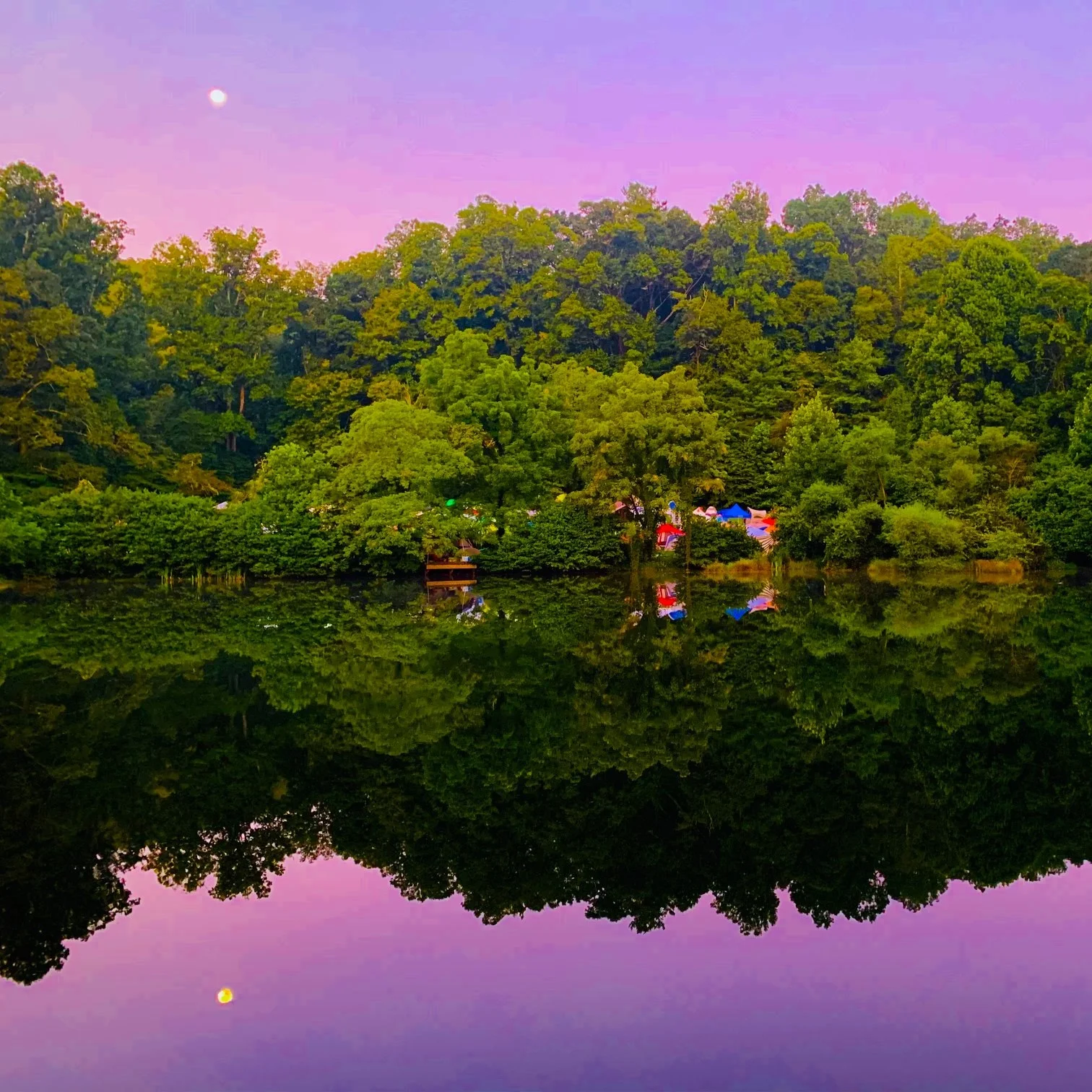
Solasta Festival Makes New Home at Deerfields, North Carolina in 2019
Placing community above all else, Solasta Festival is one of a growing number of events, gatherings, burns, and massives that exist to cultivate interconnectedness with one another, and with our own sense of health and wellbeing. For 2019, Solasta moved to the auspicious grounds of Deerfields, North Carolina, where it underwent the next phase of its ongoing metamorphosis.

The upper lake during sunrise (Credit: SuprisinglySimple)
Solasta Festival never really begins the day it’s advertised to begin. It’s the day prior during early arrival; the last moments of sound-checking speakers, fastening stage decorations, preparing water stations and late-night light sources, and prepping the camping grounds for the impending revelry. It’s the calm before the storm, when the air is still and the hum of organizers cruising about like worker ants becomes a part of the landscape.
In 2017 and 2018, this vibrant image of organization and preparation took place at Spirit Crossing, Tennessee, nestled high in the peaks of the Appalachians. Home to a pristine stretch of the Clinch River, and the site for like-minded burns and music events in years prior, it was a place that resonated with potent undercurrents. For 2019, Solasta moved east to the equally auspicious grounds of Deerfields, North Carolina.
Sequestered in the eastern reaches of Nantahala National Forest, Deerfields is a rustic retreat carved into “The Green Place”, a slice of property purchased by Monroe M. Redden in 1927. Over the course of the next eight decades, the property was gradually transformed into a sprawling network of forest alcoves surrounding two freshwater lakes. By midday, the sun illuminated every vector of the forest floor. By nightfall, the air cooled to a pleasant chill, drawing a dewy blanket across the length of the property. Despite being barely an hour’s drive out of Asheville, there isn’t a lick of cell service or wifi available on the property save for the bit of bandwidth utilized by the production team.
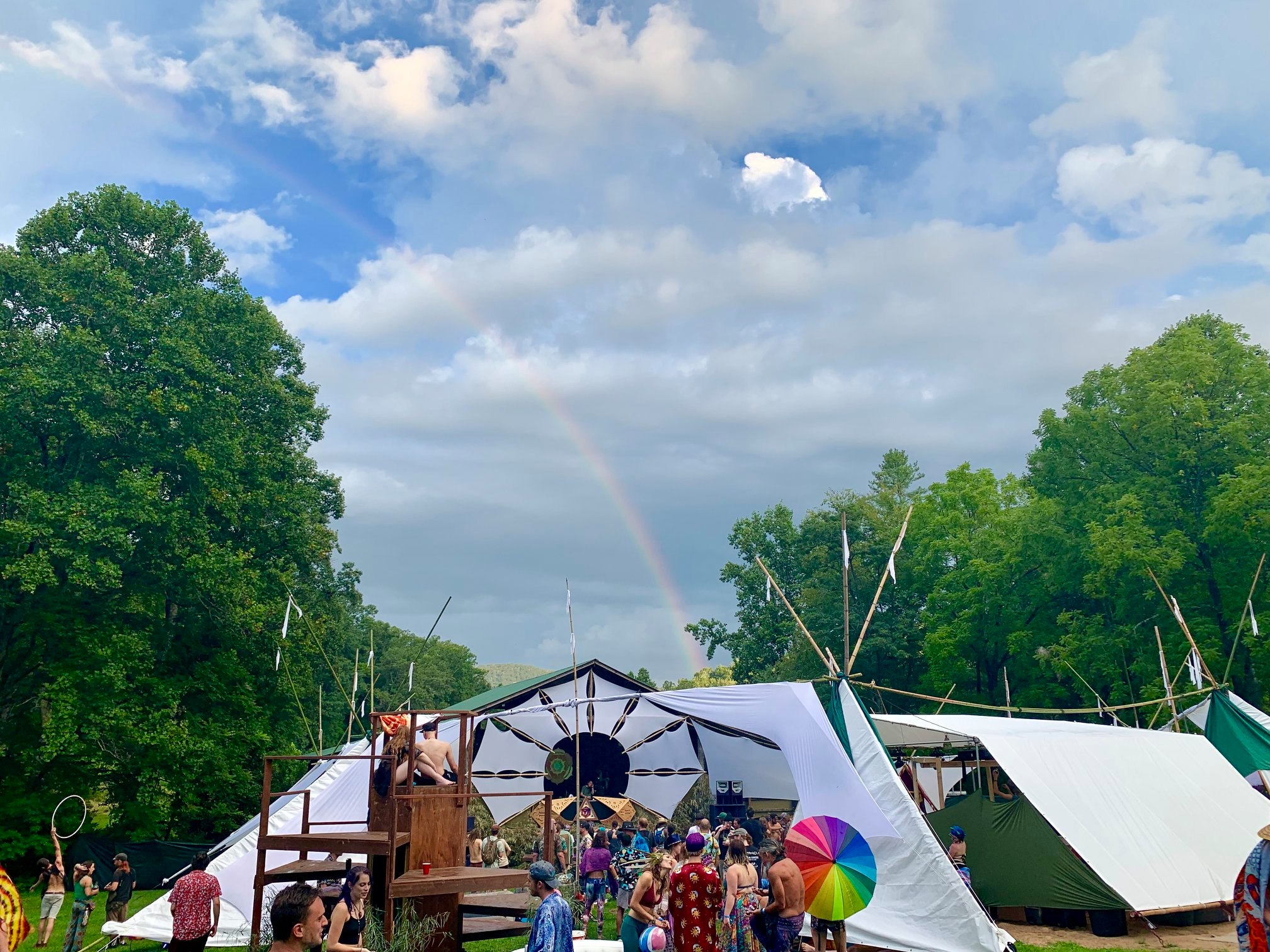
The stage by day (Credit: SurprisinglySimple)
Once again event producers Envisioned Arts and Harmonia displayed the confidence and swift problem-management skills befitting veteran production teams. As we elaborated on last year during an interview with Solasta’s organizers, their operational efficiency has been sharpened by years of experience outside of Solasta. Placing physical and mental well-being above all else, this team never missed its mark, with fans and friends keeping each other in check throughout the duration of the weekend festivities.
Making community the focal point of the festival, Solasta is one of a growing number of events, gatherings, burns, and massives that exist to cultivate interconnectedness with one another and with our own sense of health and wellbeing. The Asheville-based harm reduction and education company Harmonia, that doubles as event production entity, focused as always on providing safe spaces throughout the festival grounds. They’ve been the face of Solasta’s community operations from day one and are beginning to make an impact across the US festival circuit.
So far, Solasta has benefitted from its slim profile. The festival is intimate and there are few lines between artist, assistant, volunteer, and attendee. This interwoven social fabric is the strength of Solasta, wherein producers, engineers, audiophiles, and casual fans mingle in total cohesion, forging creative connections and friendships in a melting pot of talent and intrigue. One way Solasta achieves this dynamic by concentrating the music to a central location. As in years prior, there was again just a single main stage from midday until the following sunrise.
Hasan Zaidi, the co-founder of Envisioned Arts, paints a picture of Solasta’s strategy for success. “From the very first day of the first Solasta, the single stage dynamic has given all of our musicians and visual performers the most attentive platform we can achieve.” Solasta’s lineup has traditionally been a handpicked collection of incoming and veteran producers and DJs. Having a single focal point and an expertly-tuned sound system helps to level the playing field among the performers. Everyone gets their fair shot to make a potent impression on a captive audience.

The installation at the foot of the main stage (Credit: SurprisinglySimple)
Soundsystem Cultures, LLC (SSC) ran sound for the third year in a row, bringing along as always a potent set of Funktion One speakers featuring F218 and Infrabass 218 subwoofers and Resolution 2 tops. Sebastian Torsion, a member of Onesource Audio and a frequent attaché of Tipper’s audio crew, teamed up with SSC for the weekend. The audio team combined textbook knowledge with hands-on experience to curate an aural experience that was physically powerful yet totally comfortable. On Saturday afternoon, Sebastian joined Bill Weir, an expert audio engineer and co-owner of the international IDM label Outside Recordings, and taught attendees about the physics and technicalities of live audio production during an engineering workshop.
“Crafting an audio experience that produces immersion and comfortability at the same time is entirely a balancing act” Weir said. He explained the science behind proper concert audio, cutting zero corners as he dove into the fine details and objectivity behind specific engineering decisions. The crowd was sizable, with about 100 people in attendance despite the rising mid-morning heat. “Pushing decibels is the opposite of the operative goal. The goal is to achieve a totally balanced spread across the dance floor. We don’t want your ears to hurt, we want your ears to be immersed.”
That immersion is one of the key platforms that all successful music events rest on. Solasta has always preferred to achieve that immersion not just through a custom fit audio experience, but through a combination of sound and decoration. The eminent beauty of Deerfields was more than enough to propel attendees into a relaxed state of body and mind, but the stage design was also key to maintaining a constant feeling of immersion.
The stage was an open-air gazebo standing between both bodies of water on the property, with an alluring view of the lower lake. Dozens of white, silky sheets created a portal through which the crowd viewed the performers. The wonderful garden installation that has been a stage front staple at every Solasta had grown since the previous year. Parallel rows of trees stood in a fixed line behind the performers, seeming to meld into the foliage above and around the gazebo. The dance floor was ringed by draped textiles and bamboo, containing the party to an approachable, open space, and creating a conduit for communal experience.
Every staff member and volunteer said “Drink plenty of water” as many times as they blinked over the course of the weekend. It was an impactful reminder to us all why we were so excited to be here in the first place. That understanding of care and mindfulness between the organizers and the ticket holders creates an environment of trust, making it easier to develop social bonds within the festival.
The Southeastern experiential theatre and art troop GNOSTiK brought talents to Solasta once again. These women create transformative spaces for expression at events across the US, and they exceeded expectations with their Lounge installation at Deerfields. This year, the GNOSTiK Lounge rested in a smaller gazebo atop the upper lake, looking out across the expanse of the festival. The Lounge was a space of constant flux; dancers and acrobats gliding across a visual-mapped stage, surprise DJ sets, couches and benches warm from the entranced viewers wandering in and out of the space. It was full of intrigue and a respite from the dance-centric environment of the main stage, allowing revelers a chance to simultaneously rest and engage with performance art in new ways.

Performers in the GNOSTiK Lounge. (Credit: GNOSTiK)
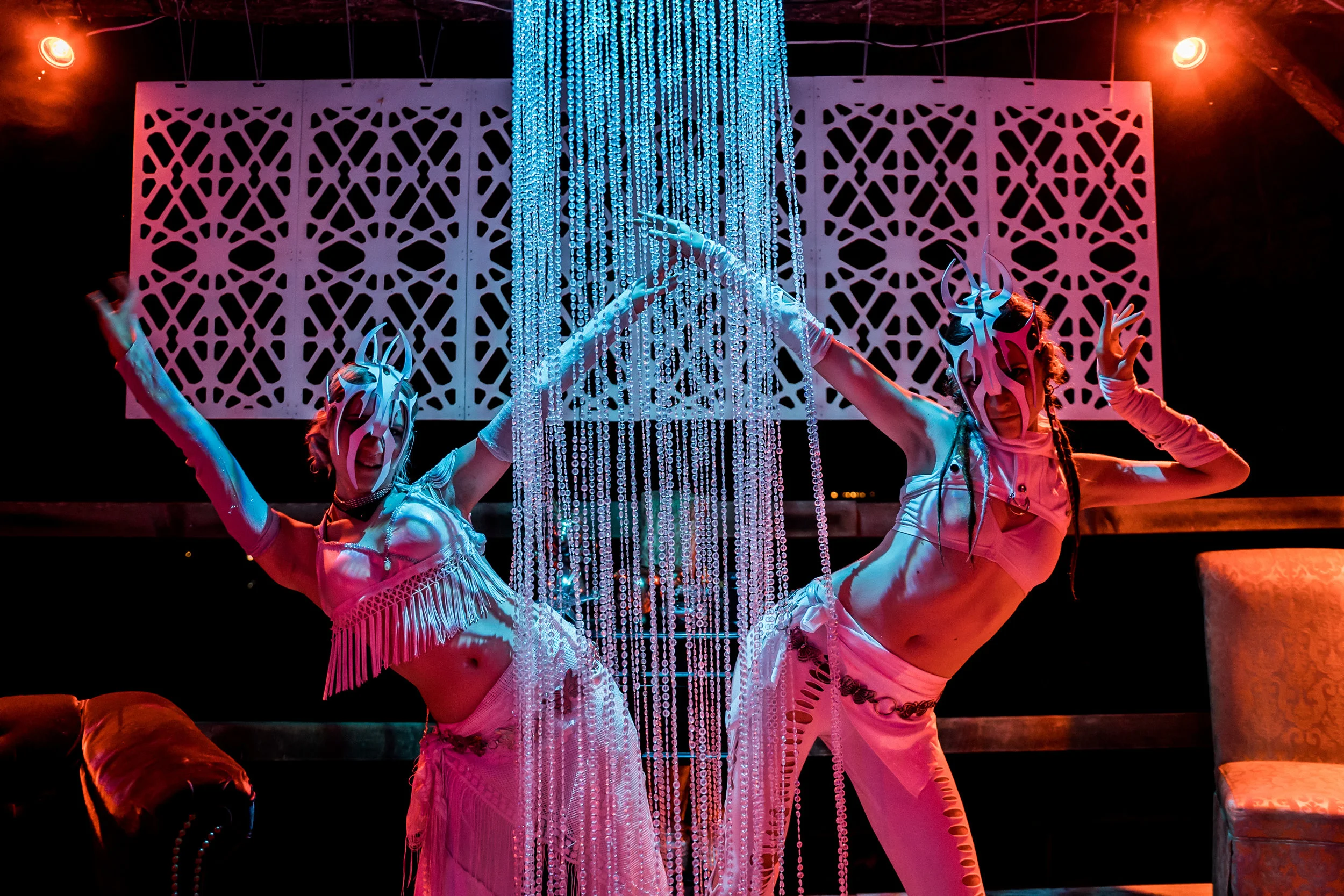
GNOSTiK performers at the Lounge. (Credit: GNOSTiK)
The music at Solasta once again leveled the crowd from start to finish. The lineup was a blend of top tier acts, rising stars, new and collaborative projects, and Solasta fan-favorites from across the electronic music spectrum, including Detox Unit, K.L.O, Ultrasloth, spacegeishA, MALAKAI, and Integrate. The order and pairing of the performers was especially well done. The prime time slots for Friday evening took the crowd on a journey through all things guttural and psybient within bass music. Base 2 brought the gears of the night into full motion, presenting a cultivated blend of original tracks that synced up with each other like a string of skeleton keys. Goopsteppa began the onslaught of surgical, fractalized synthesis that would persist through Charlesthefirst and Attya, charging the dance floor with permeable psychedelic energy.
Saturday afternoon began the festivities down on the shores of the lower lake, with a sultry blend of music to elevate the mood of the sun-soaked revelers. Rezinate co-owner Saltus initiated a serious dance-floor boogie, rinsing out salacious heaters for a specially curated funk set. Easyjack’s beloved side project, Frisk, channeled the echoes of the Chicago’s underground nightlife, with pulsing house and techno giving the festival a rare dose of steady-beat action. During the height of the afternoon sizzle, Nashville-based DJ Doyle reprised his role as the master of all ceremonies, sending the crowd into a glorified nostalgia frenzy with mid-2000’s club rap classics.
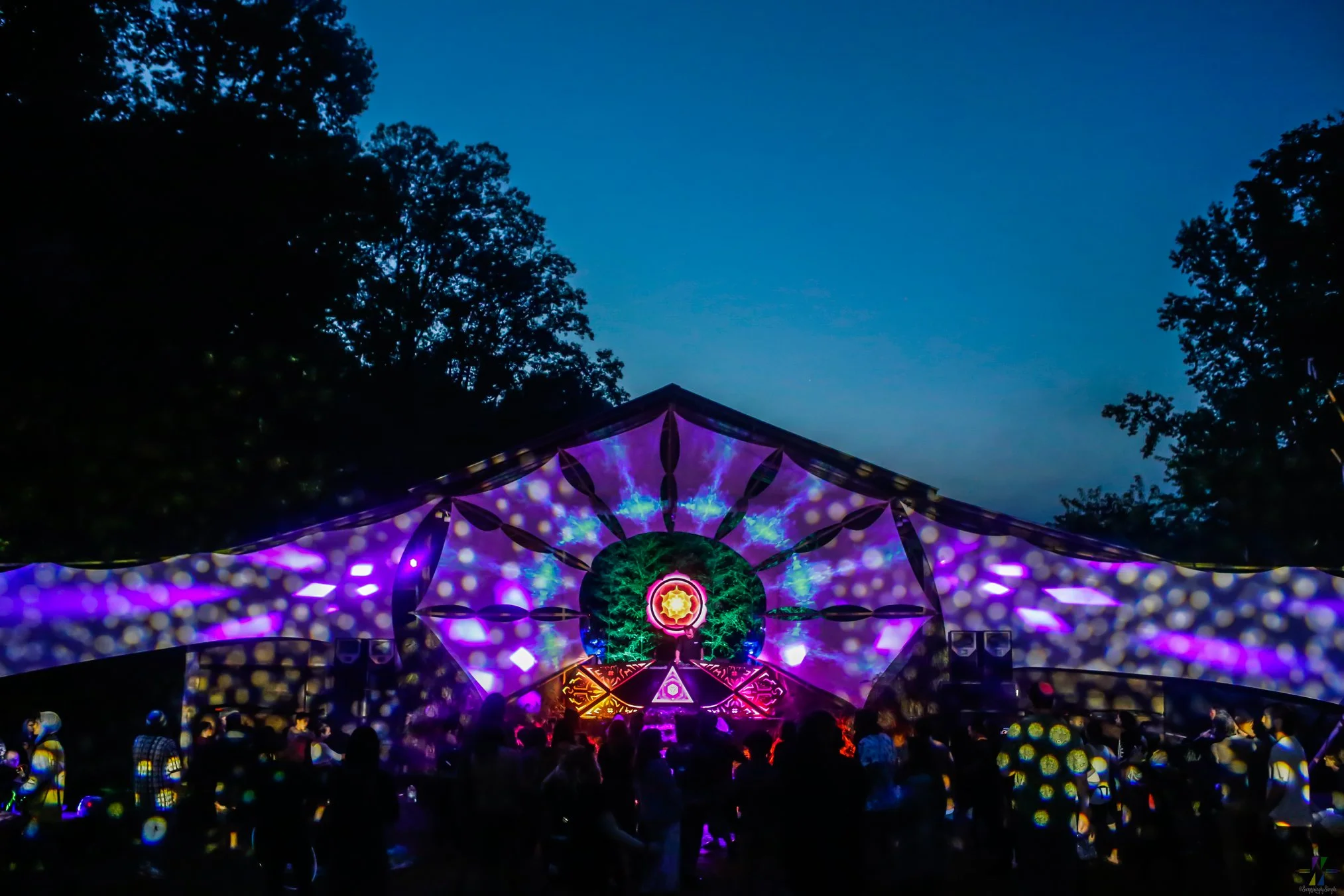
MALAKAI’s sunrise set (Credit: SurprisinglySimple)
Saturday evening saw the energy of Solasta launch straight out of the atmosphere, with a very tangible sense of excitement poking through the onset of a chilled dusk. Coalescing the energy output for Saturday’s prime run of acts, Integrate took the stage for their debut performance. A tag-team between the southeastern heavy hitters VCTRE and Black Carl, Integrate slung a bevy of original tunes and beefy selectors to mark their foray into the public eye. spacegeishA smashed her 11pm slot with a meticulously crafted exodus into the darkest reaches of sound, reverberating every inch of the dance floor. Detox Unit took the crown for crowd engagement, with every soul on the property engaged in an isometric group dance against a broken-beat flurry. K.L.O sliced and diced any remaining intact heads with their famously ferocious vinyl cuts and precision synthesis. Navigatorz claimed the spotlight as the second debut act of the weekend; Vinja and Sortof Vague brought their production and performance mindsets together for this new project, diving into the abyssal depths of synthesis. Bringing the last night to a spectacular close, MALAKAI spared no effort in executing a beautifully tailored sunrise performance. Original tracks and selections from his own archives morphed into an ultraviolet serenade of the senses, bringing the last bits of energy within the crowd to a resounding cadence of body and mind.
Sunday morning was a tired and joyous gathering for one last hurrah. The fabled pancake breakfast returned in it’s brightest form yet. Probe 1, Easyjack, and Detox Unit graced the stage for one last three-way break-beat performance, with organizers literally flipping pancakes into the mouths of their friends from behind the decks. It was an audacious and hysterical ending to a weekend filled with pure intentions and outcomes.
We left the grounds with that same sense of renewal and drive we felt last summer that made returning to Solasta Festival such a natural move. Powerful, communal undercurrents left this gathering through the thoughts and actions of everyone who came together for it, once again manifesting Solasta’s goal for inclusion and awareness. Given Solasta’s size and relative humility, it will undoubtedly continue to grow in the years ahead. We’re eagerly awaiting it’s return in the summer of 2020.
Lo-Fi Sundays 083 - outcrowd.
Hip-hop and Detroit have a visceral history between each other, and the indelible impact the city had on its homegrown artists and creators continues to flow through modern veins. outcrowd. is an upstart Detroit beatsmith who’s been knocking breaks and warping samples for the last 5 years and running.
Hip-hop and Detroit have a visceral history between each other, and the indelible impact the city had on its formative homegrown artists and creators continues to flow through modern veins. outcrowd. is an upstart Detroit beatsmith who’s been knocking breaks and warping samples for the last 5 years and running. His flavor is particularly smooth, taking inspiration from a handful of buttery genres to complete each musical concoction.
The meat of outcrowd’s output is filled with healthy slices of soul and vinyl grain. The stop-and-go, sampler-heavy touch to his arrangements breathes life into his discography, giving his music a flow like non-newtonian fluid. Staying firmly within his genre lines, all of his tracks feature a thick coat of dust and attitude, giving his music the aural aesthetic of a true polaroid. He’s released six beattapes to date, with all stylistically true to the outcrowd. blend of sultry and somber.
With a few dozen tracks and six beattapes released to date, outcrowd. has curated a collection of devilishly pocketed lo-fi tunes. He appears to have a steady release cycle of a month-by-month basis with no signs of slowing down. We’re going to be keeping close tabs on his progress, and we highly encourage you to do the same.
FOLLOW outworld.: Soundcloud / Bandcamp / Tracktrain
Drum-Driven Producer Jon Kennedy Releases Once Upon a Time Single
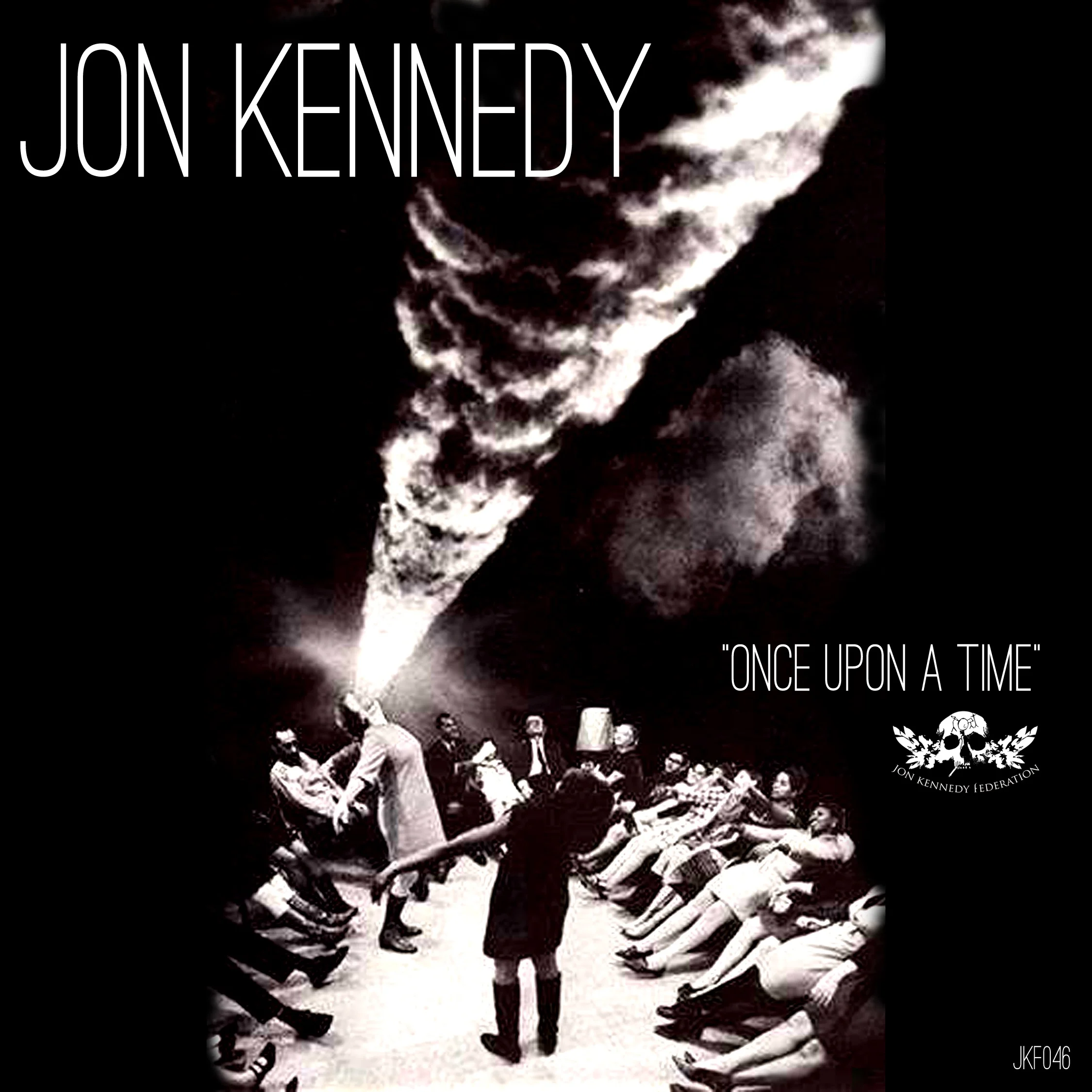
The mad percussionist, producer and label-owner Jon Kennedy has resurfaced with the hypnotic seven-minute single “Once Upon a Time”, his first new music since the spectacular 2017 LP HA!. What’s even more exciting than the sensation this song delivers is the knowledge that it’s the title track from an album forthcoming in 2020.
The mad percussionist, producer and label-owner Jon Kennedy has resurfaced with the hypnotic seven-minute single “Once Upon a Time”, his first new music since the spectacular 2017 LP HA!. What’s even more exciting than the sensation this song delivers is the knowledge that it’s the title track from an album forthcoming in 2020.
Kennedy was first discovered in 2000 by a ranking DJ in the Greater Manchester area of the UK. Today he lives in the countryside in the Czech Republic where he continues to produce and run his label, Jon Kennedy Federation, which he founded in 2007. He’s performed around the world as a DJ and as a drummer within his own live band and others, Last we heard, he was playing frequent small gigs in Thailand. With a deep discography and unsullied artistic vision, he carved out space for himself over time in the downtempo, beats and breaks universe. There’s no trend to his sound and very little shine, but there’s also no flaws, either. JK just makes great music, and “Once Upon a Time” is a predictably good addition to his catalog with an unpredictably fast tempo.
His percussion is clear and creative. It’s the element within his music that demands the most attention, while the other elements usually lilt in the background in a delightful ballet. The drums on “Once Upon a Time'“ are absolutely manic, not just the arrangement but the sounds themselves; whipping fast and prickly hi-hats and resonant, gangly snares.
To dive deeper into Kenndy’s music, check out his last album HA!. or the Rusted Rhythms mix from 2017 that he was gracious enough to drop on us. It’s full of the same drum and bass flavor in this latest single. Despite his long career, Kennedy continues to operate far from the spotlight. But he continues delivering top-shelf, uncompromising electronic music that’s more than worth our time to shine a light upon.
FOLLOW Jon Kennedy: Jon Kennedy Federation / Soundcloud / Facebook / Bandcamp / Instagram

Psy-Fi Festival Brings Best of International Bass to Netherlands
On one stage this Summer you can catch some of the best in American bass music from Jade Cicada, CharlestheFirst and Bogtrotter, international OGs like Hedflux, Rumpistol and Ott, and a living legend like Solar Fields; the Chill Out stage at Psy-Fi Festival: Seeds of Science, returning in its seventh year to Leeuwarden, Netherlands this weekend, August 28 to September 1.

Psy-Fi Festival main stage seen from above (Credit: Mushroom Magazine)
On one stage this Summer you can catch some of the best in American bass music from Jade Cicada, CharlestheFirst and Bogtrotter, international OGs like Hedflux, Rumpistol and Ott, and a living legend like Solar Fields; the Chill Out stage at Psy-Fi Festival: Seeds of Science, returning in its seventh year to Leeuwarden, Netherlands this weekend, August 28 to September 1.
As one of the larger transformational psytrance festivals in Europe, Psy-Fi has drawn people from 114 different countries. They come for good reason. According to the festival’s website, Psy-Fi invites “most of the best known live acts and dj's” to perform. That’s absolutely true of the Chill Out stage. They’re hosting the worldwide vanguard in psychedelic bass from Bluetech and Hedflux to Kalya Scintilla, Kaya Project, Bumble and ATYYA. Most of the performances from artists based in the United States, including MALAKAI and Schmoop, are European debuts.
Fully developed, highly produced chill out stages are less common stateside than they are internationally. They’re really a product of the trance scene, but there’s few psytrance festivals in the states. How does it work from a booking perspective or from an experiential perspective? The UK producer Steve Young aka Hedflux, one of the more well-traveled Chill Out stage performers at Psy-Fi, breaks it down this way:

In the trance world, chill essentially means “anything but trance.” Sometimes it's referred to as the "alternative" stage since it's not necessarily always chilled out. As a DJ you generally have free license to play whatever you want, whether it’s more sit-down chill music, or more deep dance vibes. There's no pressure to get the party rocking, but you can still get it rocking if you want to. Obviously the idea is to keep it psychedelic…but take artistic advantage of the great musical freedom you have to explore different rhythms, tempos and energy levels, and bring in musical influences from elsewhere. At the trance stage, there is a universal sense of expectation among the crowd that the next drop will be a trance beat, and if you mess with that, they'll get annoyed (understandably so). At the chill stage however there is no expectation, people are more fluid and you can take them from an ambient cuddle puddle to a frenzied ecstatic dance and back again without anyone shouting "where's the drop?".
Hedflux is a great representative of the groundbreaking global glitch at Psy-Fi. His Eclectic Psychedelica mixes arguably curate and mix through the best midtempo psychedelic music in the world. His appreciation for Itay comes through as well. “He is an amazing agent, producer and DJ and a curator of the finest psychedelic chill-out line-ups,” Steve says. “For me now, the chill stage IS the main stage.”
Itay of Feel Life Music, with his selective taste and a global roledex of bass musicians, is the mind behind the Chill Out stage. He’ll also perform there through his Kukan Dub Lagan project. While the lineup may astound someone seeing it for the first time, those who know Itay say it’s par for the course for this sommelier of psychedelic music. “I was certainly surprised, but at the same time, I’m not surprised Itay would pull something like this off,” writes Søren Thygesen, the Danish producer Bwoy De Bhajan. “I remember seeing the lineup for the first time. One act after the other made me raise my fists in joy.” This will be Søren’s fourth year at Psy-Fi. “They dare to take some chances with the lineup and not recycle the same group of acts year after year. It’s very refreshing, and i'm starting to see more festivals in Europe taking risks. You don't forget those moments where an unfamiliar act takes you by storm.”

The Chill Out stage at Psy-Fi Festival (Credit: Dutch Review)
“The amount of North American acts making their way over here is great, this rarely happens, if ever,” says Søren. Psychedelic electronic music started and first rose to prominence outside of the states. The states has its own robust electronic community, Chicago house and Detroit techno, plus the countercultural mecca Burning Man. But in the popular imagination, UK clubs, Goa beaches, Australian doofs or blowouts like Boom Festival in Portugal or Shambhala Music Festival in Canada have always eclipsed the stateside scene. Psy-Fi’s bookings recognize though that theres a growing group a forward-thinking producers from the States that’s worth integrating onto the international circuit. “I hope we keep that trend up for years to come, and build a foundation for them to come back and make their way around the European scene.” He’s excited about Schmoop in particular, producer Will Russek from the Dallas-Fort Worth area in Texas. “I met the young dude in Florida back in April, where he told me he's playing his first set abroad at Psy-Fi. The sheer excitement from his side was just amazing.”
We asked Will how he’s planning to approach his first international set. “The plan is top secret,” he wrote, but he’s playing a little bit of everything (check out his destructive single “Charge”). One thing you won’t see at Psy-Fi is a set from Wonky Llama, his collaboration with Jade Cicada. “Saving that for the future,” he wrote.

(Credit: Mushroom Magazine)
We’ll be on the lookout for feedback from this thoughtful event. It’s enabling cross pollination between producers from every corner of the world, and that’s encouraging. Speaking of pollination, what of the name “seeds of science”? From the festival’s website: “The quote from Ralph Waldo Emerson ‘men love to wonder and that's the seed of science’ shows that our imagination and our curiosity are at the base of all that men has ever created. We encourage you to find out how science can help you and others to create a better and more sustainable world.” For the full Chill Out stage lineup and more details on the festival, visit their website.
"It Was Really About the People & the Land" - A Weekend At Shambhala
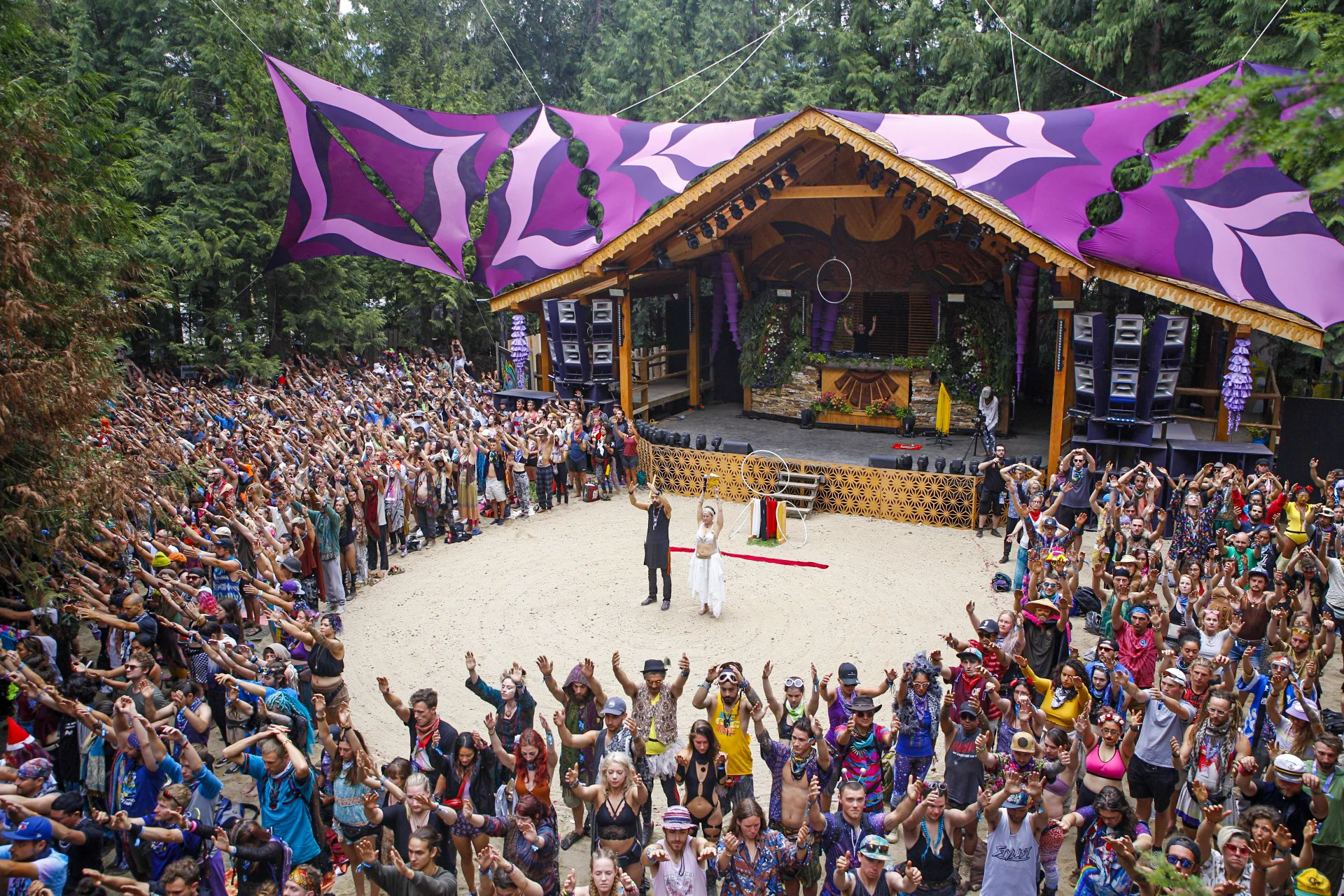
As the climate, laws, music, people, and the popularity of the entire electronic music enterprise has changed, Shambhala Music Festival has preserved and grown. How? It’s run by an enduring crew that comes back year after year. It’s become part of Western Canadian culture. And It’s centered around ideas that don’t lose value with time or trends; respect for the Earth and oneself; independence from corporate influence; reverence for higher powers; passion for good music.
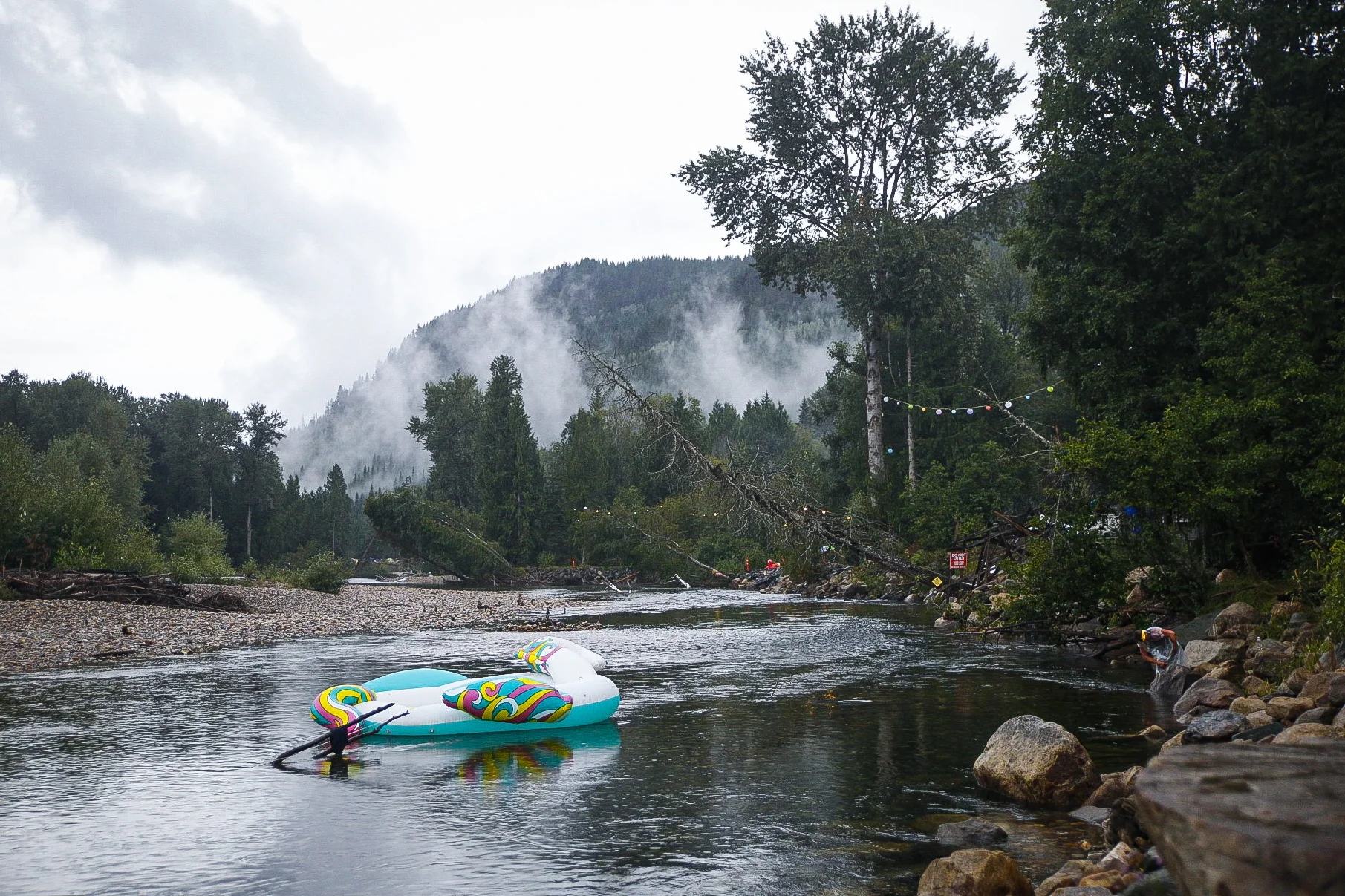
(Credit: ConcertSocks)
Flipping through my notes from Shambhala Music Festival, a few sloppy, scribbled lines stand out:
We’ve got what it takes
To make this world a better place
And make our children safe
It’s all up to me
It’s all up to you
That’s a vocal sample from soundcheck before A Tribe Called Red’s Sunday night performance at the Ampitheater, one of six stage environments at Shambhala, which ran from Thursday, August 8 through morning on Monday, August 12 at the Salmo River Ranch in British Columbia, Canada for the 22nd year in a row.
This Ottawa-based act blends all sorts of electronic music - house, hip-hop, dubstep, drum and bass, hardstyle, Jersey club - with First Nation drumming and chanting to initiate an “electric pow wow”. Participating was liberating yet chilling (“My people will sell our bracelets by the roadside. Your people will play golf, and eat hot hors d'oeuvres.”)
Their heavy performance said “dance like you mean it, but don’t forget what’s happening behind the music.” It was like a microcosm of Shambhala as a whole. The event hosts many of the best electronic acts in the world, but the music can also be seen as a means to an end. Music is just the centrifugal force around which a community, decades in the making, gathers to celebrate its renegade culture.
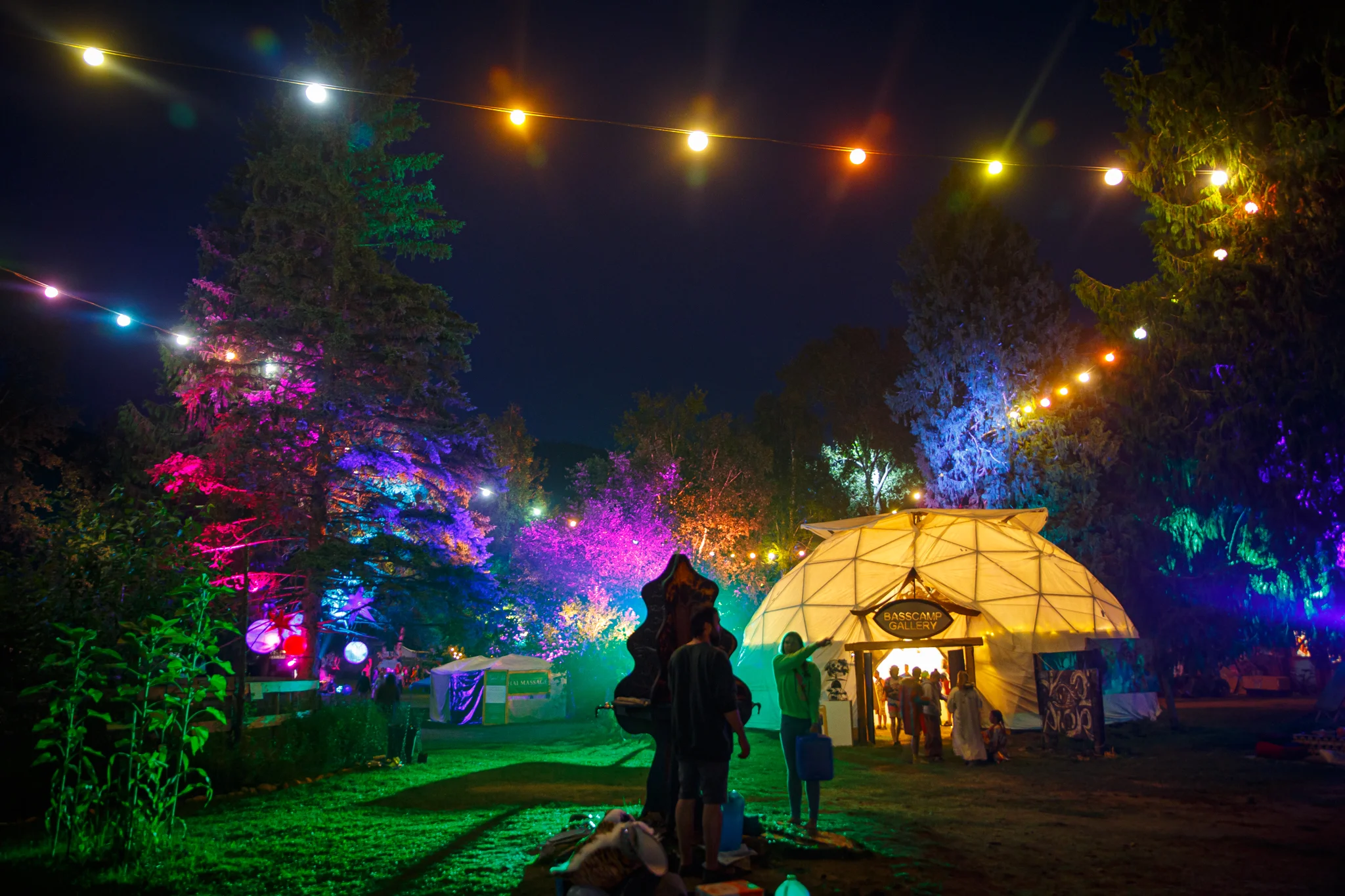
(Credit: ConcertSocks)
A British Columbia local named Osprey and perhaps others conceived the idea for Shambhala in the late 1990s. Osprey came from the psychedelic trance scene of Goa, India during its heydays, where interactions between western counter culture and Hinduism embedded eastern spirituality into the rave scene. He would tragically pass away in a car accident, but his vision for a music festival in the Kootenay Mountains would live on through the several hundred local fans, promoters, and musicians who started it.
During the Vietnam War, draft dodgers from the United States hid out in the Western Kootenays. At the turn of the 20th century, the Dukhobors, an anti-state Russian Christian sect, settled there after being exiled for their unorthodox beliefs. There’s always been a durable marijuana culture. It’s fertile ground for a party like Shambhala, which built upon the existing counter culture in this isolated region.
“The surrounding area is sort of a fortress. It’s not near any major highways, there’s mountains in every direction, deep valleys, big mountains all around. It’s not on an interstate or even a big provincial highway.” That’s Tall Brian, who for over a decade has managed Shambhala’s artist lounge and accommodations, an “outdoor hotel” as he calls it. “The event is kind of a pilgrimage in that way. You have to go there.”
Naasko is a DJ whose performed at every Shambhala since 1999 besides a few when he worked and performed at Boom Festival in Portugal. “There’s a pursuit of freedom that exists here at Shambhala,” he said. That first year he came from Vancouver, worked a food stand, talked his way into a set, and would move to the nearby city of Nelson not long afterwards. “A giant inflatable buddha like 40 feet tall out on the highway brought people into this little mystical enclave here in the woods,” he recalled.
I spoke to both of them on a rainy Sunday in a big, twisting tree house lounge before Naasko’s 6:00pm set. “It started really humbly,” said Brian. “Just local people putting stuff together. I mean the early stages were just really rudimentary tarps and small systems. I have a photo of the Living Room when it was two speakers and a tarp.”
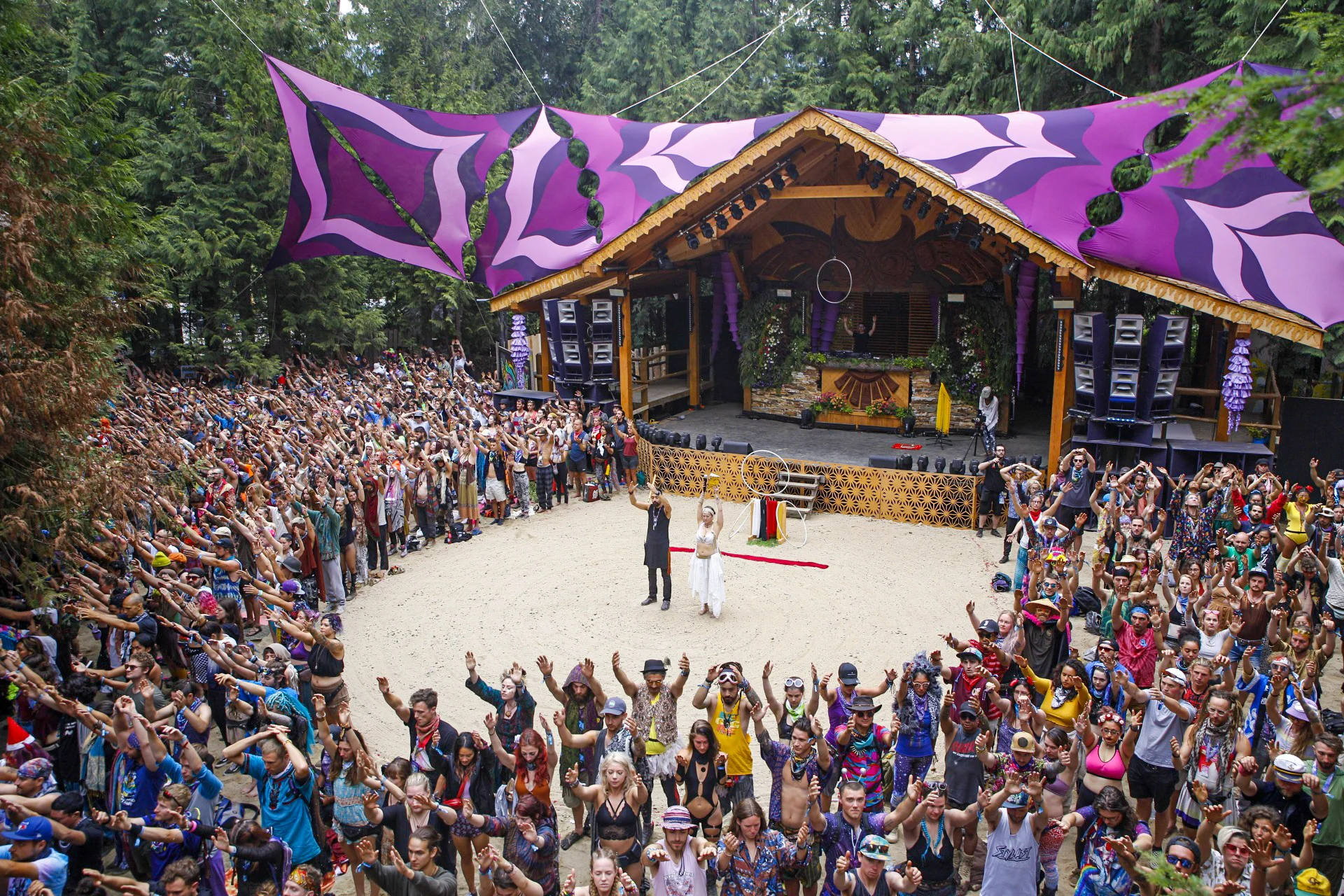
The Grove (Credit: ConcertSocks)
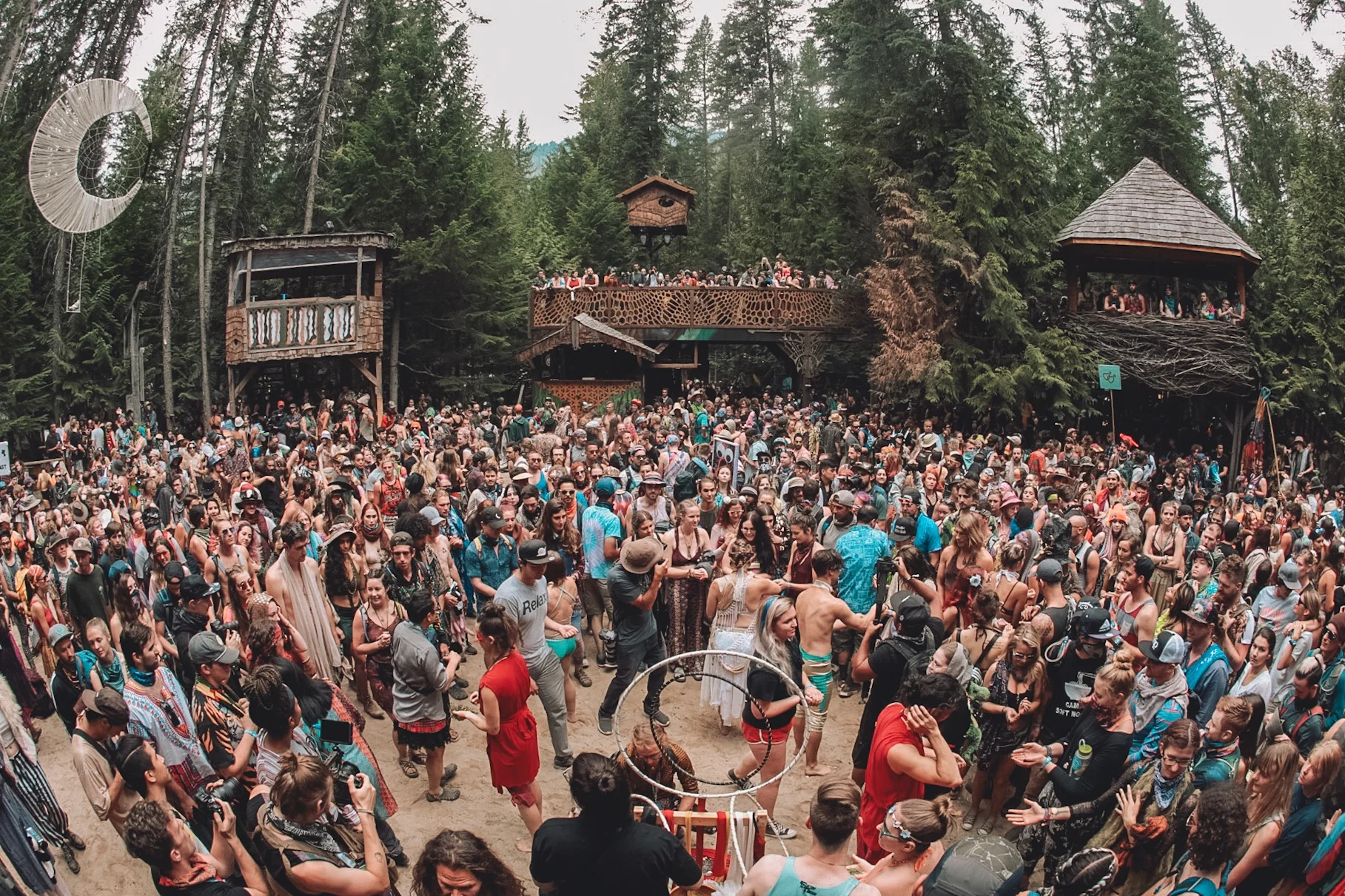
The Grove (Credit: ConcertSocks)
As the climate, laws, music, people, and the popularity of the entire electronic music enterprise has changed, Shambhala has changed, too. But it’s managed to preserve that special something. “I think the essence is still there. That’s what sustains its popularity. The festival embodies a lot of the freedom essence that’s not found in other places. That’s the appeal to the working masses in Calgary and Edmonton and Saskatchewan. When they think about coming here, it means so much to them.”
How? It’s put on by an enduring crew that comes back year after year, it’s become part of Western Canadian culture, and it’s centered around ideas that don’t lose value with time or trends; respect for the Earth and oneself; reverence for higher powers; independence from corporate influence; passion for good music.
People take care of the 500-acre ranch. Beside the river in the early morning sun, Jack Elliman sweeps his arm out across the pristine riverbank. “There used to be trash all along here. Now when people come to Shambhala they are educated by Shambassadors, the GRC and festi veterans pretty quickly. They learn how important it is to respect the land, the river, and each other, and that mind frame is contagious.”
Jack volunteers with the Shambhala Green River Collective which has been cleaning the Salmo River since 2011. He also runs the event’s cigarette butt disposal and recycling operation and invented the Pocket Ashtray (yes those pocket ashtrays), a Shambhala staple. There’s butt buckets all over the grounds, the Grove has a smoke-free dance floor, and nature’s abundance is itself a persuasive reminder not to litter. “Then they take what they learn here and bring it back to wherever they're from,” says Jack. “That's the true transformational festival."
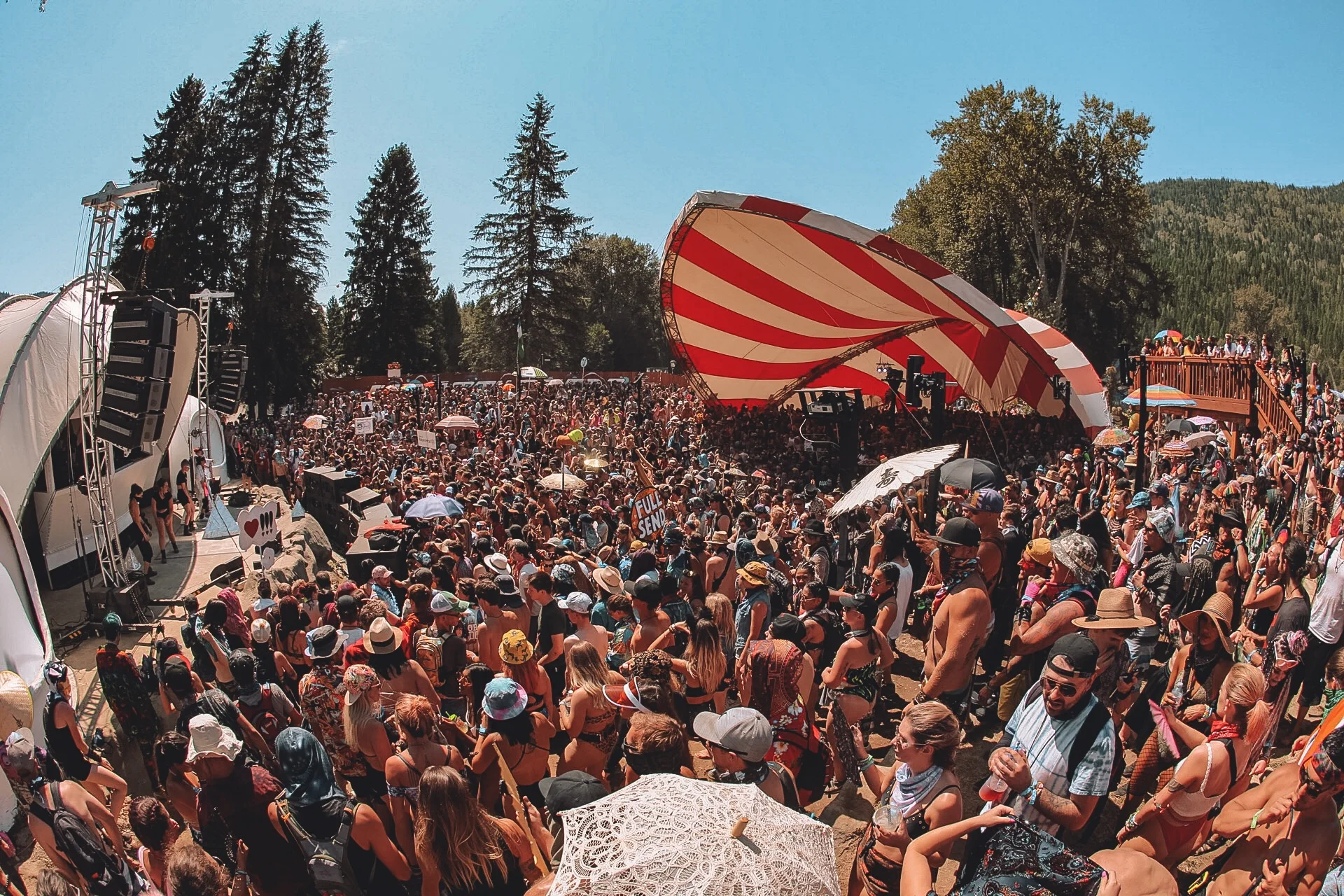
The Amphitheater (Credit: Banana Cam)
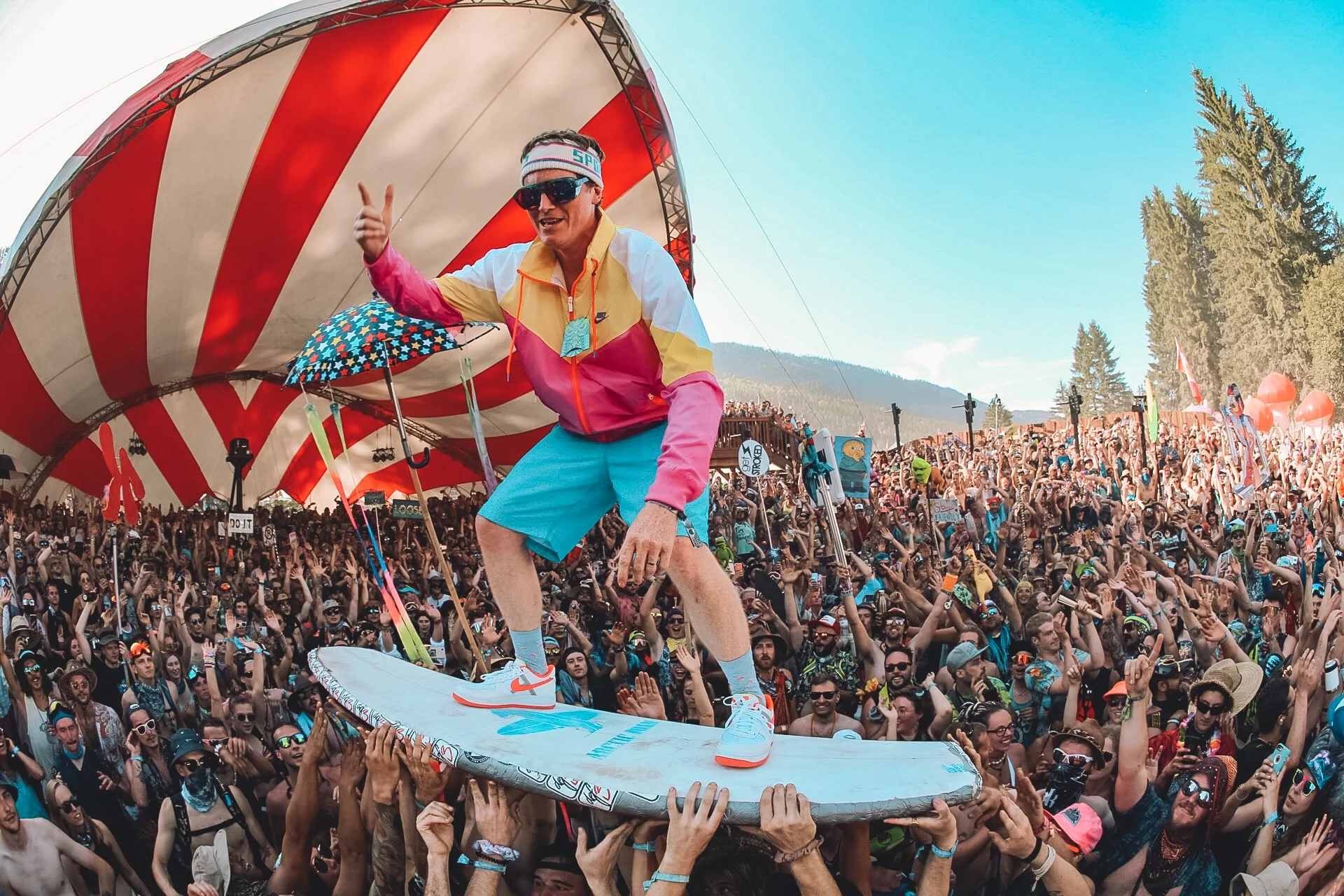
The Amphitheater (Credit: Banana Cam)
There’s Camp Clean Beats, a camping area sober festival goers who are sober or in recovery. Shambhala is perhaps most famous for its harm reduction work, from free drug testing to sanctuary spaces for women. Select weekend workshops encouraged attendees to respect themselves and party responsibly like “Cannabis: Gateway or Exit?” and “Psychedelics and Intimate Relationships.” A woman approached me during the Saturday night thunderstorm and handed me a sticker with the Shambhala SOS telephone number on it. “If you’re in trouble or you see someone who needs help, just call.”
Festivals, especially transformational festivals, are often seen as departures from the “default world” and Shambhala is no different. But it has also become part of the regular culture around those parts. The province of British Columbia actively sponsors the event. A woman named Celia from Vernon, BC, where producers JPOD and ATYYA grew up, first came to Shambhala 15 years ago and has volunteered several times since. During ATYYA at the Grove on Saturday, her son emerged from the crowd to her delight with his totem, girlfriend, and wide electric eyes.
I camped on a rented property in Nelson after the event. Lo and behold, the owner DJed at Shambhala twice and went to high school with lead organizer and Salmo River Ranch owner Jimmy Bundschuh. “Everyone around here knows the Bundschuh’s,” she said. In Calgary, I stayed with a friend who I know through channels completely unrelated to Shambhala. “But you know that pond in the woods behind the Labyrinth [now the Grove],” he asked me. “I built that one year when I was curating ambient music on the side stage back there [now the Cedar Lounge].”
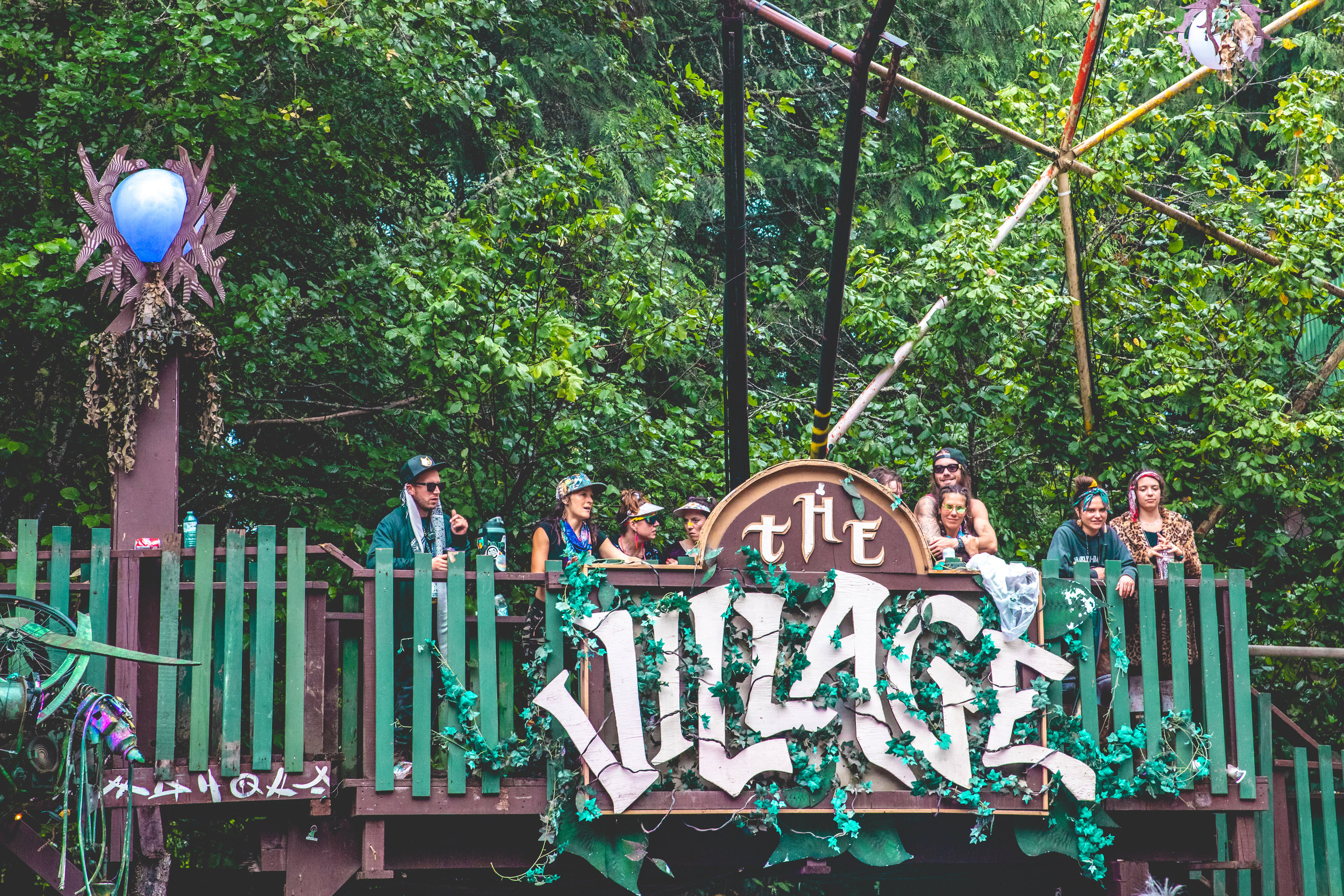
The Village (Credit: ATS Photography)
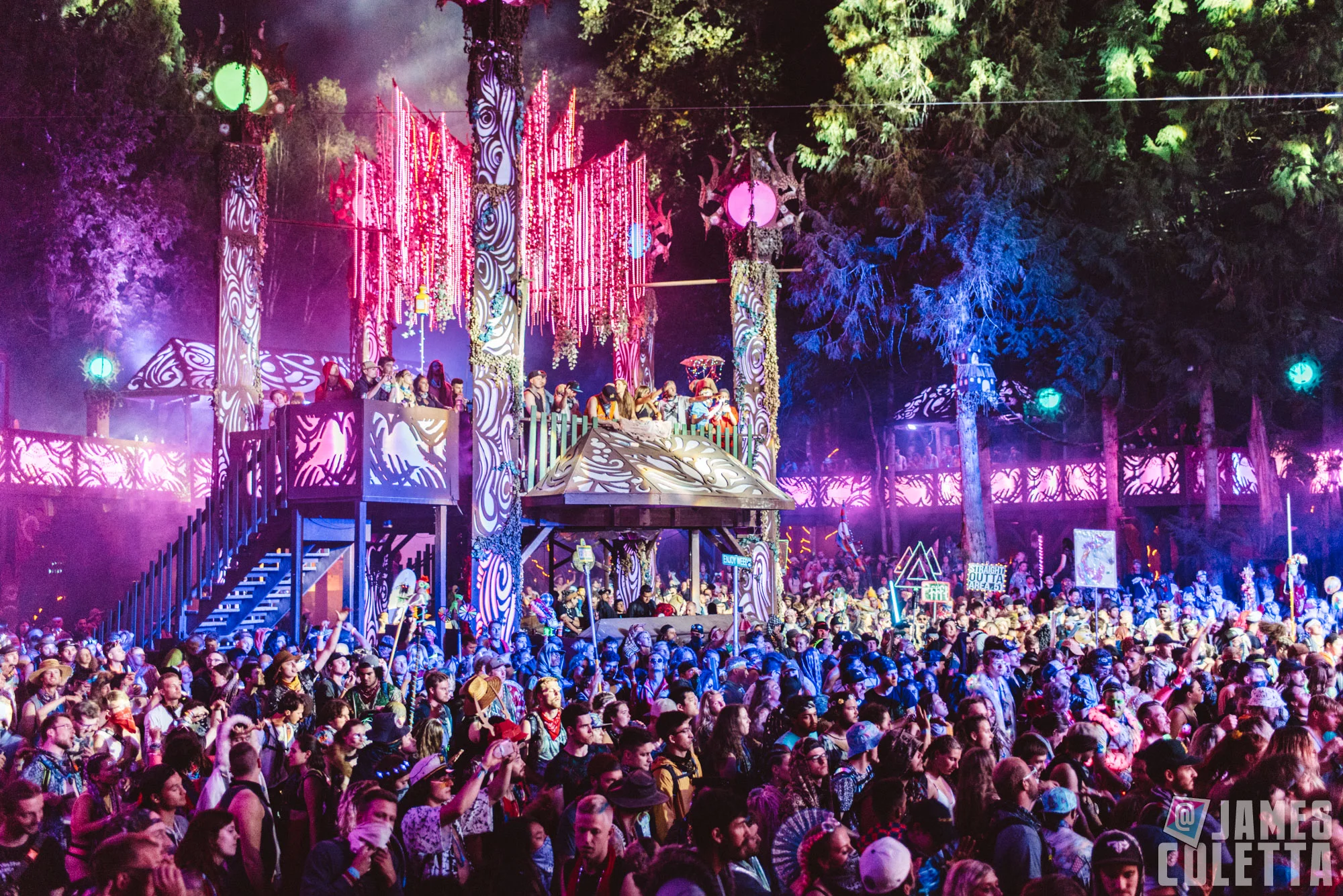
The Village (Credit: James Coletta)
The Shambhala crew, including volunteers, numbered about 2,500 people this year. That’s about 15-20% of everyone on site, an unusually high number. From long-serving stage managers down to first-year Australian volunteers, there’s an elaborate credential system for the crew. I saw a dog that was more credentialed than I was. A man with a blue beard who must be at least 75 years old sits guarding a gigantic pyramid in the Fractal Forest. A man with one eye and sharp teeth guards the entrance to the stage. So much of the crew clearly returns year after year, and most are Canadian. The infrastructure at Shambhala - world class stage, lighting, and sound infrastructure, tree houses, terraces, villages, pathways, gardens, fences, nooks and crannies - was built by generations of teams. I met at least six dudes throughout the weekend who “cut and strip wood”.
“It was really about the people and the land,” Naasko recalled as he unpacked twenty years of memories.
“Same,” I thought to myself. But I’d be remiss if I finished this piece without hitting on musical highlights from that interdimensional weekend.
After a flight cancellation and a pedal-heavy haul from Calgary through plains and peaks, I pulled in at sunset and walked into the Fractal Forest for the first time during the Westwood Recordings takeover. New Zealand producer K+Lab was landing the mothership, playing keytar on stage in that old-growth 360-degree sound garden. Coming from Kelowna, BC just west of Shambhala, Stickybuds followed and practically looked like a gigantic tree the way he dominated the energy of that space. After starting with wicked drum and bass he ran through his signature electro funk selectors including “Crooked Politicians” off his first album, which he dedicated to all the crooked politicians around the world.
The magnitude of Shambhala hit hard Sunday night. During one time slot Rusko was playing at the Village, Troyboi the Amphitheater, Bonobo the Grove, Zeds Dead the Pagoda, and Silk City (Diplo and Mark Ronson) at the Fractal Forest. The entire grounds were saturated with mud and the energy was beyond feverish.
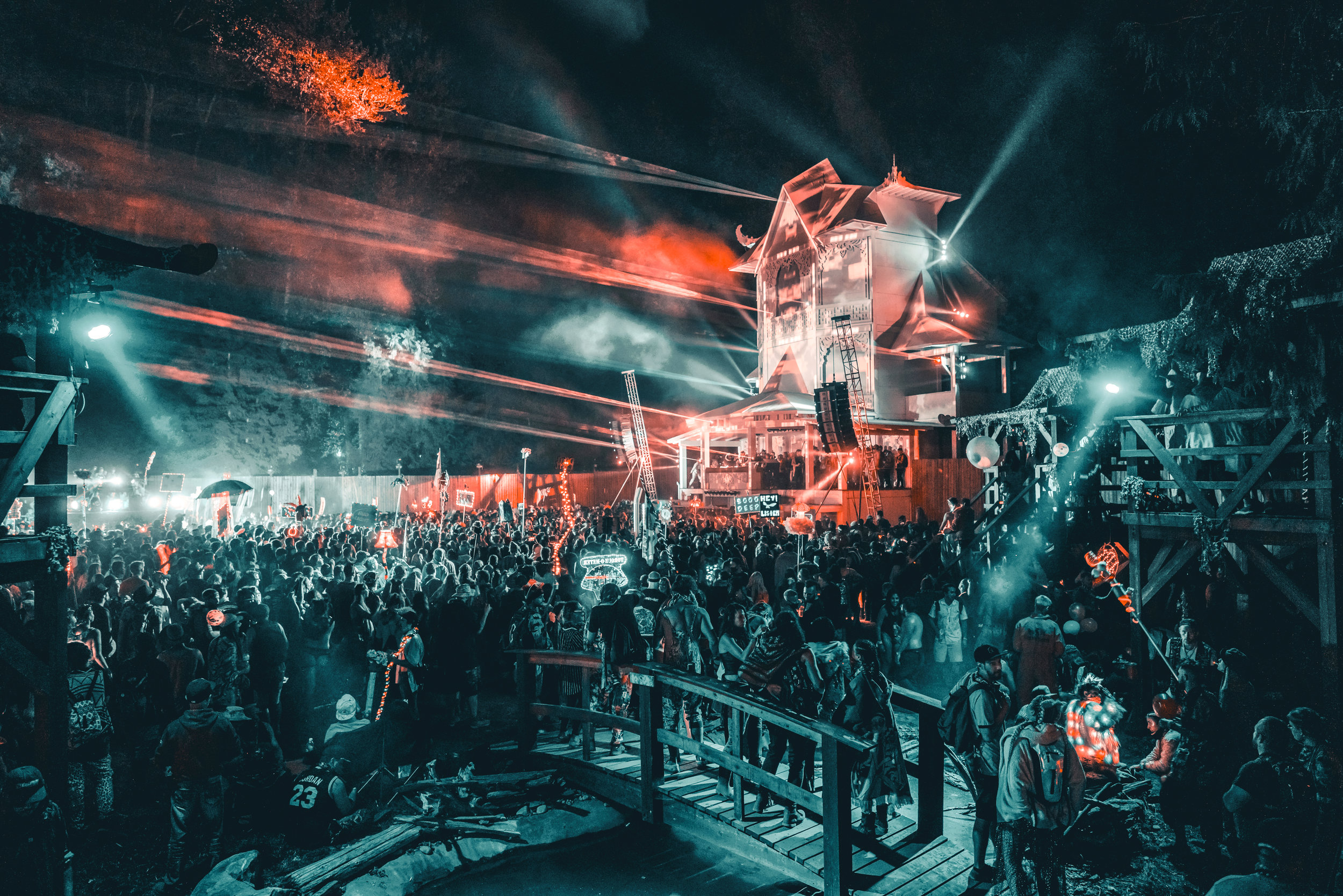
(Credit: DIVISUALS)
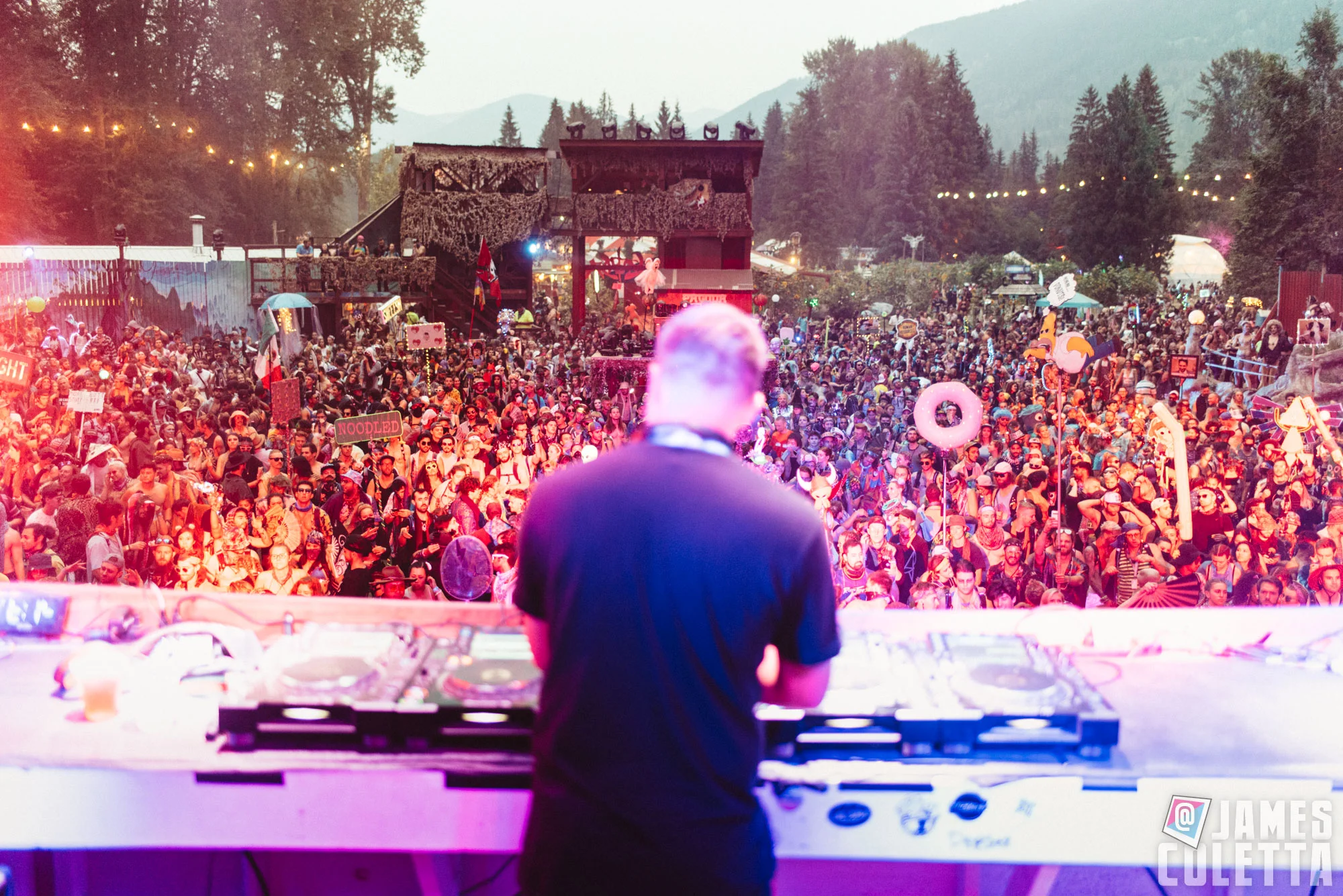
The Pagoda (Credit: James Coletta)
Late that night I found a deep heads’ delight. kLL sMTH absolutely wrecked the Ampitheater and spun me down to the Grove for Stray (one half of Ivy Lab). He was laying it in there, drilling dark drum and bass but pausing now and then to express gratitude to the audience’s for their openness. “You’re a pretty open lot. This is some of my favorite music, and it’s been years since I’ve played it.” Tor from Vancouver followed him with a perfect, grounding sunrise set for a bright, colorful capacity crowd. By that time, only the strongest psychedelic sound warriors were still kicking. But at Shambhala, that’s like everybody.
One more story from Brian is worth sharing.
When I arrived at reception today I saw this super average looking young kid, Alberta license plates. He was by himself but was clearly so stoked. I was bringing in my work crew for like the thirteenth time and was like, “yea whatever this is gonna take a long time to get these credentials.” But the guy was just so excited to see us. I think there’s something that happens as people enter. Barriers break down and there’s this whole spirit that’s there; a friendliness, a genuineness that’s contagious. It takes on different forms and qualities. For us, it was a very different experience. But for, say, a young Albertan it can feel very transformative. And this kid was like, “what’s up Shamb fam?!” And he wanted to hug us all - total strangers.

The Living Room (Credit: Banana Cam)
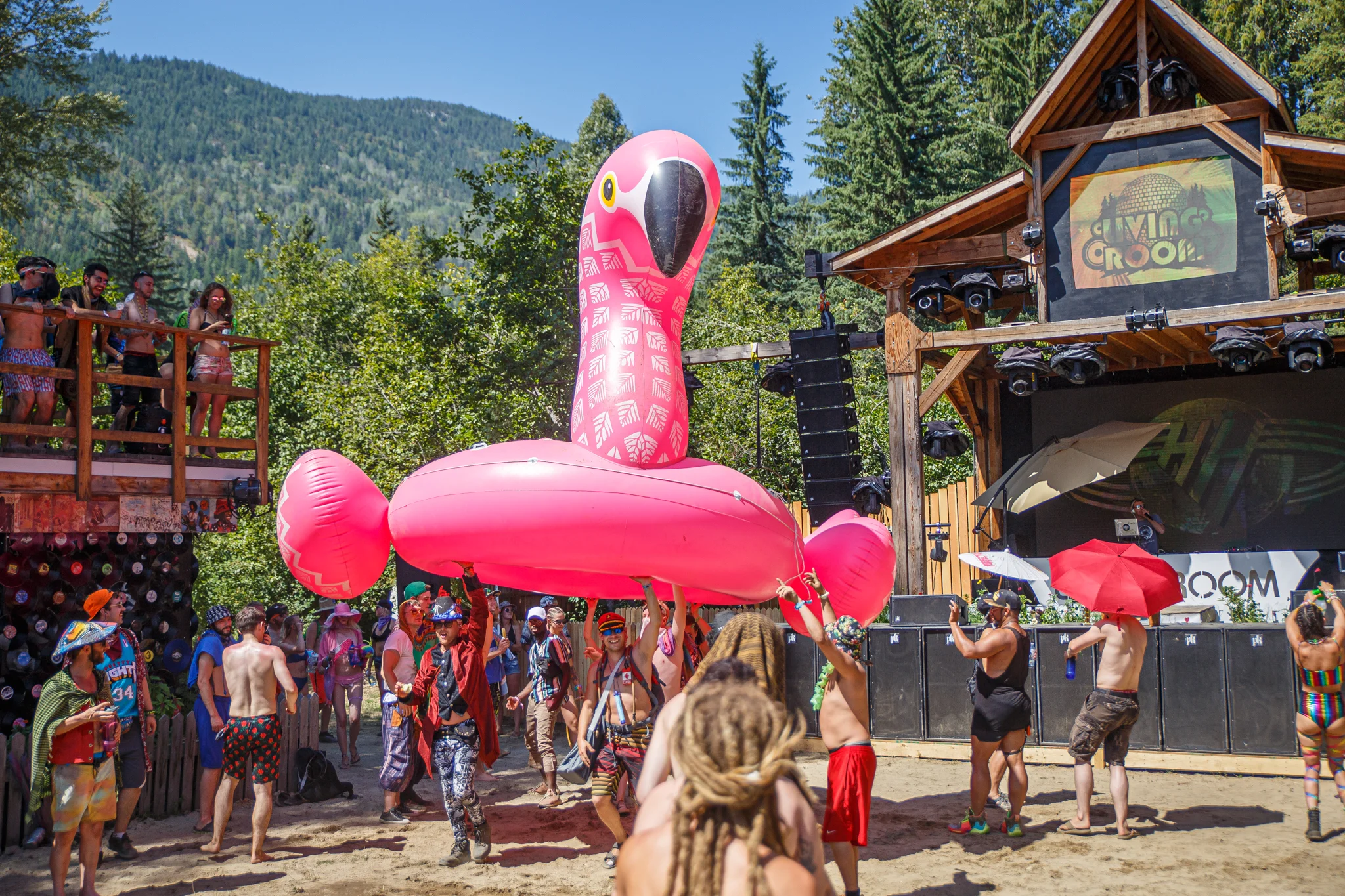
The Living Room (Credit: ConcertSocks)
Shambhala is probably the best that the electronic music culture has to offer right now, and that’s pretty damn impressive. DJ Mag recognized this by awarding Shambhala as the best festival in North America in 2019. If you’re part of this culture, and you have the means, experience it at least once. “I’m curious to see what will happen,” said Brian. “22 years going strong. I really feel that Shambhala could sell out in perpetuity. If they kept the numbers and kept the quality. It would be interesting to see where it’s at in 25 or 30 years.”
“If we’re still alive then,” Naasko chuckled.
FOLLOW Shambhala Music Festival: Official / Facebook / Instagram
Journeyman Matt Carey Releases Grab Bag LP Xtra Curricular Communication
The journeyman Matt Carey has been keeping a low but productive profile for several years on the festival circuit in the Northeastern United States. Yesterday, he released his second full-length album Xtra Curricular Communication, a grab bag ranging in styles from hip-hop to house to drum and bass and breaks. Questions about the nature of the world today are woven tastefully through the album.
The journeyman Matt Carey has been keeping a low but productive profile for several years on the festival circuit in the Northeastern United States. From his base in Boston he’s created a small but diverse catalog of stripped down tribal house and dub over the years full of ideas both righteous and sensual. Yesterday, he released his second full-length album Xtra Curricular Communication, a grab bag ranging in styles from hip-hop to house to drum and bass and breaks. Questions about the nature of the world today are woven tastefully through the album.
This is a delightfully spare record. There’s no frills. Its value depends on the strength of the songwriting, not any extraordinary sound design. “People on the Bus”, for example, has one guitar lick repeated throughout the song that dances along with one key sample. This is backed by a strong bass line and shuffling house drums, and punctuated by an excellent hook sung by Matt himself. There’s nothing revolutionary here, but when you sit back and ease in it can be real hypnotic and provocative music.
People on the bus keep falling asleep
They never get enough rest, the workforce is deep
Deep in the systemic cycle
I’m checking for vitals
Other highlights include the first cut “Stick Up (Desert Dub)”, an extraterrestrial hip-hop groove, “Break”, and “Green Leaf Cover”, a delightful dub odyssey about navigating the modern world and “chasing down the mighty dollar”. Matt’s own voice is one of our favorite parts of the album. His poetry is powerful and his tones are captivating.
Xtra Curricular Communication is a refreshing collection of electronic music that doesn’t take itself too seriously, but that still deals with some important subjects in a groovy matter. It looks like Matt’s festival season is over, but hopefully we see Matt on a few more lineups next summer for some extracurricular and extraterrestrial communication.
FOLLOW Matt Carey: Bandcamp / Soundcloud / Facebook

Lo-Fi Sundays 082 - Puar
We first found the British Columbia-based producer Puar through his collaborations with Vancouver’s bsd.u, and we had the good fortune to catch his set at the Grove Cedar Lounge (a side stage) at Shambhala Music Festival on the Salmo River Ranch in BC. He was playing his signature style of highly vocalized phonk, some lo-fi, and a ton of straight west coast bass beats evocative of the Lab Group.
We first found the producer Puar through his collaborations with Vancouver’s bsd.u and we had the good fortune to catch his set last weekend at the Grove Cedar Lounge, a side stage at Shambhala Music Festival on the Salmo River Ranch in British Columbia, Canada. He was playing his signature style of highly vocalized phonk, some lo-fi, and a ton of straight west coast bass beats evocative of the Lab Group.
This BC-based producer has been making beats for what appears to be three years and he has a healthy, diverse catalog to show for it. His signature sound is composed of big booming bass lines, trap drums, and hip-hop vocal samples but he also has more low-key lo-fi bops. He collaborates frequently with bsd.u, and he spun a ton of the producer’s music during his Shambhala set. He closed this killer set with a heartwarming remix of “Shawty” by Plies. At an electronic music festival, arguably the electronic music in North America, it was refreshing to hear Puar’s low-down and lighthearted blend.
He has six tapes on Bandcamp including three volumes of PUAR BEATS, the latest of which was just released in July of this year. In a style of music where it’s all too easy to get lost in the thousand-producer shuffle, Puar has carved out a lane all his own and we’re excited to see where it takes him.
FOLLOW Puar: Bandcamp / Soundcloud / Spotify / Twitter

Lo-Fi Sundays 081 - DLJ
Hailing from Toulouse, France, DLJ has spent the last two years producing a steady stream of top tier lo-fi content. A standout member of Retro Jungle Records, DLJ is a constant practitioner of musical cleanliness. His tunes are full of life and specificity, giving his catalog an approachable, well-rounded veneer.
Hailing from Toulouse, France, DLJ has spent the last two years producing a steady stream of top tier lo-fi content. A standout member of Retro Jungle Records, DLJ is a constant practitioner of musical cleanliness. His tunes are full of life and specificity, giving his catalog an approachable, well-rounded veneer.
Using simplicity as an attitude, DLJ’s discography focuses on strong arrangements and stronger chord phrases. It’s the unmistakable motif of smokey cafes and autumn afternoons combined with full-bodied compositions, with each of his tracks being just as moving as the next. Songs like “Take me with you” embody a slow, successive build of emotion over the course of each measure, melding sultry saxophone lines with fanciful piano phrases. Other tracks, such as in the vein of “Bright”, are strictly keys and percussion, the classic pairing of ingredients that lo-fi junkies are so fond of. No matter where you turn throughout his releases, the chances of stumbling onto your perfect daytime anthem stands near 100%.
With over a dozen varied releases under his belt, DLJ is forging himself into a one-stop shop for all things lo-fi, traversing a plethora of tempos, keys, and imagery. His release cycle is steady, with at least a new single appearing just about every month, marking DLJ as a veritable production powerhouse. While we’re gushing over his available collection of tunes, it’s only a matter of time before his next batch of summer day sonatas reaches the public sphere.
FOLLOW DLJ: Soundcloud / Spotify / Bandcamp
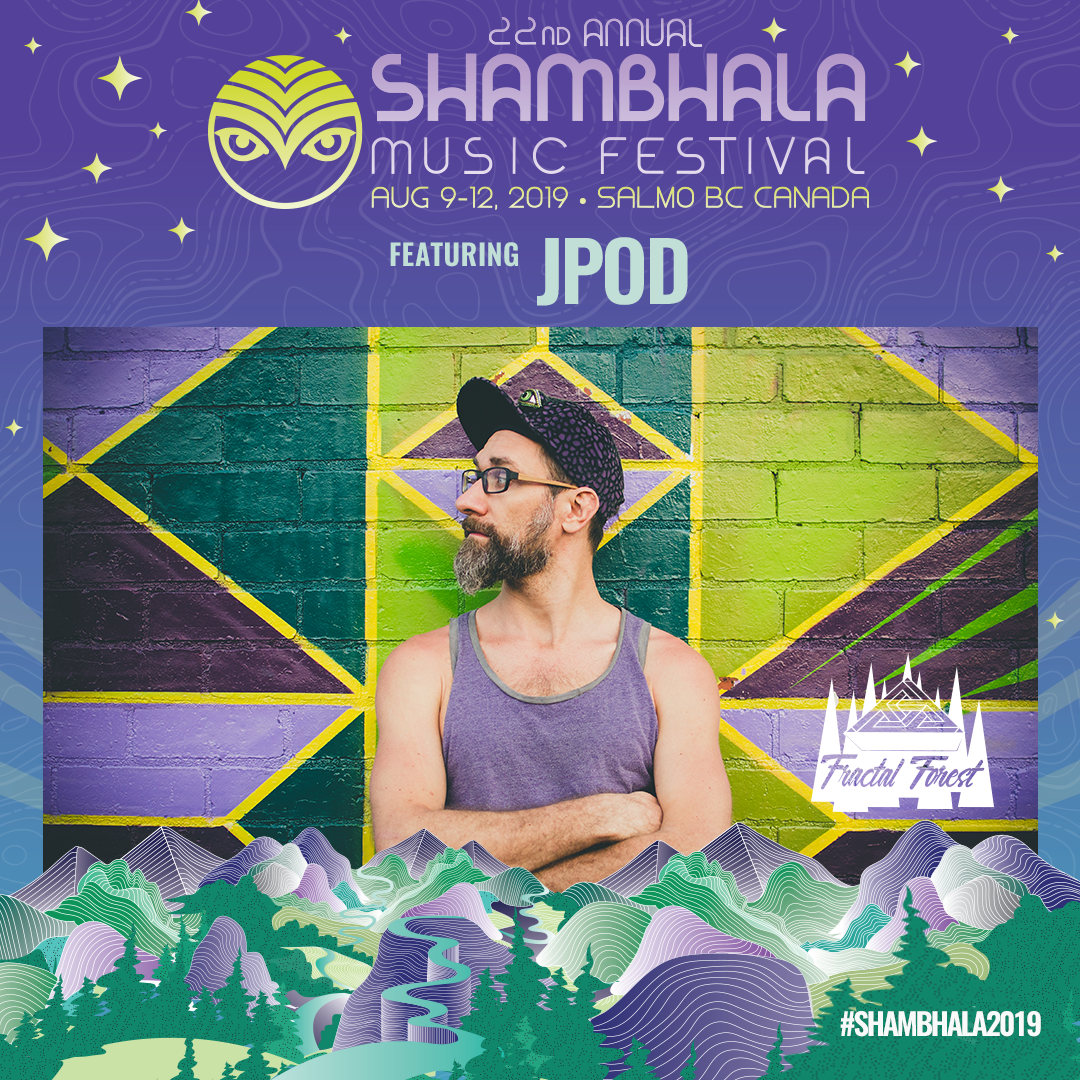
How JPOD the Beat Chef Became a Shambhala Favorite
JPOD aka JPOD the Beat Chef aka Jason is a fixture of the Western Canadian electronic music scene. This year from August 8-11 on the Salmo River Ranch in Salmo, British Columbia, Canada will be his fifteenth at Shambhala Music Festival. It’s only right that we end our “Shambhala Favorites” interview series by learning about the beat chef and how he first made his way to Shambhala.
JPOD aka JPOD the Beat Chef aka Jason is a fixture of the Western Canadian electronic music scene. This year from August 8-11 on the Salmo River Ranch in Salmo, British Columbia, Canada will be his fifteenth at Shambhala Music Festival. It’s only right that we end our “Shambhala Favorites” interview series by learning about the beat chef and how he first made his way to Shambhala.
All those years ago, he was playing trip-hop vinyl in clubs in Kelowna, British Columbia when he was first recognized by the crew which runs the Fractal Forest stage at Shambhala. He’s since established himself as one of the premier glitch hop DJs in the world - barnstorming across Australia year after year, held down a residency at Bass Coast Electronic Music & Arts Festival, become a father, and remixed everything from Amy Winehouse to Al Green. Although he’s spent the last four years playing different tones and hues of his signature sound to fit the vibe at the Grove, Amphitheater, and Living Room stages at Shambhala, he returns this year to the Fractal and the classic funk and breakbeat stage that spawned his career as a DJ
Discerning ears around the world recognize his sound. He remixes roots music like blues, reggae, soul, bluegrass, African choir music, and more and produces originals that travel through different dimensions of glitch hop. His foremost desire is to get himself and his audience dancing and smiling. Accordingly, he most often plays during the day at festivals when the vibes are easygoing. His music has a playful and laminar mindset that’s accessible to new listeners, drawing in a crowd that will begin the swell of the night to come. That’s exactly what he’s doing again this year, performing at 8:00pm in the Fractal, marking a decade and a half at Shambhala.

Jason absolutely feeling it at What the Festival in 2015
The Rust: After a few years of playing at the other stages, how does it feel to return to the Fractal Forest
Jason: I've always known I would come back to the funky Fractal. My sound has a range of styles and I like applying them in different places. However, the classic JPOD sound evolved in the Fractal Forest and will always have a place there. I'm excited to start Friday night off the way that so many Fractal friends want!
The Rust: Did you attend your first Shambhala as a patron or as a volunteer?
Jason: My first year was 2004 and it is the only year I attended as a punter. It was good to experience the line fiasco and general camping rush but of course back then it was probably half the size as now, so a little bit less stressful. I attended and camped with some Whistler friends (the Cook brothers) and I was definitely THAT guy - bare feet all weekend, sleeping all day, partying all night, crying for no reason by Sunday (ok maybe because 3rd Eye Tribe really hit me with the feels at the Living Room), repeatedly forgetting what I was just talking about, mind blown by Bassnectar and generally dancing my legs right off. Recovery that year was brutal and I learned to take some time off before going back to work.
The Rust: The funky, glitched-out breakbeat sound has become a signature of Western Canadian electronic music. You credit much of this to the Fractal Forest. Can you elaborate on how this stage has influenced the region’s electronic music and yourself?
Jason: Shambhala clearly has the reputation for being the region's first and probably most influential event for cutting edge dance music. All the local aspiring DJs and producers were attending or performing as well as getting heavily influenced by all the music. The Fractal Forest may have been one of the first stages to really establish its sound and has since been the home for funky breakbeats. Those of us who were being influenced by this music were naturally going to try to make our own flavor of it back home. I have always tried to differentiate myself. Since there was almost no one doing mid-tempo funky breakbeats back then, I took the chunky funk I was hearing in the Fractal and combined it with the hip-hop and trip-hop roots I established through DJing for over four years prior. What began to emerge was that funky bassline remix and at the time it was very fresh and inspiring.
The Rust: We read that when you met Rich-e-Rich, stage manager at the Fractal Forest, you were spinning hip-hop on vinyl in your hometown of Kelowna. Can you take us back and describe that moment in time?

Jason: My hometown has always been Vernon but after my first Shambhala I discovered the LiquidBeat community and Toddy Rockwell promoting Higher Ground events in Kelowna. I started playing funky hip-hop and trip-hop on vinyl at shows there for both LiquidBeat and Higher Ground events and my unique style spread pretty quickly via word of mouth. It was at one of LiquidBeat's shows at the Rusty Buckle that Richie attended when he basically told me straight up he wanted me to play at Fractal. If I recall correctly, he didn't even catch my set because the roads were pretty bad and he arrived late. However, other people kept telling him to book me and he took their word for it. I remember being in a state of complete disbelief. I assumed that the process of getting booked would be much more involved. I don't even think I knew who he was until we started talking and he basically told me right there that he wanted me to play. It was a very surreal experience.
The Rust: Speaking of your early years, how did you meet Todd, and what was Higher Ground like? Was it always at the same club? Is there still a scene for that in Kelowna?
Jason: When I first joined the LiquidBeat forum, I think I made a post about being a DJ and described my style. I caught Toddy's attention for good reason because at the time, there weren't really any DJs doing funky hip-hop or trip-hop anything. We setup a meeting and I gave him my latest mix which he absolutely loved, and he had me open at the very next show he was throwing. I was instantly a Higher Ground resident and it was an amazing time. Higher Ground was typically in the upstairs of Level and it was a great intimate room that, along with the Rusty Buckle, was the home for our Okanagan scene for a while. Just before that time, Thistle held the reigns doing a night at Oasis nightclub but that was before I joined the scene.
Lately the Kelowna scene has been a combination of Arcade's late-night shows, Footwerk's Sapphire shows and Habitat's variety of electronic events. However, Arcade is taking a well-deserved and likely permanent hiatus (save for bike raves and maybe one-off small events) and Habitat closed down last year. So as far as I know, Footwerk is the only remaining entity throwing consistent, quality events.
The Rust: How did your relationship with Tyler “Stickybuds” Martens form and develop? Can you tell us about the Stickypod Connection? And will it ever happen again?

The Stickypod Connection featuring a short-haired Stickybuds (left) and Jason (right) in the mid-2000s.
Jason: Back when I first found LiquidBeat and Higher Ground events I had all the energy to DJ just for fun. I was involved in a church in Vernon (VCF) and invited friends and DJs to come hang out in the building after hours and DJ together. Tyler was all about it and we quickly connected with complementary styles. At the time, he was a little into hip-hop and more into nu skool breaks. Because I had Vestax PDX 2000 decks I was able to ultra-pitch my hip-hop acapellas up to the nu skool breaks tempos (125-135 bpm). Of course, most voices sounded pretty chipmunkey pushed that far but one voice - the renowned low tones of the "verbal herman munster" aka Chali 2na - worked better than others.
Since this was such a fresh and unexplored concept, we started jamming out together and doing live acapella and scratching combos. We developed a pretty simple strategy of trading off the responsibility of holding down the instrumental foundation while the other did the vocal / sample / scratching flair on top. We scienced out several three-hour Shambhala sets along with many other club bookings and definitely influenced any other funky remix DJ duos who emerged from Western Canada since then. That's right folks - we did it first! (And best!) Our communication and categorization skills obtained during those days allow us to jam with relative ease pretty much any time we want. When the right opportunity arises, we usually do.
The Rust: You've mentioned someone named Trevor Refix as a connective force that lead to your initial booking at Shambhala. Who is he, and how did you meet him?
Jason: Trevor Refix was one of the LiquidBeat DJs and moderators. As far as I know he along with Toddy Rockwell were the artists most influentially chirping in Richie's ear about booking me at Fractal. However, I could probably assume that Joseph Martin (another Fractal resident) had something to do with it. By the way, Trevor is now the main creative force behind the Canadian indie band Texture and Light, so check that out.
The Rust: So your new album Circadian Rhythms comes out in a couple days. What can you tell us about it? Great choice of album artist by the way, Sebastian Berto is an absolute maniac.
This album is an attempt at something deep and meaningful. This is the hardest kind of music to originally produce. The thing about funky remix music is that I find it a very surface kind of music and a much easier formula to follow. It's great in certain contexts and really serves a purpose on the dance floor but I never listen to it at home. Of course the holy grail of music is the kind that works great at home and on the dance floor and that is very hard to make. But ultimately my goal with original music is to make something that is truly timeless. Lots of what we hear at festivals ends up being very specific to a time and place but the really good stuff will always last well beyond a specific date. I won't claim to have fully achieved this with Circadian Rhythms, but there are definitely certain songs that stand out as great every time I listen to them. I can only hope that everyone who listens will feel the same way.
The Rust: While we're at it, want to hip us to the theme of this year's Bliss Coast mix?
This year I simply tried to find any music that has the space I need to be workable and the feels that I want these gushy sets to have. I picked a strong variety of styles including swing, funk, latin, blues, hip-hop, reggae, and mostly modern R&B. This year things went differently at Bass Coast as my Sunday afternoon set was rescheduled to a Saturday evening Main Stage set. [The Bliss Coast mix series was born from JPOD’s consistent Sunday sets at Bass Coast.] I was able to make the necessary rearrangements but ended up cutting two songs that didn't fit that time of day. However, I will be releasing Volume 8 as it was written and not as it was performed.
—
This Friday, head on over to Addictech to check out JPOD’s new album. Given that Jason has such a penchant for remixes, it’s always special to hear new original music from him. This concludes our Shambhala Favorites interview series. Catch up by checking our chats with Slynk and Fort Knox Five & Qdup, and we’ll see you on the farm.
FOLLOW JPOD: Official / Bandcamp / Spotify / Soundcloud
FOLLOW Shambhala Music Festival: Official / Facebook / Instagram
Lo-Fi Sundays 080 - Beasty P
Our next edition of Lo-Fi Sundays brings us to the city of Minsk, Belarus. Beasty P is a European beats producer who runs with the internationally acclaimed NINETOFIVE Worldwide Beatmakers record label. He’s packing a stereophonic quality to his dusty tunes that is in short supply in the lo-fi world, and has a clear skillset for flipping breaks and samples.
Our next edition of Lo-Fi Sundays brings us to the city of Minsk, Belarus. Beasty P is a European beats producer who runs with the internationally acclaimed NINETOFIVE Worldwide Beatmakers record label. He’s packing a stereophonic quality to his dusty tunes that is in short supply in the lo-fi world, and has a clear skillset for flipping breaks and samples.
Keeping things in the rhythmic pocket is the cornerstone of each Beasty P production. His tracks display their strong source material proudly, going for a “less is more” approach to remixing and sampling. The result is a strong compositional framework for each unique tune in the Beasty P catalog, giving the whole collecton a remarkable aural consistency. Tracks like “she’s a different” and “where is da jumpin’” utilize the vocal material from their respective source tracks to full effect, merging classic anthems with salient textures and wide percussive samples. Conversely, his latest album Zenith is mostly devoid of vocal material, instead opting for the intercrossed melodies and harmonies to tell their stories. No matter which format his music takes on, Beasty P has an undeniable touch for emotive songwriting and production that sets his music apart from many of his contemporaries.
Beasty P’s catalog stretches across more than 40 tracks, released both independently and through NINETOFIVE. His sampling mastery and creative approach to layering and mixing give his productions a shining finish that is often left out of the picture for Lo-Fi hip-hop. We’ll be keeping a close eye on this intuitive beat smith from now on, and high highly recommend that you do to.
FOLLOW Beasty P: Soundcloud / Bandcamp / Spotify / Facebook
Sound of Solasta - Pathwey
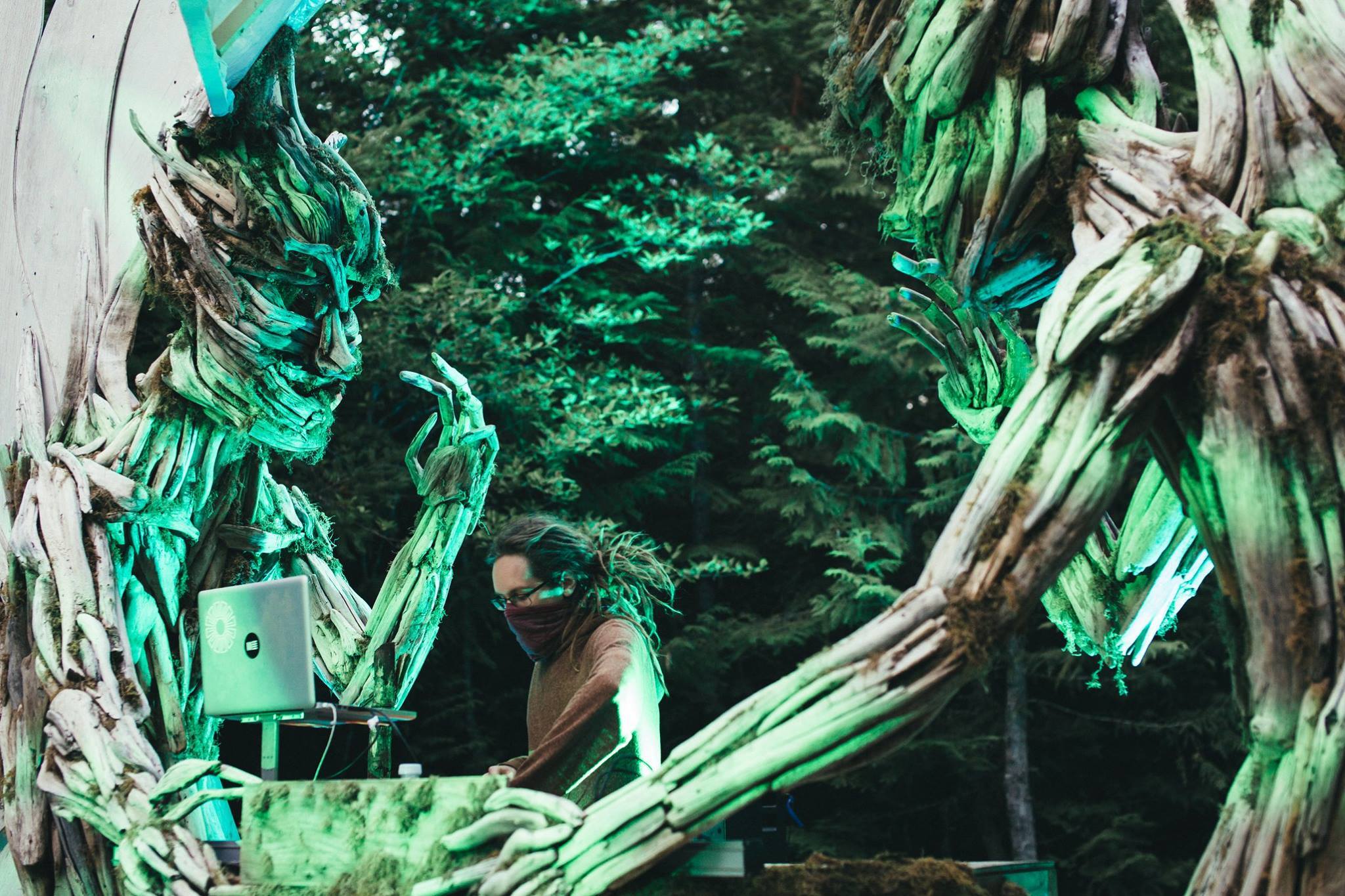
Solasta Festival is leaving its original grounds in northeastern Tennessee for the misty, hill-bound Deerfields Retreat in southwestern North Carolina. The event is known for its niche curation, booking the cream of the contemporary crop in psychedelic broken beat music. Unlike their location, this ethos hasn’t changed. Our Sound of Solasta interview series investigates the back stories of artists on the lineup, and this year we’re focusing on the ascendant audio alchemist Pathwey from the nearby city of Asheville, NC.

Solasta Festival is leaving its original grounds in northeastern Tennessee for the misty, hill-bound Deerfields Retreat in the Pisgah National Forest in southwestern North Carolina on August 16-18. Now entering its third year, the event is known for its niche curation, booking the cream of the contemporary crop in psychedelic broken beat music. Unlike their location, this ethos hasn’t changed. Solasta draws crowds, performers and some of its organizers from Asheville, North Carolina, a fertile place for electronic music culture. Our Sound of Solasta interview series investigates the back stories of those performing at Solasta and for this installment we’re focusing on one of those Asheville artists, the ascendant audio alchemist Pathwey.
He is a diverse and persistent musician whose career creating art in multiple forms has taken him across the country and back again. Although he’s been playing all sorts of music his entire life, lately Pathwey has been working at 140 beats-per-minute, and he’s one of the only producers at this glitch hoppers’ paradise of a festival who does so. But he plays it like few others do, integrating psybass sound design, world instruments, organic textures, and themes of transcendence and appreciation for nature. Make no mistake, though, Pathwey will get you pitted. He’ll just lift you up on high afterward and perhaps tickle your pineal gland along the way.
Pathwey, who usually goes by Andy, expresses himself through visual art as well. All of his songs save for compilation tracks or remixes are accompanied by his own artwork. He’s fabricated stages and worked on projection mapping projects for some of the most enduring acts in electronic music. When he was living in the Boston area, he learned from his roommate, the visual jockey Zebbler (Peter Berdovsky), and became part of FractalTribe, the New England collective with a distinguished fabrication operation.
These experiences have given Andy a holistic familiarity the electronic music culture. When he ascends the stage to spread that culture through his music, a decade and a half of history stands behind him. His persistence was recently rewarded when Street Ritual’s booking agency picked him up in April, ensuring that he’ll be holding space in more clubs across the country soon. Ahead of his “hometown” performance at Solasta, we shot Andy some questions to learn more about him.
The Rust: How long have you been producing music as Pathwey?
Andy: It’s been about two years since I started going by Pathwey, but in my mind this project has been in motion since I started creating electronic music over 14 years ago.
The Rust: What do you try to communicate with your music?
Andy: Music is so intimately connected with the feelings and experiences of the person creating it. In that sense, all of my music is translating and reflecting on some thought, feeling, or experience I’m going through at the time. For me, making music is really the most potent way I know of to process my emotions and transform them into something positive. Sometimes I’m reflecting upon spiritual and philosophical ideas around life and death. Sometimes I’m trying to translate a deep psychedelic experience. Sometimes I’m expressing my frustrations regarding global issues like environmental and social justice. Other times I’m just simply having fun and fucking around with my friends. Whatever it happens to be in the moment, I think ultimately I’m just processing what is happening in my life and trying to create something from it that is beautiful and means something to me.

My greatest aspiration with Pathwey is to use it as a vehicle for positive environmental and social transformation. We are currently faced with so much fucked up shit in our world today. Not like that’s anything new to the human experience, but sometimes it’s hard not to get overwhelmed with sadness, anger, and feelings of helplessness just thinking about it; what effect I could possibly have as one individual? But I think that music can give us the ability to create positive change in a powerful way. That change could be as immediate as uplifting someone into a positive state of being or as lasting as generating funds to donate towards environmental relief efforts, social justice programs, or building communities. This is something that I’m currently working towards with Aquatic Collective and The Undergrowth. We’ve got a lot of really exciting ideas and projects in motion. I feel like as an artist, I have a responsibility to use my platform to promote projects, ideas, and issues that I think are important. Using the gift of music to make a positive impact on the world while simultaneously doing something that I love is the ultimate reward for me.
The Rust: Can you talk about some of the projects you’ve worked on in the past, particularly visual art?
Andy: I feel so blessed to have discovered art and music at such a young age because they’ve both been incredibly positive guiding forces and teachers in my life. Art and music are like an endless feedback loop for me. One is always inspiring the other and the two are intimately connected for me. All the artwork for Pathwey, with the exception of some of the compilations and remixes I’ve released on, has been my own work. The art to me is just another piece of the full expression and I plan to continue creating original artwork and video content through this project.
I’ve created art in all types of mediums; painting, graphic design, installation art, video, wood/metal working, etc. I love exploring new mediums and forms of art. I’ve created artwork for album covers, events, and festivals, I’ve created logos, artwork, and video content for other artists and businesses, I’ve received two grants for installation pieces that I created, and I’ve worked on the fabrication of installations and 3D projection-mapped stages for Shpongle, EOTO, Verizon Wireless, Burning Man, DEFCON, and many other festivals and events. I feel like I’ll be creating visual art and exploring new mediums for the rest of my life.

This piece of Andy’s original artwork was featured as the cover for Standing with the Waters: A Benefit for Standing Rock, a benefit compilation for indigenous rights organizations from the Aquatic Collective..
The Rust: Musically, what were you doing before Pathwey?
Andy: Music has always been a huge part of my life, ever since I was a kid. Growing up I was playing saxophones, guitar, bass, and drums throughout school and jamming in bands with my friends at home. I was recording shitty demos of our songs in the basement, playing local DIY shows, and making beats with Fruity Loops on my family’s computer.
Way before I was going by Pathwey, I was experimenting with genres like Dubstep, DnB, IDM, Glitch-Hop, Downtempo, Psytrance, Trap, House, Ambient or whatever else I felt like making. I think the only difference is that now I’ve finally come to a place with my productions where I think they’re good enough to release. Most people who know my music that aren’t close friends of mine would probably never know I’ve been making lots of different music because I never released any of it. Before Pathwey, the only stuff I ever released was downtempo, but I’ve always been experimenting with all sorts of shit.
The Rust: How would you describe Pathwey music?
Andy: To me, Pathwey is this kind of sonic bridge between the past and the future, merging sounds of cultures from across the ages of human civilization with unknown futuristic and alien sounds that have yet to be created or heard. Somewhere where the natural world and technological world meet in harmony and dark and light energies combine to express the full breadth of human emotion and experience. Sometimes it’s high energy and moves your body, other times it’s chilled out and moves your mind. Hopefully some of it will move your soul…
People can definitely expect to hear forthcoming music from me in a wide variety of genres and tempos. My forthcoming album will showcase more of the explorations in 140 bpm music that I’ve created over the last few years, covering the spectrum from heavy bass-driven bangers to deep atmospheric heart-melters. I also have forthcoming collaborations and works exploring all of those genres I just mentioned.
How long have you been in the Asheville area? What’s the underground electronic music community there look like?

Andy: I’ve been in Asheville for about three years now. The music scene here is so dope, man! I get to see and perform alongside artists I love all the time! There’s certainly no shortage of awesome events happening here. It’s not as big of a scene as somewhere like Denver, but it’s a special place with a great community. I just feel so blessed to live around such a supportive and active music community and I’m so grateful for all the ways in which moving here has been a catalyst for my own growth as an artist. There’s so much talent in Asheville and it’s super inspiring to be around! The community here is really welcoming and open to new people and new music as well. You’ll definitely have a good time if you come through Asheville. Big shout out to The Undergrowth, Harmonia, and Envisioned Arts for holding it down here and providing opportunities for up and comers like myself to play and for hosting events for the community to gather and enjoy the music that we love!
The Rust: Have you been to Deerfields Retreat before? What can you tell us about it?
When I first moved to Asheville, I went to Kinnection Campout at Deerfields. It was such an inspiring experience and my introduction to the electronic music scene in the southeast. All I’ll say about Deerfields is, for those of you haven’t been there, you are in for a real treat if you come to Solasta this year! It’s one of my favorite outdoor venues on the east coast for sure! It’s truly a magical place!
The Rust: Anything else you’d like to share?
Yea, I’d just like to express my infinite love and gratitude to both my parents, my nana, my family, my friends, and my fans for believing in me and supporting me all these years. I certainly wouldn’t be where I’m at today without you all and I just want you all to know that your support and encouragement really means the world to me. To all the people who’ve reached out to me over the years to appreciate what I do, it means more to me than you’ll ever know. There’s a lot of stuff that’s finally coming to fruition after years and years of hard work and I’m so excited to see how it all unfolds and where the journey takes me! Also, to anyone out there reading this that’s struggling to achieve their dreams and aspirations, DON’T GIVE UP! Just keep fucking doing it! Keep moving forward step by step and eventually you’ll get there!
FOLLOW Pathwey: Soundcloud / Spotify / Facebook
FOLLOW Solasta Festival: Tickets / Official / Facebook / Instagram
Lo-Fi Sundays 079 - RudeManners
The experimental hip-hop and R&B producer RudeManners follows the axiom that a diverse portfolio is a stronger portfolio. Pegging this New York producer with one style is hard. He makes jazzy work, boom-bap tunes, “phonk” and trap beats, a bit of lo-fi house, and a ton of spacey trip-hop-influenced songs. But in comparison to his peers, his catalog has a distinct and recognizable sound that’s defined by a lounge aesthetic.
The experimental hip-hop and R&B producer RudeManners follows the axiom that a diverse portfolio is a stronger portfolio. Pegging this New York producer with one style is hard. He makes jazzy work, boom-bap tunes, “phonk” and trap beats, a bit of lo-fi house, and a ton of spacey trip-hop-influenced songs. But in comparison to his peers, his catalog has a distinct and recognizable sound that’s defined by a lounge aesthetic.
This lounge sound is best captured on his Avant Garde LP with Inner Ocean Records He reserves his more abstract work for a series of self-released LPs called “Do Not Disturb”, although to be sure, each of his 25+ releases all have at least a spoonful of each of his different flavors. RudeManners music is excellent for relaxing, but it can also highly emotional and cathartic at times, leading listeners into provocative mental states.
Dalton Mannerud (RudeManners) is also a fantastic illustrator who has drawn most of the artwork associated with his music and created album covers for several other beatmakers. By doing so, he’s made a substantial contribution to the overall visual aesthetics associated contemporary instrumental hip-hop at large. He supports the wider scene in other ways, too. He’s always big-upping other musicians’ work and hosted several well-curated episodes of Stzzy Radio. Dalton selected a wide-range of contemporary hip-hop and R&B for this podcast from the foundational StzzyAsFuck collective, although the episodes seem to have inexplicably and unfortunately disappeared from the web.

He’ll be performing at The Rust Music’s next Lo-Fi Sundays Live session on August 4th at Kinfolk 90 in Brooklyn, and we’re eager to see how he manifests his diverse catalog in the live setting. Dalton is always putting out new releases, collaborations or compilation tracks. Rarely is his output predictable, so if you stay chooned to his channels you’re sure to catch new, exciting, and uber chill music often.
FOLLOW RudeManners: Spotify / Soundcloud / Bandcamp / Instagram / Twitter
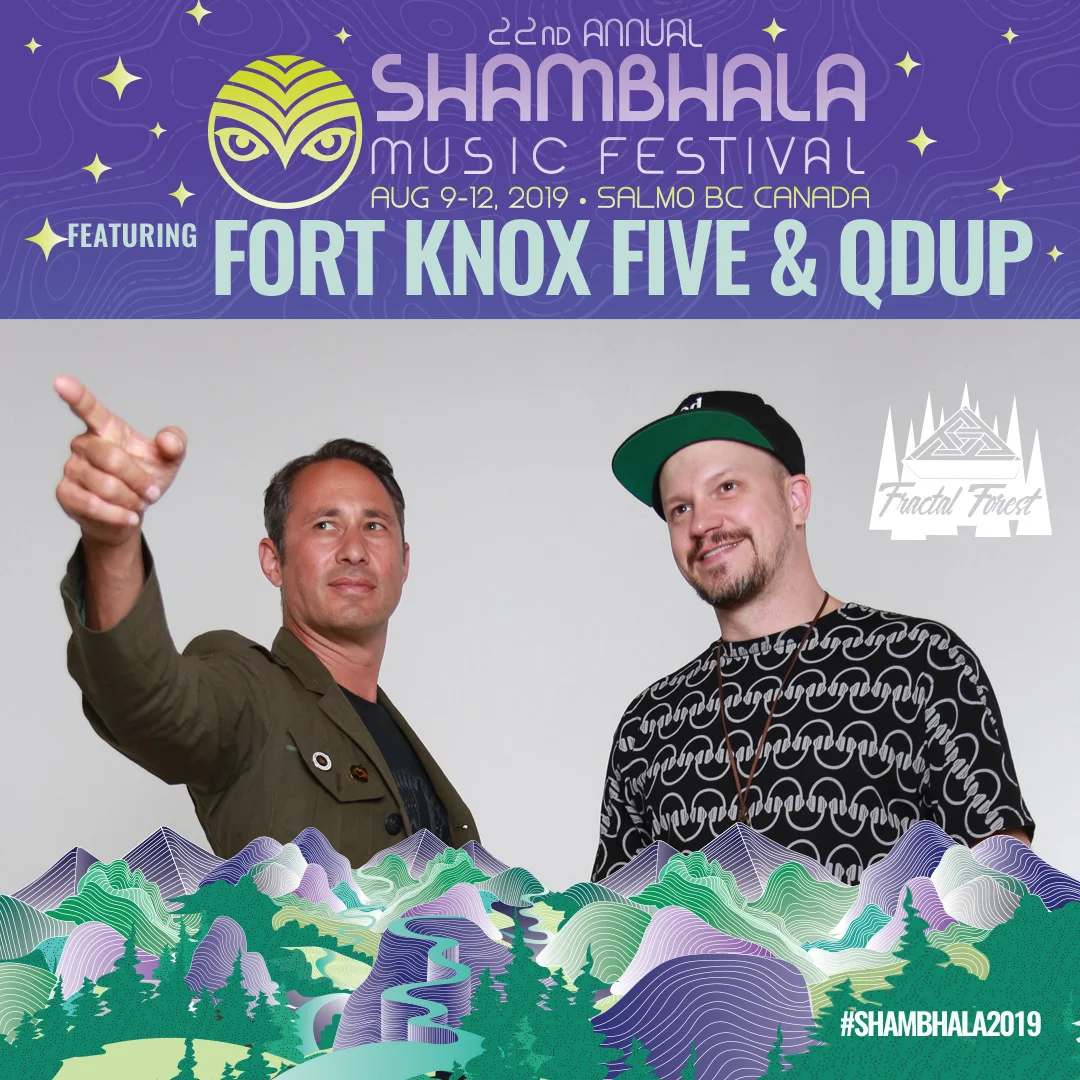
Get to Know the Shambhala Favorites Fort Knox Five & Qdup
If you trace back the career of the Fort Knox Five, you’ll also discover the evolution of the musical style commonly known as electro funk. Almost 15 years ago they found their way from Washington D.C. to British Columbia, Canada and Shambhala Music Festival, and they’ve made it their home ever since. More recently, Fort Knox Five began performing with fellow DC DJ Qdup, and soon the duo will funk Shambhala for the fifth year in a row.

Steve Raskin of Fort Knox Five (left) and Jason Brown aka Qdup (right) in 2018 (Credit: VIB Visuals)
If you trace back the career of the Fort Knox Five, you’ll also discover the evolution of the musical style commonly known as electro funk. At the beginning of the group’s journey almost 15 years ago, they found their way from Washington DC to British Columbia, Canada and Shambhala Music Festival, and they’ve made this place their home ever since. More recently, after trips around the world and twists, turns, arrivals, and departures worthy of a book, Fort Knox Five began performing with fellow DC DJ and longtime friend Qdup. This August 9-12, the duo will funk Shambhala together for the fifth year in a row. They’re two of 20 artists on this year’s lineup labeled as “Shambhala Favorites” in recognition of their deep ties to the festival. Fort Knox Five is one of the only artists in that grouping, however, whose history is nearly as old and storied as the event itself.
Fort Knox Five formed in Washington DC’s humming rave scene in 2003. Founding members Sid Barcelona, Jon Horvath, Rob Myers and Steve Raskin found their way to that scene from different starting points, from indie and art house to hardcore hip-hop. They coalesced around an eclectic sound which could only have formed at that moment in time around the turn of the millennium. It was a sound composed of funk, soul, jazz, hip-hop, and breaks sequenced and programmed through electronic techniques. They seamlessly combined live instrumentation with electronic break beats, like so many acts who would follow. The group’s influences were deep and broad, but they took many cues from another eclectic DC act, Thievery Corporation, whose live performances featured Myers on the guitar and sitar. Like Thievery Corp, Fort Knox Five would found its own label. They called it Fort Knox Recordings and described it as a means to “break down all the artificial barriers established by the ‘System’ that keeps all ‘Good’ music down.”

Fort Knox Five in 2007 (from left to right: Jon Horvath, Steve Raskin, Rob Meyer, Sid Barcelona)
“The ‘System’ is really the old music system in which you would have to compete and sell out your ideas to even be noticed,” according to Steve Raskin, the only member of Fort Knox Five still performing consistently. “To get around that, we started our own label to be a home for our scene in DC and like-minded funky artists.” The group was never overtly political, but they were always subtly separatist. “In the same way, Shambhala is that kind of home for like-minded artists,” Steve continues, “and it exists outside the ‘System’ of Live Nation and other corporate festivals and venues.” It’s not hard to see why Fort Knox Five has performed at Shambhala every year but one since 2005. But among other electronic acts on the lineup, let alone other Shambhala Favorites, few have moved through the '“System” as much as Fort Knox Five. Just two years after forming, Gwen Stefani tapped the group to open on her nationwide tour in 2005. They played arenas across the country with the Black Eyed Peas and Stefani, who encouraged the group to lean into their eclectic, do-our-own-thing sound.
Still, they’ve consistently positioned themselves outside of the mainstream and without pandering they’ve consistently distinguished themselves as innovators, even to those high places. In a DC record store in the mid-2000s Jon H slipped Afrika Bambaataa a handful of tunes, including a CD. Bam “never listened to CDs” according to a jeering onlooker, but the hip-hop pioneer apparently popped the disc into his car’s deck after he left the store. He called up Jon H and asked Fort Knox Five to produce his next album, describing their sound as “the next “Planet Rock””. Since then, they’ve performed across Europe, Australia and Asia and even held a residency at the Mandalay Bay in Las Vegas (that one year they didn’t play Shambhala). But if you ask Steve Raskin, and we did, one place has got the rest beat; the Fractal Forest at Shambhala.
“Of all the shows I’ve played in the last two decades I have never been to a comparable location. The Fractal Forest is special. It's a combination of the space - a 360-degree experience in an old growth clearing - the insanely crystal clear sound, an amazing crowd, and that BASS! For funky bass music there literally is no place better in the world. And as an artist, there is no greater feeling than performing there.” Fort Knox Five has performed at the festival’s other stages. There’s a neat video of them rocking the Pagoda with hard breaks in 2009. In 2015 when Qdup (“cued up”) first joined Steve, they played at the Living Room. But for the electro funk pioneers it all goes back to Fractal, which will host Fort Knox Five once again this year.
There’s a sense of poetic justice (not to mention alliteration) when Fort Knox Five plays the Fractal Forest. “The funk is strong at Shambhala and the Fractal Forest is at its heart. [Stage Manager] Rich e Rich has been cultivating all the top funky performers from around the world since the beginning of the stage. At its core, most of the music played there has its roots in funk,” Steve says. “For some reason all the funky music has been evolving and getting cultivated in the woods and hills of the left coast. The scene that we helped start in DC has created a thriving one here that continues to grow, and in return inspires us as well.”
Like Fort Knox Five, Jason Brown aka Qdup held down the DC scene for many years, functioning as a resident DJ about town and the host of a funk night that moved between U Street Music Hall, Tropicalia and other venues for four years. His feelings on the funk mirror Steve’s. “It seems to me that a large part of the Fractal Forest’s allure and what sets it apart is the music curation that’s been going on for 20+ years now. Its reputation has grown through electronic music in Canada and beyond. It’s the stuff that legend is made of if you love funky dance music. The talent booked…they are the DJs DJ’s.” Why is funk-based, big-break electronic music so popular at Shambhala? It’s the most common denominator among the Shambhala Favorites and the anchoring sound at the festival’s oldest continuously-running stage. “I’ve wondered that about how well the funk is received at Shambhala and Western Canada in general,” says Jason. “I think perhaps it’s something they put (or don’t put) in the water!”
But how did these DC old heads link up on stage at Shambhala? “For years,” says Steve, “Jon Horvath and I had been traveling the world as a DJ duo playing our four deck set. In 2015 right after playing at Basscoast, Jon fell ill and was hospitalized and even in the most difficult of emotional times, there was no way we were not going to perform at the Fractal Forest. We needed to be there to feel the love and strength from our Shambhala family to get through that hard time.” So Jason, who plays with the same funky breakbeat flair and who cut his teeth in the same DC clubs and warehouses as the Fort Knox Five, was naturally chosen to step up.
In more ways than one, their collaborative sets bring things full circle. “I met Steve & Jon in the late 90’s when I was a teenager,” Jason says. “We all basically learned to DJ together and were in a DJ crew before Fort Knox was a thing. Steve also gifted me the first Mac that I used and was a mentor to me as a music producer. Sitting in the back of the room on some of Steve’s early Thunderball recording sessions was my first real experience of music production and helped launch me into production.” The four-person Fort Knox Five always fancied that their fifth spot was reserved for whomever they were collaborating with at the time, be that Bambaataa, a series of drummers and percussionists, or MCs Mustafa Akbar and Asheru. The performances with Qdup are part of this legacy of collaboration.
Their four-deck set is a technical wonder. “We’re doing live mash-ups essentially and playing versions of songs that in some cases will never be played again,” says Jason. “It can be challenging at times as we’re often playing off the cuff with no sync and there’s the extra acapellas and effects going on. To do it effectively, you need the right partner.” It’s not too far off from some of Fort Knox Five’s original live configurations, when they would jam as much musical material as possible into sets featuring drums, guitar, bass, vocals, sitar and more all sequenced live by Jon H and Sid Barcelona. Improvisation and true performance is one of the common threads from then to now. “There’s a sort of unspoken communication. We just get where the other is going and it makes magic when it’s done right.” Today, the sounds differ but the style remains the same.
Besides the group’s pioneering sound, what distinguishes Fort Knox Five is their sheer longevity. This comes in large part from an unwillingness to compromise their authenticity. Take it from Jon H speaking backstage during a 2011 show in the United Kingdom. “The music scene goes from being really underground, then the commercial scene becomes completely different to where they’re one and the same. When that happens, it’s time to re-find the underground.”
Moving with the times, staying tuned into the underground, and perhaps absorbing vibrations from other Shambhala Favorites like Slynk, Stickybuds and JPOD, Fort Knox Five and Qdup integrate a healthy dose of synth bass and well-designed sound into their performances these days. And so again their history can be seen as parallel to the story of Shambhala itself. “The vibe that I experienced so many years ago is still there,” Steve says of the festival. “People come and go, and then come back, but at its core it is the same magical place - with the best music on earth.”
FOLLOW Fort Knox Five: Fort Knox Recordings / Official / Spotify / Soundcloud / Facebook / Instagram
FOLLOW Qdup: Spotify / Soundcloud / Bandcamp / Facebook / Instagram
FOLLOW Shambhala Music Festival: Official / Facebook / Instagram

Lo-Fi Sundays 078 - nick tesla
Channeling New York City's undeniable hip-hop legacy, nick tesla reinvents the relationship between sampled gold and head-nod rhythms. His style absorbs the melodic sensibilities of soul, jazz, blues, and disco wrapped up and delivered in a Lo-Fi veneer.
Channeling New York City's undeniable hip-hop legacy, nick tesla reinvents the relationship between sampled gold and head-nod rhythms. He has a fairly large catalog stretching back over five years, with a whopping seven album releases in the last two years alone. His style absorbs the melodic sensibilities of soul, jazz, blues, and disco wrapped up and delivered in a Lo-Fi veneer.
The hues and attitudes painted throughout his music conjure images of open-air high lines stretching throughout Brooklyn; a breeze throughout the train station, the faces of passing strangers, and the smells of the urban sprawl fill out the headspace. His command of melody and harmony shines through the sampled structure of nick tesla’s music, showcasing not just a talent for beat crafting, but a penchant for musical notation and arrangement. Keeping one hand rooted in sampling fundamentals, and the other rooted in songwriting and vibe management, he maintains a fundamental balance that separates him from many in the vast flock of Lo-Fi producers and junkies.
Combing through the discography of nick tesla is a week-long affair, featuring a variety of albums and singles stretching across the emotional spectrum. Throughout its entirety, there’s absolutely no denying the vivacious mood that he curates with seemingly the snap of a finger. Given his light-speed production work and fast-paced release style, it should be no time at all before nick tesla unveils even more material in the public realm.
FOLLOW nick tesla: Soundcloud / Spotify / Instagram

Enigmatic Austrian Producer Voljum Drops First EP 'Cyberglobe'
The backstory of Austrian producer Voljum is a novel one. He’s a 19-year-old classical pianist who produces electronic music in his spare time, and offers ghost production across several genres of music. He’s released six original tracks to date, and each one demonstrates extraordinarily advanced sound design. Little else is known about the producer beyond this, although perhaps more will come to light following the release of his first EP, Cyberglobe, which is available today through the experimental outlet VALE.
The backstory of Austrian producer Voljum is a novel one. He’s a 19-year-old classical pianist who produces electronic music in his spare time, and offers ghost production across several genres of music. He’s released six original tracks to date, and each one demonstrates extraordinarily advanced sound design. Little else is known about the producer beyond this, although perhaps more will come to light following the release of his first EP, Cyberglobe, which is available today through the experimental outlet VALE.
From some of his first singles like the raw neuro banger “The Basics”, listeners would be forgiven for missing the classical piano background. It’s easier to identify on Cyberglobe, through the breakdown on “Electric Forces” or the intro on the title track. The steppin’ bassline on this tune and shuffling drum pattern betray a jazz influence. The bassline continues to guide the song, but in no time the drums are replaced by a thick haltime hip-hop beat over which crushing neuro sound design descends. The melody here is clear and powerful, and a vocal sample rounds out the song by riffing about a “computerized world”. Indeed Voljum’s music could be part of the perfect soundtrack for such a world.
Cyberglobe finds Voljum becoming more comfortable with his songwriting and therefore able to take more risks and step away from some of the conventions that have grown around haltime and neuro music in the last two years. This is saying much, because his songwriting was already way out there. It still is, but here he leans more confidently on his melodies to carry the tune. He throws out nearly all convention during the second half of “Conceptual”. The EP also carries the producer’s first drum and bass tune, which is pleasing given that the rest of his catalog resembles halftime drum and bass. Hearing Voljum express himself at 173 beats-per-minute just feels right. The sonic landscape of this tune “Until the Last Breath” is as carefully calibrated as one would expect, full of razor sharp audio effects and envelopes and filters that flip on a dime to reveal new dimensions of bass synthesis.
Not only the willingness but the ability to experiment is part of Voljum’s appeal. He surely loves electronic music, but his deep training in classical piano probably affords him a refreshing approach that others who are more immersed in electronic may not have. That, in addition to some next-level innate talent, puts Voljum squarely on the cutting edge of broken beat electronic music. This Cyberglobe EP may demonstrate to audiences or to the producer himself that he’s here to stay, and that electronic music can be something more for him than a spare time activity.
FOLLOW Voljum: Soundcloud / Bandcamp / Spotify

Lo-Fi Sundays 077 - Telemakus
Telemakus is a 19-year old producer from the Bay Area who is skilled beyond his years on the piano and in the digital audio workspace. His first productions appear to come from three or four years ago, and his most recent work came earlier this year; Calantha Vol. 2, the second of his two LPs. On this record from Inner Ocean Records, you can hear Telemakus truly indulging his jazz sensibilities.
Telemakus is a 19-year old producer from the Bay Area who is skilled beyond his years on the piano and in the digital audio workspace. His first productions appear to come from three or four years ago, and his most recent work came earlier this year; Calantha Vol. 2, the second of his two LPs. On this record from Inner Ocean Records, you can hear Telemakus truly indulging his jazz sensibilities.
He packs an obscene amount of groove into his tunes, with experimental riffs and jazz chords dancing over slappy drums. He’s infatuated with cosmic themes and astronomical imagery, much of which he channels through his productions; This music is great for drifting off to space in your mind. As his career has progressed, his willingness to lean into his piano talents has increased. His phrasing has become more experimental and overtly jazz-influenced, as he’s moved slightly aware from the pure sample-based. For the fullest display of his music, definitely check out the Calantha series.
And for more on the producer himself, check out Bandcamp’s feature on Telemakus. If you like dwelling in the intersection between jazz and hip-hop, keep you eyes and ears on this artist. Within that intersection, he’s surely an ascendant talent.
FOLLOW Telemakus: SoundCloud / Bandcamp / Facebook / Instagram
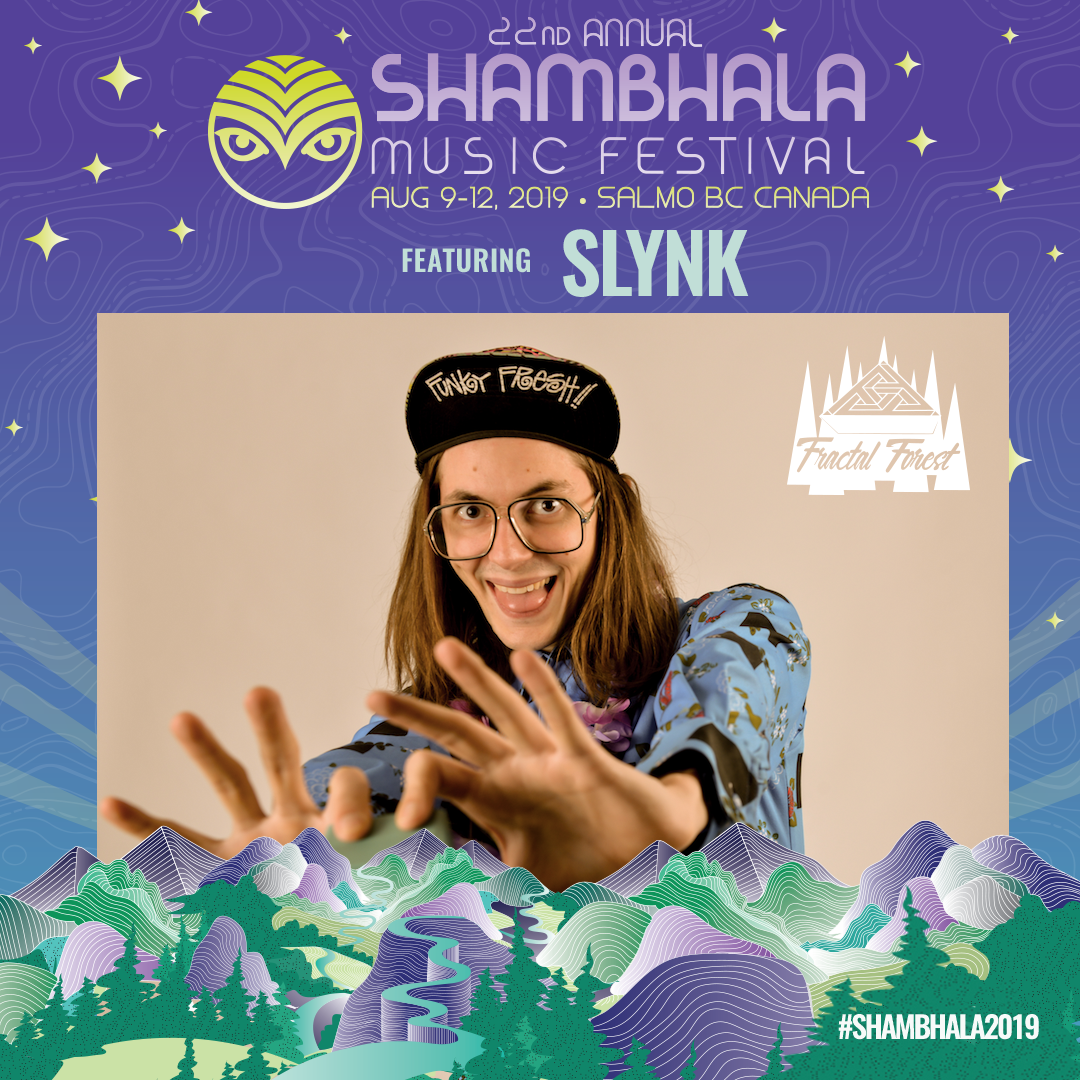
Get to Know the Shambhala Favorites Starting with Slynk
Hailed by some as “the funkiest DJ on the planet”, the Australian-born Vancouver-based DJ/producer Slynk has been performing at Shambhala Music Festival for nearly a decade and returns this summer as one of several acts labeled on the 2019 lineup as “Shambhala Favorites”. Shambhala has chosen to recognize this group of artists whose roots run especially deep with the festival, so we decided to see what the buzz is about, starting with the fun-loving and funky Slynk aka Evan Chandler.
Hailed by some as “the funkiest DJ on the planet”, the Australian-born Vancouver-based producer/DJ Slynk has been performing at Shambhala Music Festival for nearly a decade and returns this summer as one of 20 acts on the 2019 lineup labeled as “Shambhala Favorites”. For the first time, Shambhala has chosen to call out this group of artists whose roots run especially deep with the festival. To recognize this unique curatorial decision, we’re speaking to some of the Favorites as the festival approaches, starting with the fun-loving and funky Slynk aka Evan Chandler.

One of the many unique aspects of Shambhala is its booking process; the stage managers themselves book the talent. These individuals, like Rich-E-Rich, stage manager of the Fractal Forest and one of Shambhala’s original contributors, are obviously huge music fans themselves. So in addition to holding down logistics, these folks are able to exercise their fandom through these bookings. The Shambhala Favorites concept could be an outgrowth of this, as the stage managers surely had some input into the Favorites roster. The artists chosen have performed at Shambhala again and again. There’s British Columbia native and Bass Coast organizer The Librarian and Los Angeles dubstep producer Stylust. There are bass funk pioneers like Stickybuds, A Skillz and JPOD. There’s Mat The Alien, at whose Shambhala set many years ago the concept of totems (or “signs” as they’re known at Shambhala) is said to have originated with a piece of cardboard, a spray can, and the words “Really Good”.
They all have history with the festival and some of it goes beyond performing. Every year they pack out the stages and generate wild excitement, which is even more impressive when you realize how many are local to western Canada. For some, their fan bases and careers have grown in tandem with the festival. To a degree, this can be said for Slynk, who has been releasing his Fractal Forest sets on SoundCloud to wide acclaim since 2011. Slynk is completely self-taught and first began producing on the Playstation game “Music” before moving to Fruity Loops and eventually Ableton. He can also scratch up a storm, after teaching himself on two old decks a friend gifted him in his hometown of Brisbane when he was 18 or 19. He combines top-tier glitch sound design with big, bold breaks and a bottomless library of samples spanning all genres but especially funk, hip-hop, r&b and reggae.
One of the most memorable Shambhala moments for Slynk and for his fans was his surprise set at the Fractal Forest in 2012. Evan was at the event as a patron that year when he ran into Rich-E-Rich who told him a headliner had cancelled and asked if he, Slynk, would be up to throw down. Evan didn’t hesitate and today that set (below) has a good bit of folklore surrounding it. We asked Evan about his first Shambhala set back in 2009, his sound design, and his mutual love affair with this legendary festival.

The Rust: You’ve said that as humans we all crave a sense of community. What’s your community at Shambhala look like?
Evan: It's like a family reunion. It feels like it's my birthday and all my friends from all over the world have made the journey to the forest to reunite and celebrate. Some friends I haven't seen since last Shambhala, we pick up the friendship exactly where we left off last year. It's just love and laughs. You are very aware that this is a festival wide feeling too. In normal society, we're afraid to talk to one another. We put up walls and push away strangers. We avoid community and prefer isolation. But at Shambhala, these walls are torn down. You are everyone's friend and everyone is friends with you. I don't know how or why this happens. But I crave it. Who wouldn't?
The Rust: Shambhala was the first festival you ever played in 2009. Can you take us back in time to that moment?
Evan: I'd never been to a festival like Shambhala before. It's on a completely different level than anything else I had experienced. I was overwhelmed as an attendee, but I was booked to play as well! I remember spending probably too much time on my laptop at the campsite rethinking my set. Going over it in my head. Listening and planning again and again. I was nervous, really nervous! The staff in the VIP area at Shambhala were so accommodating and friendly. Tall Brian actually recommended I get a massage to relax. Hang on, you guys give the artists massages? And it's free? I got what was probably the best massage I'd ever had in my life to date. I was feeling much more centered and calm.
Evan: If memory serves me right, I was playing Friday night and as you guys know, the Fractal Forest doesn't open ‘till Friday. So I'm experiencing all the quirks and personality of the stage for the very first time, and setting up my gear at the same time. I remember playing a song in my set which had a little vocal sample that said "make noise". The whole crowd lit up with noise. For a moment I was wondering what was going on! I'd played this song many times before at other shows and never really noticed the sample until I played it there. The crowd was truly listening to my music. It was electric. It was the best moment of my life, and it's the moment my entire life changed forever.
The Rust: You’ve performed on at least four continents. What can you find at Shambhala that you can’t find anywhere else?
Evan: I can't tell you what you will find at Shambhala, but I can tell your what I found. I found a purpose. I found a home. I found a community. I found inspiration and drive. I found love and acceptance. I found my flaws and strengths. I found out who I am and I found out who I want to become.
The Rust: We’ve read a ton about how your sampling skills developed. How about your sound design? When did you first start creating sounds you were actually impressed with? What sort of sounds do you want to create in the future?
Evan: I think I'm just a nerd. Or a scientist. I do experiments, record the results and then review the data. I taught myself everything in this way. I would turn a knob and hear the way the sound changes and make a mental note. That's really the core of understanding synthesis. Eventually you're able to hear a sound in your head and then move the knobs in the right way to make that sound.
But what's more fun is to ask my music software to generate "happy accidents"; something that takes an input, and uses that to output something transformative, random and unexpected. This is where the collaboration between you and the computer really begins. I've come up with some great ideas in this way. Lately I've been experimenting with neuro style sounds. I'm learning how to use distortion without completely breaking the sound beyond recognition. It's something I haven't really messed with before. Most of my typical sounds are subtractive. I'll start with a big sound and carve away at it using filters. Neuro style sounds seem to be more additive in a way. You start with a simple sound and slowly build up harmonics and texture with distortion.
The Rust: I love how you described the relationship between performers and audiences as yin and yang. Can you elaborate on this?

Evan: It's like a feedback loop. I'll spot someone in the crowd really getting down hard and it makes me smile. They like my music! I'm proud and honoured to be giving this person a reason to get down. It makes me wanna shake it around a little bit myself. The audience sees me grooving and they can tell I'm enjoying myself. I'm smiling and boppin’ around and that makes them smile and they get their boogie on a little more, too. It just goes around and around until everyone in the room is glowing and jamming. But this isn't an exclusive relationship between crowd and performer. As a person in the audience, you have the power to lift the area vibe yourself! Put on your crazy costume, shake your butt and make people smile. It's contagious.
The Rust: What’s one thing about Shambhala that may surprise someone who’s never been?
Evan: It's strictly a non-alcoholic event. I enjoy the occasional beer but I learned a long time ago that you don't need to get hammered to have a good time. Your true personality is deep down inside you, and I think if you learned how to unlock it, you'd really enjoy yourself! Come to Shambhala and we'll teach you how to come out of your shell. Knowing how to let go of your inhibitions sober is a valuable skill to possess for all walks of life.
—
As we described last year, Shambhala is arguably the most successful music festival in North America. There’s 1,001 reasons behind this that we’re still unpacking, but the concept of the Shambhala Favorites highlights one of the key reasons; Community. This group of artists is more than a grouping of impressive talent to help sell tickets; they’re part of the Shambhala community, an integral part of the festival’s fabric. It’s impressive but not surprising that Shambhala would recognize its community with this special section on their 2019 lineup. As the festival approaches, stay chooned to The Rust Music for interviews with more of the Shambhala Favorites.
FOLLOW Slynk: Official / Bandcamp / Spotify / Soundcloud / Facebook / Instagram
FOLLOW Shambhala Music Festival: Official / Facebook / Instagram

![Seppa - Interview + Boosted [EXCLUSIVE PREMIERE]](https://images.squarespace-cdn.com/content/v1/59530136f5e2319eabb7d87f/1626113208781-BZ7C6B7E3LCECV7UD4CS/Boosted.jpg)
