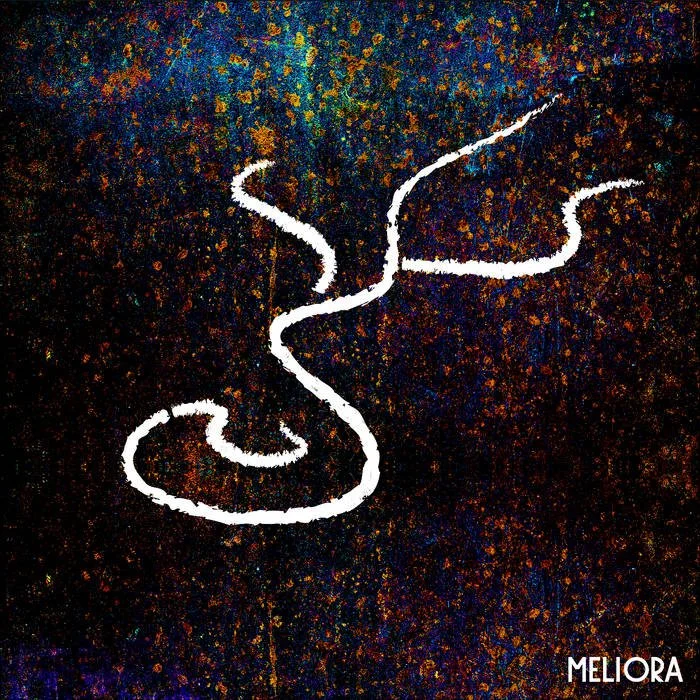
Seppa Takes a Turn For The Nuevo with Meliora EP
Following on the heels of his Boosted/Forked dual release, and dropping just ahead of his long-awaited and much anticipated return stateside this November, Seppa’s latest record is arguably some of his most developed and distinctive productions to date; the Meliora EP reshapes the image of Seppa normally beholden to the purely vicious and weighty end of the bass music spectrum.
Following on the heels of his Boosted/Forked dual release, and dropping just ahead of his long-awaited and much anticipated return stateside, Seppa’s latest record is arguably some of his most developed and distinctive productions to date; the Meliora EP reshapes the image of Seppa normally beholden to the purely vicious and weighty end of the bass music spectrum. While the punch and ferocity of that define his output are certainly apparent, there’s a marked focus on arrangements within arrangements, on the select relationships between tones, and on progressive songwriting fundamentals. Meliora adds a bounty of audible technicolor to a previously and potently austere compositional palette, showing just how much firepower is still under wraps for the Seppa project.
Drum and Bass has seen a resurgence of interest in the North American underground across the space of just the last few years, and in line with a swath of contemporaries staking their claim in genre’s amorphous boundaries, Meliora’s opening track “Imber” shuffles between nosediving breakdowns and flighty conversations between melodious synthesis. It’s the tipping of a hand that’s holding a bounty of material inspired by both past and future exploits, leading straight into the avant “Jaque”, who’s stuttered orchestral overture pairs up with the largest, and consequently meanest bass line across the record. “Apricus” follows the opening pair, toning down the intensity by a clear several degrees. Quintessentially downtempo, but fused with the distorted, curious textures that are so emblematic of the artist, it follows a repetitious, sampled vocal arc that maintains its course a top a churning sea of production artifacts and intentional spurts of synthesis. To close out the record, “Vermix” lays out space-aged and nuanced iteration of contemporary halftime, flitting between focused lead lines and mad dashes through extraordinarily gltiched-out territory. As an entire package, Meliora is by far the most matured Seppa release to date, showcasing the frayed edges of bass music and beyond.
With Seppa’s November tour just around the corner, this EP wets the tongue to his new compositions and developments in and out of the lab. To add to the growing anticipation, he’s cracking the seal a second time this Sunday at 2pm EST; with a visual accompaniment designed by Laia and Tenorless, the full EP will be streaming live through his YouTube page for your discerning end-of-week entertainment.
FOLLOW Seppa: SoundCloud / Bandcamp / Spotify / Facebook
A Brief Conversation With NYC's Blockhead
Across the span of the last three decades, Trip-Hop has gone from being the niche, extant musical trials of underground and bedroom producers to dominating a demonstrable slice of the global listening bandwidth. Blockhead is, by most measures, one of the most accessed, successful, and consistent names in the genre, placing him squarely in the center of Trip-hop's past, present, and future.
Across the span of the last three decades, Trip-Hop has gone from being the niche, extant musical trials of underground and bedroom producers to dominating a demonstrable slice of the global listening bandwidth. In its myriad forms, flavors, and spinoffs, it is a genre that inhabits the space of stages large and small, popular radio stations and burgeoning YouTube channels, Spotify-sponsored playlists and nebulous, often anonymous mixtapes on SoundCloud, and every crevice in-between. The list of artists that carry the Trip-Hop mantle ever forward grows on a near daily basis, but a few particular characters have been solidified as mainstay, immovable elements of that landscape; Blockhead is, by most measures, one of the most accessed, successful, and consistent names in the genre, placing him squarely in the center of Trip-hop's past, present, and future.
With over a dozen albums and a veritable starting point of 2001, Tony Simon's Blockhead project is both the personal effects of one man's musical journey and a chronicling of Trip-hop's timeless impact. It would be a disservice to say that his discography is indicative of the genre's evolution, as his sonic palette and compositional direction are distinctly unique; it's not enough to just bang out a traditional sample collage and call it a day, as that would simply be a pale imitation of the real goal. It's not enough to fold a few choice melodies together over top of a looped, broken beat.
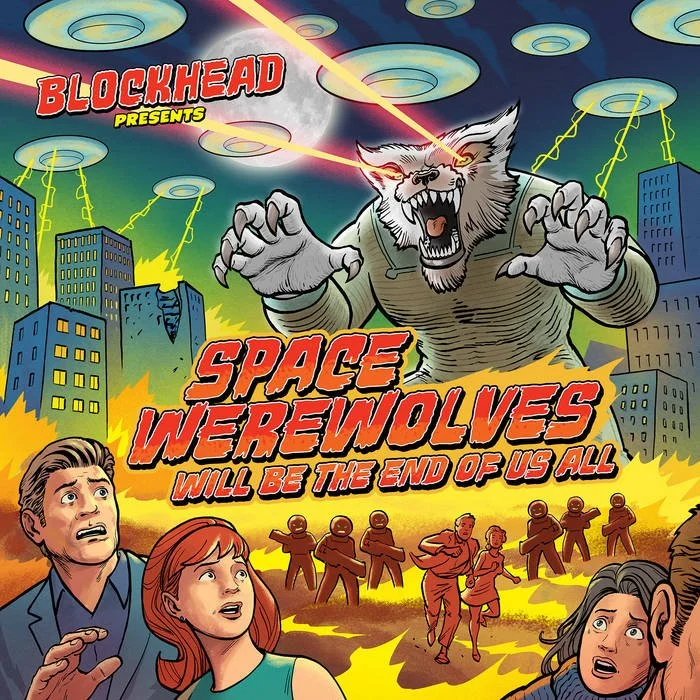
Space Werewolves Will Be The End Of Us All, the latest Blockhead LP, showcases just how particular his compositional gait can be. Where other collections of beats music often feel like just that - a collection, each arrangement on the album in question begets prudent songwriting and production chops that create the narrative arc that Blockhead albums are so known for. It's an intentional web of highs and lows, of melancholy and jubilee, and an abundance rhythmic swagger. As soon as the record begins to spin, you're trapped in a meandering sunshower of themes, bridging the gaps between hip-hop, jazz, blues, and soul music.
In order to get a better fundamental understanding of the Blockhead creative ethos and the process behind Space Werewolves, the Rust took advantage of a generous opportunity to pose some poignant questions to Tony Simon, getting us a few steps closer to the root of his musicality.
The Rust: What was your first moment of inspiration for Space Werewolves Will Be The End Of Us? Was it a desire to craft another LP, or a smaller, snowballed moment?
Tony Simon: With new albums I kinda reach a point where I'm like "Whelp, it feels like i should probably make a new album" which is a real undertaking that i have to really prepare my mind for it. In this case, I had been locked down during the quarantine and honestly, very bored, so I figured, fuck it, let's ge to work. and, for me, once the ball starts rolling, I'm hyper productive and mildly obsessive so I tend to get shit done in a timely manner.
The Rust: Your long form releases have typically included a variety of flavors and staples; do you consciously set out to cover that much territory, or do you suddenly find yourself there?
Tony: It's definitely not something I do consciously. I've always been drawn to trying to find off kilter sounds and things other people might not immediately see the value in, sample wise. But the variety is really just a testament to me sampling from a huge spectrum of music and blending those genres together with very little regard for their original settings.
The Rust: What kind of mindset do you pull from when you begin to envision your musical process? Is it something you deliberately tap into, or an unconscious reaction?
Tony: I'm all instinct. i've never sat down to make a beat thinking "I wanna make this type of beat right now". I'm guided by the samples. It just so happens , I'm drawn to melodic and often melancholy sounds. I'm not a big over thinker and generally just reacting when I make music. Kinda of impulsively just pushing through ideas that pop in my head and either executing them or abandoning them very quickly.
The Rust: Let's talk sampling: with so many years under your belt, how do you keep your productions fresh? How do you keep your sample palette fresh?
Tony: I always worry about sounding samey cause my formula is very specific. and it's been that way for a while now. But i'm also, as far as i know, the only guy who makes songs like i do using mostly samples so i feel less guilty about sometimes feeling formulaic. As far as the samples go, I'm just always looking for something that jumps out and I think my ear has evolved with time. Certain things i woulda sampled years ago, i'd pass over cause i feel like I've been there and done that. Sometimes i go through old folders of samples i never used and find great stuff i just overlooked the first time. The ear is always shifting with the years.
The Rust: How do you strike a balance between the polish of production with the rawness of instrumentation? How do you zero in on "the pocket" as you compose each track?
Tony: It goes back to instinct and trusting your ear. I can't even explain it but i know what i want it to sound like and i know what i don't want it to sound like. It's nuanced. I'm also not always in the pocket. Sometimes i struggle making anything work and others the sounds just seamlessly pile on top of each other without even trying. I've found that if i keep pushing forward, something usually happens.
The Rust: What was the creation process for this LP like? How did you fare during your time in locked-down NYC?
Tony: It was just me putting my head down, taking a deep breath and going in. My process for making albums the last few has been the same. I don't start from scratch. I make a ton of beats , pick out about 25-30 of those then see what beats can work with others. I'll match 2 or 3 at a time and meld them all together into a song. The concepts for songs kinda come after the initial framing of the song. And i just fine tune it from there.as for the lock down, I could lie and say it was awful but,truth be told, I was built for that shit. I'mma social guy but I'm also very comfortable being alone and a homebody so it wasn't that different that being home from tour.
The Rust: What's next on your list of projects? Any downtime, or is it right back to the studio?
Tony: I have a secret project with a special rapper that will be dropping in november I have finished collabo album with my dude Eliot Lipp under the name "Lipphead" that will be out next year. As well as a three song EP of stuff that didn't make this album that I'mma drop before the end of the year. But really, touring is starting again so that's gonna be taking up the glut of my time for the upcoming months.
FOLLOW Blockhead: SoundCloud / Bandcamp / Spotify / Facebook
A Glimpse Into June Jam's New Home at Playa Ponderosa
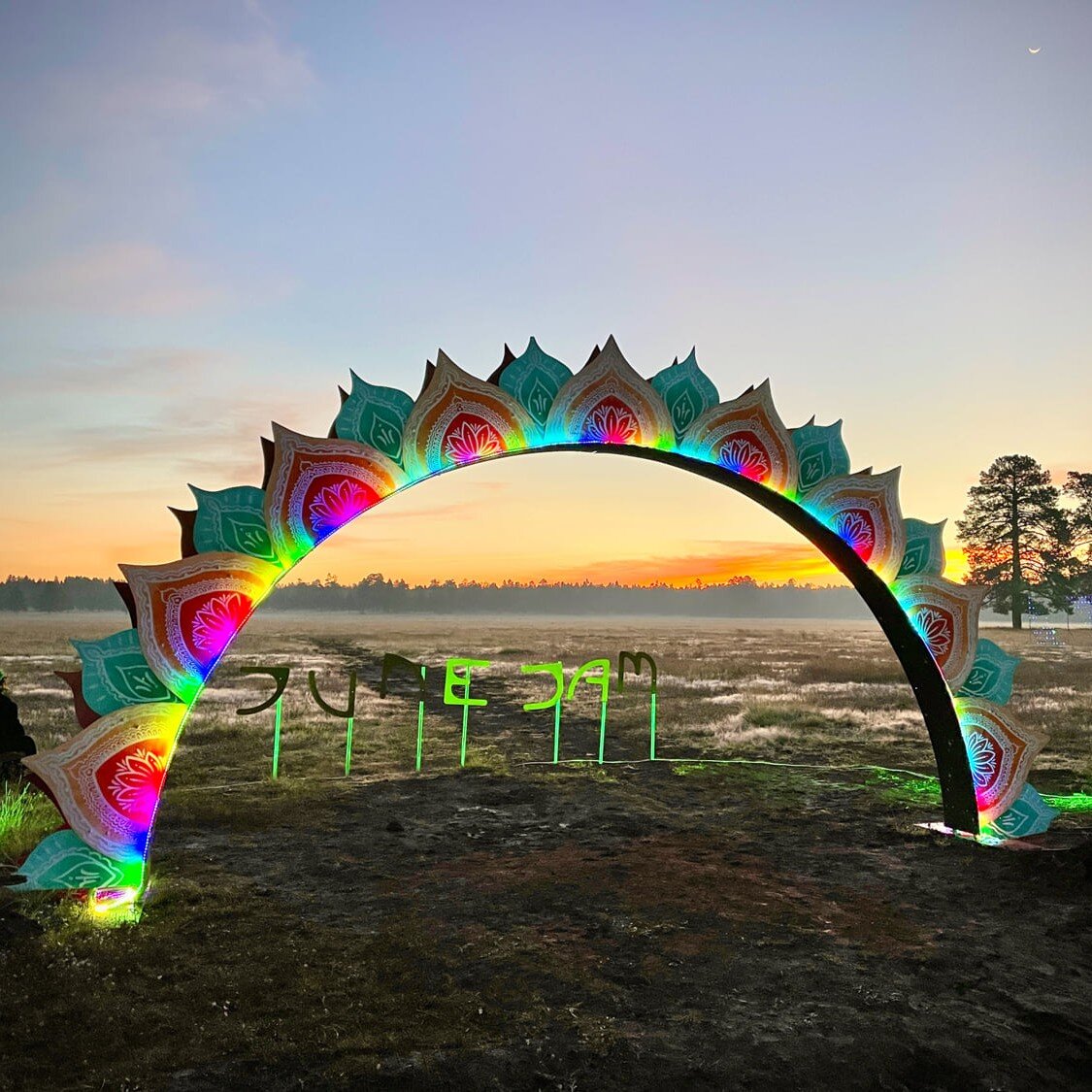
Earlier this month, The Rust team was privileged enough to glimpse behind the curtain into Arizona’s evolving grassroots culture. Flagstaff's own Junetember Jam was, simply put, magical. Previously referred to as Juniper Jam, and classically as June Jam, the festival celebrated its 3rd year with one of its most dynamic and provocative lineups of musicians and educators to date.
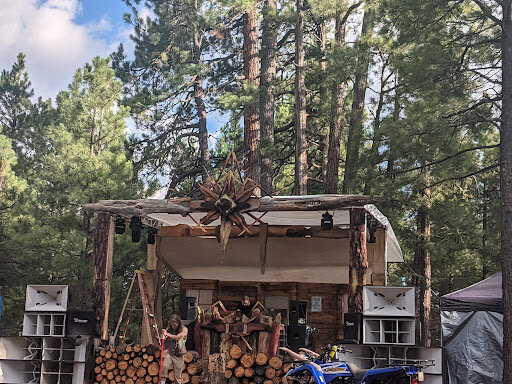
Earlier this month, The Rust team was privileged enough to glimpse behind the curtain into Arizona’s evolving grassroots culture. Flagstaff's own Junetember Jam was, simply put, magical. Previously referred to as Juniper Jam, and classically as June Jam, the festival celebrated its 3rd year with one of its most dynamic and provocative lineups of musicians and educators to date. Featuring classes on organic living, self-betterment workshops, and a variety of self-healing and kink-friendly groups, June Jam has become a local favorite and a must-visit festival for the committed patron/attendee.
Perusing Playa Ponderosa has an intimate feel and showcases the natural and magical landscape of Northeast Arizona. Tucked deep into the woods just outside Flagstaff, Junetember Jam offers spectacular 360 views atop Playa Ponderosa and is accompanied by high fidelity sound on Danley, Funktion-One sound, and KV sound systems. June Jam does an amazing job not only showcasing one of a kind musical acts, but highlights the evolving culture around speaker systems as well. Sets from artists like Navigatorz, skysia, Vinja, Arcturus and more had this year's crowd entranced by sound design flexed on some of the world’s finest dynamic sound systems to date. With four stages spread out across a quarter mile footprint, the push and pull of different styles was brilliantly balanced, allowing attendees to have those magical moments of exploring a late night festival between stages and having the convenience of being close to camp and amenities.

With a population size of about 1000, June Jam is able to offer RV friendly campsites as well as regular tent camping that is both comfortable and responsible. This year’s staff had safety as the most paramount task at hand. Event organizers implemented a simple color-coded wristband system to help attendees indicate their comfort level for giving hugs and touch; Green indicating “go for it, I'm all in for hugs”, yellow indicating “no hugs from strangers”, and red indicating that patrons would prefer to keep personal space. Our team also met with the Good Eggs, a harm reduction service offered to festivals as a way of passing along helpful information about festival culture and experiences, as well as extending a helping hand to those perhaps going through a less than desirable experience.
With their team of highly committed dreamers, creators, and staff; June Jam was able to cultivate an experience for attendees that was both responsible and worry free. The atmosphere surrounding their four stages was created to be inviting and explorative with a fire circle, chill out spaces, and elevated art hanging amongst the trees, all just a stone's throw from where music was playing. The oasis area was just within a tree line and was complete with “tiki”themed stage design and a hanging mirrored bull elevated 12 feet above the crowd. Seeing team members walking and grooving with patrons filled our teams hearts, while the delightful smells and taste of a makeshift tostada bar on Sunday morning filled our bellies. The wide range of classes and excited teachers made our team feel welcomed into some more niche realms of festival counterculture, showing off the synergy between recreation and learning in alternative spaces.

With a focus on safety and cultivating a culture that is an homage to the best aspects of festival experiences, June Jam offers an experience that is uniquely pleasant and well-regulated. Our team at every corner made a friend out of a stranger, fell into deep and human conversations, and made renewed connections to ourselves. Being touched by magic comes to us when we least expect it, and our team lived in the magic of Playa Ponderosa, found family out of friends, and will be eager to make the trip back home to June Jam next year.
![Airstrike & Lyndon Jarr - Inside Your Mind [Exclusive Premiere]](https://images.squarespace-cdn.com/content/v1/59530136f5e2319eabb7d87f/1632948926936-JWEBCP55GQ1UQOPVZ12Q/SBLMT008+-+VA+-+Reclamation+-+Album+Art+-+Small.jpg)
Airstrike & Lyndon Jarr - Inside Your Mind [Exclusive Premiere]
Dialing in on the relationship between impact and groove, Airstrike and Lyndon Jarr bring their assortment of individual strengths and flavors to the table in The Rust’s latest premiere, “Inside Your Mind”. Both undeniably potent composers in their own right, the duo’s collaboration is just one piece to the larger package of Sublimate Records’ Reclamation VA Compilation.
Dialing in on the relationship between impact and groove, Airstrike and Lyndon Jarr bring their assortment of individual strengths and flavors to the table in The Rust’s latest premiere, “Inside Your Mind”. Both undeniably potent composers in their own right, the duo’s collaboration is just one piece to the larger package of Sublimate Records’ Reclamation VA Compilation.
Drum and Bass music is a fickle beast to tame from the production standpoint, but it's clear from jump that neither Airstrike or Lyndon Jarr were intent on anything less than a pure kill shot. The precision lattice of percussion and rock-solid bass lines engender a ram unctuous and rambunctious dancefloor experience, exuding all of the attitude and none of the frills of high-fidelity electronic anthems. It’s a thoroughly direct brand of low-end synesthesia, leaving behind any dead weight in favor of sheer dynamic velocity, and that’s all in just a single serving from an expansive 18-track record. Keep your eyes peeled for the October 18th release of the Reclamation VA Compilation for a full course meal of Sublimate Records and their stalwart gang of affiliates.
FOLLOW Airstrike: SoundCloud / Facebook
FOLLOW Lyndon Jarr: SoundCloud / Facebook / Webpage

Getting Acquainted With The Magic of June Jam
We had the opportunity to poke around behind the curtain of June Jam’s celebrated operation, and get a clearer picture ahead of this weekend’s coming festivities.

Playa Ponderosa by day.
This coming weekend, June Jam is set to mark its third year of fanfare-laden operation. Beginning in 2018 with a very small, boutique-style event in Prescott called Juniper Jam, the vision and determination has turned the small party into a multi-day festival and cultural free-for-all. “It was a pretty small event, somewhere in the neighborhood of about 300 paying attendees and then a lot of awesome artists. More of an artist summit than a festival.” said Christian Cortes, June Jam’s music and event coordinator.
Fast forward one year, and the owners and team members of June Jam purchased a beautiful plot of 75+ acres that has since been named Playa Ponderosa. The land is surrounded by the Coconino National Forest, a picturesque rounded red stone and high country desert with sub-alpine forests populated by Ponderosa trees and lush meadows. Complete with three stages, freshly chipped dance floors and their own exhibition spaces, The Promenade and The Nook, for those wide-eyed insomniacs seeking a full night of music and color.
“ [June Jam] is produced by mainly burners and Phoenix natives that would otherwise be at Burning Man this particular weekend,” said Christian. “The vision for the property itself has always been to host a large, open-format music and arts event. A lot of our team has been to Burning Man or helped produce aspects of theme camps at Burning Man, so we have traditionally had to work around the reality that some of our team is involved. Given the circumstances, we felt that it was a really good opportunity for us to fill that void for the regional burner community, but also for the people who might have not gone to the burn, are interested in it, or they have glimpsed that culture and might have some curiosity. Maybe their only exposure to music and art in that kind of format is the larger music festivals. We really are trying to capture everything that is not just music.”

Playa Ponderosa by evening.
June Jam features an exhaustive list of involved, expansive, and creative workshops and classes. Starting at 9 in the morning until late afternoon, classes are spread out throughout the grounds. The team aims to provide adequate space for patrons to participate in the many activities and classes at their leisure without feelings of overcrowding. “They did an amazing job curating this list of workshops that kind of hits on all aspects of fringe culture. You've got your movement and flow workshops, your yoga classes, a lot of stuff you would normally see, like more of a traditional music festival, transformative festival setting. Then there is stuff that is more inspired by the kind of programming at a theme camp at Burning Man - like shibari rope bondage and kink classes - hings that are more a part of fringe culture as opposed to something you would see normally.” Musical acts such as Moontricks, Random Rab, 5AM , Sortof Vague, Nox-Vahn, and Vinja are a small portion featured on the eclectic line up.
While dancing in the Ponderosa-lined meadow with audiophiles and creatives alike, attendees can rest assured that some of the best safeguards one could ask for in the post-covid world are present. Their team is asking people to get tested 72 hours prior to the event and providing colored wristbands to nonverbally signal consent without overcomplicating things or alienating people. Covid has taken us all for a ride but those that would like to gather in a safe way have options.

Playa Ponderosa by night.
“We do trust people to be responsible for themselves. We have one gate. It's the kind of festival where you get through the main gate, that's it. No additional security barriers. Personal accountability is a big part of how we run this event but we have had a lot of luck and respect from taking that model and really expanding it over the course of the last two years.” said Christian.
Tickets are still available to be a part of the stunning magic that is June Jam with varying packages. Limited RV camping remains but with sprawling protections us festival goers have always hoped for in place, get ready for an immersive recreational weekend of contrasting and colorful festivities. The team hopes to see a diverse crowd of creative minds, and we’re thoroughly inclined to be a part of it.
![Spoonbill - Bushwrangle [EXCLUSIVE PREMIERE]](https://images.squarespace-cdn.com/content/v1/59530136f5e2319eabb7d87f/1629893926220-YSGPBR3MMDRS8DI6HLYN/processed_Spoonbill+Ultraniche.jpg)
Spoonbill - Bushwrangle [EXCLUSIVE PREMIERE]
Across the last 15 years and running, the music of Spoonbill has been a veritable soundtrack to audiophiles, psychonauts, revelers, and unsuspecting fans in waiting across the globe. The hallmarks of his compositional gait are impossible to miss, with his accentuated synthesis, playful sampling, and commanding arrangements. His 2019 LP Canopy saw the exploration of powerful, emotive themes and songwriting, and in the heavy anticipation of the release of his subsequent Ultraniche EP through Addic.Tech Records, The Rust is incredibly honored to host the exclusive premiere of the track “Bushwrangle”.
Across the last 15 years and running, the music of Spoonbill has been a veritable soundtrack to audiophiles, psychonauts, revelers, and unsuspecting fans in waiting. The hallmarks of his compositional gait are impossible to miss, with his accentuated synthesis, playful sampling, and commanding arrangements. His 2019 LP Canopy saw the exploration of powerful, emotive themes and songwriting, and in the heavy anticipation of the release of his subsequent Ultraniche EP through AddicTech Records, The Rust is incredibly honored to host the exclusive premiere of the track “Bushwrangle”.
There's always been a cinematic enchantment to Spoonbill productions; from choice foley, to whimsical vocal cuts, and across every moment of movement, his tracks elucidate mental landscapes with ease and by design. “Bushwrangle” is an especially juiced up iteration of his deliberate sonic world-building, with it’s notable blues slant and clear progression placing you right in the center of an outback desert-noir landscape. It's undeniably vivid, extraordinarily lusid, and just the first and calmest taste of the rambunctious Ultraniche EP, available on August 27 via Addictech Records across all major platforms.
Check out the pre-save links here
FOLLOW Spoonbill: SoundCloud / Facebook / Instagram / Webpage
FOLLOW Addic.tech Records: SoundCloud / Facebook / Instagram / Webpage
![Joro Dudovski - STRANGERS [EXCLUSIVE PREMIERE]](https://images.squarespace-cdn.com/content/v1/59530136f5e2319eabb7d87f/1628616778848-HVA6XW6291NR4MEOV7VL/joroart.png)
Joro Dudovski - STRANGERS [EXCLUSIVE PREMIERE]
With a notable bent for sculpted noise and homogenous blends, Joro Dudovski is at the forefront of an emergent fusion of precision engineering and freeform arrangements, taking advantage of compositional risks every step of the way. In anticipation of the Sanctuary Collective release of his upcoming Color Oscillations EP, the Rust is incredibly excited to host the exclusive premiere of “STRANGERS”.
With a notable bent for sculpted noise and homogenous blends, Joro Dudovski is at the forefront of an emergent fusion precision engineering and freeform arrangements, taking advantage of compositional risks every step of the way. In anticipation of the Sanctuary Collective release of his upcoming Color Oscillations EP, the Rust is incredibly excited to host the exclusive premiere of “STRANGERS”.
Folding white noise layers across swelling chords and choked-off sound design, “STRANGERS” breathes through the juxtaposition of ambience and impact. The material palette gradually shifts from granulated and pixelated to unified and organic; the opening lines shift like a vortex of sonic artifacts, while the track’s resolution meanders along a dissipating grand piano flourish, marrying the otherwise disparate ends of the track’s overall scheme. As with all Joro Dudovski productions, “STRANGERS” feels far more like a transient journey than a single song, and it’s just the first taste of the inner workings of Color Oscillations.
FOLLOW Joro Dudovski: Soundcloud / BandCamp / Spotify / Facebook
Sylph Upends Expectations with Snakeskin EP
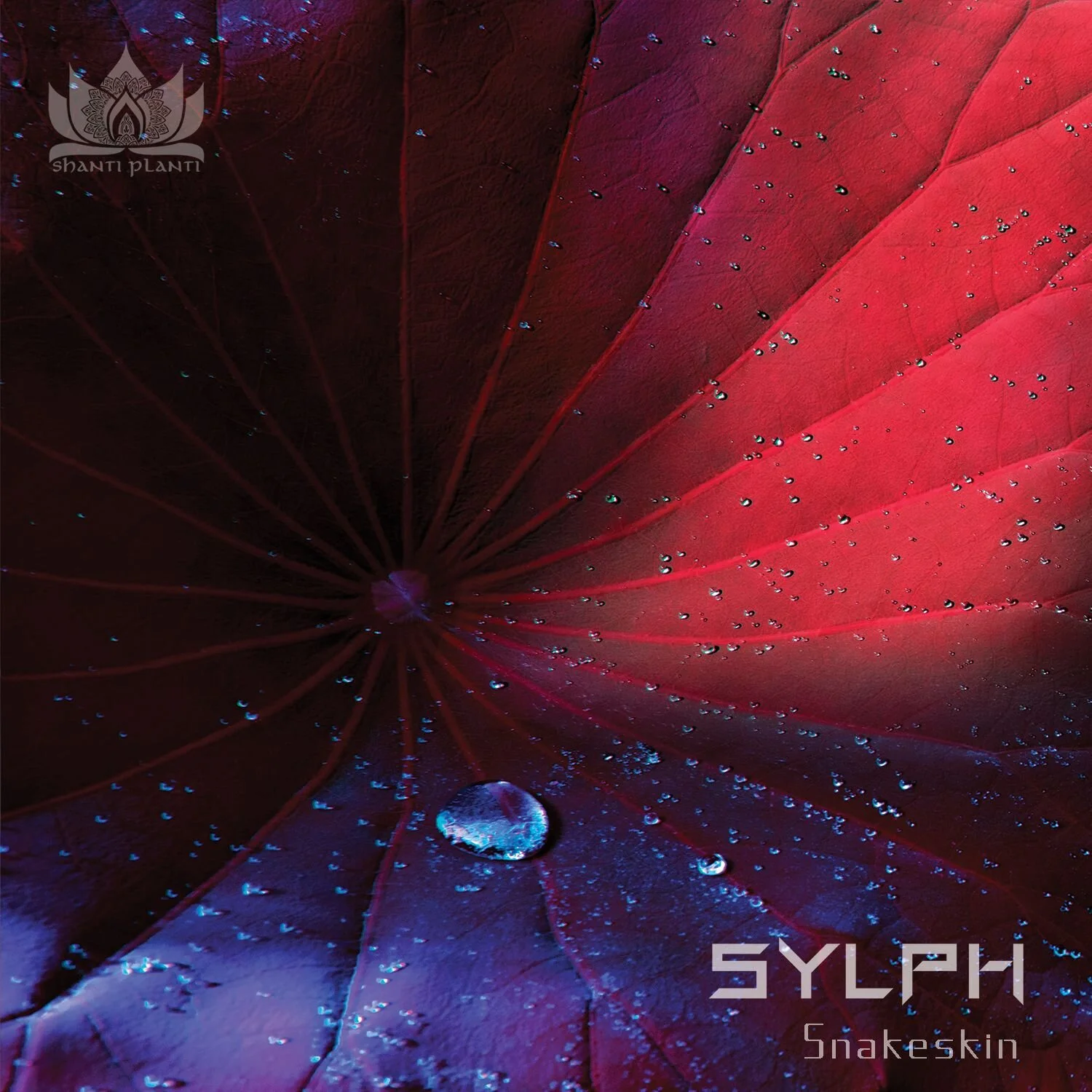
This is not your older brother's psy-trance; When it comes to reimagining the closing the distance between psybient and disparate genres, Sylph is spearheading that research one release at a time. Her latest EP, Snakeskin, exudes the classic style and fortified production that has come to mark her project, exploring the relationship between the somatic and psychological hemispheres of perspective through a matrixed web of composition and texture.
This is not your older brother's psy-trance; When it comes to reimagining the relationship between psybient and disparate genres, Sylph is spearheading that research one release at a time. Partnering up with Shanti Planti, her latest EP, Snakeskin, exudes the classic style and fortified production expected from the label’s releases, simultaneously infused with the hallmarks of her compositional gait. Known for setting the standard for spiritually-accented bass music, Shanti Planti and their devout audience is an impeccable fit for the Snakeskin EP. In prime genre bending fashion, it is a maze of psychotropic sounds and textures brought to life by animated arrangements, exploring the relationship between the somatic and psychological hemispheres of perspective.
Debuting with the Alien Speak EP in 2018 through The Rust, Sylph has taken her aural visions to new heights, drawing on an extensive appetite for production knowledge and engineering fundamentals. The distance from then until Snakeskin feels like barely a few months in the mind, but the clear distinction and pronounced evolution of her skill sets have paid off in full. The opening track “Labyrinth”, is speckled with airy and elemental moments while rolling pads straddle pulsating sub bass. Her verbose and vocal sound design comes across as a nearly intelligible language born out of melody and rhythm. “Medusa” begins with hollow, panning tones that engender a meditative harmony. Calming and tribal, the soft resonating string sounds give it extraordinary depth and clarity.
Like the ambient backdrop of a proper cave, “Prophet” exudes shuddered, salient energy and explores darker thematic tones than the rest of the EP. Taking inspiration from the expanse of system music, her genre bending slithers somewhere between trance and 140. With panning melodies and periodic vocals accented by drips and echoes, Sylph recreates a feeling of rippling water down hard, cold rock. The final song, “Quicksand”, leans on her fierce and cinematic take on heavy bass music. Utilizing percussive ramps and a powerful control of tension and release, the track reaches its zenith amidst a torrent of low-end impacts and brazen palettes of glitched-out textures, bringing Snakeskin to a resounding close.
Sylph is a clear student of clarity, a dancer in the darkness, and a motivator for those who see the lines between style as bridges to cross. Her bold flavor and crisp character has us writhing for more music, but it’s the patient wait that’s yielded the most fruitful results time and time again. Until then, keep your eyes and ears squarely centered on the rising trajectory of this stellar artist.
FOLLOW Sylph: Soundcloud / BandCamp / Spotify / Facebook
Hudson Lee Advances Sonic Narrative With Reflex Angle LP
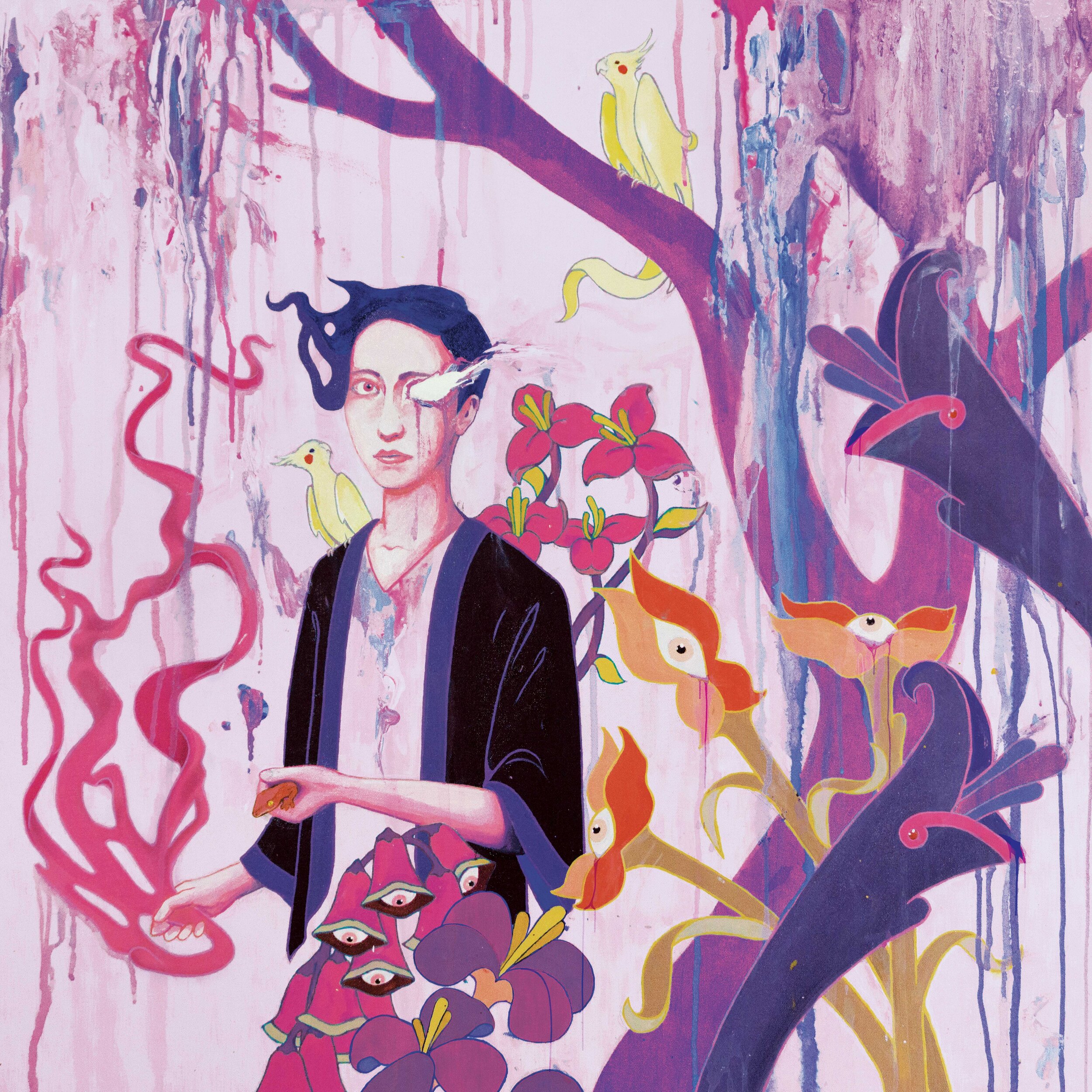
With every subsequent release, Hudson Lee adds another layer to the matryoshka sphere that surrounds his catalog. He’s has managed to transform what was once a collection of high-powered, somewhat isolated tracks, folding them into a narrative undergoing metamorphosis; the release of Reflex Angle showcases a clear transformation in his songwriting process, fusing the very best of his sound design exploits with effusive and outstanding compositions.
With every subsequent release, Hudson Lee adds another layer to the matryoshka sphere that surrounds his catalog. When tapped into a particularly daring creative for long enough, it engenders a first-class seat to the evolution of their creative arc. Hudson Lee has managed to transform what was once a collection of high-powered, somewhat isolated tracks, folding them into a narrative undergoing metamorphosis; the release of Reflex Angle showcases a clear transformation in his songwriting process, fusing the very best of his sound design exploits with effusive and outstanding compositions.
Hudson Lee has already spent the last 5 years and running carving out his share of sonic territory; between his individual works, his numerous collaborations, and the operation of his flagship label Upscale, he’s kept himself consistently busy in the best way possible. What’s pointedly remarkable is that through all that time, his compositional output blossomed in ways that beget extraordinary discipline. It’s that tunnel-vision work ethic that laid the groundwork for Reflex Angle, allowing a surge of musical ideas to achieve terminal velocity in flight. That prescient burst of musical determination comes across in both obvious and surprising forms, with tracks such as “The Long Return”, “Skin”, “Staring Up” [Co-produced by Alexander Planos], and “Antialignment” displaying a new frontier of Hudson Lee’s creativity through compositional displays of intensity and mirth intertwined. It’s an especially choice touch of emotivity, bringing the albums narrative to life with a spectacular degree of lucidity. Across the spectrum, the frenetic and powerful churn behind “Axon”, “Chasm”, and “Reanimate” bridge the gap towards his traditional output, pulsing with newfound tactile control. It’s the blending of these seemingly disparate elements that creates the ouroboros of Reflex Angle, marking another waypoint in the ongoing story of Hudson Lee.
If you find yourself as moved as we are from your first listen, then you’re in extraordinary luck; Starting at 3:30pm today and tomorrow (July 30th and 31st), Upscale is hosting a two-day online streaming event featuring a stacked entourage of labelmates, associates, friends, and masters of their craft for an immersive showcase of avant-garde electronic music. Tune in through their Twitch Channel to check out the festivities.
FOLLOW Hudson Lee: Soundcloud / BandCamp / Spotify
Analog Adventures: A Conversation with Subphylum and Channel.3
The emergence and subsequent domination of digital tech in the world of audio and visual production is, by all measures, the standard across those deeply intertwined industries. In spite of this, or rather as a result of the increasing novelization of pre-digital A/V tech, a die-hard community of DIY enthusiasts, tech purists, and artists interested in anything out of the zeitgeist have coalesced around the collection and use analog music and visual production equipment. In order to get a better understanding of the complexities under the hoods of these interlocking analog adventures, The Rust took advantage of the opportunity to pose some succinct questions to Subphylum and Channel.3, two NYC artists taking full advantage of analog tech.
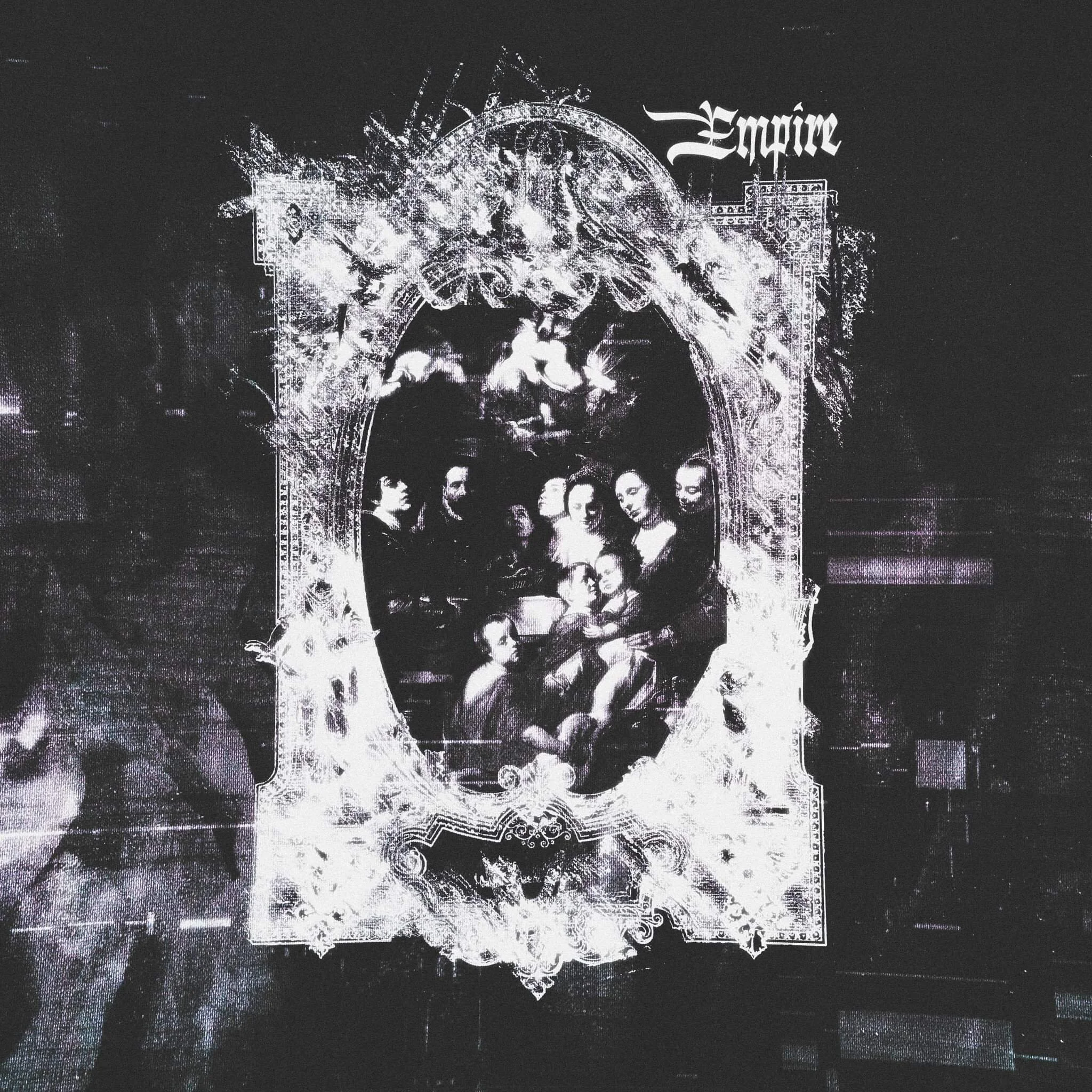
The emergence and subsequent domination of digital tech in the world of audio and visual production is, by all measures, the standard across those deeply intertwined industries. In innumerable ways, it’s given creatives an unimaginable war-chest of tools, programs, and instruments, and it has revolutionized the conceptual and concrete realities for producers across numerous disciplines. In spite of this, or rather as a result of the increasing novelization of pre-digital A/V tech, a die-hard community of DIY enthusiasts, tech purists, and artists interested in anything out of the zeitgeist have coalesced around the collection and use analog music and visual production equipment. Here in New York City, two upstart artists have begun to mingle both ends of this analog spectrum; Channel.3 and Subphylum have combined the brains and brawn of their analog equipment and mutually raw creative visions to produce “Empire”, showcasing dusted, hand-crafted rhythms and a living, glitched-out rendition of the song’s artwork.
Working within the confines of analog production is both immensely challenging and deeply gratifying; while the communities around A/V analog gear are numerous and consistently available, and the resurgence of interest over the last five or so years has seen a number of boutique manufacturers spring into existence, the barrier to entry on either end is a fairly sturdy wall made of cash and gumption. Once you’ve actually gotten your hands on any of the gear in question, the next uphill battle is figuring out how it works. Much like the freeform nature of their digital counterparts, analog synthesizers, samplers, sequencers, and visual modules can be used according to their prescribed functions, but are often extremely capable of modification through hacking, circuit-bending, and general craftiness. The extent to which novelty plays a role is however much or little the creator is looking for, and the slew of both pragmatic and ingenious combinations and outcomes that come from utilizing analog production tech is the high-anxiety reward that comes from accepting the wide room for error in a performance context.
Alex Carro’s approach to visual production is the meticulous and daunting Channel.3 project that takes advantage a new wave of analog visual gear and some significantly dated equipment with few, if any, modern iterations. The result is an intense panoply of asymmetrical visual art that is as organic as it is synthetic. On the other end of line is Max Burstein, the hands and mind behind the Subphylum project. Utilizing an array of hardware samplers, keyboards, and Kaoss Pads, he achieves a truly vintage profile across the numerous beats, flips, and tracks in his personal catalog. Their combined efforts gave the Subphylum track “Empire” a new lease on life, pairing it with a sliced and sizzled music video that showcases the generative randomness of the Channel.3 setup.
In order to get a better understanding of the complexities under the hoods of these interlocking analog adventures, The Rust took advantage of the opportunity to pose some succinct questions to both artists, and break down the barrier to understanding the challenges and rewards of analog production.
Channel.3
The Rust: Can you trace your love affair with visual tech back to its roots?
Alex Carro: I probably couldn’t bring you to something specific but as long as I’ve been seeing live music I have always thought that both visuals and light production was pretty cool and something that I wanted to try my hand at. As far as the analog direction, it stems through my love for Pretty Lights, and seeing Greg Ellis begin to incorporate elements of analog video synthesis into those performances really piqued my interest, as it was something pretty cool that not many people are doing. From there I kinda just started finding Facebook groups and different online forums about the topic and that led me to other great artists trying to do similar things, some in the more glitchy realm such as BPMC and Tachyons+, and some in a more digital but still not computer-based realm such as Phil Baljeu and even people who are using water and oil on projectors like Liquid Light Lab.
The Rust: What was the catalyst for going in an all-analog direction, given the growing accessibility and ubiquity of digital visual production?
Alex: In terms of design, I just think it has a really raw feel to it. There’s something really creative and fun in its limitations that I think brings the best out of my workflow, like sticking with one hardware synthesizer instead of working in a DAW. With that said, it definitely brings about a lot of challenges, like the mass of equipment I need, the difficulty in getting gear sometimes, and just working with older finicky tech. But that’s also part of the fun. In terms of a live setting, I can’t think of something that could possibly be a better medium for me to work with. It’s all basically being created on the spot, so it’s never exactly the same and is always influenced by the music, both with me patching sound directly into my system and also emotionally with how I want to change the different routines and visuals that I am making to fit the feel of that particular show. It’s honestly pretty meditative.
The Rust: How did you begin to hack away at collecting the gear? Did you roadmap a potential setup?
Alex:I did a pretty good amount of research about different modules and their capabilities and how I would want that incorporated into my set up, and I designed a whole rack on modular-grid and started saving money and was all excited, and then realized it was damn near impossible to get your hands on any of the gear I wanted or thought I wanted. So I had to switch gears and I started to try and track down as many modules that could present a complete “voice” as possible, meaning I can do the majority of the creation of an image within that singular module, and then the other modules could be brought in to add flavor if desired. This way, I could get right to work with the piece of gear in question, rather than have it sitting around collecting dust waiting for another module to eventually come around.
My biggest outlet for this was literally seeing patches that different artists are posting in forums that had elements I liked, and asking how they went about it. After that, you start to get a feel for what the machines do, and then you try to get certain bits that have specific functions. I really have to give a huge shout out to the people that work at and the community surrounding LZX. They are all amazing and super willing to answer questions and provide insights all the time and those lessons both big and small have been priceless.
The Rust: With that said, can you tell us a little bit about how your setup functions?
Alex: Sure it is basically a 4 channel mixer not too dissimilar to one a dj would use, except my incoming sources aren’t songs, they are modules. I can mix the signals using different keyers or a simple crossfader to get different and interesting effects. The two main modules I have been using at this time are Structure by Erogenous Tones and Memory Palace made by LZX. I sometimes layer in the Fortress (made by Phil Baljeu and LAX) with the Memory Palace for an 8-bit flair. My third input is either of the previous modules but fed through one of 2 glitch modules first that allow me to add a lot of texture and other interesting effects into the mix. The last input is the output itself. This may seem useless but if you mix the same image over itself in the proper way you create a feedback loop that creates some pretty dreamy effects. My other big module is the Sensory Translator by LZX which is essentially a band pass filter which takes in the music from the artist, breaks it into 5 bands based on frequency, and allows me to patch that into different parts of my visual as control voltage (ex. I can make the visual zoom in and out to the bassline of the song). I also have cameras to manipulate incoming footage of the artist or the crowd just to add another fun layer of complexity and source material.
The Rust: What’s your methodology for designing a visual performance? How do you account for the generative randomness that analog visual production is so known for?
Alex: I tend to think of it like a jam band honestly. I have a “setlist” of visuals I want to play (with a few extras because time dilation always messes me up and I work through my set way too fast) and I have a loose idea of how I want to go from one to another. From there I kind of let my mood determine how I want to alter the basic parameters of the patch, whether it be color or layering in a different element, patching voltage control to a different part, whatever. But really it comes down to knowing your modules as any good musician would know their instruments and having fail safes in place if something goes hell wrong , and whenever you work with glitching wires, it can and will.
The Rust: What’s your current reach goal? Is there a point that marks a finish line for this kind of project
Alex: I don’t know, really. To be honest, I just want to play live as much as I can. I really love it, it’s super exciting, nerve wracking and definitely pushes me further creatively and emotionally. There isn’t really an end game or a plan to it. I just started making this stuff and was playing around at my house while my roommate DJ’d for friends, it got to a place I felt like I wanted to show more people to see what they thought, and then I did the live stream with you (Squalpat) and Zach followed closely with the set with 5am in Delaware, and I was like wow I need to do this as much as I possibly can. The rush and excitement of performing in a live setting like that was just unbelievable. So for now, if I can keep doing that, especially with my incredibly talented and inspiring friends like you guys and Max, however that works out I’m happy.
Subphylum
The Rust: How do we get to Subphylum? What was your initial draw to “beats” music?
Max Bustein: I started producing in 2015, before then I was doing some DJing. I grew up on mostly hip-hop and electronic music so I feel like making beats was a natural progression of my interests. I feel like people have different definitions of what beats music is but at the end of the day it’s all variations of hip-hop, I consider myself a hip-hop producer first and foremost. There’s a lot of sub-genres of hip-hop I like to make as well as other styles of music inspired by hip-hop so I am never short of inspiration. The producer community is really an amazing space to be a part of, I would say that has to be the best part.
The Rust: How do you approach your music? Is there a consistent spark that gets you in the lab?
Max: I try to work on music every day. The constant spark for me is the ability to start something new at any moment really. Whether I hear a track that inspires me or a sample that I want to flip I always find a reason to work on music. My goal has always been to break boundaries between different sounds and genres, that's the DJ in me. Learning new styles and trying to make different types of beats from dancefloor bangers to chill beats keeps me on my game. I think it’s important to pay attention to your roots, but not to box yourself in.
The Rust: What kind of influences do you draw from? What informs your style of production?
Max: My favorite artists growing up were 90s and 2000s rappers. Back then I didn’t really pay attention to producer culture, but I was listening to a lot of stuff produced by Dj Premier and Dr. Dre, so I’d say they were my biggest early influences. Lately I’ve been into drill and boom-bap, I've also been making a lot of trap and phonk beats. I also love weird bass and club music. Some of my other favorite producers are Metro Boomin, The Alchemist, MK the plug, M1 on the beat, Pretty Lights, Kenny Beats, SOUDIERE, Dj Yung Vamp, Tipper, COPYCATT, bsterthegawd, Ghosty… to name a few.
The Rust: You’ve got your hands on quite an assortment of samplers and analog music gear; can you tell us a bit about your equipment?
Max: I sold a lot of my samplers and analog gear to help finance the studio I am now working out of but right now my main pieces in the setup an MPC Live 2, an SP404 sx, a Make Noise 0-Cost, a Kaoss Pad, an old Roland JV 90 Keyboard, and of course a turntable. I also have an original Midifighter-Pro CueMaster and a Traktor mixer, but that's digital stuff. I've cycled through a good amount of analog stuff and samplers though, a lot I have sold, some broke in the process that I still have. Some favorites were the MPC2000XL and the SP 555, some others I liked were the SP303, SP808, MPC1000 w/ jjosxl, and the Virus TI Snow. I am building a booth in my studio right now so I am taking things one project at a time. I don’t think you need all that to make amazing music though.
The Rust: What about your live sets? How do you approach your performances?
Max: I like to use my performances as an opportunity to test out the music that I’m working on at that time. My go-to loadout has been my SP404 with either my PT01 turntable or a Kaoss Pad but lately I’ve been having fun including my Traktor Z2. I hope to incorporate more of these elements all together as things progress.
As a Duo
The Rust: What brought the two of you to collaborate in the first place?
Alex: Max and I were catching up at the Return to New Yiddy show in the city and he asked me what i was up to and I showed him some visuals I was making and everything kinda developed from there.
Max: Alex has always shown love for my music, he showed me some visuals he was working on at a recent Rust show and it was a wrap.
The Rust: On both of your fronts, sampling is often the name of the game; what does that mean to you? How do you envision the way in which you ultimately utilize your samples of choice?
Max: Sampling is at the essence of synthesis and the heart of what producers do. A sample can be anything from a loop of a song to a single drum hit or tone. Oftentimes I hear a song and know right away I’m going to sample it, but sometimes I browse loops online or I make my own samples, there’s really no wrong way to do it. That being said, your sample selection can really make or break a beat. Having organized folders of samples helps speed up your process and mix, that’s why all of the best producers I can think of have full libraries of their own sounds, as well as sampled sounds already sculpted the way they like them.
Alex: I like to throw in some loops from different artists I like and mess around with them a little throughout my set. Generally if I’m not going to go all original with the visual I will start with something I like and try to add my own flavor into it, whether that be different effects or adding generative images over it in different ways.
The Rust: Do you find there to be a natural bridge between your styles of music and visual production, especially in light of the consistent choice of analog equipment?
Alex: Definitely, I think there’s a lot of similarities in the grittiness and the organic nature of both our styles. It was a lot of fun jamming and seeing how those styles meshed before ultimately putting pen to paper so to speak. Then going back in a live setting after we had that better understanding, I think brought out a lot of cool new ideas.
Max: I love analog gear so when Alex pulled up with the eurorack controlling the visual modules I knew what time it was. Immediately he showed me some stuff that fit the vibe I was looking for and after a few conversations, we were able to really dial in a specific style. We glitched out some black and white images and after some experimentation, ended up with these cool cathode ray tube esq vhs glitches w/ the color streaks.
The Rust: At this point in the development of our communal scene, visual and aural art are barely an arm’s distance from one another; how do you walk across that aisle to cooperate? What are you thinking about when you begin to sync your projects together?
Max: I wanted to work with Alex because he showed me video clips of visuals he already made that I resonated with, so I trusted him to do his thing. I think that mutual trust between artists is essential to really vibe right and reach a mutual vision. Something I have learned over my career as a graphic artist and musician is that adaptation and going with the flow is a key element to working with other people and encouraging creativity amongst both parties. Alex really prioritized making a final product that I was happy with and was able to capitalize on working with the constraints that I gave him while taking things to his own level. I would bet to see more collaborations in the future.
Alex: At first we started just jamming, playing out tunes and getting a feel for what we were both doing and how it fit together. Then we sat down and Max talked about some things that he liked that came out for that jam and different things like that and we went from there. It was pretty cool actually all the color in both videos comes exclusively from the glitch module which is something I’ve done a little but not to this extent before and had it not been for Max challenging me to work in a black and white space, I don’t know if I would have dug that deep in it so it’s just one of the great things about collaborating with a great artist who also has a keen eye for design.
FOLLOW Subphylum: SoundCloud / BandCamp / Spotify / Instagram
FOLLOW Channel.3: Instagram
![Seppa - Interview + Boosted [EXCLUSIVE PREMIERE]](https://images.squarespace-cdn.com/content/v1/59530136f5e2319eabb7d87f/1626113208781-BZ7C6B7E3LCECV7UD4CS/Boosted.jpg)
Seppa - Interview + Boosted [EXCLUSIVE PREMIERE]
Amongst the growing list of boundary-breaking and charismatic producers, Sandy Finlayson’s Seppa project has remained a tenured and potent force at the very helm of the international bass music movement. Returning to the active listening rotation amidst an explosive revival of live music across much of the world, The Rust is proud to host the premiere of “Boosted”, the first single of the upcoming dual release package Boosted/Forked. As a companion piece to the “Boosted” premiere, we felt compelled to have a succinct dialogue with Seppa about his experience across the pandemic, his developments as an artist and a label head, and his own self perception in the face of his hard-earned success.
Amongst the growing list of boundary-breaking and charismatic producers, Sandy Finlayson’s Seppa project has remained a tenured and potent force at the very helm of the international bass music movement. His audacious studio productions and iron-clad impact on stage are the unassailable result of years of dedicated experimentation, and the last year huddled up at home may have been his most fortuitous yet. Returning to the active listening rotation amidst an explosive revival of live music across much of the world, The Rust is proud to host the premiere of “Boosted”, the first single of the upcoming dual release package Boosted/Forked.
“Boosted” takes a departure from the oft-trodden territories of half-time and neuro-hop, and instead wields a mutated garage rhythm interspersed with generously distorted downbeats. It’s the kind of high intensity, low-riding roller that goes straight for the neck, eschewing downtime or respite in favor of sheer force. Reflecting the duality of the full release, “Boosted” is the slow-churning companion to the upcoming track “Forked”, with both reflecting the new bevy of upcoming material that Seppa is slated to release throughout the rest of 2021. It’s all within his carefully established wheelhouse while simultaneously displaying the developments and affects of his own personal year in the locked-down UK.
As a companion piece to the “Boosted” premiere, we felt compelled to have a succinct dialogue with Seppa about his experience across the pandemic, his developments as an artist and a label head, and his own self perception in the face of his hard-earned success.
The Rust: As of now, the world is spinning closer to its usual beat; Where’s your head at right this moment?
Sandy Finlayson: It’s in a pretty good place honestly! I guess you could say I’ve become very acclimated to limbo in the last 18 months. It’s definitely nice to have things like gigs on the horizon, but we’re still not back to business as usual here in the UK. It might happen soon, but it’s draining to get too invested at this point. If good things happen, then great, if not, then more studio time! It’s certainly been good to have some time to get into some healthy habits and do some uncomfortable but necessary staring into the void. It’s easy to build an identity solely around what you do, which is ultimately kind of unhealthy. Having that taken away has been a lesson in reframing who I am and what makes me me. I suppose everyone needs a reality check sometimes, whether they want it or not!
The Rust: Are you chomping at the bit for a return to the limelight, or are you content laying low as the rest of 2021 progresses?
Sandy: I wouldn't say I've ever really been into the limelight. I've always felt like I want my music to be successful and well known, but I don't really want to be a famous individual. That's pretty at odds with the accepted way things work these days but fuck it, I'm the only one that has to live with all my choices. Having said that, I do absolutely love playing music to people and sharing that really magical experience en masse. Touring and meeting so many great people, bringing everyone together through sound, is one of life's great pleasures and I'm definitely keen to get back to it! I'm not gonna rush it though, there's some stuff in the pipeline but I can't talk about it yet!
The Rust: Speaking of the limelight, you’re surely at the top of many lists as tour routes and events begin to propagate the map again; are there any cities or events in particular that you’re eager to return to?
Sandy: Oh man it's really hard to pick honestly, as I've played to great crowds all over! In terms of places that always go off - Denver, New York, Chicago, Detroit, Atlanta all spring to mind, but that’s by no means an exhaustive list. The Black Box is always a favorite venue to play, that's been the weirdest one to be away from for so long! Plenty of great festivals too, with Infrasound and The Untz being two of my favorites so far. If the sound is good and the vibe is good, it's gonna be a good time. I’m sure there’s so many awesome places I haven’t experienced yet!
The Rust: We’re well into a year after the initial global lockdowns; can you talk about the impact that has had on you and your artistry, and on your label?
Sandy: It's been a weird one for sure! As a collective we mostly just took a bit of a pause in some respects last year, with fewer releases on the label, though people were still working away on music behind the scenes. Personally, I put out Split the day after the lockdown hit here, and then just disintegrated a bit. I think it was partly burnout from the previous couple of years, and partly the fact that the ideal delivery method for my music had been banned for an unknown amount of time. Either way there was a heavy air of "fuck it" going on for a while there. In hindsight though, it was a really needed bit of space and time to reassess what I was doing and the music I've made off the back of it has felt really fresh to me. These next couple of tracks (Boosted and Forked) are really just the first bits of material I've got lined up for release in the near future.
The Rust: Your inception as Seppa involved a production knowledge base that had already been honed in through your years under the Duskky moniker; do you feel like your creative process has matured alongside the Seppa brand in the years since then?
Sandy: Oh yeah, massively. In a lot of respects, where I started with Seppa is where I really started to take things to a whole new level. Creatively, my horizons have expanded; technically, it's night and day. But I think that's not specifically because of changing my name, it's just a thing that happens naturally over time if you're really committed to mastering a craft. You get out what you put in. In some respects it was nice to have a "fresh" start as I feel like the quality of the Seppa stuff has been high from the beginning, which I can't say so much for the Duskky stuff. I started releasing as Duskky within a couple of years of starting to produce, so there was a lot of learning the fundamentals going on and it was never gonna be polished from day one. I've definitely gravitated towards increasingly dancefloor-focused material, at least with my solo stuff, which is really just down to the fact that destroying the dance is a pretty unmatched feeling. The air gets totally charged with happy energy, I love it.
The Rust: What sort of stumbling blocks do you still find yourself experiencing during your creative process? Have they changed as you’ve grown as an artist?
Sandy: There's always barriers to overcome, I don't think that ever changes. To start with they might be more on the technical side - how to get a track to sound competitive, how to make full use of a sound system, that kind of thing. As time goes by it becomes a bit more conceptual - how to keep introducing new ideas, how to break out of patterns you have established in the way you work. Really being creative professionally is a running battle with your own psyche. “How can I get the most out of my brain on a given day, how can I navigate the somewhat dubious feedback it gives me at times?” I guess, for me, the main thing is to try and keep finding excitement in what I do. That might mean switching directions and doing something really different for a while, or absorbing ideas from music outside of my normal spectrum. I see a lot of producers get jaded because they box themselves in to doing the same thing over and over again. Perhaps it's the sound they got most well known for, or they're stuck deploying the same methods over and over again and (unsurprisingly) getting the same results. If you're not enjoying what you make, why do it at all. Better to just switch up and go down some weird rabbit hole, even if nobody else gets it. People can feel the passion you have through the music.
The Rust: We last spoke on the record 3 years ago, in May of 2018, when Slug Wife had really begun to sink it’s maw into the American landscape. What’s your perception of your label’s experience in the time since then?
Sandy: Wow it's crazy how quickly that time went by. It's been a pretty wild ride! I personally wasn't able to get out to the USA until about March 2019, so at the time we spoke I really had no idea what was coming up. It's been really positive for us as a crew, the American crowd is our home crowd in a lot of ways with so many serious fans. It's blown my mind how far people will travel to come see us play, and how ready they are to get stuck on the dancefloor, whatever we throw their way. In a lot of respects it hasn't changed the label's approach all too much, as we're still focusing on a fairly select group of artists and releasing things we really enjoy. There's a temptation to get caught up in the music industry machine and just push out whatever the flavor of the month is, but we never envisioned the label like that and (for better or worse) are always gonna trust our own taste when it comes to what gets released!
The Rust: Has there been a significant change in the way you process incoming label submissions, given the explosive interest your label has experienced?
Sandy: Yeah I suppose we've had more people sending music our way. I definitely get people hitting me up directly with demos. I'm always happy to listen and appreciate it massively when people share their work (I know it can be a really nerve-racking experience). We have very, very specific requirements of what we want to release though, so I would say the overwhelming majority of stuff doesn't really fit for us. We'd rather put out a smaller number of high quality releases which are 100% our jam, than just pack out the release schedule. There's a numbers game that gets played by a lot of labels - social media platforms expect you to post constantly, therefore there must be new things to post about constantly, so the calendar gets filled with whatever and there's a new release every 2 weeks. That probably is a good way to get high follower counts and good interaction etc. but essentially it's more about being a brand/influencer/whatever than it is about music. We'd rather just focus on music and not get caught up in the popularity contest.
The Rust: Can you talk about the perception of your label at home in the UK? What’s the landscape like for our mutual flavor of broken-beat bass music these days?
Sandy: I guess it's a little hard to say as there's been very few events for the last 18 months. There's much less of a scene here for our music than in the USA, but the people that are into it are great. It's just a way more underground thing I guess! But then most electronic music is really, there's less money going around, but perhaps a bit more creative freedom and a seriously hedonistic attitude towards partying which creates some very excitable dancefloors. There's a lot of genuinely great vibes flying around in the rave scene - it's been funny to see videos of pretty run-of-the-mill free parties getting shared by American producers saying "woah these people are really going for it!" - that's mostly what parties are like here. People wanna cut loose, they don't care if they look like someone just dragged them out of a canal, they don’t care about being judged for how they dance or whatever. The music often reflects that by being really high intensity, faster and generally as rowdy as possible. There has been, even before the pandemic, a bit of a death of the multi-genre parties that I grew up on, but fortunately there's people like Ash/Scheme Boy from Varispeed trying to turn that around with his Varispeed Socials event that's putting all our favorite flavors under one roof.
The Rust: Having found yourself in headlining positions across the US for a few solid years now, you’ve had a heavy hand in influencing the current generation of grassroots producers; what’s your perception of your influence? Is it something that you pay any mind towards?
Sandy: Yeah it's always worth being aware of that. I'd like to be someone that inspires and encourages people, rather than gatekeeps. I do a lot of mastering, mixing and teaching, so I've been lucky enough to get connected to a lot of up and coming producers through that, and I've gotta say there's a lot of great people out there making awesome music with a solid attitude. Hopefully I can inspire people to just make the music they want to make, and not feel like they have to sign their lives away to be successful. Mainly it's just nice to talk to people who are as excited about music as I am!
The Rust: What are your plans for the Seppa project as we round out the rest of the year?
Sandy: So Boosted and Forked are coming out on Friday, July 16th (just in time for my birthday on the 17th) and represent the first solo stuff I've released in a while! These two are the result of some really fun experimentation, and probably represent the more...mellow end of what I've got to follow. There will be more music coming out steadily through the rest of the year. It’s all gonna be self released through my own Bandcamp. Social media reach is unreliable at best, so if you wanna make sure you always hear about my new releases head to seppa.bandcamp.com and hit follow for email updates. Touring is on the way too, but you'll have to keep your eyes peeled for info on that! If you’re interested in booking me hit up nicole@subdotmission.com and she’ll sort out the details.
With all eyes set on the road ahead, it’s only a matter of time before Seppa’s name starts to populate the top line of concerts and festivals across the US and beyond. This year of imposed downtime has given many creatives a previously unimaginable amount of time to fortify their crafts, and the premier Slug has boded his time wisely. As the rest of 2021 makes landfall, a new collection of Seppa tracks will meet the light of day, and we’ll all continue our ongoing dive into the fierce musical machinations of Sandy Finlayson.
FOLLOW Seppa: SoundCloud / Bandcamp / Spotify / Facebook

Riffing on Influences, Songwriting, and Fresh Duff with Duffrey
Duffrey has become an unassailable pole-bearer for North America’s grassroots electronic music movement. At home, it feels like he’s in every state, every weekend, and for those of us fortunate enough to live in and around Denver, he always seems to be right around the corner. In celebration of our unveiling of his Return to Source EP, The Rust was given the opportunity to poke around his skull and clear the some of the fog around his passions, his creative process, the background history of the Duffrey project, and some of the lore to the infamous UltaSloth producer trio.
Woody Klann, better known by his moniker Duffrey, has become an unassailable pole-bearer for North America’s grassroots electronic music movement. At home, it feels like he’s in every state, every weekend. In recent years, he’s become a known entity across international festivals and massives. For those of us fortunate enough to live in and around Denver, he always seems to be right around the corner.
With a continent-spanning interest in his music undergoing a meteoric rise seemingly overnight, he’s answered in kind by beating feet across the US touring circuit, splaying out a catalog full of novel, whimsical blends that avoids taking itself too seriously. That’s part and parcel of Duffrey’s appeal; his presentation is devoid of frills and oversaturated narratives, and instead relies on true groove theory and a friendly dash of musical sarcasm to power his discography.
In celebration of our unveiling of his Return to Source EP, The Rust was given the opportunity to poke around Woody’s skull and clear the some of the fog around his passions, his creative process, the background history of the Duffrey project, and some of the lore to the infamous UltaSloth producer trio.
Alyssa Barnhill: Where do you come from?
Woody Klann: I was born in Long Beach, CA. When I was about 3 months old I moved to Fairfield, CT and lived there till I was about 14. Went to high school in Olympia, WA, and then moved to the [San Francisco] Bay for a sound-arts college called Ex’pression. It's in Emeryville, in between Berkeley and Oakland. A bunch of [contemporary artists] went there, people like Wolfgang Gartner and a ton of others.
Alyssa: Did you go to Ex’pression right out of high school?
Woody: Right out of high school, yeah. I graduated when I was 20, and then I lived in the Bay from then until 2017. I moved to Oakland after college and did a lot of shit with the Wormhole crew. Then I moved to Australia for a year.
Alyssa: How old were you when you did that?
Woody: 2017, it's 2021 soooo 25?”
Alyssa: Do you mind if I ask you how old you are now?
Woody: 29, I just turned 29.
Alyssa: Did you play music as a kid?
Woody: Yeah, I started playing drums when I was 9. Then I was in like all the bands through high school. Jazz band, concert band, marching band, and pit orchestra.
Alyssa: All on drums?
Woody: All playing the drums. Then I was the drum section leader, and lead drummer for like that whole time. I was the drum section leader for marching band for the last two years of high school. Wrote all the cadences.
Alyssa: Did your school compete?
Woody: We had one of the better bands in the state of Washington in terms of our school band. We did competitions for Jazz bands but we didn't do any for marching band stuff. It was a pretty low-key kind of thing. My school was a football school and we didn't have any budget for band really. It was all going to football.
Alyssa: Did you enjoy the experience?
Woody: Oh yeah! There were days I would do like 4-5 hours of music a day. Wake up and practice, go to jazz band, then go to band. Go to pit orchestra after school and go to marching band after that. Like five hours of drums a day.
Alyssa: So music all day? Did that experience influence the kind of music you like to make now?
Woody: Oh Fuck yeah. Oh fuck yeah, bud.
Alyssa: Is Expression the only musical schooling you have?
Woody: Um, it wasn't really a music school per-say. It was a digital arts college and it was more technical stuff so it was things like recording, post production, some sound classes. There was a music production class but it … actually Vinja was one of my professors, for like a couple labs. Other than that it wasn’t a music school. I did music the whole time I was there and I started Dj-ing and producing while I was there.
Alyssa: How long were you there?
Woody: It was an accelerated program so we essentially didn't have any breaks. So I got a bachelor's degree in two and a half years. Basically you just don't have summer breaks. The winter breaks are like a week and you just continuously go to 8 week courses. I essentially did four years of school in two and a half.
Alyssa: That's a pretty heavy commitment.
Woody: Yeah it was tight. It was actually much better than doing normal school because you don't forget anything.
Alyssa: So what's the story behind the name?
Woody: It’s from a ski-snowboard collab video by Simon Chamberlain and Tanner Hall, and they have this special feature on it where they are outside Mt. Hood and they come down to the bottom. They meet this dude in the parking lot. He’s in his RV and like almost senile.

Duffrey performing at the Swamp Sessions concert series in New Orleans, courtesy of Synchronasty and Cosmic Synergy.
He goes, “ I'm the Duff pirate, I don’t need that fresh fluffy duff, that’s for the youngsters. The only thing I do with the fresh fluffy duff is I skuff it up on the youngsters hoods. I don’t even buy a lift ticket, I just hike up the other side and scrape down the crud. I'm just shoveling that fresh fluffy duff.”
The fresh fluffy duff is fresh, nice powder. My buddy Jeff showed me the video and I was like. “Man I got to go by the Duff Pirate.”
He said, “You can't just steal this guy's name.”
He said either Duffrey or Duffrent. And I thought Duffrent was kinda tacky but let's go with Duffrey. That was when I was like 16.”
Alyssa: So, do you ski? Snowboard?
Woody: I snowboard, I skate a little bit still, not so much anymore. Because I'm afraid of hurting myself. I'm not as limber. Get heavier, you fall harder, it hurts more.
Alyssa: Does having a history with extreme sports equate to the way you approach music?
Woody: I would say so yeah. Take CharlestheFirst for instance. He was a professional skier before he made beats. I have always been attracted to solo sports, fringe sports like skateboarding or snowboarding or bowling. Stuff where you are kind of competing against yourself, developing a style over time. So yeah, those sports heavily influenced my aptitude for music because when you’re trying to master a trick, you have to do the same thing fucking over and over again. It hurts and it sucks, then eventually you do it. then you eventually make it stylish. So like listening to the same shitty tune over and over again and knowing that it sucks, but not knowing how to make it better. It's about pushing through and eventually developing your own style based on your mistakes. Which is just like skating or snowboarding, definitely a pretty big crossover.
Alyssa: What else do you do outside of music?
Woody: I bowl a lot, rock climb a lot with Bogtrotter, disc golf. I like to hang out with my friends. I have got some really good friends. Snowboarding, skateboarding, but bowling and disc golf for sure. Top of the list.
Alyssa: Did you see a lot of music growing up? Was it something you knew you wanted from an early age?
Woody: Oh yeah! There is actually a home video of me when I was like 9 years old. My parents asked me, “What are you going to do when you grow up?”
I was like “I want to be on stage, I want to be famous.” So I always kind of knew, but my dad took me to my first show. It was Derek Trucks Band, when I was 11. He would take me to all sorts of shows. He took me to Linkin Park and Snoop Dogg. All types of shit. My dad is such a badass.
Alyssa: Was he a source of inspiration for you?
Woody: Oh yeah. My whole family is super musical. My mom is a singer, all my sisters play piano. One of my sisters plays the double bass. One of my sisters plays the guitar and fiddle. They are all really good singers. My dad is actually the only one who doesn’t play instruments..
Alyssa: But he likes it?
Woody: He loves it, yeah. He took me to see all the music but there was always music around. LIke always. No matter what. Every second of every day.
Alyssa: Does your family, minus your dad, make music professionally?
Woody: No, just me. My grandfather was a really sick jazz musician too. He didn't do it professionally. He was a superior court justice.
Alyssa: What have you been listening to lately?
Woody: I have been listening to very little bass music, especially over the pandemic. It just kind of felt like it was putting salt in the wound. I also feel like a lot of stuff is getting so overly produced, heavy, and dark. Like RAAAWAA technical sounds.
So I have been listening to things like Mariah Carey, Moonchild, a lot of R&B stuff like that. I have been finding a bunch of old Brazilian jazz like Stan Getz. Also been listening to a lot of Halogenix. I really like drum and bass. I don't really listen to bass music. Listening to some Kyle Watson, Dirty Bird stuff. If I'm trying to party I listen to drum and bass or house. If I'm at home, I listen to old funk records.”
Alyssa: What is your process when creating?
Woody: So, having really strong roots in drums…. I would say most people start with the drums, so they have something other than a metronome to keep them going. I pretty much never do that. I'll either start by just doing sound design, making bass patches, LFO’s, something that changes the cadence. Sometimes a rhythm pops out of a bass patch at you. If I start with drums I end up with some fully produced drum pattern, write something over it, and then I have to go back and change the drums a lot. Sometimes I just end up backing myself into a corner. Now I have drums but nothing else.
I'll either start with chords or chord progressions. I do that a lot. I'll just sit down and flip the switch in my studio, everything comes on. And my synthesizer, the Dave Smith one, flashes on. It's a poly-analog one so you can play chords on it right away. I usually keep it on a preset that sounds pleasant. Sometimes I'll just start playing the piano, a chord progression will pop out at me. After that it's all sizzle and sparkle.
Alyssa: We are all curious about UltraSloth. How did that project come about?

Duffrey and bioLuMigen performing under their UltraSloth moniker.
Woody: Chris [bioLuMigen] and I met, I think in 2015, maybe 2014, I can’t remember, on the way to Stilldream fest. My friend Hannah said to me “I have a friend that needs a ride, if you're going.” I was like yeah sure. Within 15 minutes of meeting him we were talking about how nothing is divine but everything is divine. I was like, “Man, I like this guy”. He ended up crashing on my couch for like months at a time. Not like months at a time but for like a month at a time, like a lot of times in a row. We would just sit around and write tunes. All the time. They didn't sound anything like they sound now. Dubbed out. Real slow, like 100 BPM, glitchy-funky kinda tracks.
We were at this festival called Springfair, in Washington. We were doing this like weird word association. This was a point in my life where I was saying, “Oh that's my new side project” to pretty much anything that was funny. I think he was the one who said “UltraSloth”
I was like, “That’s our new side project.” We both locked eyes and said, “THAT’S our new side project.” we just cheesed out on that for a long time.
Alyssa: So would you say 2015 was the beginning?
Woody: Yeah, yeah. We played some UltraSloth shows for the New Year season in New Zealand. The first show we played was in New Zealand. The second show we played was in Australia.”
Alyssa: Because you were living there?
Woody: No, just our first tour. We had friends that trusted us for some reason. When we came back, Kris [kLL sMTH] sat in with us for a couple shows. Scratching with us. We were at his house, some after party. I was like, “Kris, is this a real thing? Are you fully committed? Are you full sloth?”
He was like, “Fuck yeah dude.” So essentially, I caught him and convinced him to join the band. It's ancient history from there.
Alyssa: I know you have a sloth tattoo.
Woody: I do have an UltraSloth tattoo. They didn’t fucking get it. They were supposed to but they both bailed on the appointment.
Alyssa: What's your favorite part about that project?
Woody: Well, we create something that is greater than the sum of its parts. None of us alone could make UltraSloth. We all have the technical prowess, we all have the ability. No one is better than anyone else between the three of us. We are better at different shit but those tunes have a certain quality that no one could achieve by themselves.
Alyssa: You like to play unique shows at unique venues. Is that something fans can look forward to?
Woody: We have got some sick shit coming for you. If all goes well, we’ll be testing it out at a festival that I won't mention yet, this summer. But next summer get ready for some fun shit.
Alyssa: Unique?
Woody: Yeah, nobody has done this before.
Alyssa: Fun Fact for the fans.
Woody: All three of my legal names have to do with trees. You don't get to know them. Hear that, Of the Trees? I am of the trees.
With his upcoming appearances through Bass Invasion’s takeover at Cervantes Masterpiece Ballroom and The Rust x Aspire Higher’s Submersion event set to drive crowds into a nostalgic and frenetic dancefloor frenzy, and with the NYC Sub.Mission show with kLL sMTH this next weekend, it certainly feels like the action is resurging at a rapid pace. Regardless of where and when you catch him next, there’s zero doubt about Duffrey’s inclination to deliver on his name-brand sultry sets, and every indication he’s prepped with enough fresh, fluffy duff to coat the remainder of this year’s appearances.
FOLLOW Duffrey: SoundCloud / Bandcamp / Spotify / Webpage / Facebook
FOLLOW UltraSloth: SoundCloud / Bandcamp / Spotify / Facebook

Examining the Low End Perspective with Relativity Lounge
Relativity Lounge is a Chicago-based producer and instrumentalist with a proclivity for creating adventurous musical concoctions. In order to get better acquainted with the Relativity Lounge project, he agreed to sit down with The Rust and discuss his boundless respect for music, the culture he is helping to create, and the reasons behind his creative drive.
Jack Jamison, the mind behind Relativity Lounge, is a visionary producer based out of Chicago with a proclivity for creating adventurous musical concoctions. Plunging into the Relativity Lounge discography is akin to plunging into a vast expanse of creativity and euphonious low end vibrations. Time seems to slow while gravity stretches and contracts as one digs deeper and deeper into his oeuvre.
Released throughout late 2020, the Paroxysm and Omission EP’s flaunt the range of the Relativity Lounge project. Unsurprisingly, his music has been featured through a range of platforms and labels, some of which include Oddio.Files, Good Morning Collective, Black Moon Syndicate, and Lysergia Collective. In just a week from today, Relativity Lounge is set to make his debut on the highly coveted stage at The Black Box in Denver on July 2, and will be pairing up with Fowl Play, Danny Grooves, and pheel. for what will undoubtedly be an indescribable night of lusid and kaleidoscopic sound.
In order to get better acquainted with the Relativity Lounge project, Jack agreed to sit down with The Rust and discuss his boundless respect for music, the culture he is helping to create, and the reasons behind his creative drive.
Alyssa Barnhill: Where are you from originally?
Jack Jamison: I am a Chicago suburbs kid [primarily]. I was born in Chandler, AZ but I lived in New York for a brief spell.
Alyssa: How do you like Chicago?
Jack: Chicago is definitely a huge source of inspiration for me that I deliberately draw from and incorporate into my music. Living here and being able to walk, paddleboard, or take bike rides through one of the best cities in the world isn't something I take for granted.
Alyssa: I saw you’re throwing some pretty cool shows around Chi- town.
Jack: Yeah, I've recently acquired a small PA bluetooth speaker to begin throwing DIY parties around the city in different parks, boulevards, skateparks, and on the lakefront. There are so many amazing neighborhoods and so much cool art happening outside of [our scene].
Alyssa: That sounds incredible. Does that keep you sharp?
Jack: Oh yes, these kinds of shows help to keep me refreshed and consistently draw inspiration from a wide array of cultures. I'm excited to see our scene continue to grow and flourish in this city as well as experience the artistic talent bubbling up throughout every nook and cranny of this town.
Alyssa: So, when did you start making music?
Jack: I started making hip hop beats in 2016 on my own computer, after messing around on my friends' stuff and acoustically jamming for a few years before. I kept making these beats that were tough to rap over because there was too much going on. I was essentially just making electronic songs and copying my earlier influences of electronic music.
Alyssa: Who were your influences?
Jack: Man, The Chemical Brothers, Moby, Fatboy Slim, Groove Armada, Deadmau5 and so many more. I eventually dove deeper into the sonic palette of our scene after finding more shows in the Chicago area booking these ambitious underground acts. I continued to make music and go to these shows from 2016 to 2018 and they eventually shaped a lot of what I'm going for musically now.
Alyssa: What was that like? Like who did you see?
Jack: A lot of the shows included artists like Easyjack, Resonant alanguage, Kalya Scintilla, Whitebear, Bogtrotter, Dillard, Somatoast, Supertask, Alejo. All artists I really fell in love with from experiencing them live on a really proper sound system. I then met my buddy Nate Sweet, or as you may know him, BuckNasty from Black Moon Syndicate. We kicked it off at a Supertask show in July of 2018. We then headed directly to Infrasound that same year, camping and meeting the rest of the Black Moon crew. I joined them and started releasing music centered around this whole scene and experience.
Alyssa: That’s wild, I went to Infra in 2018 and also fell in love. When was your first show then?
Jack: My first show was with the Black Moon Syndicate crew in 2019 and we opened for Mt. Analogue in Kankakee, IL. Infrasound 2018 was a real eye opener. I was able to meet a good portion of the Black Moon Syndicate' crew. They’re my home collective/label who brought me into the group when I really wasn’t pushing any of my music out there, just uploading tunes to soundcloud to show my friends. I met my partner in crime Chris [Impasta] at Infrasound and we immediately kicked it off, bullshitting together, drinking rolling rocks, and cracking jokes on the hill at the main stage during the Emperor set.
Alyssa: Love it, I think that festival is an incredible pooling of music.
Jack: Yeah! The last day I had an incredible time experiencing music. We all were geeking out about loosing our minds over the incredible sound system with my dear friend Sarah. Sadly she’s no longer with us, but I’ll cherish the memories of us trudging our belongings to the treehouse stage, plopping down, and continuing to obsess over the sounds these artists are pushing through the speakers and projecting on the stage. We shared some ice cream that was generously being handed out, and many laughs during the sunrise set Mike Wallis performed. We discussed how this weekend had filled us with inspiration and a drive to push past any arbitrary limits we were setting for ourselves due to anxieties and depressions many of us deal with. The community at this event was so warm and inviting to get people involved, and it’s incredibly refreshing when it’s so easy to get stuck in communities that don’t share these same values in your day to day life. We then promptly got back to shaking our asses and getting ignorant when it turned into a 8:30am KLO party. I do adore the contrast of conversations and thoughts that can happen within moments at these events, it’s just important to remember the positive impacts and ideas that were shared, and try not to get too lost in the sauce. Sarah was a great friend and incredibly genuine person and I'm happy that’s one of our many memories.
Alyssa: I totally agree. I fell in love with this scene at that festival too. What is your background in music? Did you go to school for it?
Jack: I studied music most of my life. I was fortunate enough that my parents got me piano lessons when I was around 5 and continued with those until I was 12 or so. I also joined the school band when I was in 5th grade.
Alyssa: What did you play?
Jack: I started on the clarinet, so I could ultimately move onto saxophone in middle school. I ended up on the baritone saxophone and then moved to the tuba by 7th grade. My high school band teacher noticed I was a big guy and could handle the tuba. He noticed I could hop around different instruments pretty easily and groomed me to be the school’s tuba player to fill out the low end. I proceeded to play tuba in the high school band all 4 years. I ended up being in marching band, the symphonic band, the works. I unintentionally became aware of how important the low end and bass are, and how it can be the driving force of many styles of music. I also have shittily plucked around on the guitar as well since I was 12.
Alyssa: Then what happened? How did you find yourself doing this?
Jack: Before I started making beats I would pretty much just jam with my friends on the guitar while we got drunk around bonfires or in dank dingy basements. I spent around 2 years after high school not really doing anything with music besides jamming with my friends and just being an all around degenerate. That was the biggest gap I'd taken from studying any type of music. In 2016 my friend Ryan and I purchased an Ableton 9 standard license. At that time, I had 2 m-audio bx8a studio monitors my dad had bought when he was trying to record some music at the end of his life. I acquired an interface and spent the next 3 years annoying my mom and sister with low frequencies and loud drum patterns. My mom was a true saint and wouldn’t complain or even seem to notice when I'd be shaking the house until 4-5am. I'm infinitely grateful that she provided me a space to learn and begin to gain an understanding for audio. I borrowed my friend's subwoofer for a year or 2 and that was a very rumbly time in my life…. but it helped me understand sub frequencies and let me begin focusing on that.
Alyssa: Wow, your mom and dad sound incredible. Thank you for sharing that with us. Where did you get the name Relativity Lounge?
Jack: My name was actually my dad’s old screen name and the name he would use when he would make a song. I’d originally called myself “Jakal” because that’s a nickname I had amongst my crew back in the day. But it never really felt right for what I was trying to represent with the project. My dad instilled a lust for new and interesting sounds in me the entire time I knew him. He helped me understand art is expansive and unrestrictive, to look for the weird shit and relish in it. He played me Dark Side of the Moon on vinyl when I was in 6th or 7th grade. He made me sit down and close my eyes and actively listen to the LP front to back. It changed the way I perceive albums and music as a whole. He would constantly be playing cuts from Tom Waits, his favorite musician. People like John Lee Hooker, Muddy waters, who actually lived in my hometown of Westmont, Illinois. Thelonious Monk, Moby, Fatboy Slim, The Beastie Boys, The Chemical Brothers, Groove Armada, John Coltrane, and countless others.
Alyssa: Wow, what a musically inclined man. I can see where you got your inspiration. I think the name fits very well.
Jack: Thank you, Relativity Lounge is me just up front. I’m all over the place when I listen to music. When I make music, when I play shows I go through a wide range of bpms and rhythms. It can be very messy and all over the place but it's who I am and what I enjoy.
Alyssa: Be true to that! I love that about your music. So tell me about your work with other musicans/producers.

Jack: My partner in crime in this edm game is my friend Chris, Impasta; we have a group together called Postal where we just try to make the most loud and obnoxious music possible. Our styles are very different, but our friendship helps us deal with each other to make some really cool stuff. We’re both some real quality scumbags who love drinking too much old style, smoking weed and making speakers. We try to do weird shit and whenever we can get the new Philadelphia resident Inspect3r in the room... It's game over. I love making and playing music with my buddy Collin [Mindtality]. We live very far away from each other, but I was able to spend some time in the studio with him back in April. We immediately started cranking out beats. Get stupid high and laughing at each other. My other friend Cephas [D3xtr] and I made some easy work of a few songs when he came and hung out at my apartment in Chicago for a few days earlier this year. Long story short, I have a lot of people I love working on beats with, it’s just tough to schedule time to work in the studio and remote collaboration. It can be very hit or miss. But I have some cool songs coming up with Fowl Play, Wessanders, pheel., Inspect3r, and Ikuma.
Alyssa: What does your music making process look like?
Jack: I generally begin the process by either making a drum beat or melodic idea that I will build sounds around and get into a solid groove. From that point I begin to start fleshing things out and dragging different elements around the timeline in my DAW [digital audio workstation]. I use Ableton and I find it’s been the easiest DAW for me to use and keep my strange workflow up. I generally try to get around 80-90% of the composition and mix-down done within the first 12 hours I start the track. I have a really hard time maintaining inspiration on most songs after that initial 12-24 hours of me starting it, due to my absolute joy of a brain that immediately will become a critic to the point of crippling the track. I still will work on the songs quite a bit after that initial 12-24 hour session, but it’s definitely focused on fine tuning and the engineering side of things. I like to keep the compositions fresh and not overworked.
Alyssa: Anyone you find inspiration from when creating?”
Jack: I take a great deal of inspiration from the beat scene on the west coast and the grind that cats like J Dilla, Madlib, Jonwayne, Daedalus, Knxwldge, and countless others have. Cranking out beats just for the love of cranking out beats. That’s what a goal of mine is to continue to do. Fire off beats for the pure love of it. I release about 10-20% of the beats I make, a large chunk end up strictly in my live sets, or sitting on my computer never to be opened again. Some beats I look at as a way to help me get through the day and enjoy life a bit which is all they need to be, and some are just plain awful. Keeping the consistent habit of beatmaking is something that’s saved my life. I wasn’t in a great place from 2012-2018. I was irresponsible, apathetic, depressed, anxious, self destructive, dependent, and just kind of a young shithead overall. I was using substances in extremely unhealthy ways and getting into lots of legal trouble. I put my family through hell, my friends, and myself. I’m no saint these days by any means, but the consistent outlet of self expression, and the amount of healing it’s provided me is unrivaled. I was lost before, bouncing around with no purpose or ambition besides working shit jobs and being a degenerate. I’m still a degenerate working shit jobs, hoping to get this thing off the ground in the next few years... I’m blown away that I have seen this much love already. I never expected to perform live or have anyone listen to me specifically. When I bought Ableton my main goal was to sell beats to rappers, but now here we are.
Alyssa: Yes, here we are.
Jack: A huge help to my workflow was building a computer in 2017 with my tax return. After working on a very mediocre old laptop the year or 2 prior, this upgrade allowed me to quickly be able to lay ideas upon ideas upon ideas down without hitting the computing threshold on my machine. I haven’t really upgraded any parts since then, and I’m generally good at keeping a clean machine, so it’s kept me cranking out beats and still performs great. I built it for around ~$800. If you’re working on a mediocre laptop, and wanted to build one today you could easily make something extremely capable for music production fairly cheap.
Alyssa: Wow, I had no idea. This whole interview has been incredible.
Jack: Thank you, I mean dedicating my life to something I'm passionate about has saved my life.
Alyssa: Thank you for sharing that with us. If we could all just see it that way, I think the world would be a much more beautiful place. But before you go, I do want to ask about your trip to Morocco.
Jack: It was an amazing experience, we got in around June 18th and were some of the only tourists in the entire country. We had an experience not many would have with Medina’s that aren’t filled to the brim with people, empty hostels, easy to eat at good cheap restaurants. Soaking in the culture over there was something that helped broaden my perspective on the world and gain a greater understanding of what I'd like to do with my life.
If a relativity lounge was a legitimate physical place, it would surely have couches of velvet, cold refreshing beverages, and constant stream of mind altering music. Signed with SwampWoofer Productions currently, Jack has clear goals and clearer intentions; to be a part of and encourage growth in the blossoming electronic music community while also collaborating with other like minded musical minds.
Be sure to check his latest EP, Feral, soon to be available across all major streaming platforms.
FOLLOW Relativity Lounge: SoundCloud / Bandcamp / Spotify / Facebook

Basic Biology Cracks Open Stomata LP
Channeling a panoply of styles and attitudes directly from the Sonoran Desert, Basic Biology is an adventurous duo of multi-instrumentalist producers showcasing a musical spread across contemporary electronic production and beyond. Having garnered a well-deserved reputation for rapacious custom live sets and a catalog of variable vibes to sort through, they’re gradually creating a groundswell of focus around their combined project, and their recent Stomata LP puts their range on full display.
Channeling a panoply of styles and attitudes directly from the Sonoran Desert, Basic Biology is an adventurous duo of multi-instrumentalist producers showcasing a musical spread across contemporary electronic production and beyond. Having garnered a well-deserved reputation for rapacious custom live sets and a catalog of variable vibes to sort through, they’re gradually creating a groundswell of focus around their combined project, and have earned a place amongst the limited pool of electronic producers with a notable live bent. Sinking their talons into further exploits and experiments, Basic Biology’s Stomata LP is a buffet-style serving of rhythms and bpm’s up and down the tempo spectrum.
Unwrapping Stomata, it’s immediately clear that variability is the key phrase across the album; be it upbeat jaunts, somber saunters, high velocity rollers, or vocal-laden screwed and skewed anthems, Basic Biology juggles their blend of genre flavors through the choice array of textures and precision arrangements across the album. Tracks like “Micro Moon”, “Don’t Feed”, and “Apathy” feature scintillating percussive layers that wrap around the rhythm like a bedrock of white noise, filling out the ample space between the downbeats of these downbeat tracks. Maneuvering over to “Burn” and “Completely Different”, and we’re introduced to the kind of vocal lines and melodious flavor that underpins the very best of contemporary soul and r&b, infusing the album with a particularly virile touch. It’s all a part of the living story that Stomata tells through salient composition and production chops with a far wider berth than first assumed.
For Basic Biology, Stomata is the next natural phase of their project; the fusion of instrumental, vocally-charged modern production styles with the effusive range of electronic music is a highly sought-after balance, and it’s clear that this Duo has a monopoly on their unique variant of the combination. For fans across the style spectrum, Stomata is lying in wait to be you next go-to set of tracks for a diffusion of moods.
FOLLOW Basic Biology: SoundCloud / Bandcamp / Spotify / Webpage
![Dillard - Jimmy 57 [EXCLUSIVE PREMIERE]](https://images.squarespace-cdn.com/content/v1/59530136f5e2319eabb7d87f/1623951189248-A5X423PQ4O7N0HRU2R14/Dillard+-+Unfolding.jpg)
Dillard - Jimmy 57 [EXCLUSIVE PREMIERE]
Serving up scintillating portions of emulsified and emotive system music, the Colorado-based producer Dillard has steadily redefined the meaning of “rocky mountain high”; through careful attention to clarity and composition, he’s suffused a panoply of styles and modes into a catalog of tracks designed to carry impact while balancing a vibe. In anticipation of the release of his Unfolding EP through SmallPrint Recordings, the Rust took advantage of the opportunity to premiere the effusive track “Jimmy”.
Serving up scintillating portions of emulsified and emotive system music, the Colorado-based producer Dillard has steadily redefined the meaning of “rocky mountain high”; through careful attention to clarity and composition, he’s suffused a panoply of styles and modes into a catalog of tracks designed to carry impact while balancing a vibe. In anticipation of the release of his Unfolding EP through SmallPrint Recordings, the Rust took advantage of the opportunity to premiere the effusive track “Jimmy 57”.
Wielding liquid sub textures and a bevy of of interlocking chord progressions, “Jimmy 57” is a sensual, stirring ride through musical modality. Rhythmic pockets catch and slingshot the melody across the track’s percussive underbelly, jostling the beat in slurred syncopation. It’s the kind of subtle swing that keeps the shoulders low and the neck limber; downbeats that puncture the arrangement in tandem with the cadence of each phrase. An appropriately smooth tune to round off an even smoother EP, “Jimmy 57” is just the first taste of the full pie, and it’ll be piping hot and ready for consumption on 7/6 on all available platforms.
If you’re interested in owning a physical edition of the release, there is a limited vinyl run available for purchase HERE.
FOLLOW Dillard: Soundcloud / Bandcamp / Spotify / Facebook
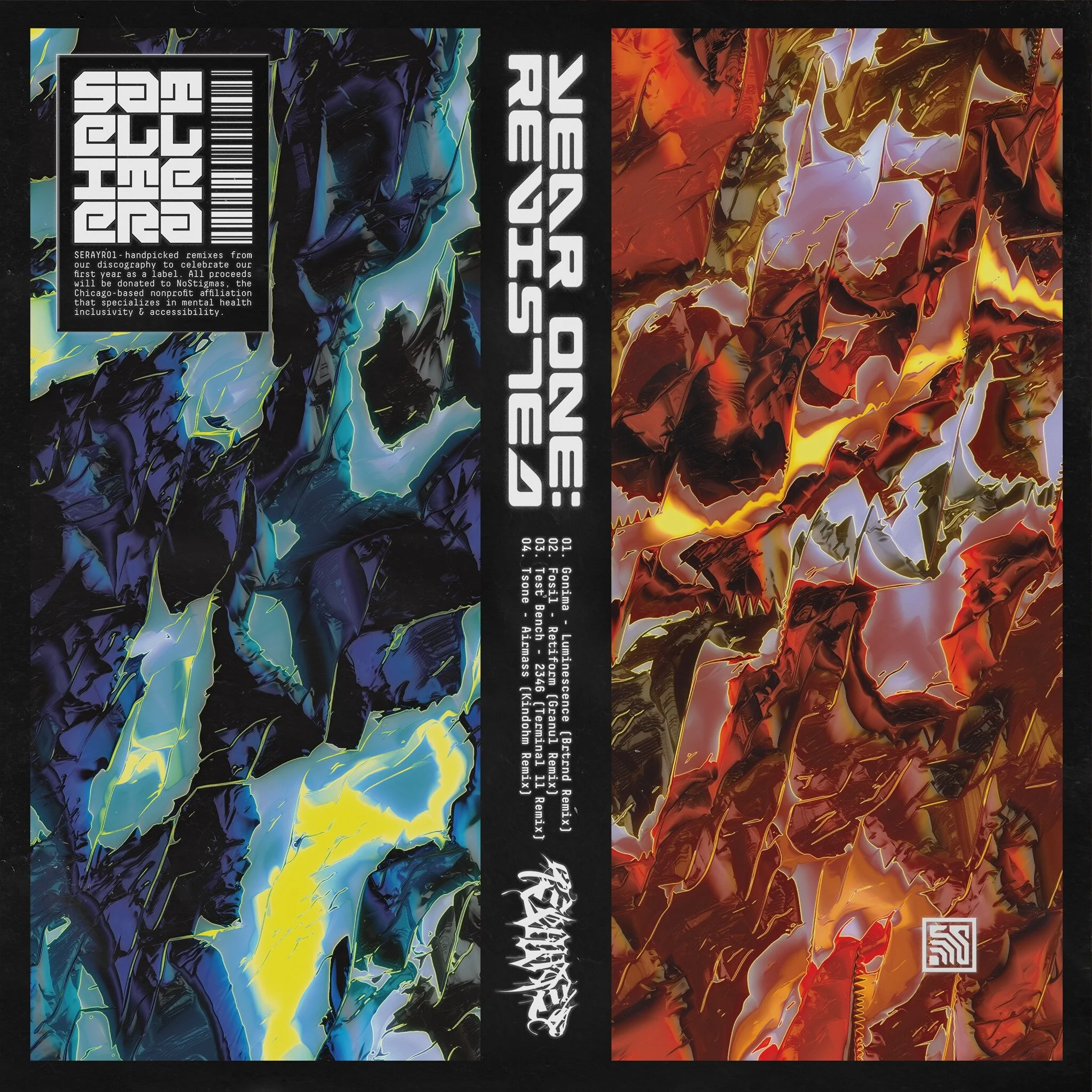
Satellite Era Takes Stock After Year 1 with Remix Compilation
Earlier this year their co-founder Amir Mashayekhi gave us the opportunity to chat about their goals, media, and pursuits of mind bending art. Fast forward to their subsequent release, One Year Revisited, and it’s clear that Satellite Era’s vision involves an extraordinary degree of musical latitude.
One year ago, we all found ourselves trapped inside listening to the news tell us for the first time about masks, washing our hands, and social distancing. Some took this time to learn a new hobby, pick up a few new books, or attempt to decipher the duplicitous world of cryptocurrencies. The Chicago-based media outlet Satellite Era used their time to coalesce their manpower and resources into a niche-filling operation, providing otherworldly A/V mixes and storied collections of their favorite artists from around the globe. Earlier this year their co-founder Amir Mashayekhi gave us the opportunity to chat about their goals, media, and pursuits of mind bending art. Fast forward to their subsequent compilation, One Year Revisited, and it’s clear to see Satellite Era’s vision involves an extraordinary degree of musical latitude.
Firing up the album with melodious, Montreal-based producers Gonima and Brtrnd offer up dusty, glitched-out melodies and uplifting harmonics through their rendition of “Luminescence”. Originally released for Distant Arrays Vol 3, the song is a lush and savory mixture that was inspired by the washed-out soundscapes of early electronica. With fresh production and added flair, “Luminescence” shines with the high degree modern polish that begets the Satellite Era style and output. In March of 2021, Fosil released his signature track “Retiform'' on Satellite Era’s Distant Arrays Vol 2, marking the Turkish icon’s move to more progressive breakbeats and experimental dance-floor flourishes. The Granul remix of “Retiform” expands on the texture dialogue in the original track, channeling the distinct feeling of a slapstick conversation between each burst of synthesis and percussion.
The UK-based producer Test Bench released “2346” in 2020 through his Welcome to a new World EP. His minimalist take on the terrain between trance and techno create a world of fine tuned four-by-four beats and swelling note relationships. The remix is completed by a 20 year vet of the U.S. breakcore movement, the Phoenix-based producer Terminal 11. This remix comes square off the heels of his hard hitting and improv based mix release and debut with Satellite Era just last year, with his production chops amping up the track’s already novel composition. To finish off the album with a crash and a bang, Kindohm’s remix of Tsone’s “Airmass” is dark, heavy, and matted with experimental rips and tares over a pulsing environment of melodious sound design. Kindohm's take on the original track turns into a commanding, explosive, and avant-garde experience befitting the compilation’s sonic profile.
Satellite Era’s goal is salient and direct: Revolutionize the quality and coverage being offered by “bass music” media. One year after their launch, they have successfully exceeded their goals and set their sights at the top of their slice of our musical hemisphere. To honor their success, and in tandem with Mental Health Awareness Month, every penny generated by this release will be given to NoStigmas, a Chicago-based nonprofit focused on inclusivity and accessibility. It’s the full-service package that Satellite Era is gradually becoming known for; reinvesting in their surrounding communities, one release at a time.
FOLLOW Satellite Era: Soundcloud / Bandcamp / Webpage / Facebook

Unraveling The History Behind Intersect
The Canadian producer-duo Intersect has spent the last 15 years separately and combined developing a wide-reaching reputation as curators of pure groove. In order to flesh out a larger understanding of the Intersect project, The Rust took advantage of a rare opportunity to speak with one half of the operation, Rahj Levinson, and explore the meaning of the dancefloor, Intersect’s time at the world renowned Shambhala festival, and growing up submerged in musical counterculture.
“Good” music, though subjective, often involves the same set of innate responses; One can identify the subtle vibrations, the artful displacement of atmosphere, and free flowing decoration of time that good music is designed to take advantage of. The Canadian producer-duo Intersect has been putting in the consistent and sometimes arduous labor to create their sonic hallmark through music that adheres first and foremost to the groove of it’s audience.
Prior to 2014, Rahj Levinson and Scott Milne had been playing together in various groups for over 15 years, but formed Intersect when they began to focus on the middle ground between dance-fusion music and contemporary bass music. Beginning with their infamous group Wassabi Collective, their combined expertise spans decades of musical and technological development. Using a host of blends that include system music, future bass, trip-hop stylings, and psybient textures, Intersect is more than a musical group; they are a vital piece of the Canadian musical anthology.
In order to flesh out a larger understanding of the Intersect project, The Rust took advantage of a rare opportunity to speak with Rahj Levinson, and explore the meaning of music, Intersect’s time at the world renowned Shambhala festival, and their experience with across their own musical lives.
Alyssa Barnhill: Where are you both from?
Rahj Levinson: [I’m from] Nelson, BC. Scott is from Ontario. The little city of Hamilton, I believe.
Barnhill: Where\How did you two meet?
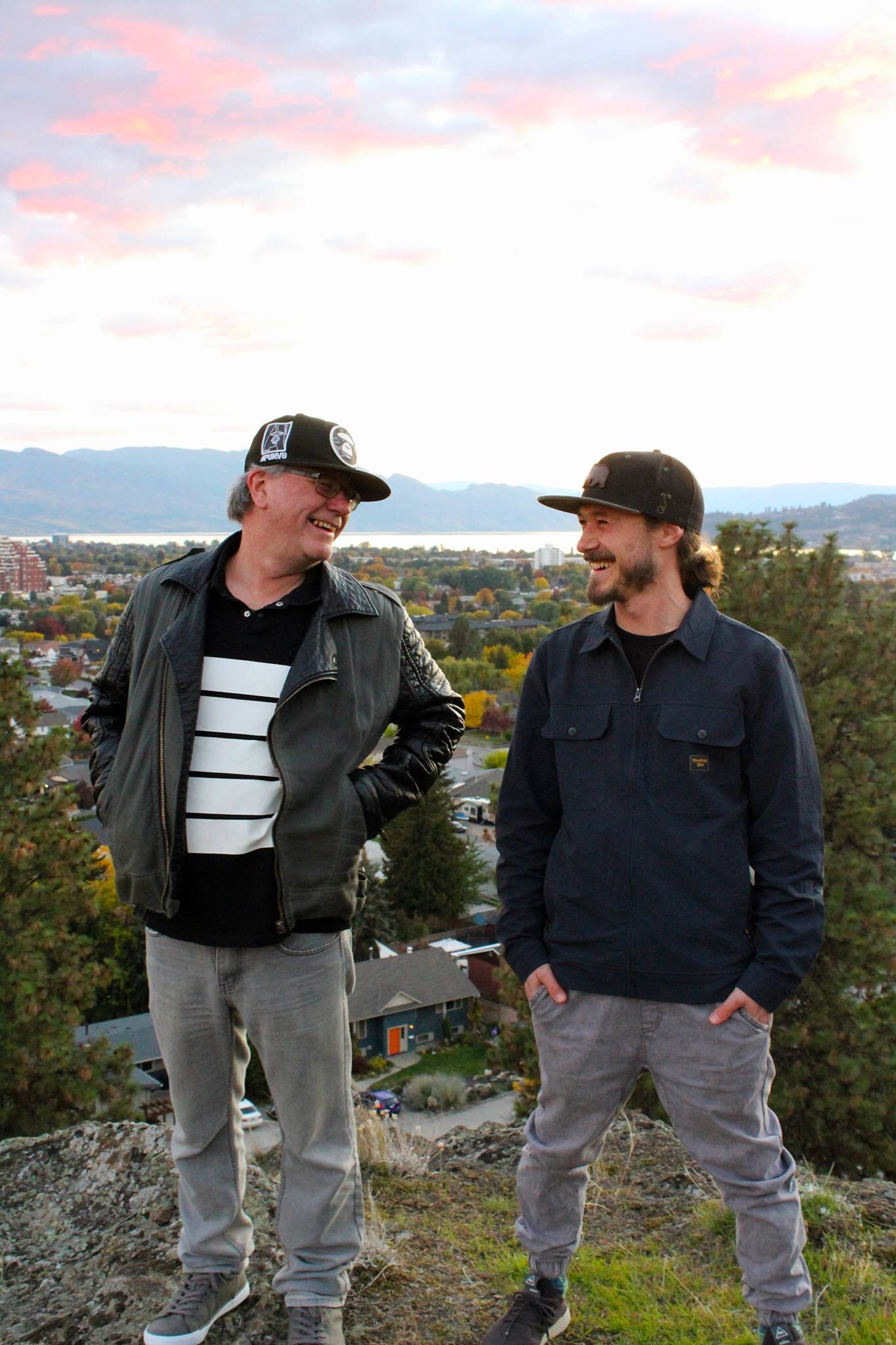
Levinson: Well, Scott was one of the founding members of the Wassabi Collective. They were in town for a show and I attended. We met in the band hotel room upstairs during a setbreak, I believe. I later went on to join them.
Barnhill: When did you start playing together? When did you start as Intersect?
Levinson: In 2000 we met, then I joined his band in 2005. We have been playing together as Intersect since 2012.
Barnhill: Where does the name Intersect come from?
Levinson: The name just kind of happened. The main idea behind the name was the intersection between playing live music and electronic music. The intersection of those styles of music and performing is what inspired the whole thing.
Barnhill: Where do you live now?
Levinson: We both live in Nelson, BC, just a few blocks away from each other.”
Barnhill: Does living so close help with inspiration?
Levinson: Living close to each other definitely helps with music and inspiration! Being able to meet up at the studio on a whim and just always hanging out talking about music has made it easy to keep inspired and always creating.
Barnhill: Did growing up there effect\change\inspire your music style?
Levinson: I think so, especially around Nelson, it has a very laid back kind of vibe. Genres like pop are not very popular here, it has always been a bit more underground. Alternatively minded hippie mountain town. For the area, Nelson has a very vibrant arts and music scene which is very special and supportive. Also, the outdoor culture here is a big part of our inspiration and goes hand in hand with outdoor festivals like Shambala and dancing.
Barnhill: Do either of you have a technical music background?
Levinson: I was actually homeschooled. My parents were hippies. So I started on guitar and moved to keys because there were always too many guitar players. I started playing guitar when I was very young, I think like 7. I picked up Piano around 2004 and then about five years later I started delving into music production. Started DJing on turntables with vinyl.
Barnhill: Were you classically trained? Is that why you make the music that you do?
Levinson: I started playing in bands first. Classical background I’d say. We like playing soulful, playful, and melodic music. Maybe jam out something in the moment but we have to create music around the dance floor.
Barnhill: What brought you both towards electronic music?
Levinson: To be honest, going to raves back in the day. That feeling of the vibrations dancing to a DJ is universal. I wanted to provide that same energy. That type of atmosphere just isn’t the same as with a live band. We like to focus more on the dance floor, create music for the dancers. Sometimes using an improvised perspective rather than technical. Whatever feels good.
Barnhill: You’re known to have a strong relationship on-stage during your performances; would you care to speak on that?
Levinson: We have been musical partners for so long, there is simply no filter. It's like a family in that way. We just kinda make music together; you could say that it’s our calling.
Barnhill: Where is your favorite place to play?
Levinson: Hands down, Shambala. It's just 45 min from Nelson.
If you’ve been living under a rock for the past 20 years, you may not have heard of the now infamous Canadian grassroots festival. Those that have made the journey describe it as a Mecca of eclectic electronic music; a festival for those seeking refuge from mainstream moments in concert and event production. Intersect’s members not only grew up right down the road from the shades of The Grove; Rahj and Scott have been flourishing there for the past decade. Sharing the limelight with names like The Librarian, Eprom, and Diamond Saints, Intersect has played an integral role in the yearly captivation of a global audience.
Barnhill: Tell me about Shambhala; what began your journey there?
Levinson: I first went to Shambhala in 1999. A lot of my friends were going to this party in the middle of the woods. It was a bush party back then but it has evolved from that into something so beautiful. I have gone religiously since and I have known some of the DJs for like 20-30 years now. It's kind of an extension of parties they used to have before it became a festival.”
Barnhill: What aspect of it do you enjoy most?
Levinson: Recreating that exact experience. Selfishly, I like sharing my music. Playing for them and seeing people happy and dancing is what it is all about for me.
Barnhill: Your latest release features three tracks with different guest artists: “All Ganja” with Mat the Alien, “Melo-sect” with Melo-nade, and the “dub n tripp” remix by L-nix. How did all of that happen during the pandemic?
Levinson: The collab kind of just fell into place. They are all friends of ours, coming to hang out at the studio. It just kinda grew into All Ganja. We were like, “We should do this”, then it all fell into place.
Barnhill: Everyone hates this next question: What genre do you consider your music?
Levinson: Genre is a hard one. Bass oriented music? I think most people try not to pigeon hole themselves with genres but I don't really think about it in that way. Left field bass, maybe?
Barnhill: What genres\music\musicians do you find inspiration from
Levinson: Early on, I would say…. The Dead and Phish were my inspiration to start doing music in the first place. Then I found myself going to raves and festivals and found a lot of inspiration there. People like Bonobo, Amon Tobin, some early dubstep producers, Vibe Squad, Sizzla, and a bunch of reggae and dancehall sound system stuff.
Barnhill: Are there other shows and festivals that stand out to you?
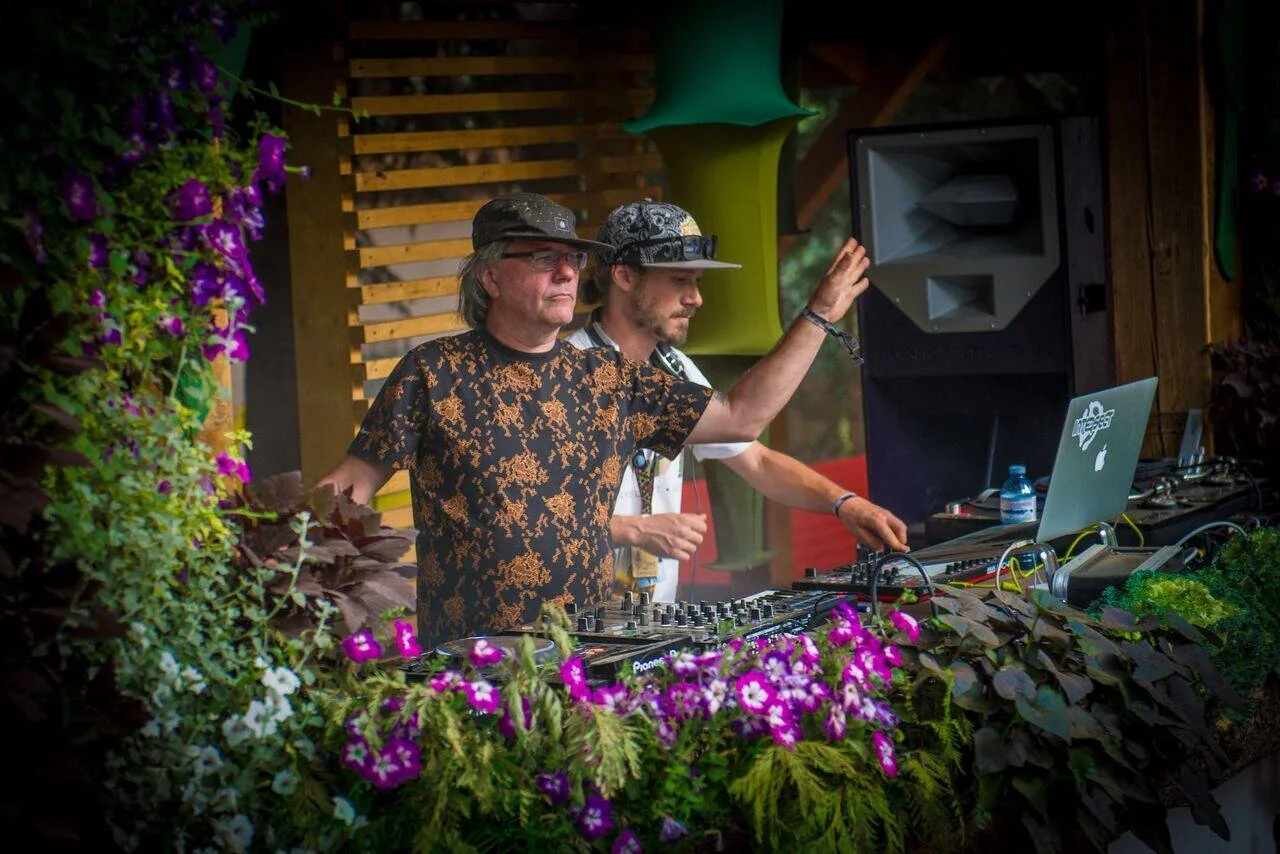
Levinson: Shambhala [is the] top of my list. It has such a vibrant music scene. But normally there are more fests than you can even play. The summer here revolves around Shambs. Depends on the dates but we try for as many as we can. Club Bloom, Shambhala’s dedicated nightclub, is our home turf too.
Barnhill: What influences the design of your sets? Is there a motif you're trying to achieve during your performances?
Levinson: Yeah, I think so. We always try and craft our sets to take people on a journey and tell a sort of musical story. It's all about the flow. We are definitely drawn towards psychedelic elements in our sets and music.
Barnhill: What are your goals and aspirations for the future of the Intersect project?
Levinson: Right now, we are working on fishing up the newest EP, as well as looking forward to going and playing shows again.
From their first EP, Push If You Like in 2014, to the throwback stylings of Vibe Setter in 2018, this dynamic duo is infinitely impassioned with clarity and musical consciousness. Years of sonic service to their homegrown communities has left with the indelible ability to weave a crowd through a powerful auditory experience. With the release of the All Ganja, and subsequently Better Days EP’s, the yIntersect catalog is stronger than ever, and their influence has officially moved beyond the 49th parallel.
FOLLOW Intersect: Soundcloud / Bandcamp / Spotify / Facebook
Iszlai: Interview + Featherbed A/V Re-Stream
The eclectic producer and multi-instrumentalist Iszlai has been carving out a space for himself amongst the nebulous field of sample-collage music. In tandem with today’s re-screening of Iszlai’s Featherbed Sessions performance for the Rusted Rhythms A/V series, we took the time to peel back some of the opaque layers to his profile, and got into some of the details surrounding his craftsmanship.
The Hungarian-based producer and multi-instrumentalist Iszlai has been carving out a space for himself amongst the nebulous field of sample-collage music. His unassailable grasp for arrangement and musical narratives is what tethers his music to sound of pure intrigue, and each iteration of his work has a tendency to overflow with a bounty of note relationships and variable rhythms. It’s a deadly combination, and one that consistently delivers in it’s unique, stutter-stepped fashion.
While geography separates Iszlai from the U.S. circuit by a little over 5000 miles, the advent of 2020’s performance streaming frenzy brought about the perfect opportunity to connect with fans new and old beyond just his studio releases. The Rust’s Featherbed Vol. XIII stream featured a full-spectrum Iszlai performance paired with Euphoric Aspects manning the visual production. It’s one thing to listen to Islzai’s catalog on record, exploring each track with as much or as little attention as one sees fit; it is another thing entirely to submerse the senses in a meticulously crafted Iszlai mix, bringing his discography to life through novel blends and precision cuts. It transforms the amalgam of songs into something far more cinematic, echoing the atmosphere of the psychedelic scores from generations past. This performance is being included in today’s edition of the Rusted Rhythms A/V Series at 8pm EDT, and will be cataloged in posterity alongside the rest of the Rusted Rhythms mixes.
In tandem with today’s re-screening of Iszlai’s Featherbed performance, we took the time to peel back some of the opaque layers to his profile, and got into some of the details surrounding his craftsmanship.
The Rust: Your music is definitely on the complex end of the spectrum; how did you come into the craft of production?
Iszlai: I used to do quite a lot of audio editing for short films back in college, and I played guitar in some bands around that time. I hated electronic music back then, but somehow I got intrigued by records having unconventional, weird guitar sounds. So I tried to record myself playing through all these crazy effect chains. It was a fun hobby, I started adding drums and other instruments, I edited my takes, then I just slid down a rabbithole and never turned back.
The Rust: Do you have a history of music education? How did you find yourself drawn to sound in the first place?
Iszlai: During my teenage years I was fascinated by playing live music. I went home and studied by myself, learned from others, it was an organic process. Everyone seemed to be better than me, that kind of pushed me to learn more, even though I was interested in applying to film school. Fortunately I could work with sound there, this opened up a whole new world for me, which eventually led me back to music.
The Rust: Given your novelty, what were some of the influences that molded your sound? Has collage-style arrangement always been a staple for you?
Iszlai: I think older, non-electronic pieces influenced me more, like Miles Davis. Miles Davis taught me to listen. That being said, the first time I heard and actually listened to electronic collage-like pieces of music, I was blown away. It fascinated me, I realized that there was this amazing ambiguity about it: being intentionally wrong and making perfect sense in a way. Rough editing messes up our perception of continuity, it challenges the “reliability” of the music itself. It is a very intriguing concept to me even today, I see it as a method for alienating the listener.

The Rust: Given the organic texture palette that you focus on, where do you perceive yourself to fit in the wider spectrum of music? Do you even bother to label it?
Iszlai: Wow, I can’t really tell, but I used to think about this. Eventually I just gave up and whatever people call my music, I’m perfectly fine with it. It is difficult for me to label it, because of my versatility. I do electronic music, but my “day job” sometimes requires the exact opposite of that aesthetic. I did small classical pieces, drove myself nuts practicing for opera, I did fully acoustic soundtracks, theatre, noise music, all those influences trickle down into my albums once I get off work.
The Rust: Your Featherbed set was really striking, and you pulled off some serious blends within your catalog. How did you go about putting that together?
Iszlai: Thank you, much appreciated! I used to play these semi-live sets arranged in Ableton, like when you just pull loops from stems, assign them to clips, start messing around. That was basically it. I only thought about how it should begin and which new tracks to include, then I just let go. I practiced a bit and came up with the idea to use that “wake up, work, sleep” interlude, went back and recorded the whole thing.
The Rust: What's the songwriting process like for you? Is there a methodology?
Iszlai: I deliberately try and change my approach, that is always very refreshing to me. I have a natural process of tapping into what I find exciting in that present moment. This can be a piece of hardware, chords, a snare drum, basically anything. I just get into it and zone out. The harder part of the process starts when I get closer to finishing the music.
The Rust: We're a year and some change into the Covid-19 pandemic; would you care to talk about what this experience has been like for you?
Iszlai: I was afraid for a while, there were definitely some rough patches. This eerie silence seeping into our daily lives, life slowly waning away... Staying busy helped, but I started noticing sleep disorder and this tranquil quality of the uneasiness I was experiencing. I remember leaving my apartment, walking down an empty street, feeling very isolated, listening to New Hymn to Freedom by Szun Waves. It was like a slow fever creeping up on me.
The Rust: What are your current plans for the Iszlai project? What are you shooting for across the horizon?
Iszlai: No plans yet, I’m currently working on scores and doing sound design for various projects. This is an exciting time for me as I learn a lot about myself while collaborating with other artists.
Be sure to take a healthy dive through Iszlai’s available catalog to get a full perspective on his cutting edge style of sample-collage production. For those who are interested in checking out further Rust-curated mixes, take a gander at our Rusted Rhythms page for a direct line on hours of aural goodies.
FOLLOW Islzai: Soundcloud / Bandcamp / Spotify / Facebook
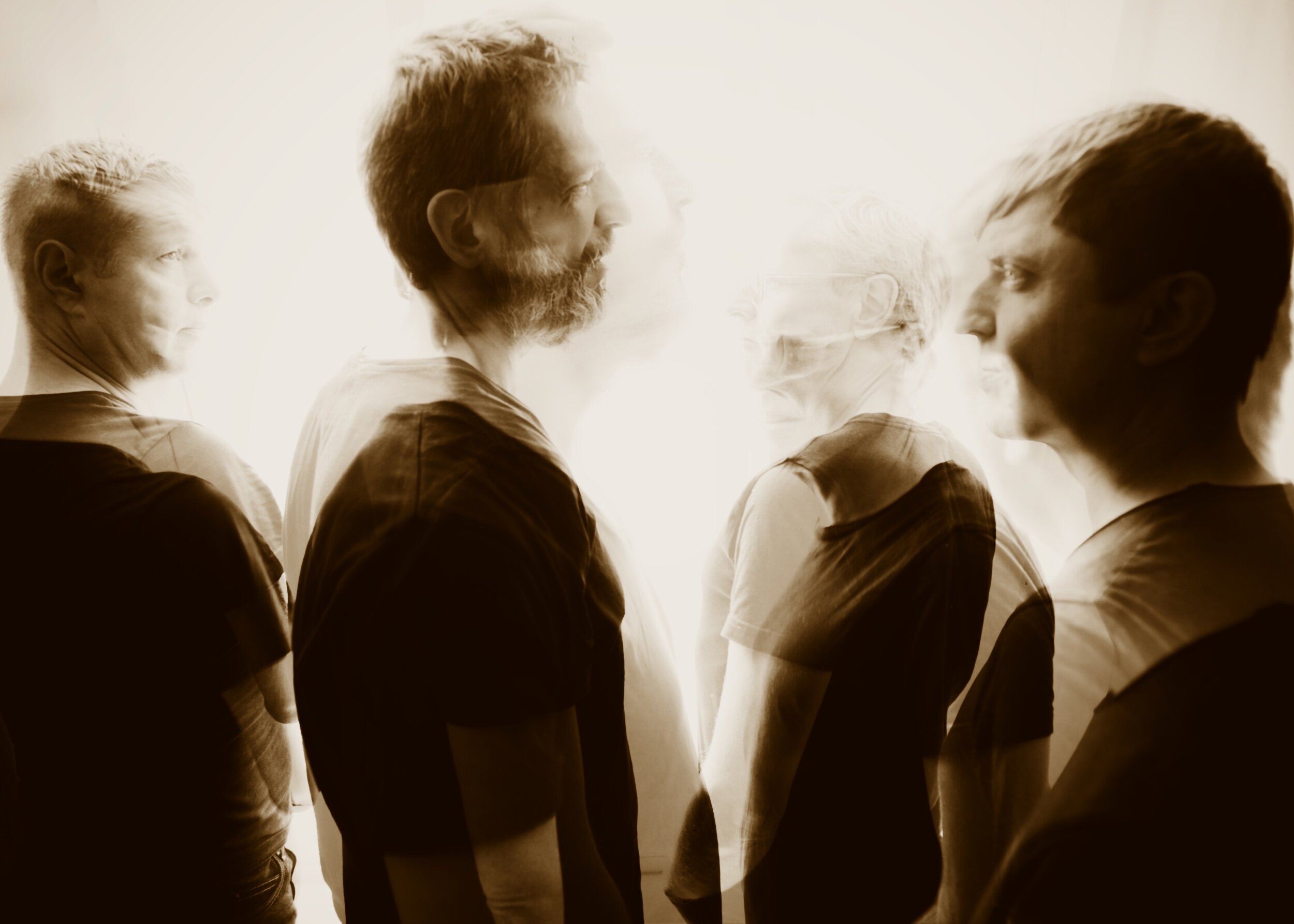
Kalaha: Interview + “Laga Luga” Video Premiere
We're incredibly excited to host the US premiere of Kalaha's “Laga Luga” music video, and in tandem with this debut, we took the opportunity to pick apart some of the production choices and guest appearances that tied together their Mystafa LP, as well as discuss Kalaha's broader experience as a group.
It's no secret that Denmark’s Kahala is at the forefront of production-centric bands and an avant-garde twist on Jazz, blues, and pan-African contemporary music, having earned their stripes through both the lucrative individual careers of it's core members, and through their expansive, world-fusion discography. Fronted by guitarist Niclas Knudson, drummer/percussionist Emil de Waal, and the venerable producers Spejderrobot and Rumpistol, Kalaha's reach is as global as their influences, making them a contemporary psychedelic mainstay on and off the stage.
Their most senior release, the Mystafa LP, combines psybient palettes, organic timbres, and an array of guest instrumentalists and vocalists into a scintillating, culturally effusive album. It showcases the height of their respective skill sets as a band, and concurrently channels a seriously hypnotic array of rhythms and grooves that are nearly impossible to ignore. In celebration of Mystafa's release, Kalaha subsequently commissioned a music video production of the track “Laga Luga”, featuring a dance-centric edit courtesy of Bos Laflar.
In tandem with the U.S. debut of the music video, the Rust took the opportunity to pick apart some of the production choices and guest appearances that tied together the Mystafa LP, as well as discuss Kalaha's broader experience as a group.
The Rust: The Kalaha style has a distinct global feel; how did the band come into that motif? Was it a natural pull, or a flashbulb moment?
Emil: The global feel of Kalaha was definitely a natural pull coming easily to the band as a result of the influences of the very different musical backgrounds of the four founding members. Finding inspiration in West Africa, India, Turkey, New Orleans, indie rock, pop, electronica, jazz, techno, funk, blues, 80´s new wave, [and] house, the four musicians fluently and respectfully move between each other´s musical inspirations. It seems that the creative inspiration keeps coming, and who knows what will be next?!
The Rust: Can you dive into the beginning of Kalaha? What drew you together in the first place?
Emil: Niclas Knudsen went to school together and have played together on and off since 1990 in different jazz and pop music projects. Spejderrobot and I have worked as an experimental drums/electronica duo since 2008 and released four albums together. Still, it was actually Copenhagen electronic music festival “Strøm” and the Danish jazz federation “Jazzdanmark” that brought us four together for the first time in 2013 for a week of teaching workshops and playing an improvised concert on Strøm Festival. The concert was recorded in a basic stereo recording that was actually released as our first album Hahaha.
The Rust: Does the approach to writing and producing Kalaha music differ significantly from your individual projects? Is there a cross-over of ideas, or is it a unique entity entirely?
Niclas: Kalaha consists of 4 very different artists and because of that, the music is a very strong and unique mix of personalities and differs from all of our individual projects.
The Rust: Mystafa spans a wide range of tempos, modes, and ideas; did you have a specific vision in mind when the album's production began?
Niclas: The productions are always very open at start, then we follow up on all ideas and then slowly the vision starts to appear. This release shows what a big artistic range the band has.
The Rust: What can you tell us about some of the album's collaborators?
Jens (Rumpistol): There are 20 musicians and vocalists on this album, so this is going to be a long answer!
First and foremost there is Hilal Kaya, who has been our "fifth member" for a couple of years now. Hilal has a Turkish background but lives in Denmark which makes it pretty easy to meet. Saz-player and songwriter Orhan Özgur Turan first told me about Hilal when Orhan and I were writing "Çok Küstüm" together. Soon after I did a recording session with her and she turned out to be a great singer and easy to work with, so it was only natural to continue that collaboration. For the new album we've done 4 tracks with her ("Özgürüm Ben", "Vivo", "Lagaluga" and "Eymen"), two of which she wrote the lyrics for, and we've also had her perform live with us a dozen of times. We were supposed to perform live with her at Boom Festival 2020 which sadly got cancelled due to COVID.

There's also a track on the album with Moussa Diallo called "Jigi Fa". Moussa is originally from Mali, but has lived in Denmark for more than 40 years now. In Denmark he's considered a bass legend and has played as a session musician on more than 100 titles as well as recording albums of his own. He has a sweet voice too so when we were looking for a vocalist for the desert blues track "Jigi Fa" he felt like an obvious choice. The last two vocalists are both "native Danish"; Uffe Lorenzen who sings on "Dans Det Op" is considered the Gandalf of Danish psychedelic rock and has released music for 35 years with projects like On Trial, Dragontears, Spids Nøgenhat, Baby Woodrose and more. Hjalte Ross is a gifted young singer/songwriter from the town of Aalborg who has often been compared to Nick Drake. Last year, Hjalte released his fantastic album "Waves of Haste" (feat. Nick Drakes old engineer John Wood!) and he's featured on "Hurt You Once Again" with the lovely Maria Køhnke on backing vocals.
Worth mentioning is also the kora player Dawda Jobarteh and the oud player Bilal Irshed who both plays on "Jigi Fa". And duduk player Serkan Yildirim who created the epic intro and outro sounds on "Özgürüm Ben". Last but not least my old high school buddy and now award winning animation director Peter Lopes is singing on "Vivo" and my daughter and one of her friends are singing back-up on "Vivo" & "Truffle Soil". This is also the first album where everyone in the band is actually singing on the album!
The Rust: Can you tell us about some of the instruments and production processes that went into the album's creation?
Jens: The press release states that it "is an album that seeks to bring people together across cultures, genres and nationalities." I'd like to add “COVID-19 restrictions” to that sentence because it was created at a time where it wasn't even possible for us to be present in the studio at the same time. So files where send back and forth between the four of us and the collaborators. The mixes also changed hands several times between me and Mikael (Spejderrobot). It was a pretty strange experience but actually also quite fun to try. As Emil once said: "In a way, we've taken all the journeys we should have taken on our canceled tours through the music instead." It turned out to be some really cheap trips to Brazil, Mali, Turkey, Aalborg and outer space!
Production-wise, we were really keen on including more live percussion so apart from playing the drums Emil had to get busy with his shakers, agogo bells, darbukas, etc. Our guitarist Niclas played a lot of bass guitar on the album, which really makes sense when you're messing around with genres like funk and psych rock. Apart from the before mentioned non-western instruments like oud, kora, duduk and saz/baglama, there's also a fair bit of synth work on the album: Mikael has been getting heavily into modular synths the last couple of years so there's a fair amount of that on the album, and I'm also using my modular on the album (the outro of "Mystafa") as well as my trusted old Wurlitzer and my old analogues: Juno-60, CS-10, AcidLab's Bassline (303 clone) plus a bunch of soft synths (mainly from the Arturia bundle). We mixed everything in the box but did use some outboard effects like the good ol' Space Echo. The hardest thing was to make all the different pieces fit together because it's bound to get messy at some point when you're trying to blend so many genres and musicians on one album. However, I must admit I really love the bands eclectic approach because it keeps the creative process open instead of ending in a situation where everyone's shooting down each other's ideas because they don't fit into a certain [framework].
The Rust: Can you talk a bit about your live setup? How do you achieve the ideal Kalaha performance in concert?
Mikael: Overall I would say that preparation is key: being on top of the material and having the mental capacity to perform while being relaxed and confident. Secondly there needs to be some kind of fire or restless energy, since we depend on improvisation and going unexpected places as we perform. On the technical side, we are pretty dependent on everything being in sync with the computer on stage. A lot of Jens’ gear syncs to the computer, also Emil receives a click track in order to lock in.
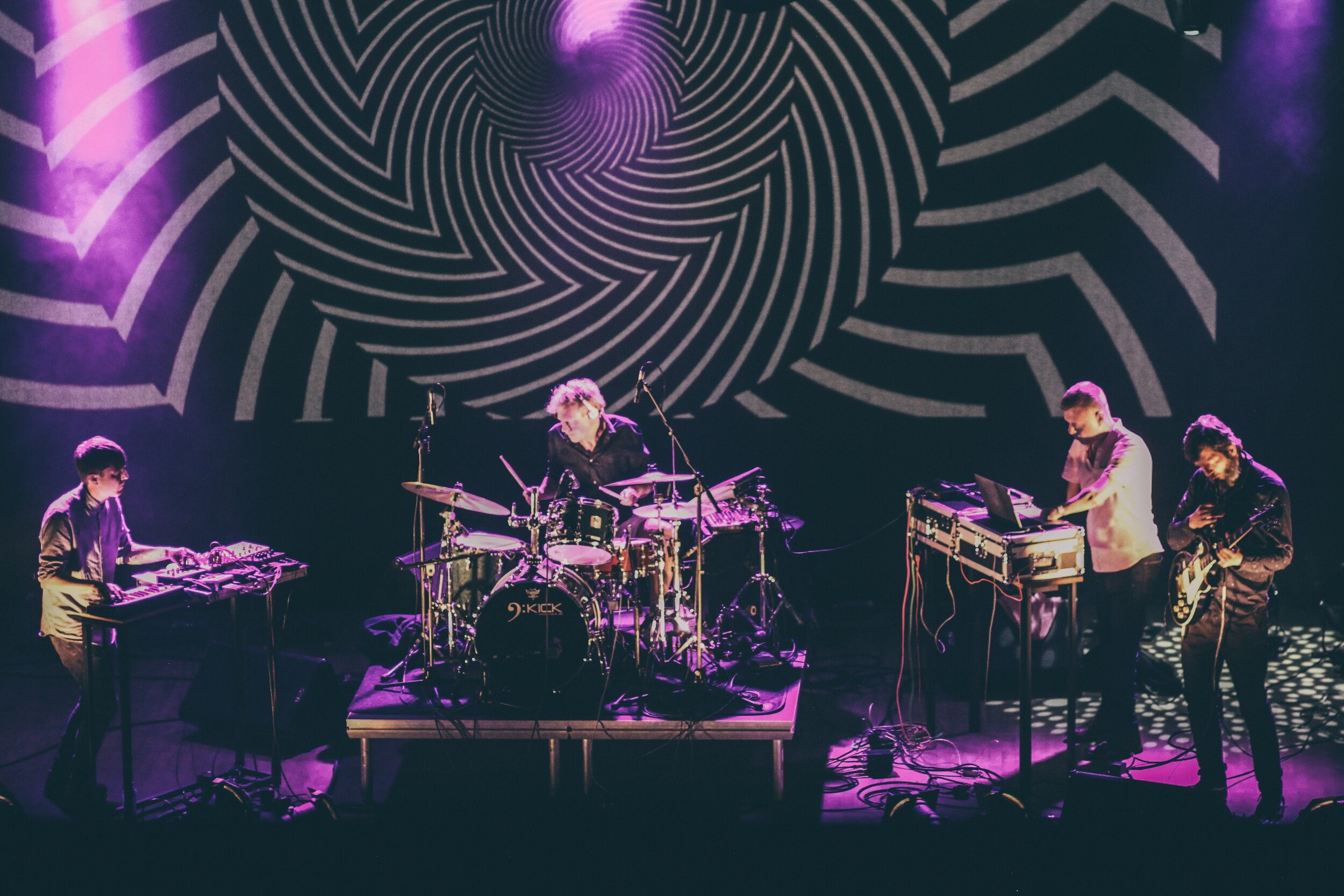
The Rust: With nearly a year having come and gone since the beginning of the COVID-19 pandemic, what has your experience been at home? What has your experience been as a band?
Mikael: Obviously the pandemic has been a mixed bag for most of us. On an individual and practical basis we have all tried to make ends meet. Homeschooling, isolation mixed with concerns for the future and the wellbeing of our close ones on one hand – on the other: a lot of quality time with our children and closest family, having the time to take a walk in the nature and a sense of time being slowed down. As a band we decided to take a look on the material we already had – and we soon realized that maybe this was the time for us to make a bunch of new songs (and that we would actually have a pretty decent album if we just wrote a few more songs). Not playing concerts suddenly gave us the opportunity to focus on creating new material for the band.
The Rust: When we first interviewed Jens three years ago, we learned a bit about the typical experience of musicians in Denmark. What has been the collective experience of Danish musicians throughout the last year?
Mikael: I think many musicians have had the feeling that culture and cultural content in general has been of great importance during the lockdowns. As a collective we have been watching series, listening to albums, reading books in order to stay sane. Hopefully this is something that we will collectively remember and appreciate once we have put the pandemic behind us.
The Rust: Have you begun to plan for an eventual return to stages and conventional concerts? What's your view of that horizon like at this point in
Mikael: We have already had a lot of shows either cancelled or moved to a later point in time. Our release concert in Danish National Radio’s concert house, was originally scheduled for the beginning of February, but has been rescheduled to May the 2nd. This could very well turn out to be too soon. We will see. Otherwise we have a bunch of concerts during the summer that we still hope to be able to play.
With vaccine rollouts and mixed-success lockdown campaigns making their impact across much of the world, there's strong signs that the return of live music is underway across North America and much of the European Union. Naturally, this will translate in the eventual return of Kalaha to stages across the European circuit, reinvigorating this Danish supergroup of stalwart musicians and producers. Until that day comes, there's still quite a mountain to climb to reach the veritable end of the Covid-19 pandemic, and that means plenty of time to stay cozied up with some choice studio music. If “Laga Luga” and the diverse stylings of Mystafa set your vibe accordingly, make sure to take the time to explore the entirety of Kalaha's variable catalog of world-class fusion music.
FOLLOW Kalaha: SoundCloud / Bandcamp / Spotify / Facebook
![Devin Kroes - Bloom (ft. ST4RFOX) [EXCLUSIVE PREMIERE]](https://images.squarespace-cdn.com/content/v1/59530136f5e2319eabb7d87f/1619026372286-GWMAEOPI6AJ9YFQGJQTE/processed_Devin+Kroes+_+Breathe+HIRES.png)
Devin Kroes - Bloom (ft. ST4RFOX) [EXCLUSIVE PREMIERE]
Based out of Portland, Oregan, the producer and multi-instrumentalist Devin Kroes has spent the last six years and counting tapping into a variety of psybient styles across a choice collection of tracks. Ahead of his Breathe EP release through the Danktronics platform, the Rust was given the opportunity to premiere the effusive track “Bloom”, featuring the soul-drenched sax lines of ST4RFOX.
Based out of Portland, Oregan, the producer and multi-instrumentalist Devin Kroes has spent the last six years and counting tapping into a variety of psybient styles across a choice collection of tracks. Ahead of his Breathe EP release through the Danktronics platform, the Rust was given the opportunity to premiere the effusive track “Bloom”, featuring the soul-drenched sax lines of ST4RFOX.
Wielding a pristine level of clarity and tonal balance, Kroes dances between lush vocal samples and vibrant layers of synthesis. Each passing phrase paints the next hue across the landscape of the song, building on additive arrangements and fleshing out the literal breath of the track. At high point of the musical narrative, ST4RFOX breaks into a spirited saxophone run that ties off “Bloom” with a proper resolution, leaving the track to fade out between ripples of waning chords. For fans of full-spectrum sound design and organic compositions, make sure you grab the full copy of Devin Kroes' Breathe EP when it drops on April 23 on all available platforms.
FOLLOW Devin Kroes: Soundcloud / Bandcamp / Facebook