

Coalesce Invites You To "Buy the Ticket, Take the Ride"
“Buy the ticket, take the ride,” writes Cosmic Synergy, quoting the late psychedelic journeyman and journalist Hunter S. Thompson to describe their event Coalesce, taking place December 29, 30, and 31 on the San Francisco Bay. These words gesture towards a spirit of faith on which DIY shows and communities thrive.
“What are you doing for New Year’s Eve”
“Oh, going to this concert.”
“Sick, who’s playing?”
“No clue.”
Heads and ticket-holders for Coalesce with Cosmic Synergy, taking place December 29, 30, 31 at the Craneway Pavilion on the San Francisco Bay, were suspended in this state of blissful ignorance until last week when the festival’s anticipated lineup finally dropped. Coalesce covertly introduced itself to the electronic music community months ago by hand-distributing sleek and clever marketing material at opportune moments. This led to now-confirmed rumors that Tipper would be ringing in the new year on the Bay. The rest of the talent was a mystery, kept tightly under wraps. There was hardly a peep from the Coalesce camp since.

More than any big name, though, it was the big mystery that generated interest for this event. The mystery of what may be, of course, can always exceed in size and scope that reality of what is. Well, except, perhaps, in the case of Coalesce. This lineup is absolutely bonkers, and it’s fair to say it exceeded all except the most gluttonous expectations.
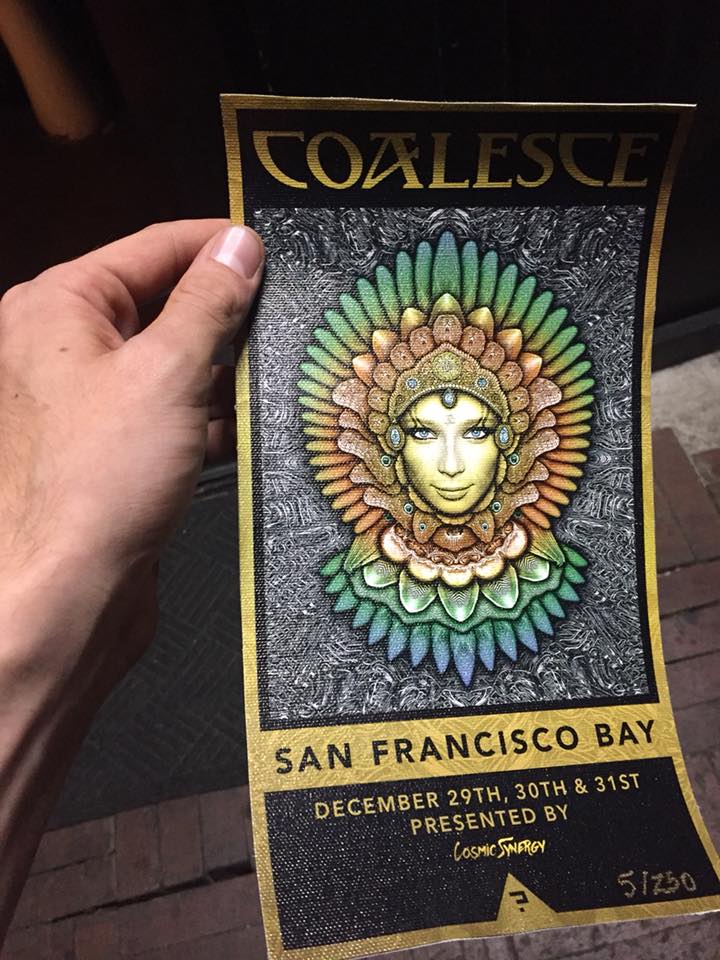
Cosmic Synergy teased the announcement of Coalesce through covert, clever marketing. These high-quality, collectible flyers were first distributed at A Benefit Show for Sibel Yalin at the Black Box in Denver in mid-September.
Those who made travel plans without the assurance of an announced lineup have been duly rewarded. That’s just the sort of audience buy-in that Cosmic Synergy has encouraged with this event. Now that the lineup is circulating throughout digital and interpersonal networks, one would be wise to secure entry while he/she/they still can. “Buy the ticket, take the ride,” Cosmic Synergy writes in the description of their event, quoting the late psychedelic journeyman and journalist Hunter S. Thompson. These words don’t (just) represent a subtle nudge towards the event’s financial solvency. They gesture towards a spirit of faith that, when combined with action, generates the energy on which DIY shows and communities thrive.
The Bay Area has always been a hotbed of rave culture, and the spirits of psychedelia and experimentation - both musical and social - have always defined the Bay’s multifaceted music scenes long before what we know as electronic music took to the airwaves. Some say the Bay really began to rave when acid house washed ashore beneath the Golden Gate Bridge in the early 1990’s. This publication’s readers are likely more familiar with the broken beat electronic music that circulated in the early ‘00s from DJ/Producers like Bassnectar, Mimosa, or Rodman “Lux” Williams,
Today, pillar organizations within psychedelic bass music like Street Ritual and Wormhole Music Group have made the Bay Area their home (both are helping to produce Coalesce). Combined with its rich history, this has cast the region as the de-facto bass music capital in the States, although Denver continues to edge for that pole position. Regardless, on the last three days of 2018, the Bay Area will be ground zero next level broken beat electronica. Indeed, Coalesce has the potential to rank with any historic Bay Area rave and become a seminal moment of sorts for a new generation of electronic fans and musicians.
The event will feature a single stage, helping attendees and artists channel all their energies into one musical vibe. The volume and caliber of rare and special sets on this lineup is unmatched. Two Fingers, a side project of Amon Tobin which offered early innovations on the grittier elements of dancehall, dubstep, and grime, will perform for the first time since 2013. Liquid Stranger will offer his only downtempo set of 2018. Fresh from the VISA office and his play at the Kings Theater in Brooklyn, Australia’s Spoonbill will deliver a West Coast play for adoring fans. There’s also a mysterious Slug Wife takeover with two of its three artists yet to be announced (Seppa?) This hardly touches the deep and intentional undercard which is stacked from top to bottom with the cream of the contemporary bass music crop from Shwex to Frequent to Sixis.
The lineup of visual artists at Coalesce may be even more impressive and rare than the grouping of musicians. Led by the first couple of visionary art, Alex & Allyson Grey, exceedingly talented collectives and individual painters will work on murals throughout the three day event, including Phaneros Art featuring the work of Jonathan Solter, sydwox and E Howard, and the Denver-based Apex Collective highlighted by the work of Stephen Kruse and Jake Amason. Michael & Violet Divine, husband and wife, will also partner on a mural, and Luke Brown aka “Spectraleyes” will also be painting a solo piece. The roster of projection artists features the usual suspects from the Tipper & Friends universe like Datagrama.TV and Fractaled Visions, as well as less familiar names like Andy Thomas, known for his “Visual Sounds of the Amazon” series. Carey Thompson, who has served as the Art Director of global dance mecca Boom Festival for nearly a decade, will be designing a world-class stage.
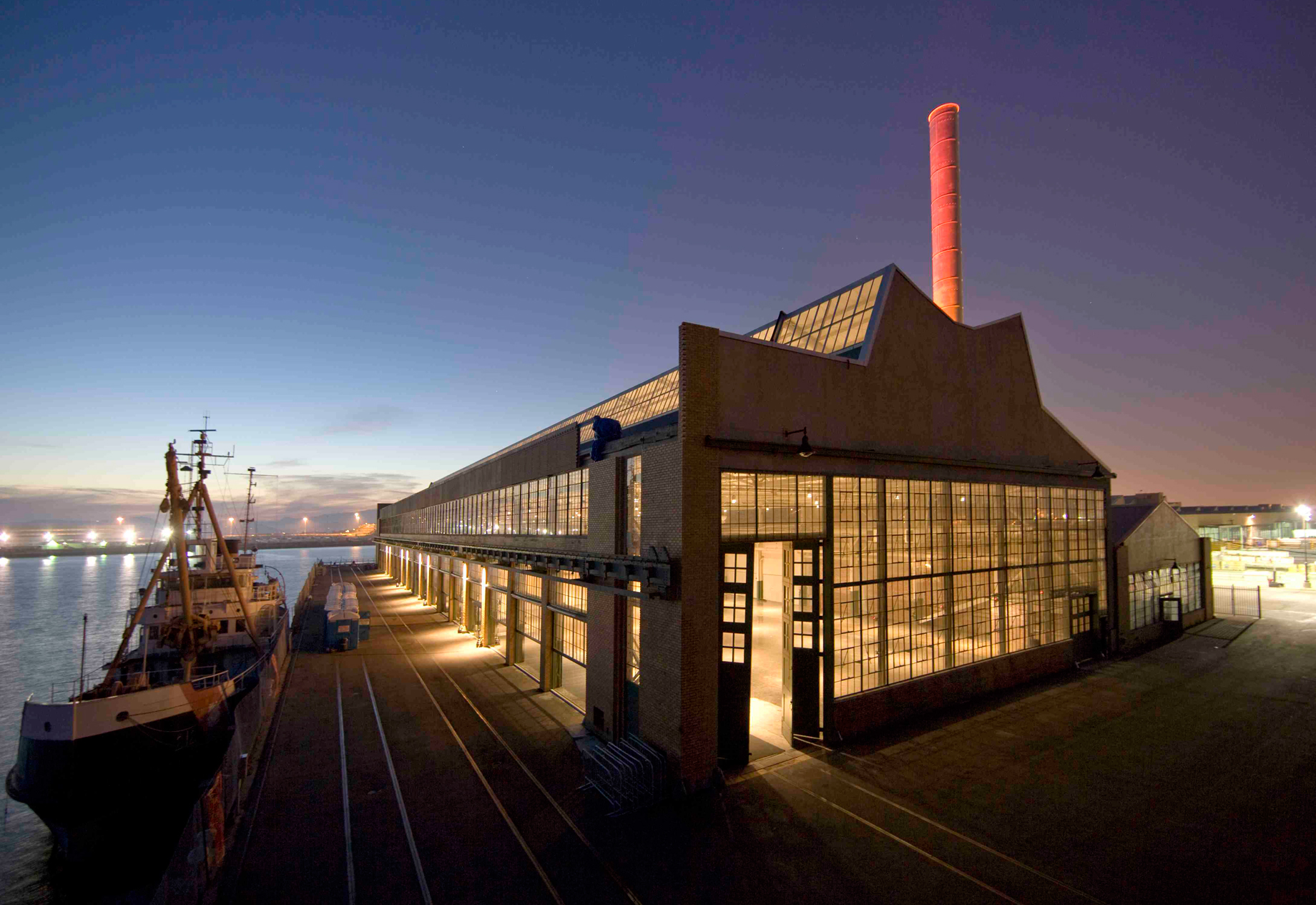
The Craneway Pavilion was awarded a National Preservation Honor Award when it was renovated in 2009, and is part of the Rosie the Riveter/WWII Home Front National Historical Park.
Cosmic Synergy spared no expense to place this all-star cast of creators in an appropriate setting. As a former Ford assembly plant that processed 60,000 tanks during World War II, the Craneway Pavilion is “as state-of-the-art as it is historic” says Venue Report. Towering floor-to-ceiling windows offer panoramic views of one of the world’s most iconic urban environs - the San Fransisco Bay stretching out towards the Oakland-San Francisco Bridge and The City itself. One can also drink in this view while ambling with their friends and non-biological family around a 20,000 square-foot open air patio in the swirling Bay mist.
Your correspondent is curious about the acoustics in the Pavilion. Bay Area hip-hop festival Feels has been hosted there, so the space is battle-tested to a degree, although that doesn’t speak to it’s capacity for presenting high-fidelity sound. Sure enough, though, Cosmic Synergy is working with world-class acousticians to dial in the Funktion One sound system and create a world-class concert experience. According to the Cosmic Synergy team, they’ve had the room and speaker array acoustically analyzed and modeled to understand the frequency response of the cavernous, glass pavilion. Based on the results, they’ve produced proprietary (read: one-of-a-kind) absorber-diffusers to control the bass and the high-end frequencies. This pre-emptive action on acoustics is usually out-of-sight but rarely out-of-mind for the discerning audiophiles who are sure to show up to Coalesce. Accordingly, Cosmic Synergy is taking the steps necessary to ensure its crowd receives the deluxe sound treatment they’ve come to expect.
Word is that throwing an independently-promoted show in the Bay Area, let alone a bonanza like this, is becoming increasingly challenging. Cosmic Synergy lucked out, then - well, luck likely had little to do with it - by snagging this venue. The real lucky ones, though, are of course the ticket-holders who will coalesce at the edge of the United States and the edge of the known sonic universe to ring in the new year.

Solasta Festival Levels Up in Second Year
The event was conceived with the intention to do something different. With just a single stage, a niche lineup full of rare international and coveted local acts, a dedicated lounge and performance theater, and a pervasive emphasis on health and self-care, Solasta didn’t stray from this conception.
When the sun rose over the lush, green fields of Spirit Crossing in Northeastern Tennessee on the first day of Solasta Festival, you couldn’t see it, shrouded as it was by Appalachian mountain mist and cool cloud cover. Volunteers and staff who worked through the night were putting finishing touches on modest infrastructures and installations in the quiet dawn. Campers who arrived the night before took prized real estate along one of the grounds’ lone tree lines, or on the bank of the Clinch River that flows lazily through the grounds. As morning turned to noon the sun began to peek on the festival. For the rest of the weekend - from logistics to music to the familial atmosphere - the presence of the sun was the only inconsistency at Solasta Festival.
Just over 1,000 people settled on the grounds that weekend. In its second year, the gathering quadrupled in size and exceeded the expectations of everyone besides perhaps its young and wily staff. The event was conceived with the intention to do something different. With just a single stage, a niche lineup full of rare international and coveted local acts, a dedicated lounge and performance theater, and a pervasive emphasis on health and self-care, Solasta didn’t stray from this conception.
Strolling and patrolling on Friday afternoon was Officer Larry of the Hancock County Sheriffs Department, the bulk of Solasta’s security force. A law enforcement presence at a music festival without the characteristic firearm or body armor was a rare sight, my colleague noted. He didn’t need that equipment with this kind of crowd, he suggested. His toothy grin stood out from his sun-weathered red skin as he asked, “how do you like Hancock County?”
“It’s different,” I responded. And indeed it was. Spirit Crossing sits on the outskirts of the county seat, Sneedville, home to approximately 1,200 people. The hills - steep, rolling, and frequent - break apart and condense cloud formations and create that unpredictable weather. Although the forecast called for constant rain, the festival saw just one brief, powerful storm and a series of scattered showers.

The GNOSTiK Lounge at Solasta Festival (Credit: Shots By Carl & GNOSTiK)
In the spirit of differentiation, Solasta partnered with GNOSTiK to establish the GNOSTiK Lounge and Performance Art Theatre at the center of the broad, flat festival grounds. This welcoming space hosted 22 performers doing about 15 acts on Friday and Saturday, from fire manipulation to less conventional fare like contemporary dance, poetry, kink, and burlesque. Our favorite act had to be Fire Circus for their combined acro yoga and fire-spinning act, “It’s a platform for performance artists to express fully realized visions in a cultivated environment,” according to GNOSTiK co-owners and co-creators Ali Khemi and Silv Era, who traveled west to Solasta from their base in Savannah, Georgia.
The Lounge captivated by creating an atmosphere apart from the rest of the festival, while simultaneously being an integral part of it. “Gnostik is not reliant on already existing spaces provided by the music culture,” Ali and Sliv explained, “but rather creates the vessel that invites performers, musicians and artists to create within the vision.” Other attractions and concerns faded fast as one became enraptured in the theatrical and sexual nightclub mystique of the Lounge. The decor was sophisticated but with a sharp edge, and heady teas and elixirs were served out of a Lounge bar.
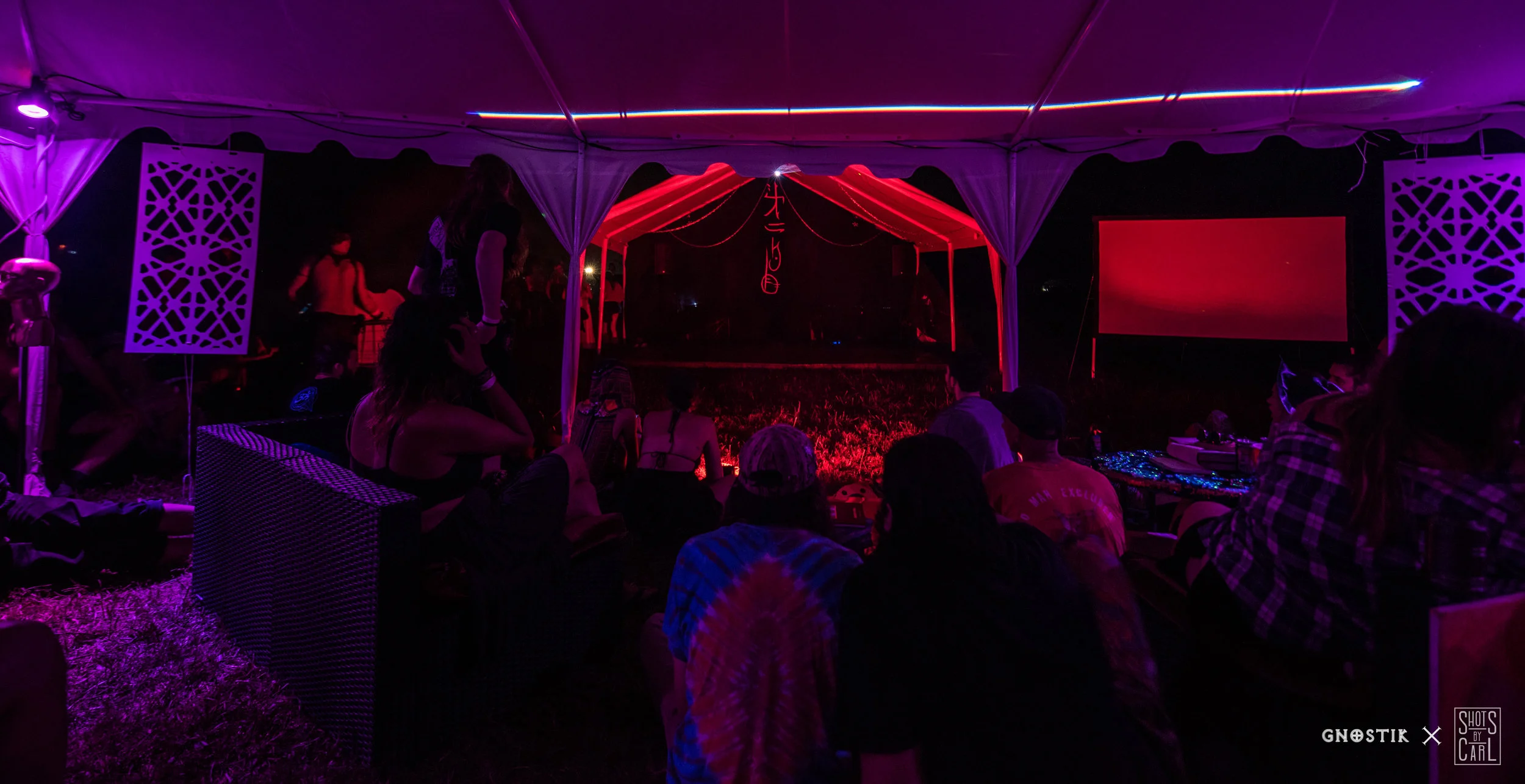
The GNOSTiK Lounge & Performance Theatre (Credit: Shots By Carl & GNOSTiK)

Molly Reed (Credit: Shots By Carl & GNOSTiK)

One-half of the act Fire Circus (Credit: Shots By Carl & GNOSTiK)

GNOSTiK co-creators Ali Khemi & Silv Era (Credit: Shots By Carl & GNOSTiK)
GNOSTiK “merges the lines between performers, musicians, and spectators,” according to Ali and Silv. DJs spun music from behind the theater’s curtain (this lent itself to secret sets from Detox Unit, Grouch in Dub during the theatre's off hours), performers hung out and served at the elixir bar, and cross-legged spectators in the grass inched as close to the fire manipulators as safety would permit. It was all too easy to get couch-locked in the Lounge, sinking into a plush cushioned seat with an arousing beverage as performer after dazzling performer floated and stomped across the stage. Your correspondent was nearly couch locked thusly were it not for the call of journalistic responsibility. Instead, I found myself ambling briskly between the Lounge and the stage to absorb the best of both worlds.
This walk between Lounge and stage involved frequent stop-ins with the Mermaid Oasis Hydration Station, a twist on the traditionally faceless festival water-fill up. Here ladies costumed as mermaids ran cold, fresh, plain or flavored with watermelon or cucumber or more. Pickles, the leader, humbly demonstrated her filtration system; the water is drawn on grounds from a well, sterilized for bacteria, and filtered for sediment. In the sporadic but consistently hot Tennessee sun, Solastafarians kept hydrated throughout the weekend.

Solasta's single stage was designed by Sacred Element Event Design (Credit: Lisa Diamond)
Down towards the river was the main stage - a fully encapsulated dance environment created by Sacred Element Event Design. Sacred Element’s founder Maurice Legendre is actively shifting away from manic, masculine, and overwhelming norms in stage and lighting design, and his creation at Solasta reflected this. “It offers but it does not demand,” he told me. Indeed the lighting was first and foremost atmospheric. Lights backing the stage and ringing the dance floor were subtle in their movement and usually featured no more than two colors at once.
The low stage was decorated with elements from the natural environment, with wood and rock creating a tranquil pond at the foot of the platform surrounded by mammoth hunks of quartz. Approaching the stage on Friday afternoon, Cameron Ingraham aka Mickman briefly dipped his hand into the pond, looking for a second like someone dipping into a vessel of holy water before entering a house of worship. The stage was flanked by two purple Funktion One speaker towers tuned to perfection by the Soundsystem Cultures, LLC crew which came north to Solasta from Chattanooga, TN. I’d later see Cameron on top of one towers pulling a tarp over the stack during a scattered shower, one of many small instances where the lines between performers, staff and attendees at Solasta were greyed.
A ring of bamboo trussing and six or seven teepee-like structures encircled the dance floor. One could literally recline luxuriously with the crew in these structures filled with blankets and pillows without leaving the stage. Two terraced jungle gym like towers added greater dimensionality to the dance floor (“more of a West Coast thing” according to one of the sound techs). These spatial designs helped cultivate the kind of communal atmosphere at a stage that is prized by every festival, but truly achieved by few.
Solasta’s talent bookings offered rare artists in a rare setting, like Solar Fields from Sweden, Grouch from New Zealand, or Goopsteppa and AtYyA from British Columbia, Canada. It was the undercard, though, that provided some of the most endearing one-of-a-kind sets. There was a Saturday afternoon set from Doyle, making his first festival appearance ever after spinning for nearly a decade, most recently out of Nashville, TN. A swaggering Southeast crew swarmed the floor with unmatched enthusiasm as Doyle dropped a clean DJ set full of classic and contemporary heaters. spacegeishA brought a big time DJ set as well. She impressed folks who were unfamiliar with her seamless mixing style and unmatched track selection (informed by her position as director of the vanguard digital label Street Ritual). This packed primetime set (10:30pm) combined with the informative talk she delivered on "Living the Label Life" solidified spacegeishA aka Becca as a major presence at Solasta Festival.

Ali Khemi performing a synchronized geisha fan dance during spacegeishA's set (Credit: Shots By Carl & GNOSTiK)
As international dubstep deep head Leon Switch started spinning on Saturday night, a pair of bright red and green lasers suddenly began beaming out from the landowner’s house. The house sat on the property's high ground about 400 yards up a hill opposite the stage. The lights soared across the sky high above Spirit Crossing, tying a bow on the entire experience and creating one of those rapturous moments where you can perceive all elements in an environment as one beautiful, synchronous whole. My colleague, who was strolling up grounds nearer the house, said he saw a man in his sixties with long, thinning blonde hair perched on the porch above a control board. There, swinging the lasers back and forth with ecstasy in his eyes, was Wes, the landowner, apparently having more fun than anyone else at Spirit Crossing.
Additional stand out sets came from EasyJack, Mickman, Vinja, of course Jade Cicada, and Push/Pull aka Liam Collins, one of Solasta Festival’s three main organizers. As the sun began to set on Friday, Mickman, uncharacteristically enthusiastic on stage, led his performance with provocative downtempo before launching into 40 minutes of his spellbinding sine-wave bass and hard drum breaks. Push/Pull followed with earthy midtempo, channeling some of the energies he’d picked up while staging the grounds in the past week. After shaking up the vibes with some tasteful Techno as Frisk, Jack Whelan thrilled the crowd with raw yet intricate psychedelic breaks as EasyJack on Saturday evening. Every musician on site truly brought their best juice. At a certain point it became a matter of pure stamina for the crowd.
Even amidst this stellar lineup, the Clinch River was Solasta’s star attraction. Running slowly east to west along the border of Spirit Crossing it provided all sorts of relief and recreation. It was perfect for cooling down and connecting with new people or old friends outside the bustle of constant bass music. Although Solasta was billed as a one-stage event, a last-minute river party saw the festival add a modest “river stage” designed with humor by Illuminera. This little spot had a renegade vibe, as DJs and producers not part of the original billing including Deerskin and Soul Candy sent vibrations out across river for the utterly happy people cooling off in it.
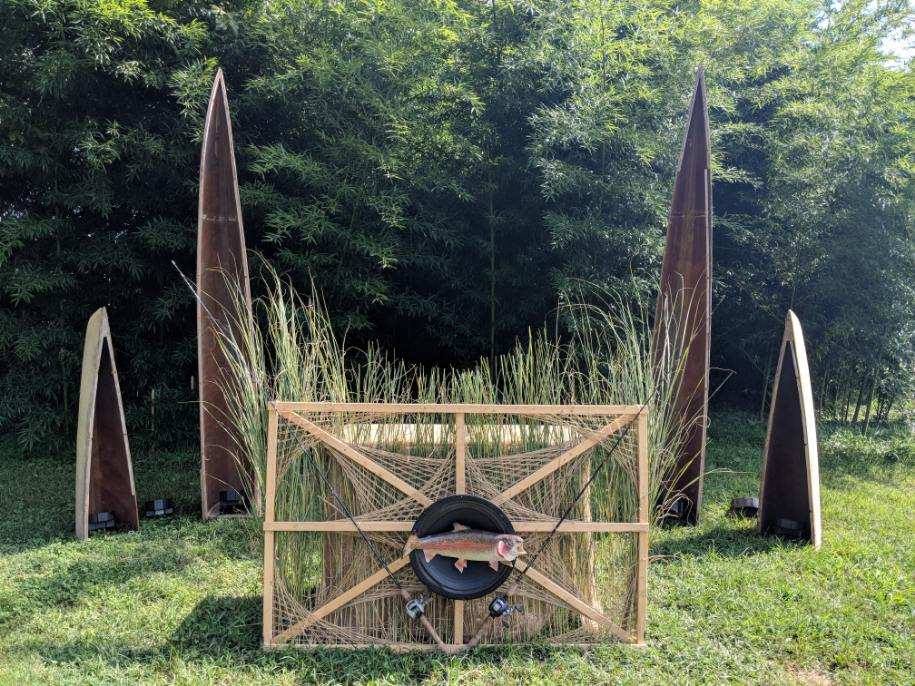
Not advertised before the event, the "river stage" designed by Illuminera had a renegade feel
Solasta Festival of course couldn’t conjure magic without the diligence and attention to detail of the producing entities Envisioned Arts and Harmonia. Each company brought their own production team which, joining with Collins, formed a dream team of young and excited event producers. On Sunday, Solasta Festival’s officially unofficial decompression day, as brunch was being served down at the stage I found myself in an administrative trailer sipping a strong mimosa stirred up by Dom Lu, the site lead at Solasta and a veteran of Envisioned Arts. We spoke about his early years in event production (“Anytime someone asks you to do something, just do it”) and the often unnoticed efforts that contribute to a safe, functioning festival.
“For me, I’m all about the attendees,” Dom said. “If you throw me in Artist Hospitality or something…that’s not my style. To me, everyone who’s on the dance floor, everyone who’s in the back with their friends who paid to be here, those are the artists to me. That’s who I care about.” As I felt my own forehead slowly begin to cook from a weekend in the sun, I noted that Dom had a permanent peel down along his nose. The skin under his eyes appeared raw with a pinkish hue; battle scars from many successful events, and likely a few failures. “Doing all the work, I don’t mind doing it. I’ve had those experiences where I’ve been to festivals and had the time of my life. I want to be able to recreate those experiences for other people.” Judging by the fixed smiles and strong auras of good will across the grounds all weekend, Dom and the rest of the event producers undoubtedly hit their mark at Solasta.
Much of what made Solasta special are those elements native to smaller festival environments. Replicating these elements on a larger scale while preserving the magic they deliver is challenging. Solasta’s growth was impressive in its second year. “A lot of festivals are still camp outs at their second or third or fourth year”, Dom noted with a bit of wonder in his voice. As this festival’s reputation grows, its organizers may have to balance a welcome increase in popularity and size with their ability to curate the intimacy that may earn the event its reputation in the first place.
The great takeaway from this kind of epic Appalachian sojourn gets back to one of those old lessons or cliches of transformational music festivals; take the knowledge and experiences gained on the grounds back out into the world with you. Whatever you learned about or reflected upon at this event; music production, friendship, stage design, romance, event production, sustainability, hummus-oriented brand partnerships - bring those reflections forward with you. Woven into the rest of the world, the atmosphere and attitude of the festival becomes less of an anomaly or some brief escape from life, but a greater part of culture and life itself.
Shambhala Music Festival Enters Third Decade in Style
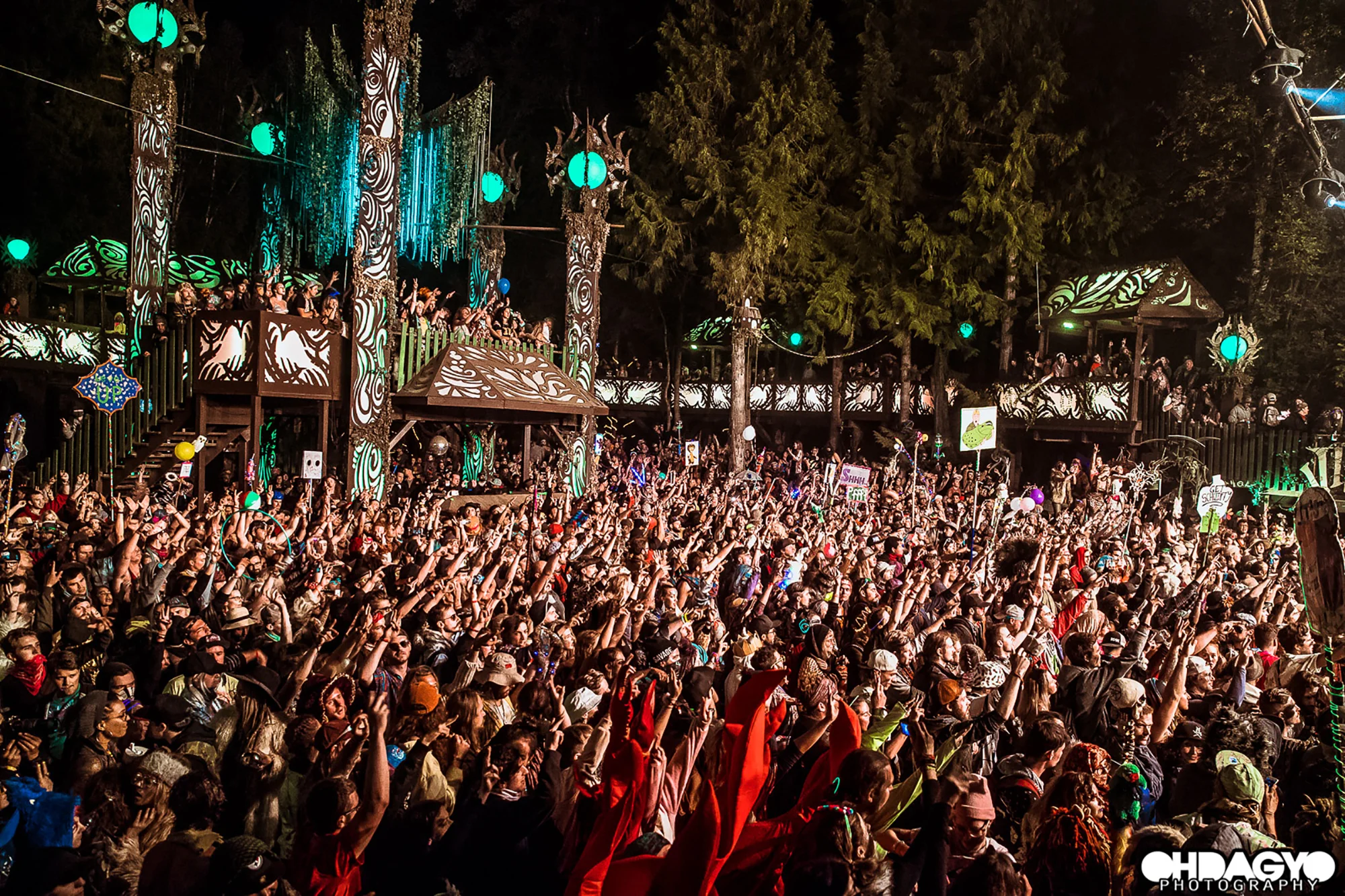
With 21 years at the same location, seven stages of music, event direction handled by the landowner's family, no corporate sponsorship, and now the purchase of a mass spectrometer, Shambhala Music Festival at Salmo River Ranch, British Columbia, Canada is perhaps the most successful music festival in North America.

The Grove stage (Credit: Oh-Dag-Yo)
With 21 years at the same location, seven stages of music, event direction handled by the landowner's family, no corporate sponsorship, and now the purchase of a mass spectrometer, Shambhala Music Festival at Salmo River Ranch, British Columbia, Canada is perhaps the most successful music festival in North America. Its powerful grasp over the breadth of dance music culture has enabled it to create a diverse following with a high potential for cross-pollination of sonic ideals and outlet discovery. To say I was shocked and awed by what I saw upon my first attendance to this festival would be a sad understatement of the kindness, generosity, and care that I experienced. Shambhala Music Festival and its attendees are quite attentive to the general experience of the festival, and quite in touch with one another.
Shambhala's two-decade rise has been marked by slow and careful growth, and each new increase in size is met with vital infrastructural improvements. The increase to some 20,000 attendees in recent years caused the two outlets to the Salmo river (the Living Room stage and Muscle Beach) to become overcrowded. Increasingly, people began walking across the footbridge at the Living Room into the neighbor's property to make use of the opposite bank. As a result, that bridge has been removed, and a new path eased out along the riverside with many outlets for squadly activities. The dance floors are now watered by the stage workers. The Village is especially noteworthy for incorporating a large waterfall installation. When last year's nearby wildfire caused an emergency exodus that demonstrated the need for additional egress in stressful situations, the landowners installed a new bridge made of steel to split the herd near the exit. Major moves like this demonstrate the dedication the Salmo River Ranch owners have for the safety and wellbeing of their attendees.
Shambhala has also been a vital germinating force for the growth of original sounds. The festival hosts yearly performances from now-confirmed Big Deal acts like Stickybuds and Stylust (formerly Stylust Beats), and has helped raise underground success stories like Goopsteppa and CharlestheFirst (whose Big Deal-ness appears imminent). Then there’s the blooming of burgeoning dubstep label Chord Marauders, for whom Shambhala was the biggest show they've ever played. For Jafu, Shambhala three years prior was his first time ever playing a show that wasn't “something small, for friends, to get myself comfortable playing music for people.” As a rare-to-Shambhala label showcase act, the collective received more attention than ever before, even spotlighting their first signed artist FLO.


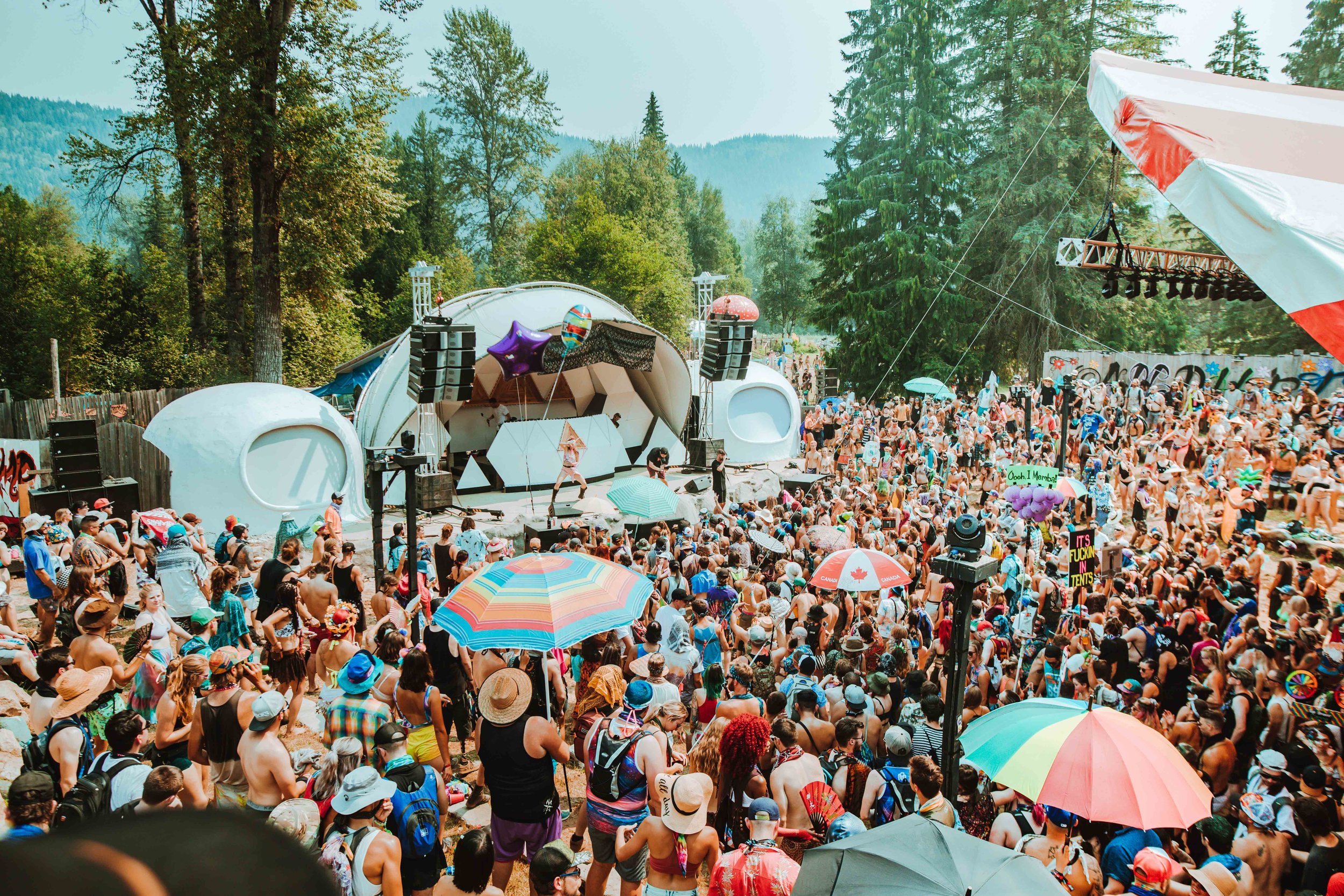

Between the funky basslines at the Fractal Forest, the hard-hitting powercore of the Village, and the soothing atmosphere of the Grove, there could exist a serviceable underground dance music festival. Between the live acts of the Living Room, the intimacy of the Amphitheater, and the “Main Stage” appeal of the Pagoda, there could exist another strong, more mainstream music festival. That the organizers chose to combine all of these thematic feelings and managed to keep attendance low enough to support a comfortable amount of breathing room at each stage is nothing short of miraculous. The result of this miracle is felt in the joy of constantly finding new music and new areas of the culture to discover, and experiencing the curiosity from others towards the rituals and artifacts of one’s own section of dance culture. The myriad of people passing by and sharing themselves with one another is the hallmark of any successful festival. Shambhala takes it further by creating comprehensible territory for the growth of distinct, microcosmic “scenes” in greater numbers than I've ever seen, both in terms of attendance and in number of stages. The stage-to-attendee ratio is easily twice as high as most festivals, and the resulting experience is immersive and enrapturing.

The Village stage (Credit: Oh-Dag-Yo)
The talent curation at each individual stage is extremely attentive to detail. When Joker couldn't make it to his set at the AMP stage, the stage staff rustled up a set from the intentionally rare Shadow People, aka TRUTH and Youngsta. TRUTH was performing that weekend without Youngsta, who wasn’t booked for Shambhala at all but was at the Ranch anyway since the two were on tour together (and Youngsta was playing a Shambhala pre-party). They were playing only a handful of Shadow People festival dates in North America, so the organizers found not only a replacement, but a spur-of-the-moment set that their attendees likely couldn't have caught otherwise. Similarly unique, while most of the dubstep of the Grove was beautiful, somber, and deliciously spare, there was also a rare grime set from D-Double-E and a set from Joe Nice; two grizzled veterans who'd become kings in their own right, playing alongside the next generation. Such was the power of Shambhala that the entire motion flowed smoothly from one act to the next, never causing any disruption in the crowd.
Perhaps the most impactful aspect of Shambhala was how distinctly I could observe my past, present, and future as a listener of electronic music. I caught the entirety of Koan Sound, remembering how next-level their sound design and beat structure appeared before I ever learned to describe such things in words. Performing prior to the boys from Bristol was Adventure Club, who I had last seen in those same baby raver days. There was Dirtwire, who I'd seen grow over the last three years from a small two-person project to a three-person band with matching outfits and a developed sonic aesthetic. Then there was Kursa, who pushed the boundaries of what I considered danceable. Each laid out how I, as a listener, have developed my tastes, how I'd been spending my time and energy since I went to my first show, and what I wanted to see more of in the future. Shambhala’s unique spread is truly appropriate for anyone at any point in their journey through bass music.
The infrastructure of Shambhala grows and improves every year. Even if you feel that only one stage speaks to your booking tastes, there will undoubtedly be acts you enjoy on other stages. I found myself having the time of my life at the Fractal Forest most mornings despite not once catching an act that I recognized or that was recommended to me (damn me for missing Skratch Bastid), simply because the stage design was so incredible. Shambhala exists to provide its attendees with the smoothest experience possible, from the drug testing to the Shambhassadors - Info Hub volunteers who roam the festival spreading information, sharing their experiences, and generally raising the vibe (as far as I know the only festival job that encourages smoking cannabis with the attendees). Without a doubt, there is something for everyone at Shambhala, and a thriving culture that wants to show you every facet of its being besides. Well, no psytrance, although that's a whole other article altogether!
FOLLOW Shambhala Music Festival: Official / Facebook / Instagram

A Conversation with the Organizers of Solasta Festival
On August 17 & 18, the homegrown gathering Solasta Festival returns to Spirit Crossing in Sneedville, Tennessee for the second year. The lineup is dreamy and the extracurricular activities include audio development workshops and a unique Sunday Brunch. The Rust Music has been corresponding with the festival’s three key organizers about their intentions and areas of focus for Solasta, as well as the festival's short history.

On August 17 & 18, the homegrown gathering Solasta Festival returns to Spirit Crossing in Sneedville, Tennessee for the second year. The lineup is dreamy and the extracurricular activities include audio development workshops and a unique Sunday Brunch. The talent bookings are ambitious, from the New Zealand psytrance legend Grouch to the Swedish ambient composer Solar Fields, who hasn’t performed in the States for nearly a decade. Top-billing is given to rising musicians like Jade Cicada and Detox Unit whose new sounds and young energy are invigorating the community’s collective nervous system.
Solasta is far from the only exceptional grassroots festival to pop up and spotlight alternative electronic music recently. However, strong intentions toward individual and communal growth, a risk-taking and rarified musical lineup, and an obsessive focus on safety and organization distinguish this event from most others. The Rust Music has been corresponding with the festival’s three key organizers about their intentions and areas of focus for Solasta, as well as the festival's short history.
Another steamy summer was approaching in the Southeastern United States in 2017 and lovers of alternative electronic music and culture were naturally excited. For the electronic community and culture at large, summer is when the magic - and the music festivals - happen. That summer, however, the intentional gathering and Southeastern anchor festival Kinnection Campout was taking the year off. The regional music scene was looking at a “very bleak summer” according to Liam Collins, a music producer known as Push/Pull local to Asheville, North Carolina.
Solasta appeared in this void. The event lasted two days and two nights in September in Sneedville, a town of less than 2,000 people tucked into the foothills of the Smokey Mountains in the northeastern corner of the state. The small but refined lineup featured rare international talent. Workshops offered included a sampling seminar with RJD2. The Clinch River ran slowly through the grounds, the sun rose with music, and campers left without a trace. The festival passed into the autumn quietly, although a foundation was set for the future.

Spirit Crossing, the grounds for Solasta Festival, as seen from the air
Electronic music thrives in a handful of cities scattered among the hills and hollers of the Southeast. Asheville stands out among them for its vibrance. On his first U.S. tour, the highly sought after UK producer Kursa is playing major cities like Denver, Atlanta, Boston, New York, and…Asheville. The city is also the home to Harmonia, one of the producing entities behind Solasta. Founded by Asheville resident and perennial festival worker Maegen Coral, Harmonia is one of a handful of companies worldwide dedicated to providing harm reduction and creating sanctuary spaces at music festivals.
Maegen and Liam linked through the greater Asheville electronic circuit over the years, particularly through Kinnection where Liam was a performer and Maegen a part of the festival crew. The gathering was formerly hosted just north of the city on the Deerfields Retreat, one of the only places in the Southeast apparently where one could play bass music through the night.
Also working Kinnection in years past was Hasan Zaidi, another perennial festival worker holding down the box office and going on about “high-density awesomeness”. Hasan had recently started the production company Envisioned Arts in the Bay Area. Today, Envisioned Arts is a leading provider of live niche electronic music, and the other key producing entity behind Solasta. Hasan and Maegen worked festivals together from California to Costa Rica and back to the Carolinas where another transformational event called Gratifly Music & Arts Festival roared with abundance for two years before fading away due to financial insolvency.
In this landscape where the cultural soil is fertile but the fruit of financial stability struggles to flower, Hasan, Maegen and Liam linked up to throw the first Solasta Festival. “The three of us definitely connect on the core principles of how people should be treated and how the experience should be facilitated,” Maegen told me while working her Harmonia sanctuary space at Elements Lakewood in Pennsylvania over Memorial Day weekend.

“It’s crucial for the organization behind an event to have a higher intention than money or just having a party,” Liam writes via email. “You can feel when there is real love and thought behind it versus when there is a disconnect between the organizers and the patrons…For me, Solasta is about keeping the musical lifeblood flowing in the Southeast, and stems from a very sincere desire to grow the scene and musical community.”
Maegen has seen much while working the festival circuit across the continent, and it’s not all good. Despite its fantastical atmosphere, the electronic music community isn't free from destructive behavior. “In this culture, what I’ve noticed, the cool thing is to not give a shit and to not care. Like ‘let’s eat all the drugs, let’s throw shit on the ground, who cares.’ It’s kind of self-serving. That’s the culture, so people are learning that as they come into it.” This is why Maegen started Harmonia, to empower through education, lead by example, and subtly push the cultural needle in the opposite direction. These same intentions undergird Solasta Festival. “What we’re trying to do is create the other culture, where it’s cool to take care of yourself and it’s cool to check in on people. It’s like a culture of compassion.”
As the head of a production company, a booking agent, and the initiator of the Bassnectar AmBASSadoor program, Hasan is uniquely positioned to comment on the micro-communities that are both a cause and effect of the rising popularity of alternative electronic music. For it’s part, Envisioned Arts has been helping to set the pace musically in the States for years now by booking rare talent, particularly in the psydub universe, before others began to.
“Our events are different because we’re all similar in these weird ways, and we’ve come together because of the music,” Hasan says. “But when we’re actually together we realize we share these certain qualities and characteristics.” Birds of a feather flock together. Music nerds have a great time hanging out with each other, especially if their favorite tunes are pumping through a top-of-the-line system under the bright light of the moon. “There’s a rampant sense of humor that tends to run through everyone, kind of a skeptical view of what is fed to us from a commercial perspective, and a desire for something more authentic and different.”

Goopsteppa performing at Solasta 2017 (Credit: Reston Campbell Photography)
Solasta is intended to be that something. It’s hosted by the community, for the community. The organizers believe this DIY approach is imperative. “We have all been to those larger corporate festivals,” writes Liam. “They throw up a big stage in a hot field and sell you bottled water and shove beer ads in your face.” Indeed, no one who’s ever bought an Aquafina for five or six dollars will soon forget the sting of that experience. “You’re herded through long security checkpoints and it just feels like the purpose of the event is to make as much money as possible while caring little about the experience. Unless we all create and support the kind of events that we want to see, they just won’t happen anymore.”
Creating an authentic, homegrown underground event within the framework of the festival market is like threading a needle. A group seeks to put forward their purest ideals, but it must bend with the force of a conscious-less machine market that doesn’t give a damn about ideals. “In a broader sense,” Hasan muses, “all grassroots movements that do something right will one day expand into something more. Being able to consciously monitor that growth and actually stand by the core ideals from outset, instead of just paying them lip service, is the actual battle.”
Community and grassroots are not just buzzwords for this crew. The organizers build a sense of community into everything they do, particularly by blurring the lines between performer, staff, and audience. “Our team for Solasta is very literally embedded in every aspect of the scene,” writes Liam. “We are booking the shows, managing touring acts, checking you in at the door, rocking the clipboard in the back, making sure that you are supported during tough experiences, on the four-wheeler keeping you safe, dancing right next to you in the crowd, and up on stage.”
There’s no VIP area at this festival. “We often joke that Solasta is a producer’s festival,” says Hasan. “Last year especially that's really what it was....All the artists we book are going to be on the dance floor ripping it up. Woah! Nice, we just sold five tickets,” he says over the phone, interrupting his own train of thought. Hasan loves to talk, but he doesn’t bullshit. There’s one stage and no overlapping sets at Solasta. It’s fortunate for attendees because every set on the lineup is worth catching. There’s no “check the box” bookings here. We’re sure the producers dig this, too. They miss sought after sets sometimes, too, you know. Solasta also lowers the stage towards the ground, bringing the performer closer to eye-level with the audience.

Born from the nerdy natures of each of the three organizers, one of Solasta’s most unique offerings is the full slate of audio development workshops. There will be sessions on vinyl scratching, integrating hardware synthesizers, piecing apart the frequency spectrum and more. Last year the focus was placed exclusively on the deep technicalities of production. This year’s workshops will be a bit more accessible, including seminars from “industry movers and shakers” about other aspects of the underground music community. Solasta intends to give people the knowledge to do it themselves, and do it properly. “A lot of the workshops we do allow the participants to become the people who will be on stage,” Hasan says.
Although Solasta is a second-year festival, expect a safe and highly organized experience. These folks know what they’re doing (at least when it comes to hosting events). “We are technically a startup but we do not have the organizational clusterf*#@ that most startup festivals inevitably have,” writes Liam. Sometimes one trades the six-dollar Aquafina in for a traumatizing porto-potty lineup or a botched musical schedule. Not here. “Our entire staff in every department is filled by one tight-knit community that has been doing this together professionally since before 2012.”
Spirit Crossing is nestled into the western foothills of the Smokey Mountains where the ground is soft, the fog settles early and often, and the sun splits through the hills at dawn. Running through Spirit Crossing is the Clinch River, one of the cleanest rivers in the Southeastern US and home to rare and diverse marine life. One can camp next to the river and wake to its bubbling rhythms each morning. Wes, the landowner, began hosting burns on the grounds years ago, but they were more like river clean-ups with music. “We try to impart on people, don’t just keep the land clean because we’re telling you to,” Hasan says. “Keep it clean because you genuinely want to.” Solasta intends to maintain the pristine conditions at Spirit Crossing by strictly adhering to a ‘leave no trace’ policy.
To sustain the festival and it’s growth, the organizers are partnering with other like-minded companies. “Solasta is a group effort,” says Hasan. “No event happens with just one community." Solasta has linked with Midnight Voyage, who for years ran the electronic circuit in Knoxville, Tennessee. They’ve brought on outfits from New Orleans, Chicago, Boston and New York City (The Rust Music is partnered with and actively promoting Solasta Festival) to spread word through the underground. “What I’ve found is that a lot of people are so competitive,” Hasan continues. “We can do cool shit without being competitive. We can collaborate and do something far bigger than any of us. I’ve always believed that.”

The Clinch River in the morning mist (Credit: Reston Campbell Photography)
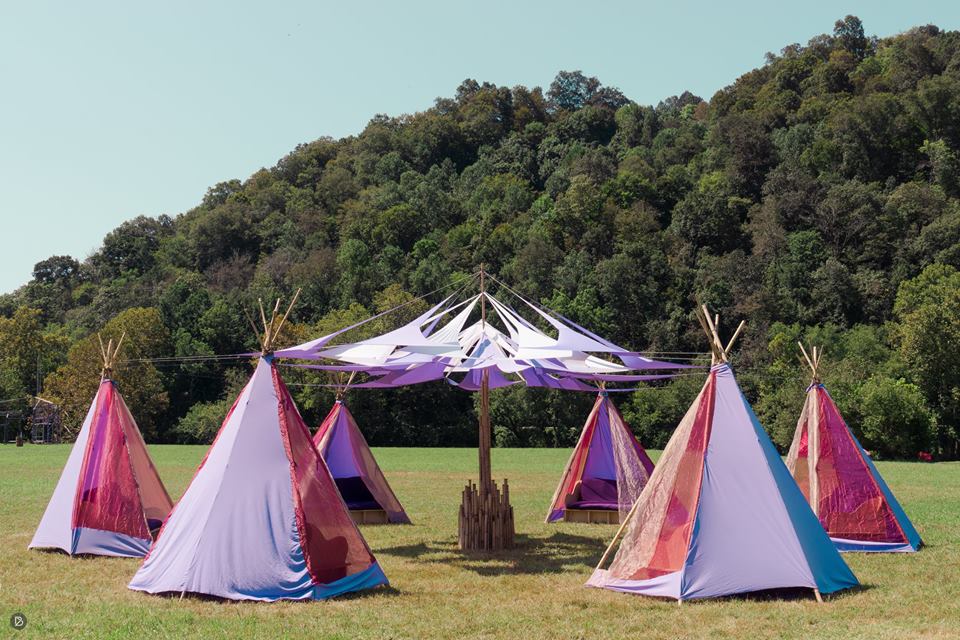
Perhaps the most important area of focus for Solasta is safety, which according to Maegen reaches “almost to the point of paranoia.” Harmonia will establish its public sanctuary space on site (attendees of the Tipper & Friends 4321 event may recognize this serene, domed environment). They’ll also have isolation tents for those with augmented experiences who require individualized attention from a caring volunteer. “You have the best time at festivals when everyone’s smiling and looking out for each other,” says Maegen. “That inspires people and helps them connect in a potent way. So to make a statement and make it a critical part of the infrastructure changes the game completely.”
“All of us keep coming back to these festival experiences for a reason,” says Liam, who has himself been coming back to festivals for about a decade and a half. “Small, thoughtful gatherings are some of the most potent places for release, communion and connection that I know of. Amazing things happen when people of like mind gather to celebrate. Solasta is the newest attempt at growing one of these from within our community.”
Solasta tickets are available for a startlingly low price and special magic is already swirling around this event. If you’re traveling from far afield, Solasta has shuttles running from the Atlanta airport. If you’re driving, be wary of the switchbacks once you get into the mountains. Although the organizers have poured their own resources and intentions into the project, it’s the attendees themselves that make it all thrive. “We might be creating a central gathering point,” says Hasan, “but the idea is to empower each individual to their fullest, and allow them to spread the feeling they get at the event to others.” Noble intentions aside, “just get ready for some good old tomfoolery,” the organizers suggest.
FOLLOW Solasta Festival: Official / Tickets / Facebook
FOLLOW Envisioned Arts: Facebook / ATL
FOLLOW Harmonia: Official / Patreon / Facebook / Instagram
FOLLOW Push/Pull: Soundcloud / Facebook / Instagram / Visionary Magnets
Shambhala Music Festival - Chord Marauders Showcase
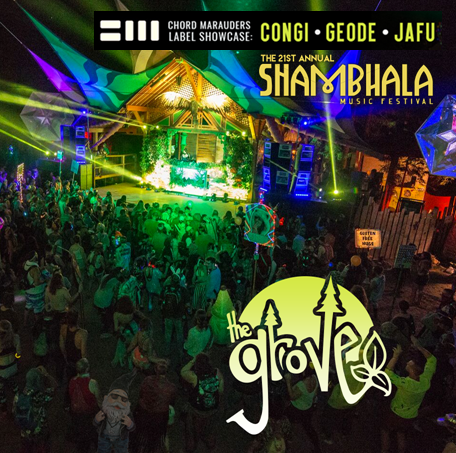
The Chord Marauders are London-based, jazz-infused label that is a collective between artists Geode, Congi, B9 & Jafu, and a beacon of originality in the dubstep universe. They’ll hit Shambhala Music Festival on August 10-13 for what appears to be one of the only label showcases in this legendary festival’s history.

For the Chord Marauders, 2017 was an important year. The London-based, jazz-infused label is a collective between artists Geode, Congi, B9 & Jafu and a beacon of originality in the dubstep universe. The year saw label head Geode's first full-length release Beluga, as well as Jafu's first LP Second Impressions, making him the last of the four founders to release on the label. All of this solidified their label as a major force on the heels of Groove Booty Four, their most successful compilation release to date, which featured a release with Ago of Innamind/Blacklist, a groovy lounge track from circula (sic), and coverage in Vice's THUMP. The compilation was also their first vinyl release, a trend they have kept up with that's put them on the radar of the crate-diggers and audiophiles which frequent any genre that traces its roots back to Jamaican sound system culture.

2017 was also the first year Congi played in North America outside of Denver, the most hipster place to live in North America if you like bass music. He was booked for Shambhala Music Festival at the Salmo River Ranch in British Columbia, Canada where B9, Geode, and Jafu (a native Canadian himself) played in 2015. Since then, the label has only achieved greater success. As a result, Congi, Geode, and Jafu will hit Shambhala Music Festival on August 10-13 for what appears to be one of the only label showcases in this legendary festival’s history. They’ll play at "The Grove", an intimate stage much favored by dubstep-heads. Vigilant fans of Shambhala's dubstep culture have had the privilege of watching the slow build of Chord Marauders unfold before their very eyes. This year, their showcase will likely be one of the most enchanting and brilliantly original blocks of music all weekend. As each of the label’s members continues to ascend in their career paths, this unique moment will likely become the most monumental achievement yet for the jazzy and melodic sound they champion.
In 2012, when Chord Marauders began to form, the word “dubstep” had gone through major upheaval. What was once a small but solid underground sound that had slowly grown from UK garage, 2-step, and other hardcore fuzzy bass noises in London (particularly the Croydon area), transformed into an aggressive genre of EDM, and become an international sensation in the meantime. Scarcely more than a decade after the creation of Forward>> - a club night that was the incubator for the fledgling new noise - the whole concept of “dubstep” had undergone a shift from the hush-hush darkness and grit of deep bass culture in London to the bass growls and high screeches of what dubstep purists call “brostep”. This new evolution paid more lip service to the neurofunk (an offshoot of techstep, itself a drum n bass concept) era of London bass music, encouraging less atmosphere and more big snares, often with a jumbled arrangement of speedy drums.
The vibe had died and been replaced with more of the soulless junk that had inspired movements towards the dubstep sound in the first place. In this brave new world of dubstep's mainstream acceptance and coopting by EDM culture, the phrase “melodic dubstep” can all too easily signal songs you'd find reposted by Suicide Sheep on Youtube: popular feelings in easily consumable verses, glossy drops for the smiling dancers, and dramatic frequency shifts to drive home the “heavy metal” (read: pop-emo) influence. It means wide-eyed proclamations of “feels”, it means a community more into progressive trance than dub reggae, and it means Chord Marauders faced (and faces) an uphill battle to market their sound. This was the state of affairs when the Marauders began to connect to each other, trading project files and contemplating a go at their own music label to breathe new life into the stagnant dubstep community.
Each of the four projects under the label's banner (Geode, Congi, Jafu, and B9) has a distinctively melodic bent, usually using the synth keys to drive the mood, but there is rarely a time where the mood is uplifting, making it unsuitable for highly commercialized “raves”. Trapped in the “melodic dubstep” box, they would each have a low likelihood of both succeeding as artists and retaining their unique voices without one another's support. With their unity, each have been able to release a full-length LP without losing sight of the goal of pushing the now-antiquated dubstep sound back into a new and challenging territory. They lead this effort alongside the slick badmen of Deep Medi and the cerebral technicians of Innamind/Blacklist. Indeed, their leadership has netted them a release by FLO, an up-and-coming artist from Slovenia, so it is safe to say they are actively changing and challenging bass culture with their association.
Having built such rapport with Shambhala as to be able to promote their label through the festival, Chord Marauders is slated to totally redefine “melodic dubstep” and bring listeners back to the roots of the sound. We've seen Shambhala lift the appeal of acts that refuse to neatly fit a populist mold, with Stylust and Stickybuds as great examples. The Chord Marauders showcase suggests that Shambhala’s attentiveness to dubstep purity will be like steel in the face of the festival’s ever-rising popularity. In other news, Skream still plays house.
FOLLOW Chord Marauders: Official / Soundcloud / Bandcamp
FOLLOW Shambhala Music Festival: Official / Tickets / Newsletter
Psychedelic Sleepover Raises the Bar for Family-Style Festivals
Psychedelic Sleepover raised the expectation in the Northeast US for what a family-style bass music festival can be. Praise for its curation and operations was widespread. The hype surrounding the festival was substantial, but Taproot delivered and then some.
Concord, New Hampshire is pretty hard up, I thought to myself as our car cruised along sloped back streets lined with squat homes flaking their paint. We were scoping out signs for Page Farm, the grounds for the Psychedelic Sleepover on June 1-2 and a site rumored to be paradisiacal for family-size music festivals. “That’s got to be an insane asylum,” my colleague said as our vehicle became shadowed by a hulking brick structure perched on a riverbank. Hot sun caught the red brick of this empty building which stood in high contrast to its surroundings; a rushing river and the lush green of full Spring in New England. It was just an empty factory, no insanity here. We’d have to find Page Farm first to tap that vein. Weather reports had attendees nervous leading up to this anticipated gathering, but as we finally rumbled onto an access road for the Farm, strong sunshine was penetrating through the forest canopy.

The main stage was modest in size but boasted a perfectly tuned system from Hennessey Sound Design (Credit: Nachturnal Images)
The niche psychedelic music festival is a visionary concept. Bring the most righteous bass music and a killer sound system onto some isolated land for a weekend of indulgence. And boy did the Taproot Productions team have a barnburner on deck. In addition to a who’s who of Northeastern underground bass slingers, plus rare names like AtYyA, Shwex, and Alejo, they booked Koan Sound to play on Friday night with Opiuo to follow on Saturday. Not to mention the ultimate wildcard booking, Diplo, who would go on to temporarily frustrate festival logistics by pulling an inordinate amount of resources and staff into his bougie orbit.
Anyway, it’s a great idea to go balls out and host a festival like this, but executing that idea is where things can get hairy. Based in Portland, Maine, festival organizers Taproot Productions are nearly the only game for psychedelic bass music in northern New England. I’d hardly encountered the crew before and wondered just what kind of game they were running. With a name like Psychedelic Sleepover, I wasn't holding my breath for tight organization, polished presentation and universal safety. But that’s just what Taproot offered all weekend.
I lodged zero complaints in my mental notebook. There’s always one aspect of a gathering that’s less than ideal, or doesn’t come off right. Here, there was nothing. Perhaps my experience was biased by my credentials as a media professional, but it seemed like everyone was riding the same wave of excitement, comfort, and safety. The staff was responsive. The volunteer team was substantial and they put in good work. All the music went off on time. The sound was flawless; one Hennessey Sound system for each of the three stages engineered all the weekend by their creator Sean Hennessey and his crew. Visual art was prominent and thoughtfully curated. The public water supply, while somewhat difficult to locate at first, was consistently cold and available. The production value was high, startlingly so given the modest setup during the Sleepover’s first iteration last summer, which featured just one stage. The festival sold out around 10:00 pm on Friday night, hitting Page Farm’s 2,000 person capacity.

The field was the nexus of the festival and provided ample space for activities (Credit: Nachturnal Images)
There was actually one snafu. Whispers rippled through the campgrounds during mid-afternoon on Friday as the Farm started to fill up; Diplo’s cold-cuts had spoiled. We’re not sure how this situation was resolved, but it cast a temporary pall over Page Farm. Diplo was in fact participating in the Psychedelic Sleepover because he’d performed in 49 of 50 states except New Hampshire, and he wanted to hit them all. The crowd was getting down at his Friday evening set that began to light rain, the only precipitation all weekend. He didn’t go deep with it or break out unique cuts to match the unique setting, as some speculated he might.
The Sleepover population was so safe and civilized. This was made easier by universally shaded camping that actually afforded the ever elusive good night’s sleep, if that was your thing. No one was imposing, no one was putting on airs. Everyone was smiling and getting down. “Right now there’s such a cool thing going on here,” Jake Maxfield told me. Jake, whose awesome surname doubles as his artist name, was one of eight producers represented by Taproot who played the Sleepover. With a cache of large unreleased glitch tunes, Maxfield put down one of the more impressive sets of the weekend on The Field stage, which was actually two stages with music rotating between them. After splitting atoms for an hour, Jake closed with “Helplessly Hoping” by Crosby, Stills & Nash.
Cooling in the shade at the southern edge of the field while Scatz pumped sedate Saturday afternoon beats, we chopped it up about the festival. “The people are really cool. I’m not very social so it’s cool to be able to have an excuse to get out and meet a bunch of people all at once. You're in a space where you feel like you have something to talk to them about. As opposed to other times when, you know, you’re at your friend’s Superbowl party and you feel like a band geek or something.”
The field was the nexus of the festivities. This large, broadly sloping section of pure green grass, about one and a half football fields long, offered infinite room for flow and socialization in the open air, which was pleasant but not hot during the day and crisp but not cold at night. On one flank of the field at the foot of the tree line was a pastoral and purely New England rock wall. One could picture visionary seventeenth century women climbing this wall and disappearing into the woods to get down on some spiritual activity to avoid being labeled as witches. The smaller of the two stages, a rustic roofed structure with one LED screen behind the performance space, was bordered on one side by the rock.
On the opposite side of the field was the larger stage adjacent to a Chris Dyer mural which the happy fellow himself sprayed with color all weekend. Here was a similar roofed structure but boasting a set of LED panels and an array of lasers which at night would fly over the busy crowd to criss cross on the tree line that, backlit with blues, greens, yellows and purples, stretched so high above. Attendees set up mobile picnic spaces in the field and ferried them back and forth between the stages as the music rotated. It was pure psychedelic Americana. “They have all the right elements,” Jake said of the Sleepover. “This space in particular, too. Page Farm is one of the best festival spaces I think I've been to for this size event.”
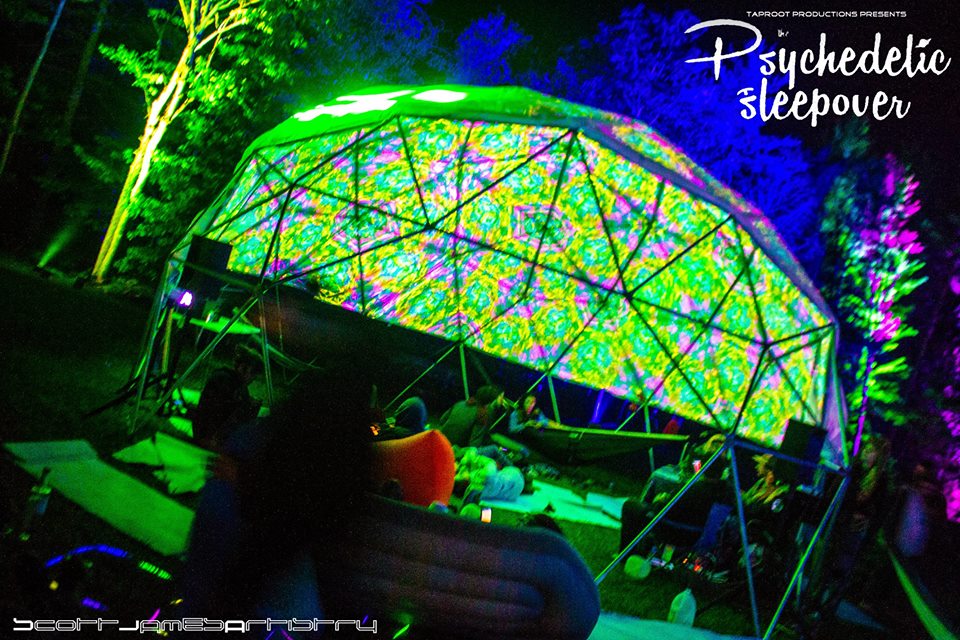
The geodome by Illumine Productions was the spot for late night shenanigans (Credit: Scott James Artistry)
Sitting center field was a geodome. Innocuous and hammock-strung by day it became the spot for entertainment come late night. Once darkness fell, the dome’s interior lit up with master class psychedelic projection mapping. This sorcery came courtesy of Illumine Productions, a project by Derrick Planz and Brandon Decker out of Baltimore. With stages shutting down at 3:00 am, these fellows provided a heroic service by creating gathering space for a peppy graveyard crowd. Their space became truly sanctified on Saturday night when MALAKAI began an impromptu hours-long ambient set on a quiet speaker setup under the dome. The scheduled music finished and all was quiet on the Farm, but here Sleepover attendees, quite awake, began to gather, splay out, and drink in the last drops of this festival’s potent vibes.
Psychedelic Sleepover provided a perfect platform for some of the Northeast’s rising talent to showcase its tunes. The musical peak of the weekend, however, came unequivocally from the headliners Koan Sound. The duo from Bristol, England has been working on a new album for two years. For the first time ever, they performed a string of tunes from this most anticipated release. They absolutely ran the gamut with brand new drum n' bass, jazzy synth jams and back-breaking glitch hop, all with their signature sound design, only improved. It was too good, shattering already elevated expectations. “Koan Sound is one of my biggest inspirations,” Jake said, no doubt echoing the sentiments of many producers. “It’s always special when you get to see them perform. There’s inevitably a lot of hype and pressure behind it, but they definitely blew everyone away.”
The lasers were flying, ClearVoid visuals was casting spells on the LEDs, the Hennys were thumping and Jim Bastow’s fingers were dancing on the keys while he and his partner Will Weeks flawlessly mixed the new material with Koan Sound bangers including “Fuego”, “Mr. Brown”, “Sly Fox” and “Sentient”. Magic hung like a membrane in the air while the crowd whooped and hollered, nearly incredulous at the quality of the music they were hearing. It was one of those rare sets that will live on, glorified in memories of folks who know they got it.

Safety was widespread throughout the weekend (Credit: Nachturnal Images)
Down grounds from the field, through the shakedown and across a wide expanse of parked cars, broaching another tree line one entered the woods sheltering the bulk of the Farm’s campers. Smack in the center of this scene was the Woods Stage integrated into the landscape beneath taut neon string that ran from tree to tree and looked like secret agent security lasers at night.
On Saturday night the vibes at the Woods Stage were supreme. Hammocks were slung and chairs grounded around the perimeter of the dance floor. Shwex came all the way from Olympia, Washington and offered an astounding and cinematic avant grade sound experience. He built pressure to the perfect point but held from releasing it. Just when a groove became solidified he would pull the rug out from beneath it, sending the mind spiraling. He was followed by AtYyA, a master of spiritual bass and downtempo who was followed by hometown hero DeeZ who earned the Sleepover’s closing slot. “Snooze [aka Taproot Productions’ founder Danny Bruning] is good at making sure all the headliners get what they deserve, then giving that underdog spot to someone who really deserves it,” Jake said.
And close DeeZ did, in rare style. According to Snooze, "DeeZ’s set was scheduled 2:00-3:00 am and they wanted me to cut it at 2:00 am. Brian Page actually came down at 2:20 am and said 'Snooze, you shut this down right now', to which I responded 'No wayyyy man!' pointing to all the happy, dancing party people. He relented and went to bed without a fight." The show went on, but the sound was cranked way down. So there’s DeeZ with his bag of bangers throwing them down one by one on a system running at half volume. He even played his remix of “Bass Head”, a fan favorite. The crowd, packed tight among the trees and laced with energy, took to speaking in hushed tones to allow the tunes to ring out. In this moment it was clear that those who came to the Sleepover treat music with the utmost reverence and respect.
Psychedelic Sleepover raised the expectation in the Northeast US for what a family-style bass music festival can be. Praise for its curation and operations was widespread. The hype surrounding the festival was substantial, but Taproot delivered and then some. “Our culture is almost inherently commercial,” says Tovia Shapiro aka Terraphorm, a wise man and prolific DJ out of Worcester. He offered a deep-dive, highly cultivated dubstep set on Saturday afternoon.

More than one person was hawking pashminas in the camps at the Sleepover (Credit: Nachturnal Images)
“There’s aspects of all that marketing and promotion that are important to the process of having a good party. You obviously want a critical mass of people to share and experience this art together. But just that leaves something to be desired.” Tovia puts together events with FractalTribe and spoke about approaches to curating atmospheres and cultures within festivals, in addition to just music. “I think we’re starting to see a lot of great festivals in the Northeast which embody that and push the boundaries in their own way. Psychedelic Sleepover is definitely part of that way of thinking about throwing events.”
After cleaning the Farm and setting down beneath a tree for a two day snooze, Danny and Taproot set to work on next year’s Sleepover - and much more. This is an event that they and the community at large can be proud of. We look forward to witnessing its evolution.
Elements Lakewood Creates a Musical Melting Pot
BangOn! set the stage for the 2018 festival season, and has since received a roaring response from all involved parties. Elements Lakewood has made an indelible mark on the community that propped it up in the first place, solidifying itself as a major contender for the affection and adoration of the Northeast US counterculture.
In a world bursting with musical trappings, tastes, intrigues, and developments, where does one find the nexus of it all? Music is, as it always has been, a labyrinthian mosaic that pushes and pulls at our fluid emotional states, and for every person on the planet, there is some tone that rings just right in his or her ears. As a natural result there’s a multitude of social scenes and collectives that create their own bubbled zions of aural stylings, so as to connect with like-minded individuals and explore the depths of familiar genres. The modern music festival often attempts to cross-pollinate various music cultures, but Elements Lakewood Music & Arts Festival achieves this vision to its fullest capacity.
Elements Lakewood, hosted during Memorial Day weekend by NYC-based production company BangOn! NYC, is an experiment in combining the often at-odds camps of broken and steady beat electronic music. On the surface these collectives could not be further apart; from phenotypes to vernacular, waves of influence, venues, clothing, and demographics. The 4x4 dust-kickers and heavy bass head-nodders seem like spiritual opposites. This dichotomy is, however, only skin-deep. Push past the vain and perfunctory surface of either music scene and you’ll find that many of the same speaker creatures inhabit both worlds simultaneously out of their sheer love for all things boisterous within the wildest music of our generation.
Elements Lakewood is situated in a pastoral rural community in Northeastern Pennsylvania that is its namesake. The grounds themselves are a wondrous cornucopia of rolling hills, forest glades, throughways swampy and dusty surrounding a petit, picturesque lake. Across the expanse of property are the familiar trappings of any purebred American summer camp, all of which would be leveraged to create a well-organized and immersive festival experience. The facilities and materials were all available, the proper permits were filed, all the revelers were gathered. From the start of the weekend, BangOn! and a host of collaborative production companies presented a multifaceted aural adventure offering passage through every rabbit hole imaginable. Backed by eight stages of varying design, power, and vanity, the force of over 100 musical acts was unleashed on a torrent of jubilous weekend warriors. Each stage was tailored to curate a particular atmosphere and headspace, but was simultaneously inviting to anyone who wandered close enough.

Wax Future were part of a small handful of livetronica acts to rip the Earth Stage

The Reliquarium worked wonders on the Earth Stage for the second straight year
At the entrance to the festival, you’re presented with the most technologically equipped stage at the event. Conceived and designed by The Reliquarium and Rhizome, the Earth Stage presented a formidable array of well-tuned speakers, lasers, lights, projection mapping, and fidelitous LED screens. Surrounding it stood a series of art cars and asymmetric structures that created the natural boundaries of the dance space and added dimension to this particular party. The soft earth bore the wounds of a thousand boots, birkenstocks, and bare feet kicking and pounding at the grass and dirt below, a sure demarcation of the round-the-clock revelry at hand. The talent featured here varied stylistically, but was unified under the theme of broken-beat bass music and eclectic livetronica acts. Some of the movers and shakers tapped to perform on the Earth Stage included Detox Unit, Wax Future, Somatoast, Charles the First, DeeZ, Smigonaut, and the legendary Stickybuds, whose first Northeast US set in four years exceeded expectations. As the result of a last minute cancellation and some help from a few friends, 5AM assumed the stage and pulled off a surprise slam-dunk performance to close out Saturday night.
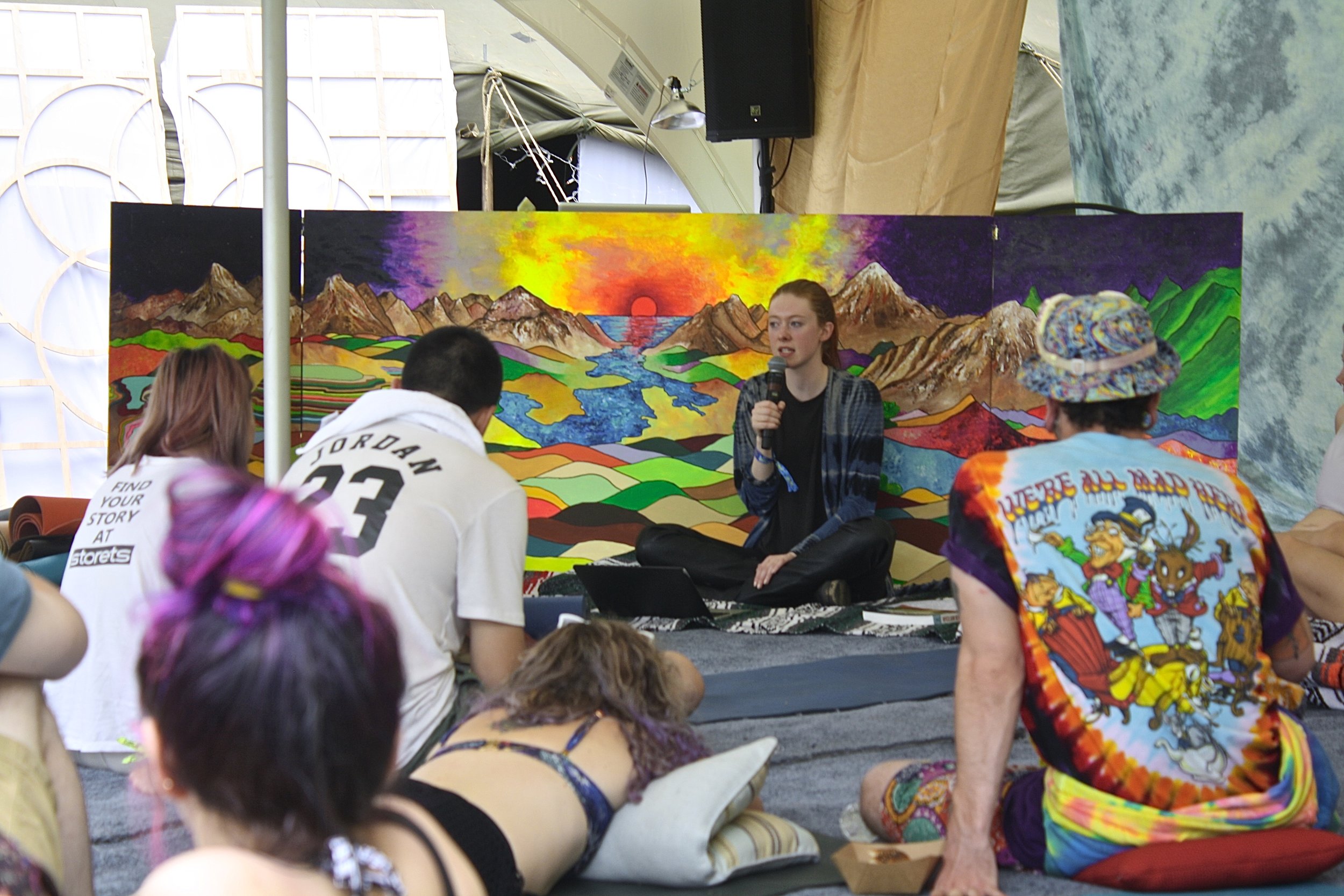
Bad Ginger offering her presentation Mushroom Madness: Into to Mycology in the WellNest
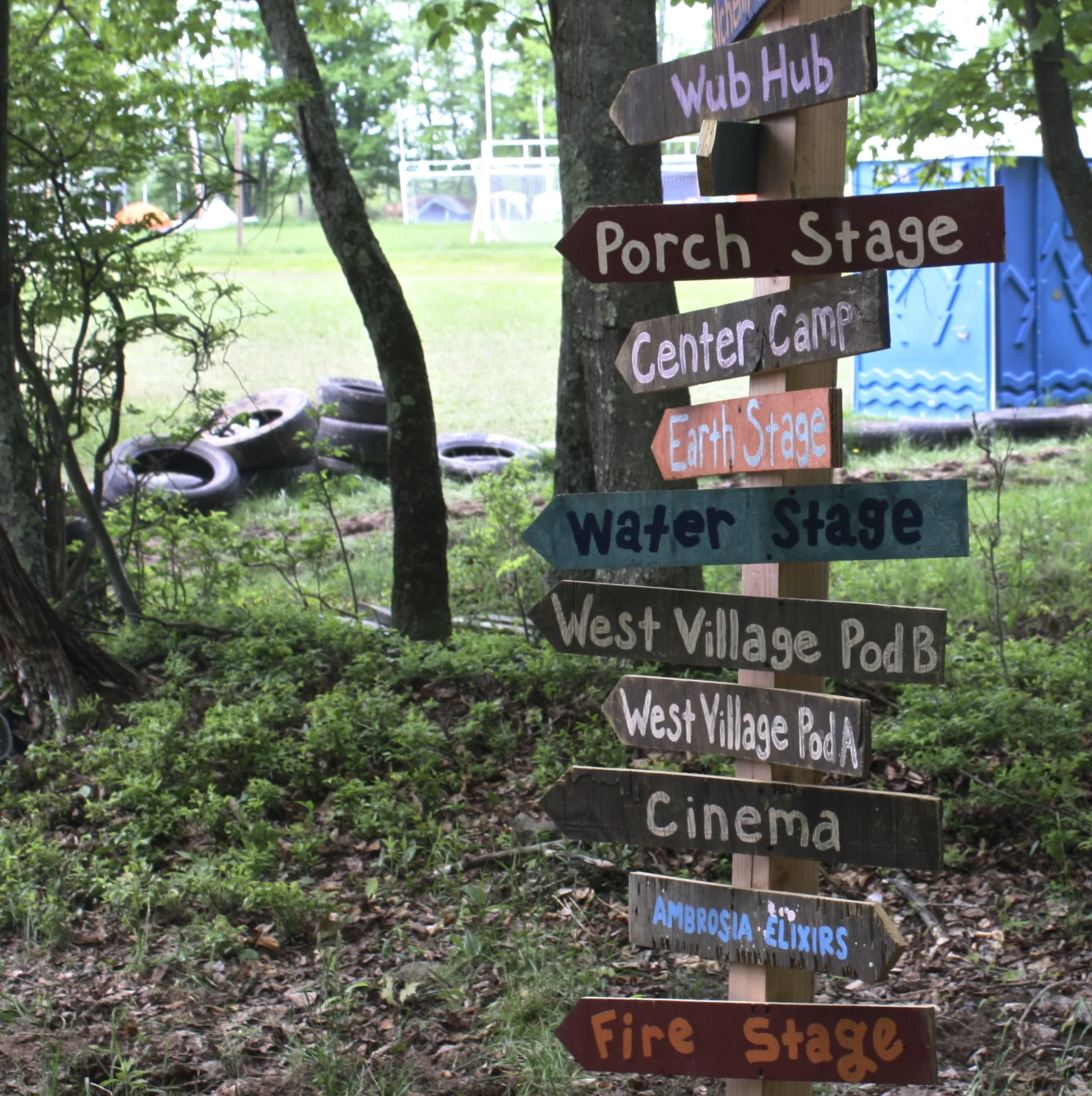
Rolling past the Earth Stage one arrived at center camp surrounded by a host of repurposed cabins and structures inhabited by festival staff and some of the various companies recruited to add their flair to Elements. Harm reduction organizations DanceSafe and Harmonia set up shop around center camp and maintained staff throughout the day and night to keep folks safe, educated, and at an advantage in this complex, indulgence-laden atmosphere. Here was also the WellNest, a multifaceted workshop space that supplemented the overarching theme of health, cognizance, and connectivity with yoga, flow workshops, meditations, and lectures on everything from consent to mushrooms. A stone’s throw across the road from the WellNest was an innocuous front porch with an equally innocuous name; the Porch Stage. A laid back alignment of singer-songwriters and groovy instrumental bands cycled through here during the day. By night the building came alive as the Wub Hub, welcoming a host of deep frequency freaks seeking prime cuts of contemporary low-end production. Saturday evening saw Good Looks Collective and Sermon join forces to present another installation of NYC’s beloved After Dub events, bringing along the talents of Honeycomb, Brightside, Ethan Glass, Saltus, Zoo Logic, and Doctor Jeep.
Descending from center camp towards the lake, the Water Stage hosted light fair during the day. Party-goers were splayed along the beach lounging in the sun, washing down crab cakes with obscenely overpriced Modelos, dancing and bouncing atop a docked pirate ship, and occasionally testing the water on one of many free kayaks, canoes, and rowboats. This stage featured no flashy fanfare, just a DJM mixer, a few CDjs, and a full serving of bread-and-butter house DJs to maintain the vibe during those peak daylight hours. Noteworthy musical curations were provided by Agents of Vibe, The 1989, NSR, Trotter, and Dropkat.
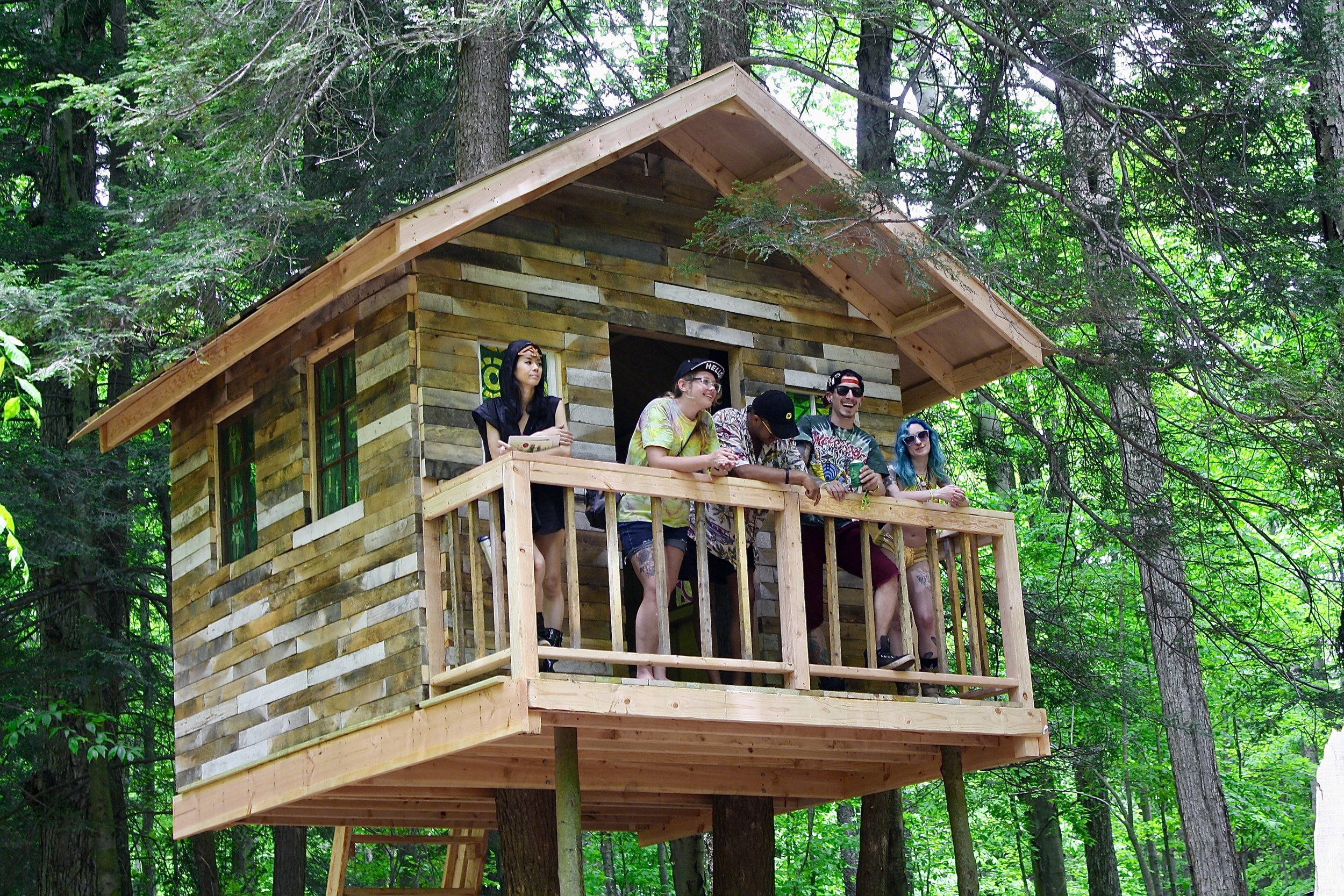
Fun in the sun is usually fun for everyone, but we all need reprieve from the heat. Lucky for the sandy-haired shufflers, the bounty and sprawl of the neighboring woods would provide more than just shade. One step into the forest at large revealed a bevy of art installations and visually-appealing structures. Here among the scattered branches and curious forest pathways one felt immersed in the core of Element’s creative ethos. The deepest layer of this topographical adventure housed the Air Stage. Constructed from a plethora of reconstituted wood and miscellaneous building materials, this organic structure overlooked a muddied glade that would host all manner of delinquents, dragon-chasers, ravers, techno heads, and casual party crawlers. A treehouse and a series of canopy walkways loomed over the stage creating a delightful spatial dynamic and morphing the traditional one-dimensional dancefloor into a true woodland hideaway. Swaying to the sounds of Lemurian, The Alchemist, Experiment.al, Maceo Plex and especially Lee Burridge in these woods was a nearly unparalleled pleasure.

Doubling back deeper into the woods a rising hill gives way to the Alchemy Stage. A small pavillion decorated with medieval flare, a few strong speakers, a fire pit, and a curious tent housing the mobile shop of Ambrosia Elixirs created a self-contained but welcoming atmosphere. This nestled space served as a resting ground during midday and a hip-shaker’s battleground by night. The earthy aroma of those organic elixirs filling the nostrils of passersby. As the sun passed its midway point in the sky above and the surrounding air began to cool the Alchemy Stage would spring to life. So began the longest running micro-party of the event, running nonstop until 10:00 AM the next morning on the first day alone. Psychedelic variants of house and its related genres pulsated from the sound system forcing every passerby to give themselves up to the aural journey at hand for at least a few minutes. Here the disparate audiences from the four other elemental stages were fused into a new micro-community; alchemy. Some of the performers elevating the vibrations here included Soul Potion, Eli Light, Bushwick AV, and Devotion.
Emerging from the tree line past the edges of the Alchemy Stage, a grassy knoll overlooking the vast expanse of the festival bore the weight of the final stage and its vivacious, feet sweeping crowds. Created from an amalgamation of Incendia domes and light fixtures, surrounded on all sides by massive art cars and makeshift lounges, the Fire Stage lived up to its name figuratively and literally. This space hosted the most bawdy and brawny of the weekend's house music as oncoming waves of libidinous dancers took to the blasting pyrotechnics like moths to a flame. The rumble of high-powered subwoofers was felt far enough away to get a body moving with nothing more than rhythm alone, and once fully submerged in the growing mud marsh in front of the decks, there was absolutely no escape. Serving as the yin to the Earth Stage’s yang, the Fire Stage featured some of the most esteemed 4x4 producer/DJs currently running their slice of the scene, including Lee Reynolds, Chris Lake, Ardalan, and the venerable Claude Von Stroke.

It could be assumed that respective heads would gather primarily at the stages curating their particular flavor of electronic music, but that assumption would be not entirely correct. The extent to which true cross-pollination occurred within Elements Lakewood cannot be overstated. It was evident that every corner of the electronic music counterculture was well represented at all stages simultaneously. Elements Lakewood wasn’t just a hodgepodge of fandoms finding common ground with one another, but a destination sought by audiophiles and countercultural types aware that the worlds of steady and broken beat music and their corresponding cultures exist as one wide culture of which we’re all a part.
BangOn! set the stage for the 2018 festival season, and has since received a roaring response from all involved parties. With travelers coming in from seemingly the world over, BangOn! created a true melting pot and stirred it properly. Elements Lakewood has made an indelible mark on the community that propped it up in the first place, solidifying itself as a major contender for the affection and adoration of the Northeast US counterculture. With production companies and wellness services coming together across the board, this festival provided a fully engaged, responsive, and dynamic experience for all who made the trek.
FOLLOW Elements Music & Arts Festival: Elements Lakewood / Elements NYC / Facebook / Instagram
Harmonia Builds a Strong, Safe Community at Elements Lakewood
The organizers and partners of Elements Lakewood Music & Arts Festival promote wholesome vibes and values and you could feel it in the air all Memorial Day weekend. At the verdant Lakewood Retreats there was so much to see and do, Something not so conspicuous was the strong infrastructure in place to keep attendees safe, supported and sanctified during their experience.
The organizers and partners of Elements Lakewood Music & Arts Festival promote wholesome vibes and values and you could feel it in the air all Memorial Day weekend. At the verdant Lakewood Retreats in the Northeasternmost corner of Pennsylvania, there was so much to see and do, from the festival’s array of art installations to its innumerable stages. One aspect of the festival which was not so conspicuous was the strong infrastructure in place to keep attendees safe, supported and sanctified during their experience.

At the foundation of this infrastructure was Harmonia, an Asheville-based organization that provides sanctuary spaces, harm reduction, and so much more to the festival community. A harm reduction presence offers such peace of mind and added value for a music festival, albeit value that most attendees don’t see. It may be surprising, then, that only four dedicated harm reduction and sanctuary space organizations operate in the United States. Elements Lakewood was wise to invite one of them, Harmonia, back for the second year in a row.
Harmonia was founded in 2015 by a passionate perennial festival worker named Maegen Coral. The organization has grown in the hippy holler of Asheville, North Carolina, and has begun to broaden its impact up and down the eastern seaboard and as far west as Missouri. Harmonia can be many things; an attitude, an intention, how one carries oneself. Specifically, Harmonia is an on-site professional support team and task force that promotes health and safety at music festivals. Going beyond the role of the Good Samaritan, this team actively promotes self care as a preventative and harm-reducing technique.
Harmonia believes that widespread health and safety vastly improve the festival experience and allow attendees to truly open up and explore themselves and the world. By bringing back this group of volunteers for a second year, Elements demonstrated its commitment to this ethos as well. “It changes the energy, it changes the expectation,” Maegen says as we chat cross-legged in the grass next to a row of EZ-Ups outfitted so that each resembles a spiritually-aware living room. Ideas tumble from Maegen, the next one arriving before the last one is completely wrapped. With a radio strapped around her shoulder, her shock of bright dyed red hair belies the fact that she’s all business when it comes to safety and ops at festivals. While we spoke, she maintained a sporadic dialogue with other workers through the radio strapped to her shoulder. Now and then she executed some surely needed leg stretches.
“What we’re doing here is 'iso', which is isolation - individual pods for people who have augmented situations and who are highly distressed.” Here Harmonia volunteers provide one-on-one support to guide festival attendees experiencing amplified states, and help de-escalate their experiences as necessary. “We have a lot in common with the philosophy of the Zendo Project,” Meagen says, referencing the organization at the forefront of harm reduction at music festivals. The Zendo volunteer training, offered annually at Burning Man and available for free online, became the first building block for Harmonia’s volunteer trainings.


Harmonia was positioned adjacent to the Well Nest at the center of the festival grounds. Their three isolation tents, each walled in on three sides by rich tapestries, may have been the most comfortable and serene spaces to be found on the grounds. Next to them was a table, a practical music festival oasis. Upon the table next to an amethyst geode, a small picture of Albert Hoffman and fliers for Solasta Festival was bug spray, sunscreen, hand sanitizer, condoms, aloe vera, and body lotion all available to the public. Elements Lakewood is early in the festival season. Many folks, especially city folks of which Elements was chock full, were stretching their festival legs outdoors for the first time. As such, the availability of these provisions was truly appreciated by all. (Your correspondent visited Harmonia’s space more than once for sunscreen after spending time down on the lake, though fortunately a return visit for aloe vera wasn’t necessary).
The sun bore down Saturday at Elements as Meagen and two of Harmonia’s volunteers, Laura Eshelman and Greg Pool, continued to share their experiences in the shadow of their sanctuary space. Elements Lakewood had an infectiously groovy vibe from start to finish. But while talking to these good Asheville folks, I couldn’t help but feel an even greater confidence, a nascent feeling of empowerment that my newfound company was bringing out of me. “They create an environment of great peace and relaxation, not just physically, but more importantly - metaphysically and spiritually. The importance of this should never be lost on an event promoter,” according to the Tipper & Friends crew. They call Harmonia their “go-to” for harm reduction. At the Tipper & Friends 4321 event in Astral Valley last summer, Harmonia established their public sanctuary space. At Elements, just the isolation tents were present due to budgeting constraints. Maegen gets a note in her voice and a smirk flashes briefly across her face when she mentions the public space.
It was a relatively slow weekend in and around the Harmonia space at Lakewood. Ironically, that can ultimately be positive for this group. It hopefully means people are already implementing the practices that Harmonia promotes. What are those practices? Most are more simple than you’d think. “You’d be a surprised at how much your mood and energy levels and emotions change when you have a lack of water compared to when you’re drinking water. It’s a physiological, emotional shift. So drink water and offer it to others who may need it,” Maegen suggests. “You need nourishment; a lot of deficits come from lack of nutrition or lack of water. Check in with your friends, check in with your neighbors. Pay attention.”

Indeed, the crowd at Elements Lakewood was a self-aware and sophisticated bunch. Bad scenes were few and far between. Unhealthy behavior was a bit harder to find than usual. In addition to providing a sanctuary space and a cache of healthy resources and critical knowledge, Harmonia offered indirect benefits to the festival. The group serves as a backstop of sorts for festival security. After all, security staff ought to be handling issues of safety. They’re not trained in compassion work and harm reduction. The Harmonia crew, then, can handle “augmented situations” and allow security to allocate more of its own staff to the safety and ops work that is their purview. Elements Lakewood appeared slightly understaffed this year, so this added value was essential. According to Eshelman, also an Asheville resident, even when Harmonia's space isn't too busy it's value endures. "It's a symbol," she says.
During the offseason, Harmonia hosts shows - fundraisers - in their native Asheville and elsewhere in the Southeast US. It takes some resources, after all, to transport a box truck full of care items, festival decor and zen trappings across the Eastern US. Yet these events are more important than the windfall they provide. “One of the ways we seek to spread our message out in the community is to actually be an active part of the community. So the best way to really influence these festivals and this electronic culture in a positive way, encouraging people to be conscious and aware of what they’re putting into their bodies and how they’re caring for themselves, is to be an active part and create the container for that,” says Maegen. “So it’s not just us asking promoters ‘hey, will you support this mission?' We actually create and produce these parties where that’s at the forefront.” To that end, Harmonia is co-hosting its own festival called Solasta Festival in the hinterlands of Eastern Tennessee on August 17 & 18.
The need for capital, though, persists. A few weeks ago Harmonia established a Patreon account to help sustain their enterprise through crowd-funding. Patreon seeks monthly contributions and targets monthly funding goals while also inviting patrons to immerse themselves more deeply into the Harmonia crew and culture. There are tiers of support, and some are pretty hilarious. A $5 monthly donation earns you the title of Harm Reductor. “By choosing to be a Harm Reductor, you are choosing to actively maintain and support a healthy festival culture for everyone. Along with those karma points, you get access to our Patron-only Live Feed as well as our undying love and appreciation.” At $25, you’re a Pillar of Support. With $500 you’re a Healing It Homie. “You are literally *The Homie*. With your contribution, Harmonia can be more free and available to give our all in the service of others.” Different contributions earn physical and sonic swag like stickers, t-shirts, exclusive artist mixes and guest passes to Harmonia events. (If you’re in the Southeast US, Harmonia events are no slouch. Check out their past bookings).
Harmonia’s ethos and the core of its volunteer training are empowerment through education and self-care. These principles, not limited to Harmonia’s sanctuary space, were on display everywhere at Elements Lakewood and made for a wildly wholesome party. Music festivals, particularly those in far-flung retreats like Elements Lakewood, can be physically and emotionally challenging experiences. So empower yourself, says Harmonia, by taking care of yourself and making sure your crew does the same. Self-knowledge is the real vibe, and the vibe was thick at Elements Lakewood. “So many of our interactions are intuitive,” Maegen says. “You go off of facial expressions and body language, so what are we paying attention to? How can we put it in our minds to prioritize our well-being and the well-being of others. Because when we’re all feeling good, we’re going to have a better time. When we’re all looking out for each other we're going to feel safe.”
SUPPORT & FOLLOW Harmonia: Patreon / Official / Facebook / Instagram
FOLLOW Elements Music & Arts Festival: Elements Lakewood / Elements NYC / Facebook / Instagram

Artists to Watch - Psychedelic Sleepover Undercard
Headliners grab headlines for a festival, but its often the strength of the undercard that makes a great musical experience on the ground. By their nature, undercards carry unfamiliar names. There's value in wandering festival grounds hither and thither drifting towards whatever catches your fancy. In fact, we recommend this approach. But The Rust Music was designed to give unheard artists an audience, so we took a magnifying glass to the undercard at Psychedelic Sleepover.

Page Farm in Croydon, New Hampshire (Lucid Photography)
"Who are these people? What do these words mean?" "No clue." Frequent refrains from festival-goers examining an undercard. Headliners grab headlines for a festival, but its often the strength of the undercard that makes a great musical experience on the ground. By their nature, undercards carry unfamiliar names. There's value in wandering festival grounds hither and thither drifting towards whatever catches your fancy. In fact, we recommend this approach. But The Rust Music was designed to give unheard artists an audience, so we took a magnifying glass to the undercard at Psychedelic Sleepover.
This exploratory bass music showcase takes place on June 1 & 2 in the woods of New Hampshire. It's hosted by northern New England's best bass crew, Taproot Productions, who stuffed their bill with talent. It's a small gathering, so the undercard is no 60-artist rabbit hole. Northeastern folks are probably familiar with at least a handful of the names. Still, to acquaint audiences with underground sound, we offer 10 artists to keep your ears on from the bottom half of the Psychedelic Sleepover bill. For a further taste of the undercard's energy, we assembled a playlist containing a cache of psychedelic grooves from these 10 performers.
ALEJO
Alex Hinger aka Alejo is a psychedelic bass heavyweight from the Midwest with reach from coast to coast. Coming out of Cincinnati, Alejo is a co-founder of ThazDope Records and has additional releases on Street Ritual, Shadow Trix, and Wormhole Music Group. With multidimensional down to mid tempo and halftime bass music, he pries open sonic spaces and slices through mental states. Alejo can act with force, as on "Phonetic Flex", or with delicacy, as on "Inciting Ferdinand". Aqueous downtempo soundscapes run into fuzzy neuro halftime business within his mixes, which include a superb session with BeatLab Radio. Alejo has performed at a solid cross section of festivals including Infrasound in Wisconsin, Bloomtown in Minnesota, Resonance in Ohio and Stilldream in California.
FOLLOW Alejo: Official / Soundcloud / Bandcamp / Facebook / Instagram
Malakai performing at Ode to Earth in Philadelphia (Panda Media)
MALAKAI
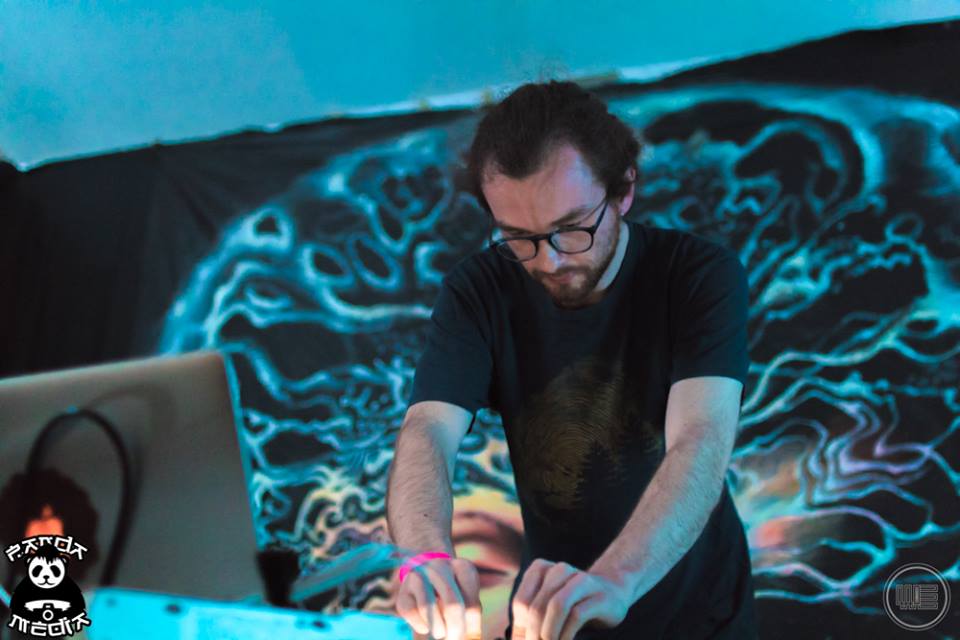
Malakai performing at Ode to Earth in Philadelphia (Panda Media)
There's a mysticism to Malakai's music that's amplified when brought out from the night club into the bright fields and foliage of a festival. Ranging from downtempo to midtempo, at times dipping into ambient but always equipped with an edge, his music appears invigorated by fresh air. Fortunately Malakai is no stranger to the northern New England woods. He's a familiar face in Portland, Maine, the home turf of Taproot Productions. As a veteran of Wild Woods Festival, a cousin to Psychedelic Sleepover, he's perhaps played Page Farm more than any artist on our list. Lately he's been holding down New York City and the Tri-State and testing a bit of new and unreleased material. His music borders on many styles, but ultimately cultivates an energy all its own.
FOLLOW Malakai: Soundcloud / Spotify / Bandcamp / Facebook / Instagram
MATT CAREY
Matt Carey's debut LP was called Born into Bablyon. He chooses not to stay inna babylon, opting instead to journey back to roots guided by minimal, earthy house music. Hailing from Boston, Carey will hold down the local support along with so many others. Save for other locals like Moses and a few more, the diversity on Psychedelic Sleepover's lineup is mostly limited to broken beat music. Carey's four-on-the-floor movement should be a delightful departure, then. Hand drums and woodwinds mirror drum machines and synthesizers in his drawn-out, slow-developing tunes. There's a touch of glitch in all the right spots, too, especially on "Future Sound". The vibe is energetic and sexual, the presentation peaceful and serene.
FOLLOW Matt Carey: Soundcloud
MAXFIELD
Jake Maxfield has been dropping diverse strains of intriguing bass music on a consistent basis for the past year from his home in Boston, Massachusetts. His offering ranges from neuro to glitch and quasi-dubstep, and even a bit of purple vibes come through based on the synthesizers he chooses. He truly queers typical genre classifications, and just goes for the jugular with his own unique one-off arrangements. There's danceability and psychological complexity in his music; a devilish combination He's represented by the folks at Taproot Productions and as such he's playing two of the Sleepover's pre-parties including the New York City warm-up with Kalya Scintilla presented by The Rust Music. It's rumored that he has a stack of unreleased goodies prepared for these performances and the Sleepover itself.
FOLLOW Maxfield: Soundcloud / Facebook / Instagram
SHWEX
Shwex released his first EP before graduating high school. Since then he's been steadily elevating his sound and reputation within the psychedelic downtempo universe. Some downtempo can be overwhelmingly in its complexity. Shwex gets complex, with the intense, industrial "Square One" as an example. But there's also relaxation and a unique simplicity in his composition, as on "Aurai". His developing side project anomly seems to balance both these extremes. Recently he's been introducing IDM and glitch vibes into Shwex music where psy influence was once more prevalent. We imagine the energies within a Shwex performance would be ripe for release in dead of night or the spring of early afternoon. He resides in Olympia, Washington, so for him the Sleepover is a rare East coast excursion not to be lightly overlooked.
FOLLOW Shwex: Soundcloud / Spotify / Bandcamp / Facebook / Instagram
SOMATOAST

Somatoast relaxing
First, Somatoast's name is righteous. One could say the "soma" refers to the sedating downtempo that he's been producing for the past five years, while the "toast" hints at the charred state of the collective audience brain after he's through throwing his psych funk uptempo offering. Like many artists on the Psychedelic Sleepover lineup, Somatoast is comfortable across tempos and blurs lines between them within his complex performances. Hailing from Austin, Texas, Somatoast aka Mark Rubin is a multi-instrumentalist. This acoustic training adds earthy dimension to his music, an example being his cut "Unraveling" featuring Zonra off Aquatic Collective's Standing With The Waters compilation
FOLLOW Somatoast: Soundcloud / Spotify / Bandcamp / Facebook / Instagram
TERRAPHORM
Here's a great opportunity to catch some of the gratuitously deep and spaced-out dub music that's less available in the festival's first two tiers. This fellow offers deep, dark, rootsy dubstep. He's from Worcester, Massachusetts and recently began hosting shows under his brand called Citadel Bass. He's rooted deeply in Fractraltribe, performing in April at that group's 10-year anniversary bash in New York City. His sets are rumored to spellbind, offering a dance floor experience that's "transformational". Terraphorm's available music, mostly made up of past sets including an immense FractalFest 2017 Minimix, point in this direction. It's deep stuff. That only a small but rich taste is available from Terraphorm intrigues us even more. You won't know exactly what's coming, just that it's got weight.
FOLLOW Terraphorm: Soundcloud / Facebook / Instagram
TSIMBA
Deep roots generate plump, wholesome yields. Mark Evan Musto aka Tsimba has for years driven forward his future roots sound - a hybrid of dubstep, drum and bass and neuro - and today its bearing juicy, delicious fruit. Mark is from Connecticut and cut his teeth in that state's burgeoning community with Elemental Minded Promotions. Now residing in Brooklyn, he's become a regular performer in New York City, a roaming resident one could say. His DJ skills are rock solid and he performs with mostly original music save for a few choice selectors, usually tunes from his peers. Being a drummer by trade, Mark spares no effort in crafting hard-hitting and well-rounded percussion, just the sort that keeps a crowd engaged and moving during a live performance.

Tygris cutting up
FOLLOW Tsimba: Soundcloud / Spotify / Facebook / Instagram
TYGRIS
Tygris' live performance continues to evolve, but its authenticity and quality is established. The heavy hip-hop influence in his studio music really manifests itself during his performances. The tempo often stays at a steady bop, and all sorts of screwface neuro synthesizers are woven through the beats. His original tunes bang, especially those off his recent Redefined EP, and he mixes these up with choice selectors from the glitch hop hall of fame. Tygris aka Zach Plocic from Long Valley, New Jersey, also uses skillful live record scratching to set off the hip-hop vibe even more. He's been known to sit in and scratch with other artists, so we wouldn't be surprised if he hits the stage more than once at the Sleepover.
FOLLOW Tygris: Soundcloud / Spotify / Facebook
WESSANDERS
Being unfamiliar with his performances, our zeal for Wessanders is based almost exclusively on the strength of his "Christmas Miracle Mix" from this past December. It's just twelve minutes of original music, but its twelve minutes of unequivocal heat. The young man, whose real name is Kai Felsman, is clearly cooking with gas though he hasn't served up many plates yet. We hope his Sleepover set will be an opportunity for audiences to explore his sound, which is clearly cutting edge and very visceral. Like his collaborator Maxfield, Wessanders is held down by the Taproot team.
FOLLOW Wessanders: Soundcloud / Spotify / Facebook / Instagram

Elements Lakewood Music & Arts Festival - Zoo Logic Warmup Mix
Presenting the second promo-mix in anticipation of Elements Lakewood this summer, Zoo Logic has provided a well-crafted smorgasbord of melodious interplay, evolving sound design, and excellent cuts between tracks. The mix features a majority of original Zoo Logic tracks alongside a few choice remixes and selectors, and is sure to whet a multitude of palettes with its varying stylistic directions.
Presenting the second promo-mix in anticipation of Elements Lakewood this summer, Zoo Logic has provided a well-crafted smorgasbord of melodious interplay, evolving sound design, and excellent cuts between tracks. The mix features a majority of original Zoo Logic tracks alongside a few choice remixes and selectors, and is sure to whet a multitude of palettes with its varying stylistic directions.
Zoo Logic is the brain child of Austin Rogers and Jeff Blair, who have carved out a following for themselves through their intuitive combination of high-polished production and beefy bass tones. If you’re itching to catch them up close and personal, then make sure you find your way to Elements Lakewood in Pennsylvania this summer. The get-down is scheduled for May 25-27, and features a host of like-minded producers and DJs ready to serve up something extra hot for Memorial Day weekend.
FOLLOW Zoo Logic: Soundcloud / Facebook / Spotify
FOLLOW Elements Music & Arts Festival: Elements Lakewood / Elements NYC / Facebook / Instagram
![Afterdub - Mad Zach [Profile]](https://images.squarespace-cdn.com/content/v1/59530136f5e2319eabb7d87f/1529795769229-OKAI7R5Q0ZWJ5VGC11AY/AfterDub+-+Mad+Zach.jpg)
Afterdub - Mad Zach [Profile]
Mad Zach is one of the most interesting personages in contemporary electronic music. He is one of the world’s foremost experts in controllerism, which is the practice of using software controllers (MIDI, Open Sound Control, joystick) to create and perform music. He’s been finger drumming for almost a decade and his skills are masterclass. On March 8 Mad Zach will roll into Brooklyn, New York laden with gear and keen on expanding and potentially blowing minds at Brooklyn Bazaar.
Mad Zach is one of the most interesting personages in contemporary electronic music. He is one of the world’s foremost experts in controllerism, which is the practice of using software controllers (MIDI, Open Sound Control, joystick) to create and perform music. He’s been finger drumming for almost a decade and his skills are masterclass. Mad Zach’s music is pure innovation, so much so that Aphex Twin rinsed one of his tunes live last year. Mad Zach essentially embodies the concept of the electronic musician, and his ocean of knowledge about production is channeled with ferocity into one-of-a-kind dynamic live performances.
Mad Zach came up in the Bay Area electronic music scene, and his sound is rooted in hip-hop and West Coast bass. He’s collaborated with fellow Bay Area native G Jones so many times that the two are virtual partners in crime. As trap, dubstep, and future bass have evolved globally in the past five to ten years, those sounds have entered the Mad Zach laboratory where they’ve been reconfigured. His sound eludes classification, but in a phrase it's a hybrid of hip-hop, dubstep and trap. However the influences interacting in his music are more numerous than the buttons on his midi-pads. His most recent release, “The Visitor”, demonstrates how chimeric Mad Zach music has become. Having moved to Berlin, Germany a few years back, his sound has assumed a bit of the darkness so ubiquitous in that city’s techno scene. That’s not to say Mad Zach was peaches and cream to begin with; his work has always involved a bit of eyes down business.
Many were first introduced to Mad Zach in 2015 through the Ableton Push video, where Zach skills what was then the new Ableton Push controller as only he can. This, or any of the countless videos on his Youtube channel, illustrate the performance style that Mad Zach brings to his live sets. “When I perform, I’m typically rocking a couple midi fighters and a twister for mixing and effects,” Zach told Ariel Hawk of Smoothie Tunes in a 2015 interview. A Mad Zach performance is as live as live gets in electronic music. It’s freeform, groovy, and supremely dynamic. Zach’s music is not beholden to any semblance of the build-drop format. It’s instead a mercurial, evolving groove highlighted by anticlimax and subtle interplay between provocative note arrangements, and subdued but dazzling soundscape.
On March 8 Mad Zach will roll into Brooklyn, New York laden with gear and keen on expanding and potentially blowing minds at Brooklyn Bazaar. Billed as an Afterdubevening and presented by Good Looks Collective and Sermon, the show includes support from the steady-handed audio surgeon SubDocta and the DMV-area dub deviant ChoppyOppy. Catching a Mad Zach set is an opportunity not to be overlooked. The performer was originally part of the recent G Jones & EPROM tour, but he had to drop off and ended up playing only a couple dates. The soundman's return to the road is thus all the more exciting.
Familiarize yourself with Mad Zach music on any platform, scoop tickets to his Afterdub performance, and gird your loins.
FOLLOW Mad Zach: Official / Soundcloud / Bandcamp / Spotify / Youtube / Facebook / Twitter
The Gradient Perspective Takes Over Nightmare Festival
"One of my focuses with this is to bring in some really up and coming, talented artists, who are pioneering their own sound in one way or another. They deserve the opportunity to show people their music; people will appreciate the diversity beyond hearing the same tracks dropped in every set at a festival main stage," mused Jared Oppenheim, Co-Founder and musical director of the Gradient Perspective, as we spoke about his choice of talent to rock the Gradient Perspective Lounge all weekend.
"One of my focuses with this is to bring in some really up and coming, talented artists, who are pioneering their own sound in one way or another. They deserve the opportunity to show people their music; people will appreciate the diversity beyond hearing the same tracks dropped in every set at a festival mainstage," mused Jared Oppenheim, Co-Founder and musical director of the Gradient Perspective, as we spoke about his choice of talent to rock the Gradient Perspective Lounge all weekend. "Another main intention is for people who already love electronic music to dive deeper into a new niche that they might not have been privy to before." He certainly hit his mark 100x over, having been given the opportunity to host a stage at the annual Nightmare Festival in Maryland, bringing together an extensive conflagration of musicians and producers that subsist deep in the entrenched niches of electronic music.
HeavySide Function, slinging an impressive Ableton setup complete with modular synthesizers and sit-in sessions with a gaggle of instrumentalists, presented a flourish of electro-soul and golden-era hiphop beats that brought a delicious head-nod vibe into the weekend; Tygris, unleashing a torrent of home-brewed neuro-hop and breakbeat-inspired dance floor compositions, scratching vinyl to every transient bursting out of the speakers; Choppy Oppy (Mr. Oppenheim's musical project), presenting a powerful blend of triphop, glitch, and dub, all accompanied by his right hand man and expert guitarist, Al Smith; Sketchy Pete, a long-time collaborator with the Gradient Perspective and an incredibly potent DJ, combining a healthy serving of original tracks and choice selectors from across the bass music spectrum; Face Plant, a resident Rust artist who brought out the Halloween spirit with an intoxicating dose of his signature biotic sound design and visceral glitch soundscapes; Yheti, with his instantly identifiable half-skewed tambres, brought not just his typical and widely appealing performances multiple times over the course of 48 hours, but also curated an immersive, 3 hour sunrise set to ring in Saturday morning. Mindwalker, Jizzy Fra, Smokestax, Vide, IndoBeats, Skankuh, The Orcestrator, and Stratosphere would provide their own unique stylings and musical adventures throughout the the weekend as well, adding to the impressive army of sonic revolutionaries spearheading the success of the Gradient Perspective's efforts, and subsisting as the maximum highlight of the weekend festivities at Nightmare.

In the sleepy town of Darlington, MD, Camp Ramblewood finds its home nestled amidst a small forest clearing, complete with a picturesque lake and quaint cottages lining the trails around the campgrounds. It hosts a number of events each year, including Luna Light and Dreamscape. For the past 5 years, Badass Events has been hosting the Nightmare Festival at Camp Ramblewood on Halloween weekend, to much critical success. Featuring a modest, outdoor main-stage and several barns retrofitted with full LED and laser visual displays, Nightmare successfully juggles several active stages at all times throughout the duration of the event each year. Typically, the lineup is heavily associated with dubstep, D-n-B, and other aggressive formats of bass music; Without breaking away from their traditional pool of artists/genres, Nightmare 2017 featured a new addition to their festival experience, vis a vis The Gradient Perspective. I joined them for the weekend down in Maryland and got up close and personal with the top-notch team of art enthusiasts.
The Gradient Perspective is an art and music collective based out of Washington, D.C. With Ally Grimm and Jared Oppenheim at the helm, the GP team has hosted events non-stop over this past year throughout the DMV, and the community response has been nothing short of massive. "Jared and I met last year, and we got the idea to create the Gradient perspective while under an incendia dome at Luna Light. We loved the communal culture behind the dome installations," co-founder and art director, Ally Grimm, said to me. Incendia Domes are multi-sensory, immersive geo-domes found around the festival circuit in the US. "Our main goal is to inspire a sense of unity and community through creative collaboration. We're very much about an equal playing field; there is no hierarchy within our events."
The Gradient Perspective's home at Nightmare was a two story lodge found right behind the main-stage field, and was entirely retrofitted to become a psychonautic paradise. Walking up to the building, it was evident that the weekend denizens of Nightmare were drawn to it likes moths to a flame. People mingled on a balcony hanging above a pool covered for the Fall. Fluorescent, neon lighting was radiating from the windows and from under a tarp-covered section of the balcony. The familiar pulse of sub-frequencies emanated from the very walls of the structure. The outer aesthetic was already wildly tantalizing, but quickly became an afterthought once one stepped foot inside of what turned out to be a psychedelic haven for creative minds and lost wanderers.
Entering the building, the rest of festival melted away into the back of the mind. I was instantly greeted with a bevy of visual installations, from scintillating ocular displays to a retrograde phone booth renovated with high-reflective veneer, crafted by artists I'd later come to know as T.J Spurge and Liz Lubitsky, respectively. The room was bursting with visual artists and their labours of love, with every table and every inch of wall space displaying dozens of creations, ranging from high-relief vistas to gorgeous digital portraits. Brian Cohen, the art gallery director for Nightmare, is the first person you see on the way in and the last on the way out, greeting newcomers with a comfortable smile while maintaining an intense focus on his live painting exploits scattered around the room. A rotating team of artists joined him throughout the weekend, all brought in to help The Gradient Perspective's collaborative vision coalesce into a reality.
Stepping through a series of curtains at the far end of the art emporium, above my head hung a sign - "The Imperium". This word is Latin for "absolute power"; I failed to see the true significance of the title until later in the evening, as I had come a bit early in the day, so I was greeted with a quick sneak-peak of the stage design and setup within the room. Amidst the quiet calibration of the visual equipment for the late night party, Ally was leading a yoga session attended by about a dozen or so passive attendees. This space would continue to be utilized in the daylight hours of the weekend as the hub of the Gradient Perspective's workshop offerings. I stepped onto the aforementioned balcony to check out the micro-party I could hear through the door, and was instantly taken aback by the delightful audio-visual alcove I walked into; a multi-sensory grotto filled with effervescent space-scape signature designs, ceramic sculptures, and soul-piercing resin eyes.
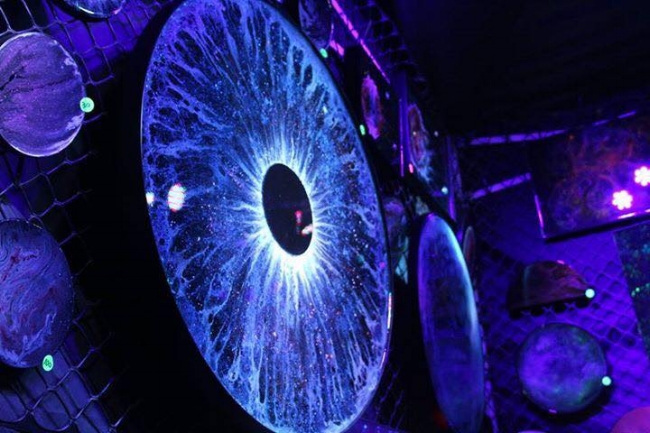
Based out of Ghent, New York, visual maestro T.J. Spurge was brought onboard to pilot his famed "Resinations Lounge". "I met Ally at Disc Jam this year, she was in the art gallery there. She recruited me to come down here with her and the Gradient Perspective. I was super excited because I had never done something like this before.” I was doing my best to get some choice words from him about his experience with working with The Gradient Perspective, but kept getting distracted by his outlandish, neon live visual setup adjacent to us. “They are really dedicated to what they do; I probably annoyed the hell out of them with a million questions and they just rose to the task,"
The installation came complete with couches, it's own soundtrack, and a projection screen covering the entirety of the far wall. A series of high-fidelity cameras were hooked up to a meticulous setup that allowed T.J. to go beyond displaying already finished works of art, and using his signature resin, powder pigments, and alcohol based ink, create entheogenic collages, swirling and merging to a point of chromatic harmony. Each person who stepped into this omni-artistic domain was either instantly encapsulated by the live visual setup, or found themselves lost in one or another of Spurge's exoplanetary designs. When someone would light a smoke underneath the tarps, Ally would swoop around the corner and kindly ask them to take it to the open-air section of the balcony, a small detail but one which made the space more pleasant and functional throughout the weekend.
After being submerged in the Resination Lounge, I found the Gradient Perspective team taking in the last rays of sunlight across the balcony before the nighttime festivities began. "My intention with the Gradient Perspective space is to bring an extra dimension to festivals that have a larger audience, but maybe people are looking for something more than just their usual festival experience, so we want to bring an immersive, interactive space that showcases eclectic music and art," said Jared. Being there for under an hour, I could already see his vision clear as the beams splaying through the tree limbs in front of us.
The sun had set, every laser, light, and LED had been switched on all over Camp Ramblewood, and I suddenly realized that the pounding frequencies I was hearing over my voice was coming not from the main-stage, but from behind the wall at my back; The Gradient Perspective takeover had transformed from a tranquil lounge into a nightcrawler paradise. The ceiling was adorned with translucent clouds that boasted an internal mixture of fluorescent hues. The two back corners of the room were covered in couches and blow-up beds adorned in an array of wondrous textiles. A sea of nocturnal revelers in costume bounced and slid around the room to a constantly evolving beat and groove. The stage, or maybe it might be better to call it the "Nexus Imperium", was a breathtaking amalgamation of precision-cut white surfaces and sift draperies, coated top to bottom in expert-level projection mapping. I thought back to the sign hanging above the entryway, and realized that this was the power it was referring to.
My jaw dropped as I craned my neck and observed Jack Hurley and Ricardo Martinez controlling the entire production from a complex series of midi controllers. I had to understand more of what I was seeing, and eventually I tracked down Jacob New, the technical director for the Gradient Perspective stage. "I guided the animator and the projectionist (Hurley and Martinez) in a way that enabled them to take their animations, render them slice by slice, and map every single video in order to puppeteer their stage with midi controllers designed with a very ergonomic interface that allows you to create an instrument out of your stage." An instrument it truly became, with Hurley and Martinez bouncing off of one another's sequencing and visual modulation in perfect, beat-matched tandem with the music. "You can have a performance that's synchronous and jamming with the music. It creates something thats interactive, real time, and unlimitedly creative." His endeavor was an absolute success, with the Gradient Perspective stage easily usurping the visual spotlight from even the festival's own mainstage. It was the centerpiece that tied the entire GP operation together, and allowed the Gradient Perspective to assume the role of the absolute coup de gras of the weekend.
The Gradient Perspective, true to its' name, seamlessly balanced a suite of artistic hues, musical colourations, and vibrant positivity, birthing an entire closed ecosystem and immersive experience that stood apart not only from the rest of the Nightmare festival, but even more so from almost every other attempt to create such an immersive environment I've thus far witnessed. The artistic merit, the musical talent, the organization and execution, and the absolute genuine want to foster an inclusive, creative space for likeminded individuals seeking an outlet for emotion, creative content, and communal gathering was second-to-none. Having seen what the Gradient Perspective brings to the table, and how far they are willing to go in order to both accomplish their vision, and accommodate all who endeavored to help bring that vision to life, gave me a sense of the true strength and capability of our ever-growing community of society's wildest creatives and revelers. Keep all eyes peeled and ears open to any and every bit of news coming from our friends at the Gradient Perspective: this is but a taste of what is yet to come.
The Rust Music would like to thank Jared Oppenheim, Ally Grimm, and Badass Events for making this piece possible.
FOLLOW The Gradient Perspective: Facebook / Soundcloud
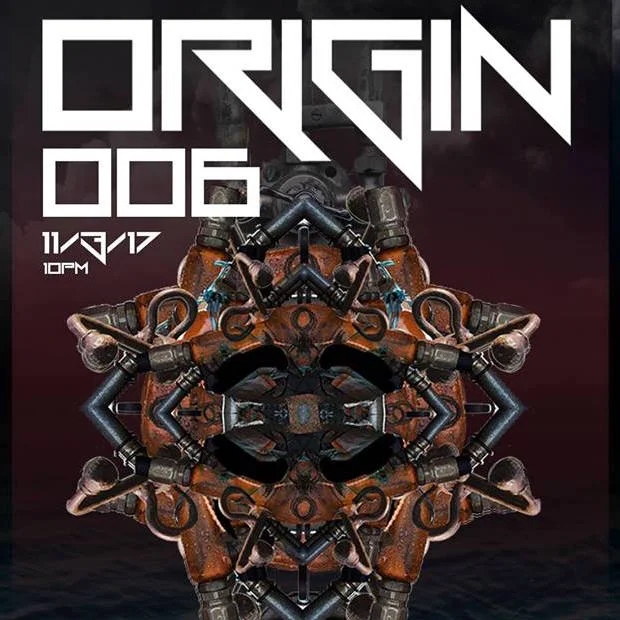
Origin 006 Brings Ton of Underground Talent to Bizarre Bushwick
The Rust has the privilege of co-hosting Origin 006 on Friday, November 3rd with the Brooklyn Bass Troupe at Bizarre Bushwick (12 Jefferson St. 11206 Brooklyn). The ORIGIN series focuses on cutting edge electronic production, primarily in the realms of bass, glitch and psy music. Each one of the artists will be playing a 100% original set. We put together a warmup playlist with tunes from a select couple of Friday evenings performers so you can get a little taste of what you're in for.
The Rust has the privilege of co-hosting Origin 006 on Friday, November 3rd with the Brooklyn Bass Troupe at Bizarre Bushwick (12 Jefferson St. 11206 Brooklyn).
The ORIGIN series focuses on cutting edge electronic production, primarily in the realms of bass, glitch and psy music. Each one of the artists will be playing a 100% original set. We complete the environment with reinforced sound, installations, vending, live art and space saved especially for flow arts.
Bringing beautiful ethereal beats to Origin 006 is Amawalk, an NYC-based producer who spun a delightful set at The Rust Music's Kalya Scintilla & Whitebear pre-party on October 14th. Truckin' up 95 from Philadelphia, Shapesift offers emotive ambient sound with thick layers of wet synthesis, while LRKR offers melodic, synth-laden music.
Holding down the heavier end of the spectrum is local producer Wubwitz, and Bagger Vance, a Queens native who'll give drum and bass heads a reason to get reckless.
Then there’s Nieratka, the man behind the Origin series and a true master of the squanch.
Vocal stylings will come from the quick-witted NYC rapper Rasp-5, who will join both Soley and Tygris for a collaborative performance. The trio teamed-up for an early October performance in Queens with Soley offering his extremely tight, soulful beats and Tygris on the cuts. Tying the night together with detailed, filthy sound design, and forming the greater part of The Rust Music’s imprint on Origin 006 will be Philthadelphia pride, Face Plant.
With this diverse roster, Origin 006 offers strains of sound for almost every electronic ear. As each performer presents all original sets, attendees can hear a night’s worth of new music for just $5. So join us for this unique gathering, and turn out early because that fiver becomes a ten-spot once the clock strikes midnight.
We put together a warmup playlist with tunes from a select couple of Friday evenings performers so you can get a little taste of what you're in for.

![Seppa - Interview + Boosted [EXCLUSIVE PREMIERE]](https://images.squarespace-cdn.com/content/v1/59530136f5e2319eabb7d87f/1626113208781-BZ7C6B7E3LCECV7UD4CS/Boosted.jpg)
