
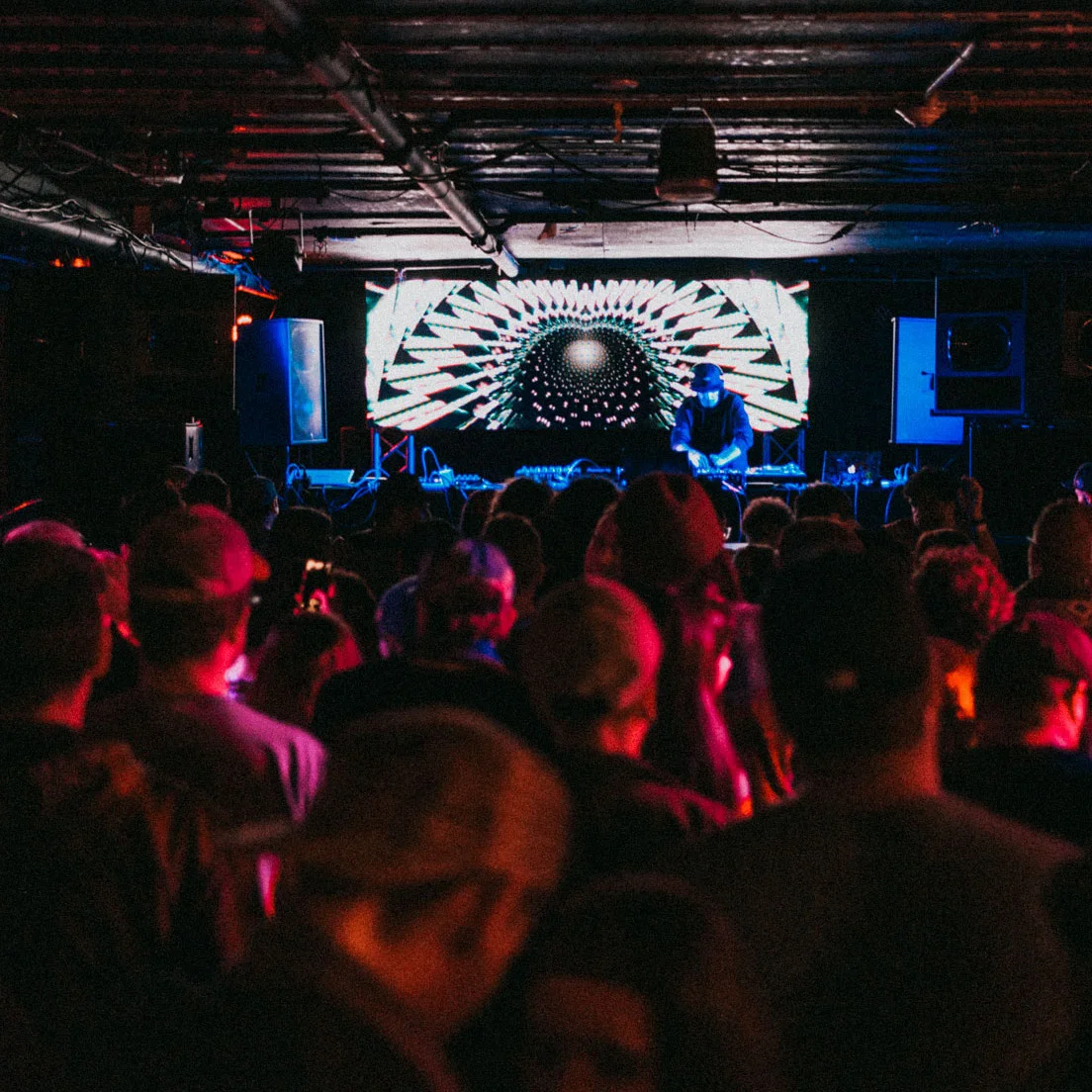
KLO, Mickman Offer Glitch-Hop Getdown at Middle East Downstairs
The atmosphere cultivated by Rezinate, Hennessey, The Middle East and all the fans on nights like these helps nurture a wholesome community based around freedom of expression and an appreciation for authentic performances. This Boston-based partnership consistently provides expert-level audio experiences, and with powerhouse glitch-hop act K.L.O headlining the historic venue’s basement, this night would be no different.

(Credit: James Coletta)
Around mid-day, Friday, April 26th, Rezinate began its familiar controlled chaos at the Boston mainstay venue The Middle East Night Club. Stacks of Battleaxes, Switchbacks, Cannons, and more were loaded into the building by the masterminds from Hennessey Sound Design, the Massachusetts-based company that works essentially as Rezinate’s exclusive partners at the Middle East. Through their long history with the venue, these teams have been able to perfectly adjust their sound set-up to the dimensions of the room. As a result, they consistently provide an expert-level audio experience, and this evening would be no different. This particular night, the collaborative powerhouse glitch-hop act K.L.O headlined in the historic venue’s basement.
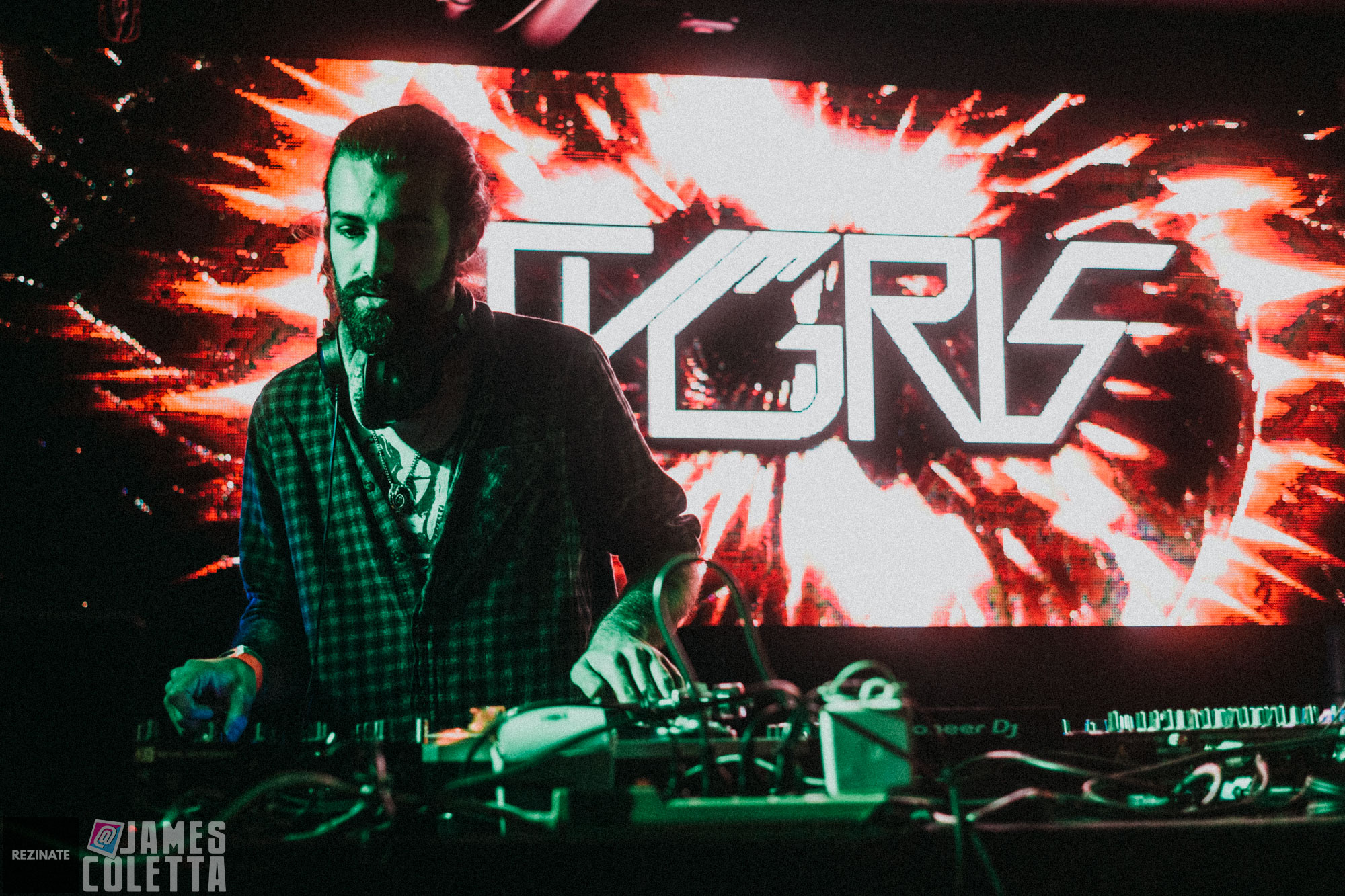
The night kicked off with a familiar face, Tygris, a trained audio engineer, producer and instrumentalist. Fresh off a 5AM Trio performance the night prior in Philadelphia, Tygris took the early arriving crowd on a journey rooted in hip-hop, with a seamless flow that allowed the crowd to effortlessly follow the story he depicted through sound. He produces dramatic soundscapes coupled with voice manipulations that echo in the back of our minds and keep us bobbing our heads, especially when Rasp-5 hops on stage and dishes us some fresh lyrics for the brain.
Next, the Street Ritual label boss took the stage and held the room in a constant wobble. Fresh off a Rezinate guest mix that received a ton of fanfare just a few days prior, spacegeishA was noticeably excited to be rocking it. Her personal tune collection is 50 fathoms deep, boasting names from every corner of far space, and samples galore from many dimensions of the underground electronic scene. She leaves no stone unturned in the worlds of halftime, 140, and psy-bass, and she delivered a crushing set once again.
By 10:15, the room began to swell with people. The sound team had seamlessly transitioned into Vinja’s set, and the room really began to feel more alive. This set touched on just about every concept of free-form production techniques one can think of, keeping the crowd bouncing from beginning to end with flawless scratches, cuts and mixes. Vinja’s primary style draws glitch hop, old-school rap and break-beats, but he can flow in and out of opposing genres while maintaining an overarching sound. This evening it was a deep house track that earned the most enthusiastic response from the crowd, believe it or not.
Direct support came from the one and only Mickman. There was a long turning of the sta turn which that left the room perplexed but not uncomfortable, he came out guns blazing with a set bursting - as always - with new music. Dripping in complex, original trip-hop and heavy psychedelic beats, Mickman brought a vibe that kept the crowd gasping for air between drops and breakdowns.
Hailing all the way from the UK, fresh off of a headlining set at Tipper and Friends, K.L.O. got things moving quickly for their highly anticipated Boston debut. Osmetic and Lone Drum lit up the stage with a style that can be described as none other than “acid scratch”. These two have a flawless technique when in tandem and really represent what high caliber live mixing looks like. Osmetic aka Mike Wallis (one half of Crunch) is an OG in the game and he rinsed out a surplus of selectors. Ben Parker (Lone Drum) was on the turntable duties that evening, splaying and fraying cuts and samples across stereo space.These two know what they are doing, taking the crowd through cerebral warfare with their complex soundscapes, layering endless samples and loops upon one another. It’s no wonder everyone around the country is flocking to see what The Slugwife crew has to offer.




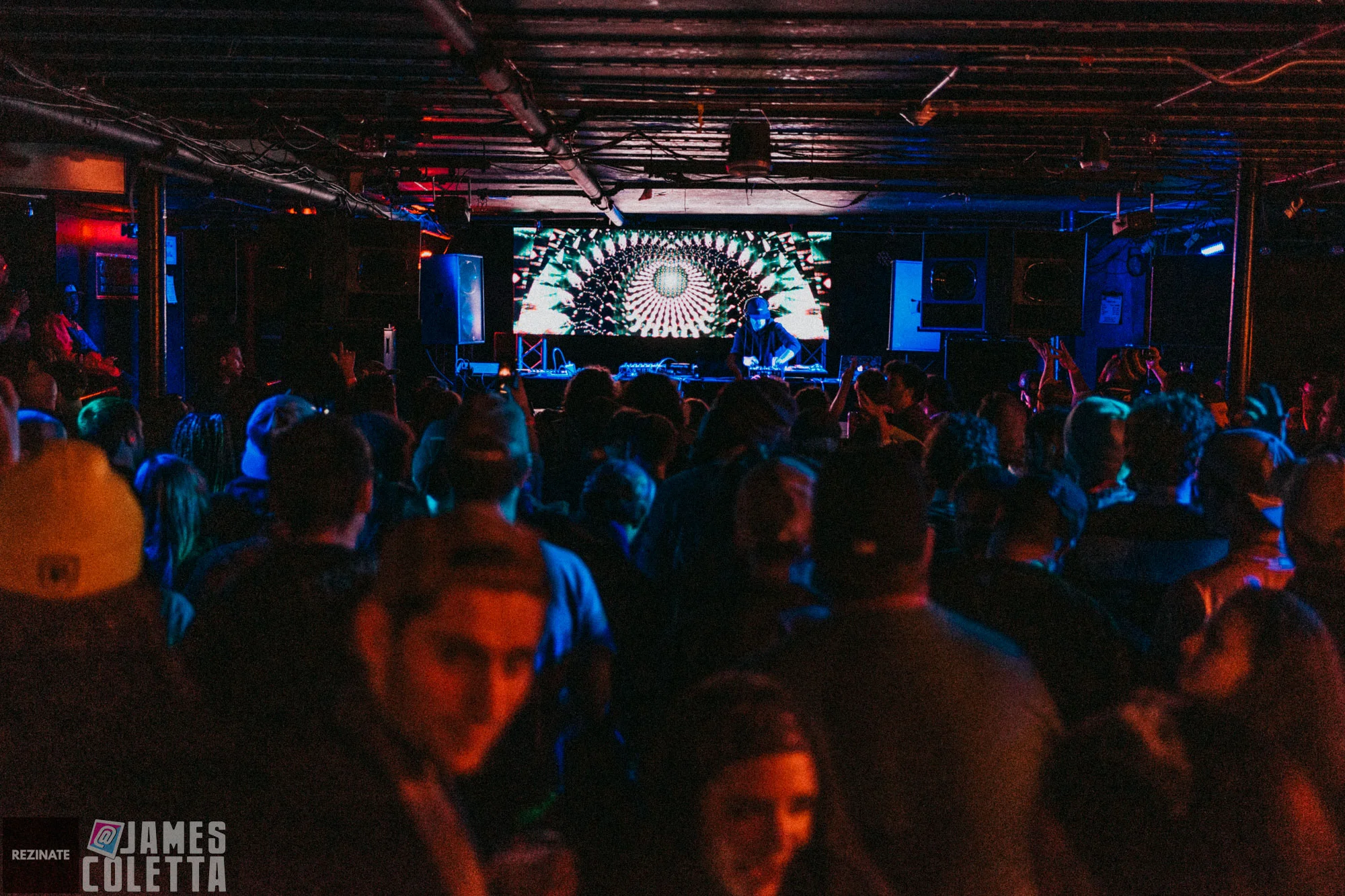


Rezinate was able to display the spectacular visuals of New England native David Schunemann aka Actualize on a crisp, brand new LED. Actualize is a becoming a force in his own right, steadily gaining traction as a respected VJ. You can catch him at Equinox Festival this summer among other shindigs. His smooth transitions and deep reservoir of art to select from created a great audio visual synchronization at the Middle East.
It’s nothing new for this New England team to showcase world-class talent while simultaneously big-upping local artists with supporting roles. They strive to curate a rather avant-garde experience whose fundamental focus is “cultivating deep, reverberating sound for a discerning audience,” and they hit their mark once again this evening. The atmosphere cultivated by Rezinate, Hennessey, the Middle East and all the fans on nights like these helps nurture a wholesome community based around freedom of expression and an appreciation for authentic performances.
FOLLOW Rezinate: Facebook / Soundcloud / Instragram / Twitter / Rezinate HQ
FOLLOW the photographers: James Coletta

Sound of Solasta - spacegeishA
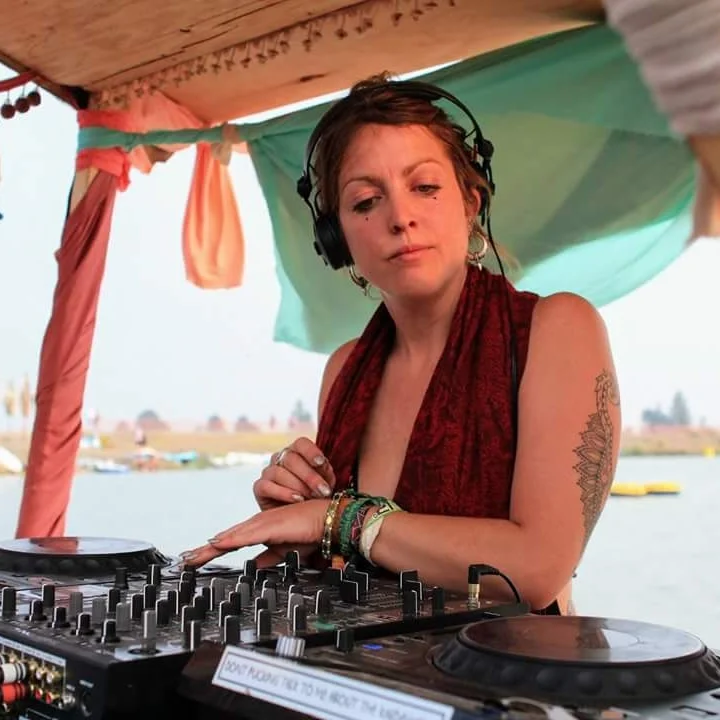
For the next installment of the Sound of Solasta series, we're tapping into another industry powerhouse who will bring a multiplicity of talents to Solasta Festival on August 17-18. Rebecca Drylie-Perkins, better known by her performance moniker spacegeishA, is a top-tier DJ and the co-owner and director of Street Ritual.

For the next installment of the Sound of Solasta series, we're tapping into another industry powerhouse who will bring a multiplicity of talents to Solasta Festival on August 17-18. Rebecca Drylie-Perkins, better known by Becca or her performance moniker spacegeishA, is a top-tier DJ and the co-owner and director of Street Ritual. Born in 2006 from burn culture and a pervasive west-coast influence, and officially launched in 2008, Street Ritual is a digital label that puts maximum focus on spreading glitchhop, IDM, psychedelic bass music, and their various offshoots.
Leading the pack in many regards, spacegeishA has cultivated clout from over a decade of DJ sets. She also tenaciously advocates for the more than 70 artists that Street Ritual has come to represent. When each time comes for her to get behind the decks, the bounty of the relationships she's forged presents itself in the plethora of unique tunes, both released and unreleased, that she chooses from her collection. Those relationships, however, provide more than just access to good tracks. She is positioned among similar industry players who focus on the communal nature of this widespread counter culture. With this in mind, her booking at Solasta is no coincidence, with “community” being no buzzword for the Solasta team, but the ethos of the entire event. Understanding the dynamism of Becca's career requires more insight than can be gathered from just surface-level digging, so we’re grateful she afforded us the opportunity to ask a few questions.
The Rust: You're the label director for Street Ritual. How did that journey begin? What challenges do you currently face in the position?

I am one of two co-owners of Street Ritual and have been the Director of the record label for seven years and booking agency for two years. As one might imagine I am also the accountant, marketing team, social media manager, merchandiser, staff liaison, artist scouting, and recruitment supervisor.
There are a myriad of challenges that record labels face; mostly that of the evolving trends of digital music sales, social media, and streaming platforms. Spotify didn’t exist when I began, and now it’s an integral part of our business. Initially Facebook was beneficial; not so much anymore. To combat this, I research and strategize to stay in line with current market and online trends. In regards to the booking agency; every artist wants more shows. Booking artists/tours successfully requires confidence, patience, and a vast understanding of the nation’s “scene.” I contend that HYPE is the driving success of a large percentage of artists and it begs the question; where did the hype originate and how has it sustained itself?
The Rust: How do you build relationships with the producers and other music professionals that you later work with?
I’m really happy you asked this, because I believe that ‘networks’ are the key to being successful in this industry. I come from a small town in NJ, so connecting with the top tier industry professionals on the west coast back in 2011 was a challenge. Initially I invested significant time reaching out to forge these connections with minimal results. I attended the Symbiosis 2010 Festival with only knowing my small group of friends. In just six years my network includes hundreds of patrons, musicians, artists, producers, directors, and fans in a dozen countries. My work in event production for festivals such as Lucidity, Enchanted Forest, Symbiosis, and even BOOM festival in Portugal afforded me the opportunity to expand my connections and build these lasting relationships. This endeavor entailed unpaid 16 hour shifts, angry artists, hot tents, flying to gigs all over, and a lot of miles on my car. The cool thing for me was, a lot of these sacrifices resulted in awesome releases, DJ gigs, or bookings for the artists I manage.
Relationships expand and grow to the next level when you attend an event and elevate your relationship from digital to physical. I recommend that you make sure you are not another email or unanswered facebook message. Get out there, be confident in what you are doing, and go talk to someone important. If you have to work for free to get your foot in the door it is *probably* worth it. Aside from reaching out to a stranger, solid relationships can be built online through sharing music, ideas, feedback, and more. The amount of access we have to our community through the internet has allowed me to make connections all over the country and world! If you really like someone's tunes, tell them; they'll be happy to hear.
The Rust: Your DJ sets showcase music from a vast cross-section of producers. Where do you look to find fresh inspiration for your sets?
I find inspiration from a variety of creative sources. I love to watch successful DJ’s and producers performing, and the growth of our fan base filling the dance floors. Another source of inspiration comes from following my favorite labels. I listen to tracks that may not be included in my own DJ set but are a perfect fit for our label, or vice versa. This requires patience, however I live for that feeling of surprising the fans on the dance floor with something they don’t expect or know yet. There is a lot of rinsing of well known tunes in this scene, and while I like to have one or two in each of my sets that are "hott rn", I mostly aim to go for the songs that no one on the dance floor knows yet.
The general vibe of the song is a crucial part of my inspiration for building sets. I wait for that scrunch-face reaction when I hear it. I look for the funky, sexy, deep, dark, hard, weird, minimal, scary, crunchy, and hard-hitting. I don’t genre-discriminate. I intentionally organize my catalog by my bpm and key instead of by genre (which a lot of people do) because I don’t want to DJ out of genre folders. I use Soundcloud, Beatport, Bandcamp, and DJ mixes to discover new artists; and can’t say it’s an easy task. There is extensive digging, organizing, and filing necessary to be a DJ. Your time on the decks is earned by time spent on the computer. I invest on average $100 a month on buying tracks, even with the benefit of all the unreleased goodies I have access to. I feel strongly that we need to contribute to digital music sales and the charting and online performances of artists and labels we support.
Lastly, I get a big rush of the go-get-em feels after I play sets and talk with people who were there. I still get a little shy when people tell me they’ve been following me for a while or they’ve listened to my mix over 50 times, but those moments humble me, stay with me, and ultimately reinforce that I'm on the right path. Without the community or communication; there is no success to be had!
The Rust: How did you begin DJing, and how has your attitude as a DJ evolved over time?
I have been a” selector” of music since I was young. My 8th grade gym teacher recognized this talent and chose me to provide the list of tunes for the school dance. My mom talks about my constant commandeering of the radio in the car when I was young to blast Busta Rhymes and Jay-Z. Fast forward to Philly with my college lacrosse team; I created a hip-hop mix every year for our pre- game warm-up. This helped intimidate teams (as if our field in West Philly didn’t already do that). When we threw big parties I’d be DJing from my IPod. Upon graduation I moved to Portland, Oregon and spent my free time DJing by myself and for after house parties (compliments of our fat living room sound system and serato station-- thanks DP). I got tired of hearing all the boys play tunes out that I would also play, so I decided to get more serious about it. Then, I went to Burning Man and found myself spinning on a few different sets at my camp since I had curating and was managing five full nights of the most badass bass music to be found on playa that year. I played my first real set after that at Wormhole Wednesday in Oakland when it was still at Era Bar, opening for the legend Digital Rust.

I don’t think my attitude ABOUT DJing has changed, however I continue to see an increasing value and importance in it as an art form. A lot of success in our industry comes from producers, but I feel DJ’s supporting their tunes (by buying them, playing them out, etc.) is a piece of that puzzle. DJ’s can pivot if a dance floor falls flat; producers don’t always have that option. DJ’s can spread the word on tunes, artists, labels, or genres and producers should be taking advantage of that as it is a symbiotic relationship. DJ’s are the vibe curators, where producers create a certain vibe. We are all in this together; and I’ll be the first to speak up for the importance of DJ’s in this rising underground movement.
The Rust: Solasta is set to offer a plethora of production, audio engineering, and industry-focused workshops. What are your thoughts on festival seminars like these?
It is important for our community to educate and explore various aspects of our industry through group discussion. When we examine the positive and negatives we face as musicians, promoters, and participators in this scene, we grow collectively. Bottom line is, we are all in this together so let's get together and talk about it more. Sets from a bunch of firey producers and DJ's are workshops on their own for me. However, being able to leave with more knowledge about bookings, production, management, or our culture in general is just a bonus. I had the pleasure of speaking on a ‘Women in Music’ panel at Lightning in a Bottle last year, and it served as a potent reminder for me about the challenges women face in this industry. I still reference that panel discussion frequently and would love an opportunity to continue that discussion again some day. The more education covering a wide variety of topics at festivals, the better. In regards to the above question about forging relationships, these can serve as a great opportunity to do that. I am scheduled to be speaking on a panel at Solasta; stay tuned to hear more about that as it develops. See you on the dancefloor!
--
As the weeks fly by and Solasta Festival grows ever closer, the excitement from all involved is palpable. With such an outstanding assortment of intelligent and meticulous organizers, producers, and DJs tapped for this year, it’s important to afford these individuals the proper spotlight for their actions and operations. If you plan to make the journey to Spirit Crossing in Sneedville, Tennessee for the weekend of August 17-18, be sure to find yourself front and center during the spacegeishA set.
FOLLOW spacegeishA: Soundcloud / Facebook / Street Ritual

![Seppa - Interview + Boosted [EXCLUSIVE PREMIERE]](https://images.squarespace-cdn.com/content/v1/59530136f5e2319eabb7d87f/1626113208781-BZ7C6B7E3LCECV7UD4CS/Boosted.jpg)

Amongst the incoming generation of artists having finally found their bite, not yes exemplifies the modern paradigm of electronic production; there are no hard boundaries, no clearly defined destinations, and unbridled compositional freedom. There’s a refreshing whim to their choice of direction, and the result is a fast-growing, dynamic catalog that takes us through virtually every space in low-end territory.