
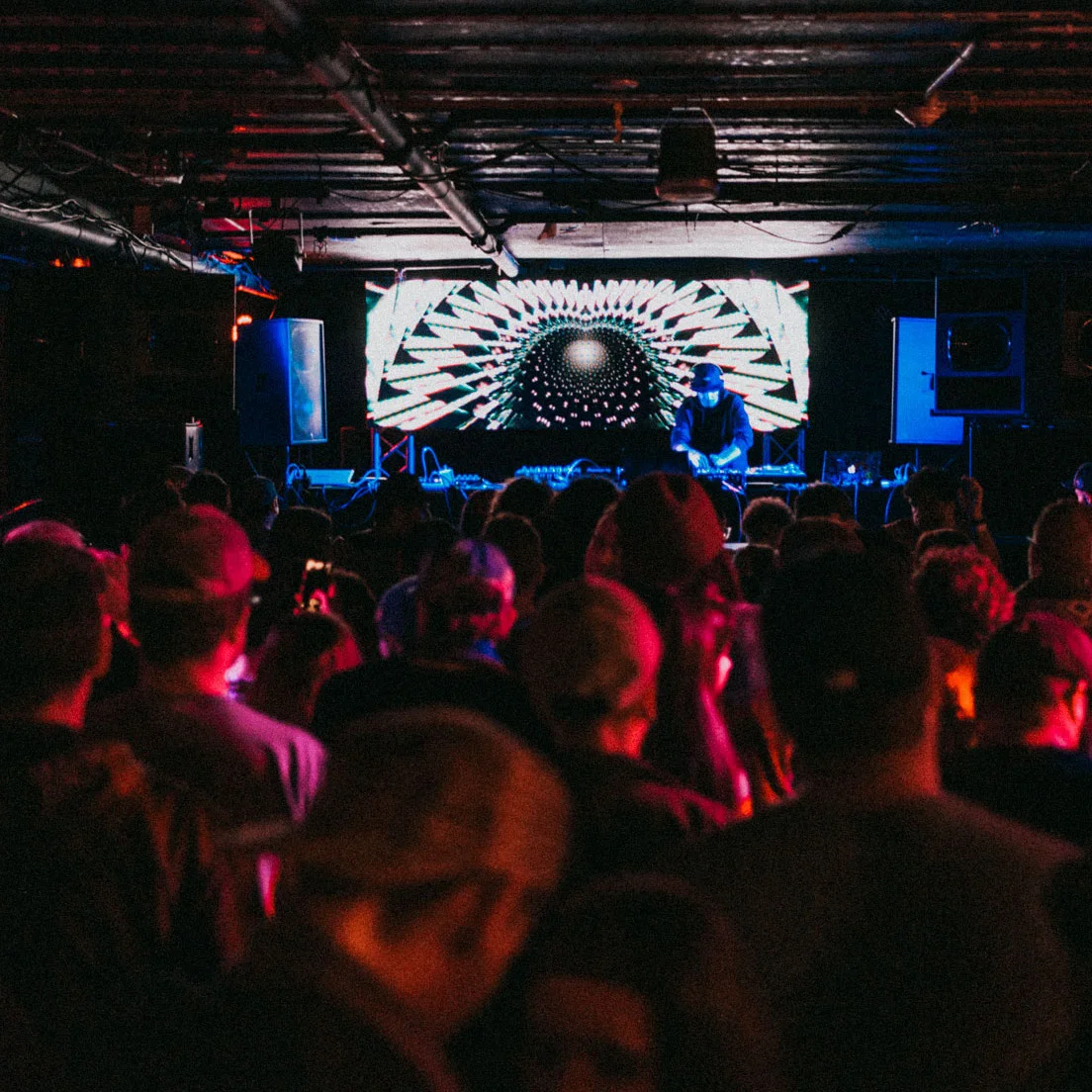
KLO, Mickman Offer Glitch-Hop Getdown at Middle East Downstairs
The atmosphere cultivated by Rezinate, Hennessey, The Middle East and all the fans on nights like these helps nurture a wholesome community based around freedom of expression and an appreciation for authentic performances. This Boston-based partnership consistently provides expert-level audio experiences, and with powerhouse glitch-hop act K.L.O headlining the historic venue’s basement, this night would be no different.

(Credit: James Coletta)
Around mid-day, Friday, April 26th, Rezinate began its familiar controlled chaos at the Boston mainstay venue The Middle East Night Club. Stacks of Battleaxes, Switchbacks, Cannons, and more were loaded into the building by the masterminds from Hennessey Sound Design, the Massachusetts-based company that works essentially as Rezinate’s exclusive partners at the Middle East. Through their long history with the venue, these teams have been able to perfectly adjust their sound set-up to the dimensions of the room. As a result, they consistently provide an expert-level audio experience, and this evening would be no different. This particular night, the collaborative powerhouse glitch-hop act K.L.O headlined in the historic venue’s basement.
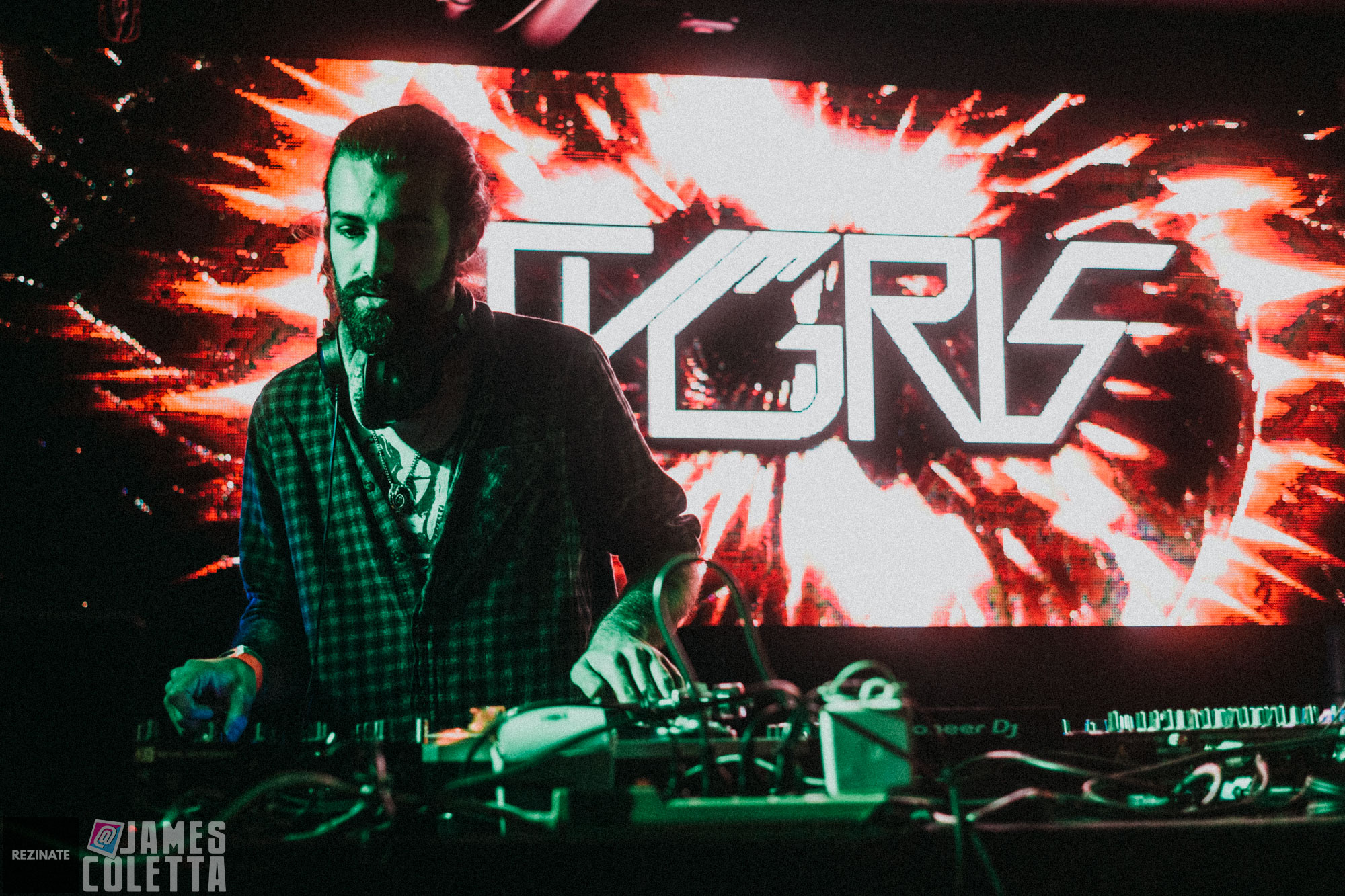
The night kicked off with a familiar face, Tygris, a trained audio engineer, producer and instrumentalist. Fresh off a 5AM Trio performance the night prior in Philadelphia, Tygris took the early arriving crowd on a journey rooted in hip-hop, with a seamless flow that allowed the crowd to effortlessly follow the story he depicted through sound. He produces dramatic soundscapes coupled with voice manipulations that echo in the back of our minds and keep us bobbing our heads, especially when Rasp-5 hops on stage and dishes us some fresh lyrics for the brain.
Next, the Street Ritual label boss took the stage and held the room in a constant wobble. Fresh off a Rezinate guest mix that received a ton of fanfare just a few days prior, spacegeishA was noticeably excited to be rocking it. Her personal tune collection is 50 fathoms deep, boasting names from every corner of far space, and samples galore from many dimensions of the underground electronic scene. She leaves no stone unturned in the worlds of halftime, 140, and psy-bass, and she delivered a crushing set once again.
By 10:15, the room began to swell with people. The sound team had seamlessly transitioned into Vinja’s set, and the room really began to feel more alive. This set touched on just about every concept of free-form production techniques one can think of, keeping the crowd bouncing from beginning to end with flawless scratches, cuts and mixes. Vinja’s primary style draws glitch hop, old-school rap and break-beats, but he can flow in and out of opposing genres while maintaining an overarching sound. This evening it was a deep house track that earned the most enthusiastic response from the crowd, believe it or not.
Direct support came from the one and only Mickman. There was a long turning of the sta turn which that left the room perplexed but not uncomfortable, he came out guns blazing with a set bursting - as always - with new music. Dripping in complex, original trip-hop and heavy psychedelic beats, Mickman brought a vibe that kept the crowd gasping for air between drops and breakdowns.
Hailing all the way from the UK, fresh off of a headlining set at Tipper and Friends, K.L.O. got things moving quickly for their highly anticipated Boston debut. Osmetic and Lone Drum lit up the stage with a style that can be described as none other than “acid scratch”. These two have a flawless technique when in tandem and really represent what high caliber live mixing looks like. Osmetic aka Mike Wallis (one half of Crunch) is an OG in the game and he rinsed out a surplus of selectors. Ben Parker (Lone Drum) was on the turntable duties that evening, splaying and fraying cuts and samples across stereo space.These two know what they are doing, taking the crowd through cerebral warfare with their complex soundscapes, layering endless samples and loops upon one another. It’s no wonder everyone around the country is flocking to see what The Slugwife crew has to offer.




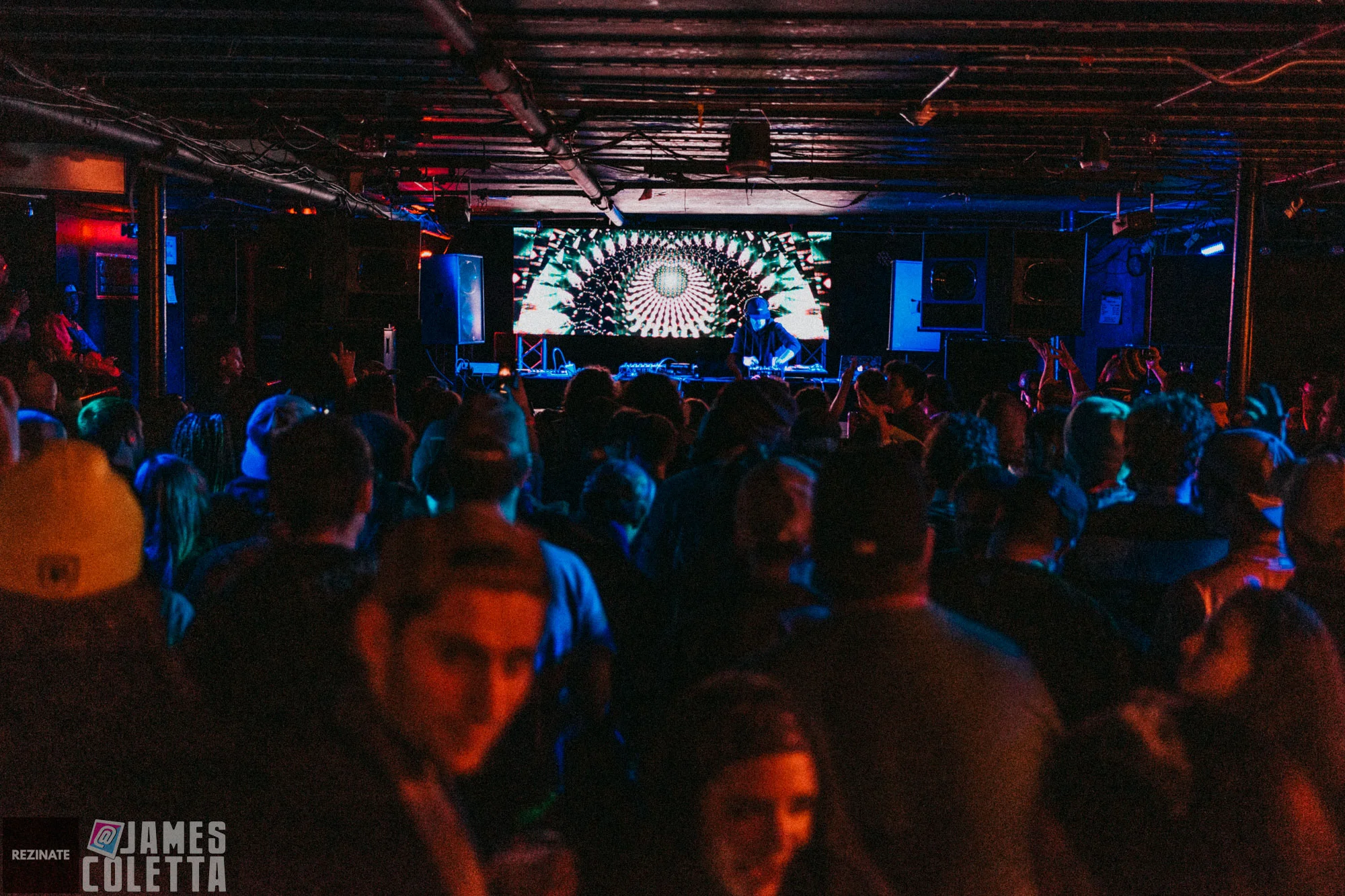


Rezinate was able to display the spectacular visuals of New England native David Schunemann aka Actualize on a crisp, brand new LED. Actualize is a becoming a force in his own right, steadily gaining traction as a respected VJ. You can catch him at Equinox Festival this summer among other shindigs. His smooth transitions and deep reservoir of art to select from created a great audio visual synchronization at the Middle East.
It’s nothing new for this New England team to showcase world-class talent while simultaneously big-upping local artists with supporting roles. They strive to curate a rather avant-garde experience whose fundamental focus is “cultivating deep, reverberating sound for a discerning audience,” and they hit their mark once again this evening. The atmosphere cultivated by Rezinate, Hennessey, the Middle East and all the fans on nights like these helps nurture a wholesome community based around freedom of expression and an appreciation for authentic performances.
FOLLOW Rezinate: Facebook / Soundcloud / Instragram / Twitter / Rezinate HQ
FOLLOW the photographers: James Coletta
![Solasta Festival - Vinja [Interview]](https://images.squarespace-cdn.com/content/v1/59530136f5e2319eabb7d87f/1558498387804-U5DE6LQEU4N6CEXPJEPQ/Vinja_Solasta+Festival+The+Rust+Music+Interview.png)
Solasta Festival - Vinja [Interview]
The venerable Vinja is a stalwart of turntablism and high-octane electronic grooves. This summer, Vinja performed in Tennessee at the upstart gathering Solasta Festival. We were able to steal Vince Santora (Vinja) from the revelry for candid conversation covering the development of his tunes, Solasta itself, and the ever-evolving music social phenomena and his place within it.
Delivering everything from neck-breakers and 4x4 shimmies to brolic breakbeats, the venerable Vinja is a stalwart of turntablism and high-octane electronic grooves. Vince Santora (Vinja) picked up the decks for the first time back in 1998. So began a journey that would lead not to widespread acclaim, but to Vince setting down the project after several years of extensive gigs throughout the US. Come the turn of the 2010s, Vinja had put skin back in the game and caught the attention of Envisioned Arts. After partnering with EA, the Vinja project was reinvigorated and pointed towards new territories and audiences.
This summer, Vinja performed in Tennessee at the upstart gathering Solasta Festival, itself co-produced by Envisioned Arts. During the course of the weekend, we were able to steal Vince from the revelry for candid conversation covering the development of his tunes, Solasta itself, and the ever-evolving music social phenomena and his place within it.

Vince Santora (Vinja) performing at Solasta Festival 2018 (Credit: Anna Norwood Photography)
“It’s fun to have the kind of perspective that I’ve gained in seeing how the scene has developed from my beginning years until now,” Vince told me, as we watched the Sound System Cultures LLC team at work from behind the stage. “The culture has always been there. For me, it began a little bit differently, as I grew up raving in San Francisco, so the parties were a little bit different. The DJing was all vinyl, and it was dominated by this warehouse vibe all over. To see how much this culture has grown, and how passionate the people within it are, it just absolutely blows my mind. I’ve always really considered myself a hobbyist. I love making music, and I love DJing, but I never expected any sort of ‘touring-travel-around-playing shows’ dynamic to evolve out of that. I’m really just riding the wave that everyone else is riding.”
He’s speaking frankly on the paradigm shift that happened within electronic music here in the states almost eight years ago, wherein a few especially wild producers began to exert great influence on the gradual direction of our slice of audio culture. “It became apparent to me at the Tipper [Denver] Fillmore show. There were just thousands of people there. Meanwhile the first time I saw him was in a community center with some twenty-odd people. And that’s just one artist. There are dozens of them that started all in the same kinds of places, who grew to have a very visible and powerful influence over the scene as it has developed.”
While he spoke of these artists as pillars of inspiration for the community at large, I felt he didn’t immediately recognize his own impact. Being a true and tried practitioner of turntablism, Vince is in part responsible for influencing a generation of DJs who seek to bring their performances beyond just contemporary mixing. “I’ve always firstly enjoyed the ‘live’ aspect of all music. I started in a band like anyone else I knew at the time, but I don’t have any reservations against someone who is just a DJ without any conventional music background. It’s not the instrument, it’s the intent.”
The way Vince delivers this remark, it almost reverberates throughout Spirit Crossing and the wider valley surrounding us, as if he was echoing some greater ethos of Solasta as a whole. “As far as why I decided to scratch in my sets, I like the vulnerability of it. I like putting myself out there and performing something live, knowing it could go terribly wrong at any moment,” he said, chuckling. “It also comes down to having a hip-hop musical upbringing. I grew up seeing Mix Master Mike cutting it up onstage. What really brought me directly here was Krafty Kuts. I was a breaks DJ, and whenever I listened in to him or watched what he was doing, it became extremely apparent that what he was doing was not only overtly technical, but took me for an absolute loop around the fact that this wasn't hip-hop: it was dance music. I realized that I wanted to step into that dynamic as well, to begin creating a much more immersive concert experience.”
Considering that he was tapped to host a workshop on vinyl scratch earlier that afternoon at Solasta, Vince has without question stepped forcefully into that dynamic. Years of intimacy with waxy vinyl has granted Vince an indelible skill that sets him several cuts above the competition. To get a better feel for Vince’s vinyl skills, check out Rusted Rhythms 23, a new mix from Sortof Vague featuring cuts and scratches from Vinja.
The conversation naturally shifted gears towards his personal catalog. For someone who got their start 20 years ago, it’s remarkable that Vince stays up on relevant sound design and genre developments. His discography is indicative of a producer and composer who has a mind as malleable as a digital synthesizer. “I’m still rocking some 87 bpm half-time stuff, but lately my body of work is moving more into the 100 bpm golden-era hip-hop region. I’ve been really digging 110 bpm, and I find it can be really inviting to kids who don’t have a lot of experience with house or techno. Overall, I feel a very bouncy, Afrika Bambaataa-esque vibe to my whole catalog. Having been so influenced by classic electro and dance floor themes over time, I gradually began to merge the edgier grit of hip-hop with the repetitious design of dance music.”
Vince’s earlier productions were no less high-octane than now, but they were curiously devoid of any vocal work. Naturally, that thought begged for an answer. “I began very much opposed to the use of vocals, deciding instead that all emotive communication needed to happen at the instrumental level. As the years passed, and I opened up to new musical influences, I began to see where repetitive vocal lines and cuts could actually help further whatever emotional output I was trying to convey.” Throughout our conversation, he keeps coming back to this idea that so much of what he does is done for each and every person who follows the vibe he sets. “In my mind, a great gig is me doing my job, and you dancing your ass off and working up a sweat. That’s what I want out of this.”
As our time together came to a close, I asked him about his thoughts on Solasta Festival. He’s been on board with this event since its infancy, having performed there last year, and he was anything but coy about his adoration. “So Solasta this year looks like it has just quadrupled in size! Last year it was really just a bunch of producers partying out here. We didn’t quite have the numbers at the time that some people expect from a ‘successful’ festival, but right then and there I knew Solasta would be something special for all of us.” His voice betrayed his affection and high esteem for the operation.

Vince Santora (Vinja) performing at Solasta Festival 2018 (Credit: Anna Norwood Photography)
“First and foremost, the convergence of the crews working here. I’m glad we have the Rust crew down here, bringing your slice of the musical pie with you guys. The Harmonia team from Asheville is absolutely essential to the ethos of this place. As for Envisioned Arts, what Hasan and that team are building is just amazing.” He hits the mark without a fumbled word. Envisioned Arts and Harmonia indeed encompass nearly every aspect of integrated, patron-first musical experiences. (For more about these organizations, check out our past interview with their respective founders here).
“The second thing that makes Solasta so inviting is the incredible level of intimacy that pours out of this little venue. You have one of the cleanest stretches of fresh water running right through the grounds. You’re nestled inside this gorgeous nook in the Appalachians. Once you’re out here, it just hits you square in your happy place. Furthermore, it’s especially appealing to me because it’s so specifically focused on the musical curation,” says Vince, who is himself a prime example of this curation. “For me as a performer, I sometimes struggle with the multiple-stage dynamic, wondering who and how many will show up to the time slot I’m given on the stage I’m placed at. Here, there is a single stage, with a top-tier sound system, ironically being operated by a DJ, who I suppose is DJing DJs (laughs).” His statement could not have been more on the money.
The overwhelming advantage to utilizing a one-stage dynamic in this setting was already making itself apparent, giving attendees a shared space in which communication and openness prevailed throughout the weekend. “I feel like this old-school approach, with one central gathering point and one ship to man, it really allows all of us as performers to get comfortable with the crowd, the atmosphere, one another, and it is certainly triggering a bit of nostalgia for me. The fact that the stage doesn’t even turn on until 3:00 or 4:00 pm each day is an absolute blessing. We’re all up partying usually until the sun is peeking up for a new day, and having a crowded lineup will quickly land people 8:00 am time slots where the whole thing is just a glorified zombie pit.”
As Vince finished regaling a love for Solasta shared equally by all in attendance, Hasan rounded the corner to grab him for some artist-to-manager business, bringing a succinct end to our conversation. I was left with the impression that we owe this man a thanks many aren’t aware of yet. Not only has he been a long-time player within our community, but he actively seeks to engage with it all these years down the road. From here out, all eyes are aimed straight ahead at Vince Santora and the Vinja project, as he’s sure to continue impressing the best and crushing the rest in his continued quest to energize the dance floor.
FOLLOW Vinja: Soundcloud / Facebook / Spotify
FOLLOW Solasta: Facebook / Website

![Seppa - Interview + Boosted [EXCLUSIVE PREMIERE]](https://images.squarespace-cdn.com/content/v1/59530136f5e2319eabb7d87f/1626113208781-BZ7C6B7E3LCECV7UD4CS/Boosted.jpg)

Amongst the incoming generation of artists having finally found their bite, not yes exemplifies the modern paradigm of electronic production; there are no hard boundaries, no clearly defined destinations, and unbridled compositional freedom. There’s a refreshing whim to their choice of direction, and the result is a fast-growing, dynamic catalog that takes us through virtually every space in low-end territory.