

Solasta Festival Levels Up in Second Year
The event was conceived with the intention to do something different. With just a single stage, a niche lineup full of rare international and coveted local acts, a dedicated lounge and performance theater, and a pervasive emphasis on health and self-care, Solasta didn’t stray from this conception.
When the sun rose over the lush, green fields of Spirit Crossing in Northeastern Tennessee on the first day of Solasta Festival, you couldn’t see it, shrouded as it was by Appalachian mountain mist and cool cloud cover. Volunteers and staff who worked through the night were putting finishing touches on modest infrastructures and installations in the quiet dawn. Campers who arrived the night before took prized real estate along one of the grounds’ lone tree lines, or on the bank of the Clinch River that flows lazily through the grounds. As morning turned to noon the sun began to peek on the festival. For the rest of the weekend - from logistics to music to the familial atmosphere - the presence of the sun was the only inconsistency at Solasta Festival.
Just over 1,000 people settled on the grounds that weekend. In its second year, the gathering quadrupled in size and exceeded the expectations of everyone besides perhaps its young and wily staff. The event was conceived with the intention to do something different. With just a single stage, a niche lineup full of rare international and coveted local acts, a dedicated lounge and performance theater, and a pervasive emphasis on health and self-care, Solasta didn’t stray from this conception.
Strolling and patrolling on Friday afternoon was Officer Larry of the Hancock County Sheriffs Department, the bulk of Solasta’s security force. A law enforcement presence at a music festival without the characteristic firearm or body armor was a rare sight, my colleague noted. He didn’t need that equipment with this kind of crowd, he suggested. His toothy grin stood out from his sun-weathered red skin as he asked, “how do you like Hancock County?”
“It’s different,” I responded. And indeed it was. Spirit Crossing sits on the outskirts of the county seat, Sneedville, home to approximately 1,200 people. The hills - steep, rolling, and frequent - break apart and condense cloud formations and create that unpredictable weather. Although the forecast called for constant rain, the festival saw just one brief, powerful storm and a series of scattered showers.

The GNOSTiK Lounge at Solasta Festival (Credit: Shots By Carl & GNOSTiK)
In the spirit of differentiation, Solasta partnered with GNOSTiK to establish the GNOSTiK Lounge and Performance Art Theatre at the center of the broad, flat festival grounds. This welcoming space hosted 22 performers doing about 15 acts on Friday and Saturday, from fire manipulation to less conventional fare like contemporary dance, poetry, kink, and burlesque. Our favorite act had to be Fire Circus for their combined acro yoga and fire-spinning act, “It’s a platform for performance artists to express fully realized visions in a cultivated environment,” according to GNOSTiK co-owners and co-creators Ali Khemi and Silv Era, who traveled west to Solasta from their base in Savannah, Georgia.
The Lounge captivated by creating an atmosphere apart from the rest of the festival, while simultaneously being an integral part of it. “Gnostik is not reliant on already existing spaces provided by the music culture,” Ali and Sliv explained, “but rather creates the vessel that invites performers, musicians and artists to create within the vision.” Other attractions and concerns faded fast as one became enraptured in the theatrical and sexual nightclub mystique of the Lounge. The decor was sophisticated but with a sharp edge, and heady teas and elixirs were served out of a Lounge bar.
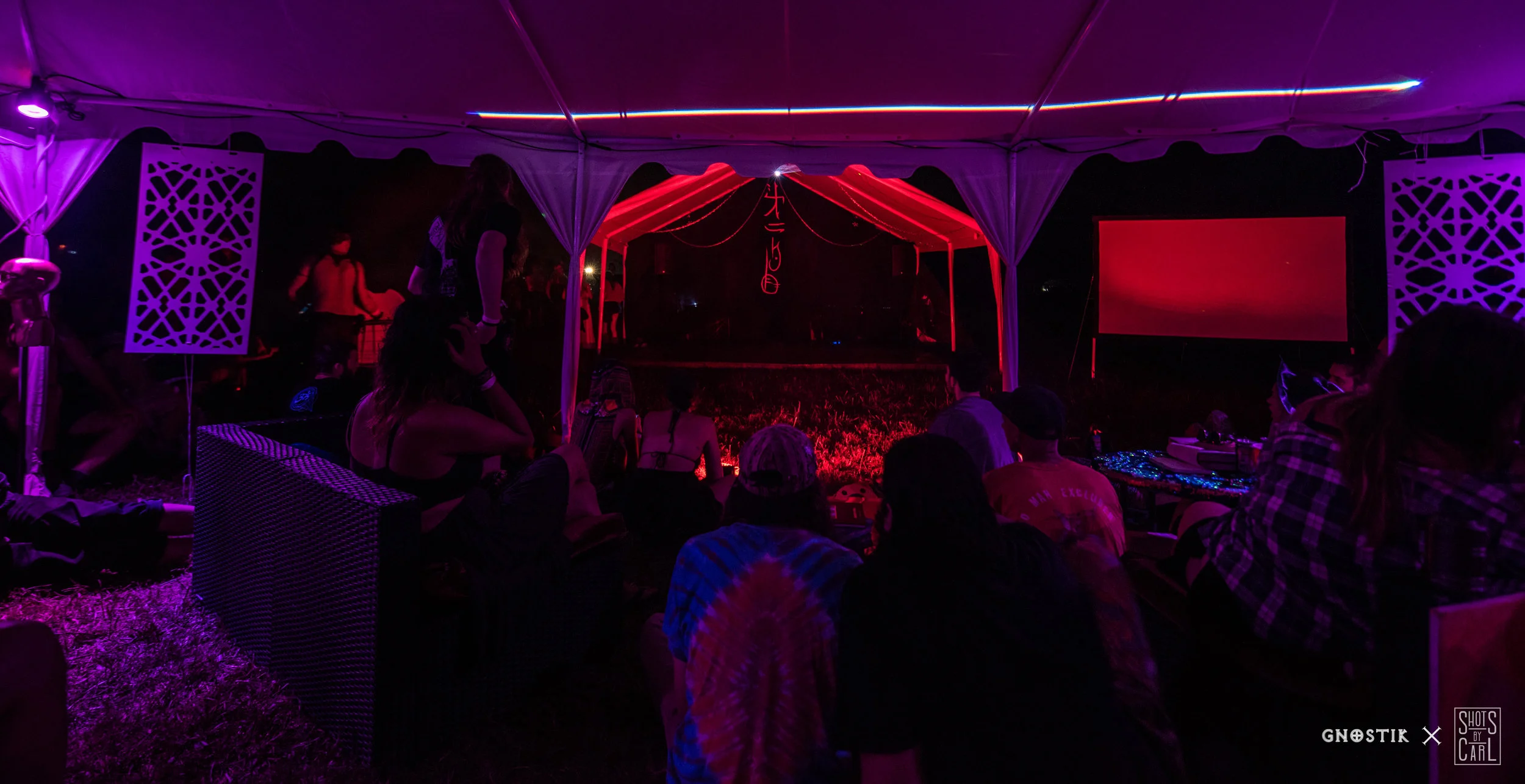
The GNOSTiK Lounge & Performance Theatre (Credit: Shots By Carl & GNOSTiK)

Molly Reed (Credit: Shots By Carl & GNOSTiK)

One-half of the act Fire Circus (Credit: Shots By Carl & GNOSTiK)

GNOSTiK co-creators Ali Khemi & Silv Era (Credit: Shots By Carl & GNOSTiK)
GNOSTiK “merges the lines between performers, musicians, and spectators,” according to Ali and Silv. DJs spun music from behind the theater’s curtain (this lent itself to secret sets from Detox Unit, Grouch in Dub during the theatre's off hours), performers hung out and served at the elixir bar, and cross-legged spectators in the grass inched as close to the fire manipulators as safety would permit. It was all too easy to get couch-locked in the Lounge, sinking into a plush cushioned seat with an arousing beverage as performer after dazzling performer floated and stomped across the stage. Your correspondent was nearly couch locked thusly were it not for the call of journalistic responsibility. Instead, I found myself ambling briskly between the Lounge and the stage to absorb the best of both worlds.
This walk between Lounge and stage involved frequent stop-ins with the Mermaid Oasis Hydration Station, a twist on the traditionally faceless festival water-fill up. Here ladies costumed as mermaids ran cold, fresh, plain or flavored with watermelon or cucumber or more. Pickles, the leader, humbly demonstrated her filtration system; the water is drawn on grounds from a well, sterilized for bacteria, and filtered for sediment. In the sporadic but consistently hot Tennessee sun, Solastafarians kept hydrated throughout the weekend.

Solasta's single stage was designed by Sacred Element Event Design (Credit: Lisa Diamond)
Down towards the river was the main stage - a fully encapsulated dance environment created by Sacred Element Event Design. Sacred Element’s founder Maurice Legendre is actively shifting away from manic, masculine, and overwhelming norms in stage and lighting design, and his creation at Solasta reflected this. “It offers but it does not demand,” he told me. Indeed the lighting was first and foremost atmospheric. Lights backing the stage and ringing the dance floor were subtle in their movement and usually featured no more than two colors at once.
The low stage was decorated with elements from the natural environment, with wood and rock creating a tranquil pond at the foot of the platform surrounded by mammoth hunks of quartz. Approaching the stage on Friday afternoon, Cameron Ingraham aka Mickman briefly dipped his hand into the pond, looking for a second like someone dipping into a vessel of holy water before entering a house of worship. The stage was flanked by two purple Funktion One speaker towers tuned to perfection by the Soundsystem Cultures, LLC crew which came north to Solasta from Chattanooga, TN. I’d later see Cameron on top of one towers pulling a tarp over the stack during a scattered shower, one of many small instances where the lines between performers, staff and attendees at Solasta were greyed.
A ring of bamboo trussing and six or seven teepee-like structures encircled the dance floor. One could literally recline luxuriously with the crew in these structures filled with blankets and pillows without leaving the stage. Two terraced jungle gym like towers added greater dimensionality to the dance floor (“more of a West Coast thing” according to one of the sound techs). These spatial designs helped cultivate the kind of communal atmosphere at a stage that is prized by every festival, but truly achieved by few.
Solasta’s talent bookings offered rare artists in a rare setting, like Solar Fields from Sweden, Grouch from New Zealand, or Goopsteppa and AtYyA from British Columbia, Canada. It was the undercard, though, that provided some of the most endearing one-of-a-kind sets. There was a Saturday afternoon set from Doyle, making his first festival appearance ever after spinning for nearly a decade, most recently out of Nashville, TN. A swaggering Southeast crew swarmed the floor with unmatched enthusiasm as Doyle dropped a clean DJ set full of classic and contemporary heaters. spacegeishA brought a big time DJ set as well. She impressed folks who were unfamiliar with her seamless mixing style and unmatched track selection (informed by her position as director of the vanguard digital label Street Ritual). This packed primetime set (10:30pm) combined with the informative talk she delivered on "Living the Label Life" solidified spacegeishA aka Becca as a major presence at Solasta Festival.

Ali Khemi performing a synchronized geisha fan dance during spacegeishA's set (Credit: Shots By Carl & GNOSTiK)
As international dubstep deep head Leon Switch started spinning on Saturday night, a pair of bright red and green lasers suddenly began beaming out from the landowner’s house. The house sat on the property's high ground about 400 yards up a hill opposite the stage. The lights soared across the sky high above Spirit Crossing, tying a bow on the entire experience and creating one of those rapturous moments where you can perceive all elements in an environment as one beautiful, synchronous whole. My colleague, who was strolling up grounds nearer the house, said he saw a man in his sixties with long, thinning blonde hair perched on the porch above a control board. There, swinging the lasers back and forth with ecstasy in his eyes, was Wes, the landowner, apparently having more fun than anyone else at Spirit Crossing.
Additional stand out sets came from EasyJack, Mickman, Vinja, of course Jade Cicada, and Push/Pull aka Liam Collins, one of Solasta Festival’s three main organizers. As the sun began to set on Friday, Mickman, uncharacteristically enthusiastic on stage, led his performance with provocative downtempo before launching into 40 minutes of his spellbinding sine-wave bass and hard drum breaks. Push/Pull followed with earthy midtempo, channeling some of the energies he’d picked up while staging the grounds in the past week. After shaking up the vibes with some tasteful Techno as Frisk, Jack Whelan thrilled the crowd with raw yet intricate psychedelic breaks as EasyJack on Saturday evening. Every musician on site truly brought their best juice. At a certain point it became a matter of pure stamina for the crowd.
Even amidst this stellar lineup, the Clinch River was Solasta’s star attraction. Running slowly east to west along the border of Spirit Crossing it provided all sorts of relief and recreation. It was perfect for cooling down and connecting with new people or old friends outside the bustle of constant bass music. Although Solasta was billed as a one-stage event, a last-minute river party saw the festival add a modest “river stage” designed with humor by Illuminera. This little spot had a renegade vibe, as DJs and producers not part of the original billing including Deerskin and Soul Candy sent vibrations out across river for the utterly happy people cooling off in it.
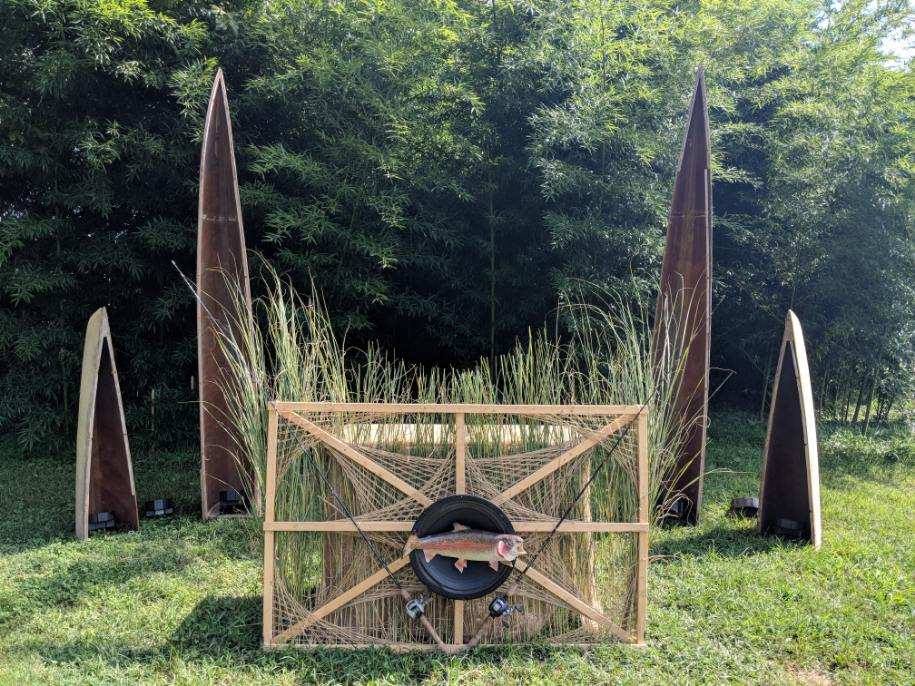
Not advertised before the event, the "river stage" designed by Illuminera had a renegade feel
Solasta Festival of course couldn’t conjure magic without the diligence and attention to detail of the producing entities Envisioned Arts and Harmonia. Each company brought their own production team which, joining with Collins, formed a dream team of young and excited event producers. On Sunday, Solasta Festival’s officially unofficial decompression day, as brunch was being served down at the stage I found myself in an administrative trailer sipping a strong mimosa stirred up by Dom Lu, the site lead at Solasta and a veteran of Envisioned Arts. We spoke about his early years in event production (“Anytime someone asks you to do something, just do it”) and the often unnoticed efforts that contribute to a safe, functioning festival.
“For me, I’m all about the attendees,” Dom said. “If you throw me in Artist Hospitality or something…that’s not my style. To me, everyone who’s on the dance floor, everyone who’s in the back with their friends who paid to be here, those are the artists to me. That’s who I care about.” As I felt my own forehead slowly begin to cook from a weekend in the sun, I noted that Dom had a permanent peel down along his nose. The skin under his eyes appeared raw with a pinkish hue; battle scars from many successful events, and likely a few failures. “Doing all the work, I don’t mind doing it. I’ve had those experiences where I’ve been to festivals and had the time of my life. I want to be able to recreate those experiences for other people.” Judging by the fixed smiles and strong auras of good will across the grounds all weekend, Dom and the rest of the event producers undoubtedly hit their mark at Solasta.
Much of what made Solasta special are those elements native to smaller festival environments. Replicating these elements on a larger scale while preserving the magic they deliver is challenging. Solasta’s growth was impressive in its second year. “A lot of festivals are still camp outs at their second or third or fourth year”, Dom noted with a bit of wonder in his voice. As this festival’s reputation grows, its organizers may have to balance a welcome increase in popularity and size with their ability to curate the intimacy that may earn the event its reputation in the first place.
The great takeaway from this kind of epic Appalachian sojourn gets back to one of those old lessons or cliches of transformational music festivals; take the knowledge and experiences gained on the grounds back out into the world with you. Whatever you learned about or reflected upon at this event; music production, friendship, stage design, romance, event production, sustainability, hummus-oriented brand partnerships - bring those reflections forward with you. Woven into the rest of the world, the atmosphere and attitude of the festival becomes less of an anomaly or some brief escape from life, but a greater part of culture and life itself.
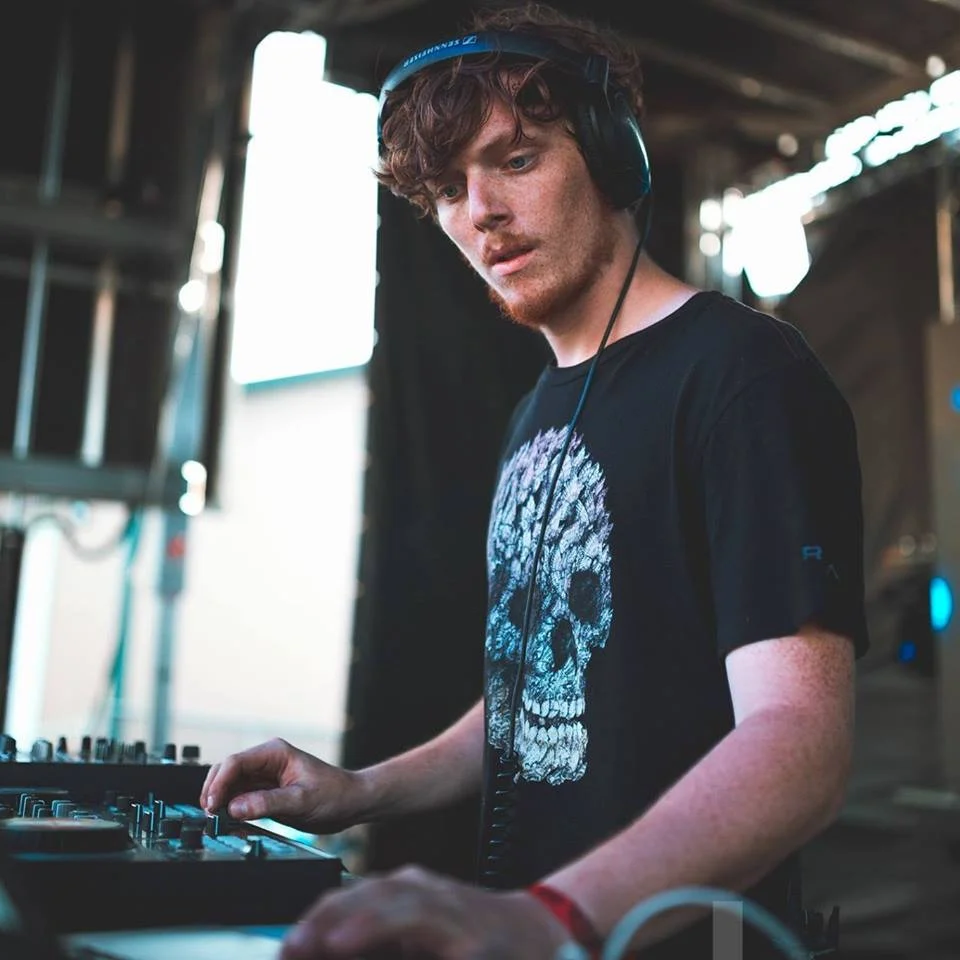
Sound of Solasta - EasyJack
For the last installment in our Sound of Solasta series, we linked up with a vital individual within the infrastructure of Solasta Festival, the producer/DJ and sound system connoisseur Jack Whelan. Known on the stage as EasyJack, Whelan the co-owner and lead engineer for Soundsystem Cultures LLC, an audio production and Funktion One sound system rental company based out of Chattanooga, Tennessee.

For the last installment in our Sound of Solasta series we linked up with another individual who is both on the lineup at Solasta Festival, and vital within the festival's infrastructure; the producer/DJ and sound system connoisseur Jack Whelan. Known on the stage as EasyJack, Whelan is the co-owner and lead engineer for Soundsystem Cultures LLC, an audio production and Funktion One sound system rental company based out of Chattanooga, Tennessee.
The EasyJack project stretches across a number of genres and tempos, but low-frequency is the common denominator. Many folks were first introduced to EasyJack and his diverse presentation when he performed during the Chicago Tipper run in August 2015. His released catalog numbers just below two-dozen tracks, including contributions to Oxidized Vols. 1 & 2, but the quality and intention of each does not go unnoticed. Jack and the Soundsystem Cultures crew have had a stellar rise since launching the company in 2015. They supply gigs with high-fidelity, properly-tuned Funktion One speaker systems. Northeastern heads would have heard them in action recently at the Camp Bisco Renegade Stage. They continue to push upward the benchmark for hi-fi sound system experiences, and they'll deliver that experience all weekend long at Solasta Festival on August 17-18.
The Rust: Tell us about Sound System Cultures. What is the ethos of your operation?

Soundsystem Cultures LLC was originally started by my business partner Philip Irwin. We met through Infrasound Music Festival and various mutual friends. Initially, I was assisting him in acquiring some of the needed equipment for his original set up and during that process we decided that joining together as parters was a much more effective solution so we could build a bigger system. Living in separate parts of the country had a natural advantage because we both had a good number of established connections for bookings in our respective regions. Things kind of fell into place naturally from there. We’ve never come up with any kind official ethos or motto, but our general goal is to provide the highest quality audio experience possible for our customers, no matter what it takes. We’ll go to any lengths possible to ensure that everything has been set up in the most optimal way for the system to operate in the given conditions of the show. If that means re-stacking the rig multiple times to achieve the perfect configuration for the environment, we’ll do it. If we have to dig a 100ft trench in the mud to hide cables so the dance floor is obstruction-free, we’ll do it, and so on… We cut no corners and take everything possible into consideration to truly take our clients' events to the next level.
The Rust: What drew you towards a career in curating sound? What drew you to hi-fi systems in general?
I was a producer/DJ and musician before I was doing sound professionally. Growing up being involved with underground events and playing in various bands, I always had an interest in the production and audio side of things. Eventually around 2012 I met Antoine Kattar who had been working for the Funktion One US distributor in Chicago for a number of years. He was looking for someone to fill an apprentice type position to help him with permanent sound system installs around the region. Antoine has served as the front of house engineer for Tipper and many other prominent acts. He was also a member of the team responsible for a number of well-known installs around the city including Chop Shop, The Mid, and Smartbar which has been referred to as one of the best dance floor systems in world. Through working with him I learned how to tune and maintain these systems. After the first time I experienced a proper Funktion One rig I was certain I only wanted to be working with extremely high fidelity systems and I’ve been hooked ever since.
The Rust: The EasyJack project seems to encompass a number of styles and tempos. Can you talk about your musical output, and the influences that shaped your production prowess?
My early influences came from video games like the SSX series and number of others that feature quality underground music. Later on, I discovered the world of glitch hop through the likes of Tipper, Kilowatts, Opiuo, Vent, (early) Griz, and many others. But the main influence on my own personal sound has always come from my love of Chicago house music. I love incorporating subtle elements of classic house into my glitch hop and dub sounds and I think thats been the main driving factor of developing my sound over the years. Another key influence for me is the idea of making “music for sound systems”… basically producing music that can really show off the capabilities of the high fidelity systems that we work with.

The Rust: Solasta has partnered with some top-tier organizations. What role does Soundsystem Cultures play in the Solasta infrastructure?
We basically handle all things sound for Solasta. We’ve been tasked with coming up with a rig that will compliment the sonic environment to the best of our ability while also working together with the stage design team to ensure everything will be a perfect fit. This year we will have a slightly bigger set up than year one and we hope to keep it evolving as the event grows. Last year the stage incorporated both a waterfall, fire elements, bamboo, and tons of other materials scavenged from the woods around the grounds. Making sure the footprint of our system can fit in within all of the beautiful deco, while still being optimal for sound quality, is crucial to delivering the best possible audio/visual experience for the crowd.
The Rust: What do you have in mind for the future of EasyJack?
Right now my main focus is my upcoming release with Addictech Records. It features some tracks I’ve put years of work into and will technically be my debut EP on an established label. Im also currently in the process of building my new studio which will serve as my creative space hopefully for years to come. On top of that I’ve also been developing a new side project called Frisk that will focus on a psychedelic mesh of techno and house. Most of that music will be four-on-the-floor and feature some pretty ravey vibes. My goal is to continue touring and keep growing both projects as much as possible.
--
Solasta Festival strives to nail every aspect of the attendee experience, and sound is arguably the most important aspect of all. Fortunately for anyone heading to Sneedville, Tennessee for this special gathering, Soundsystem Cultures will be running the boards all weekend. When Whelan takes the stage for a rare EasyJack set, and an even rarer Frisk set, he'll be flexing his handiwork in more ways than one.
FOLLOW EasyJack: Soundcloud / Facebook

![Seppa - Interview + Boosted [EXCLUSIVE PREMIERE]](https://images.squarespace-cdn.com/content/v1/59530136f5e2319eabb7d87f/1626113208781-BZ7C6B7E3LCECV7UD4CS/Boosted.jpg)

Amongst the incoming generation of artists having finally found their bite, not yes exemplifies the modern paradigm of electronic production; there are no hard boundaries, no clearly defined destinations, and unbridled compositional freedom. There’s a refreshing whim to their choice of direction, and the result is a fast-growing, dynamic catalog that takes us through virtually every space in low-end territory.