
Solasta Festival Makes New Home at Deerfields, North Carolina in 2019
Placing community above all else, Solasta Festival is one of a growing number of events, gatherings, burns, and massives that exist to cultivate interconnectedness with one another, and with our own sense of health and wellbeing. For 2019, Solasta moved to the auspicious grounds of Deerfields, North Carolina, where it underwent the next phase of its ongoing metamorphosis.

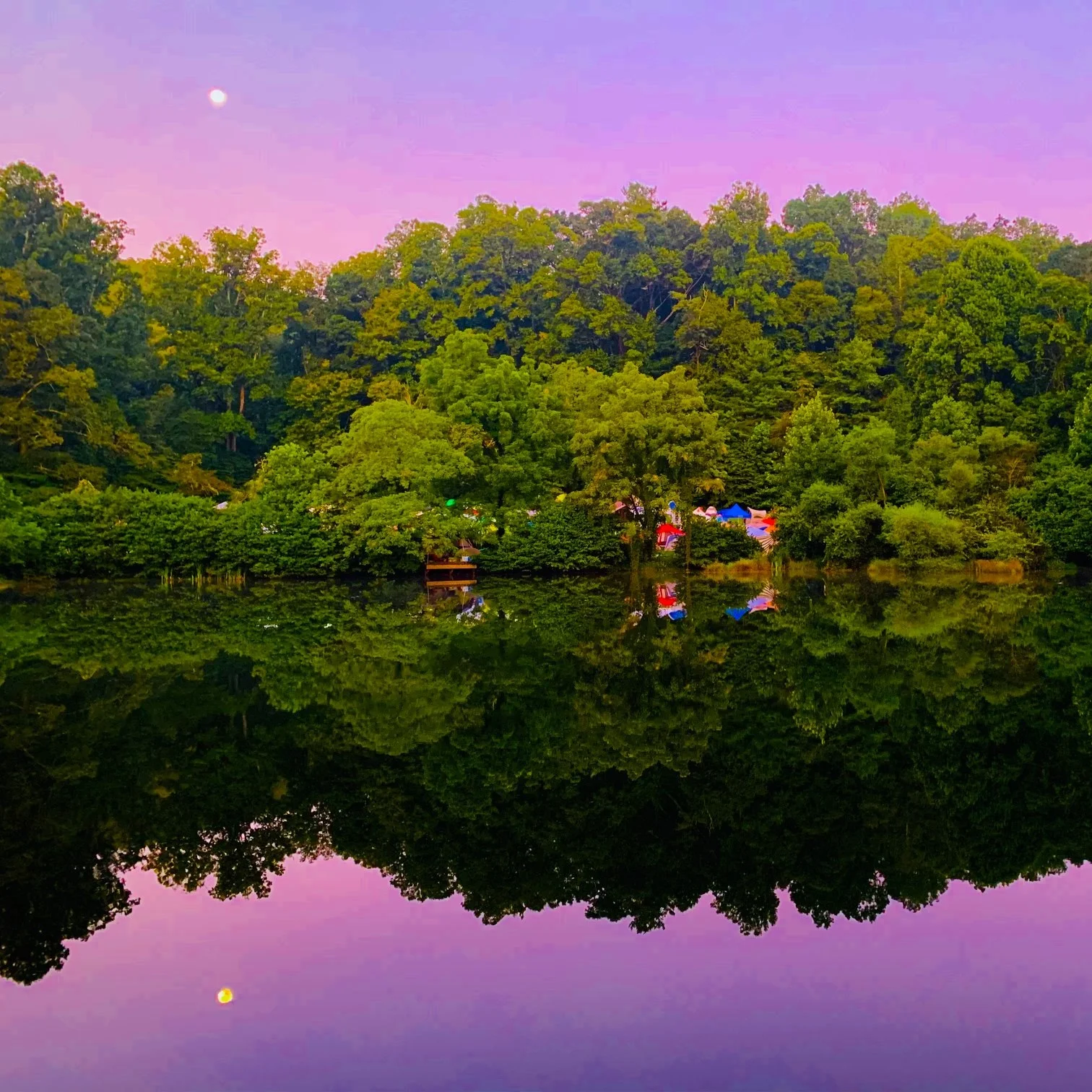
The upper lake during sunrise (Credit: SuprisinglySimple)
Solasta Festival never really begins the day it’s advertised to begin. It’s the day prior during early arrival; the last moments of sound-checking speakers, fastening stage decorations, preparing water stations and late-night light sources, and prepping the camping grounds for the impending revelry. It’s the calm before the storm, when the air is still and the hum of organizers cruising about like worker ants becomes a part of the landscape.
In 2017 and 2018, this vibrant image of organization and preparation took place at Spirit Crossing, Tennessee, nestled high in the peaks of the Appalachians. Home to a pristine stretch of the Clinch River, and the site for like-minded burns and music events in years prior, it was a place that resonated with potent undercurrents. For 2019, Solasta moved east to the equally auspicious grounds of Deerfields, North Carolina.
Sequestered in the eastern reaches of Nantahala National Forest, Deerfields is a rustic retreat carved into “The Green Place”, a slice of property purchased by Monroe M. Redden in 1927. Over the course of the next eight decades, the property was gradually transformed into a sprawling network of forest alcoves surrounding two freshwater lakes. By midday, the sun illuminated every vector of the forest floor. By nightfall, the air cooled to a pleasant chill, drawing a dewy blanket across the length of the property. Despite being barely an hour’s drive out of Asheville, there isn’t a lick of cell service or wifi available on the property save for the bit of bandwidth utilized by the production team.
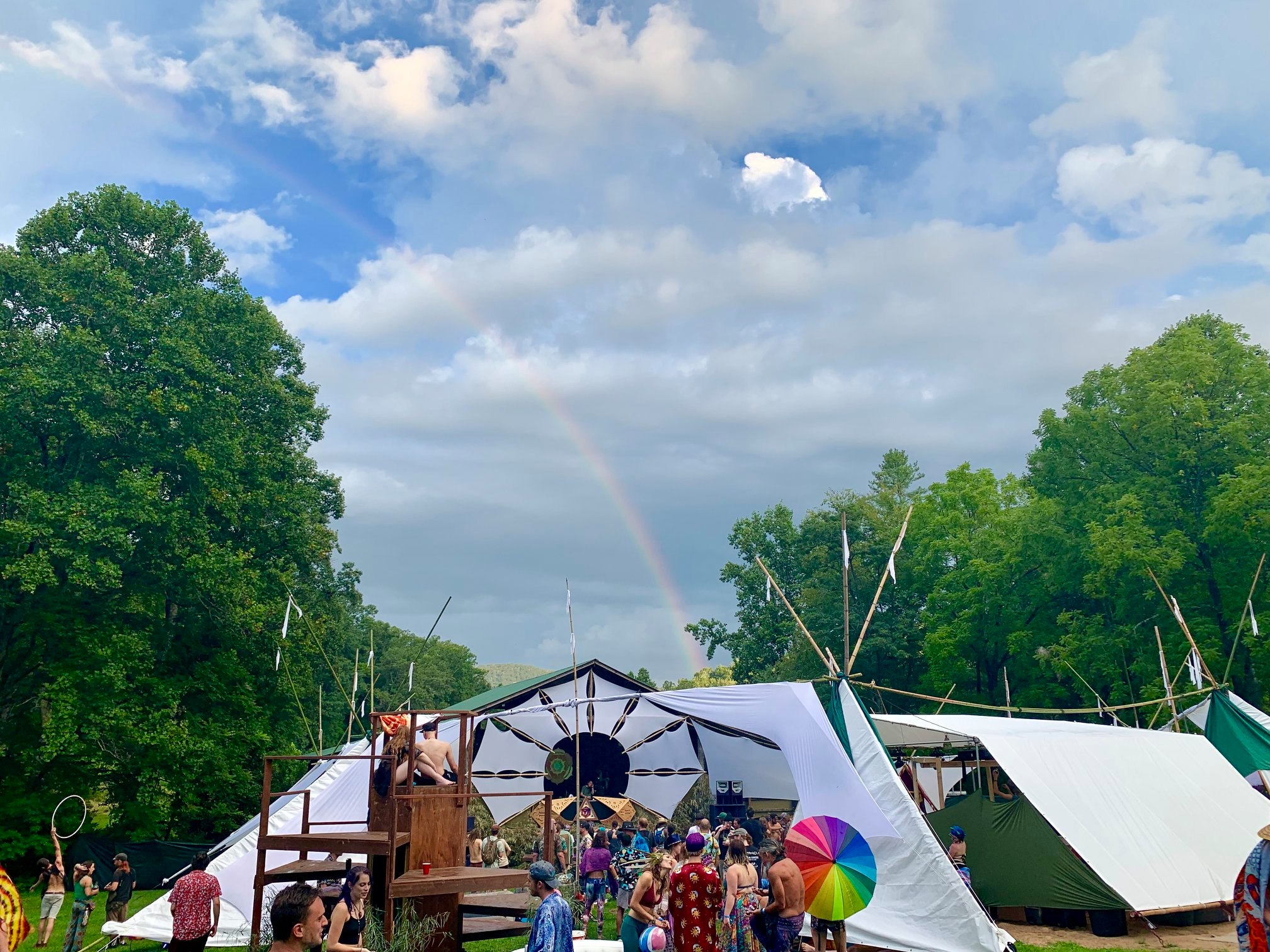
The stage by day (Credit: SurprisinglySimple)
Once again event producers Envisioned Arts and Harmonia displayed the confidence and swift problem-management skills befitting veteran production teams. As we elaborated on last year during an interview with Solasta’s organizers, their operational efficiency has been sharpened by years of experience outside of Solasta. Placing physical and mental well-being above all else, this team never missed its mark, with fans and friends keeping each other in check throughout the duration of the weekend festivities.
Making community the focal point of the festival, Solasta is one of a growing number of events, gatherings, burns, and massives that exist to cultivate interconnectedness with one another and with our own sense of health and wellbeing. The Asheville-based harm reduction and education company Harmonia, that doubles as event production entity, focused as always on providing safe spaces throughout the festival grounds. They’ve been the face of Solasta’s community operations from day one and are beginning to make an impact across the US festival circuit.
So far, Solasta has benefitted from its slim profile. The festival is intimate and there are few lines between artist, assistant, volunteer, and attendee. This interwoven social fabric is the strength of Solasta, wherein producers, engineers, audiophiles, and casual fans mingle in total cohesion, forging creative connections and friendships in a melting pot of talent and intrigue. One way Solasta achieves this dynamic by concentrating the music to a central location. As in years prior, there was again just a single main stage from midday until the following sunrise.
Hasan Zaidi, the co-founder of Envisioned Arts, paints a picture of Solasta’s strategy for success. “From the very first day of the first Solasta, the single stage dynamic has given all of our musicians and visual performers the most attentive platform we can achieve.” Solasta’s lineup has traditionally been a handpicked collection of incoming and veteran producers and DJs. Having a single focal point and an expertly-tuned sound system helps to level the playing field among the performers. Everyone gets their fair shot to make a potent impression on a captive audience.

The installation at the foot of the main stage (Credit: SurprisinglySimple)
Soundsystem Cultures, LLC (SSC) ran sound for the third year in a row, bringing along as always a potent set of Funktion One speakers featuring F218 and Infrabass 218 subwoofers and Resolution 2 tops. Sebastian Torsion, a member of Onesource Audio and a frequent attaché of Tipper’s audio crew, teamed up with SSC for the weekend. The audio team combined textbook knowledge with hands-on experience to curate an aural experience that was physically powerful yet totally comfortable. On Saturday afternoon, Sebastian joined Bill Weir, an expert audio engineer and co-owner of the international IDM label Outside Recordings, and taught attendees about the physics and technicalities of live audio production during an engineering workshop.
“Crafting an audio experience that produces immersion and comfortability at the same time is entirely a balancing act” Weir said. He explained the science behind proper concert audio, cutting zero corners as he dove into the fine details and objectivity behind specific engineering decisions. The crowd was sizable, with about 100 people in attendance despite the rising mid-morning heat. “Pushing decibels is the opposite of the operative goal. The goal is to achieve a totally balanced spread across the dance floor. We don’t want your ears to hurt, we want your ears to be immersed.”
That immersion is one of the key platforms that all successful music events rest on. Solasta has always preferred to achieve that immersion not just through a custom fit audio experience, but through a combination of sound and decoration. The eminent beauty of Deerfields was more than enough to propel attendees into a relaxed state of body and mind, but the stage design was also key to maintaining a constant feeling of immersion.
The stage was an open-air gazebo standing between both bodies of water on the property, with an alluring view of the lower lake. Dozens of white, silky sheets created a portal through which the crowd viewed the performers. The wonderful garden installation that has been a stage front staple at every Solasta had grown since the previous year. Parallel rows of trees stood in a fixed line behind the performers, seeming to meld into the foliage above and around the gazebo. The dance floor was ringed by draped textiles and bamboo, containing the party to an approachable, open space, and creating a conduit for communal experience.
Every staff member and volunteer said “Drink plenty of water” as many times as they blinked over the course of the weekend. It was an impactful reminder to us all why we were so excited to be here in the first place. That understanding of care and mindfulness between the organizers and the ticket holders creates an environment of trust, making it easier to develop social bonds within the festival.
The Southeastern experiential theatre and art troop GNOSTiK brought talents to Solasta once again. These women create transformative spaces for expression at events across the US, and they exceeded expectations with their Lounge installation at Deerfields. This year, the GNOSTiK Lounge rested in a smaller gazebo atop the upper lake, looking out across the expanse of the festival. The Lounge was a space of constant flux; dancers and acrobats gliding across a visual-mapped stage, surprise DJ sets, couches and benches warm from the entranced viewers wandering in and out of the space. It was full of intrigue and a respite from the dance-centric environment of the main stage, allowing revelers a chance to simultaneously rest and engage with performance art in new ways.

Performers in the GNOSTiK Lounge. (Credit: GNOSTiK)
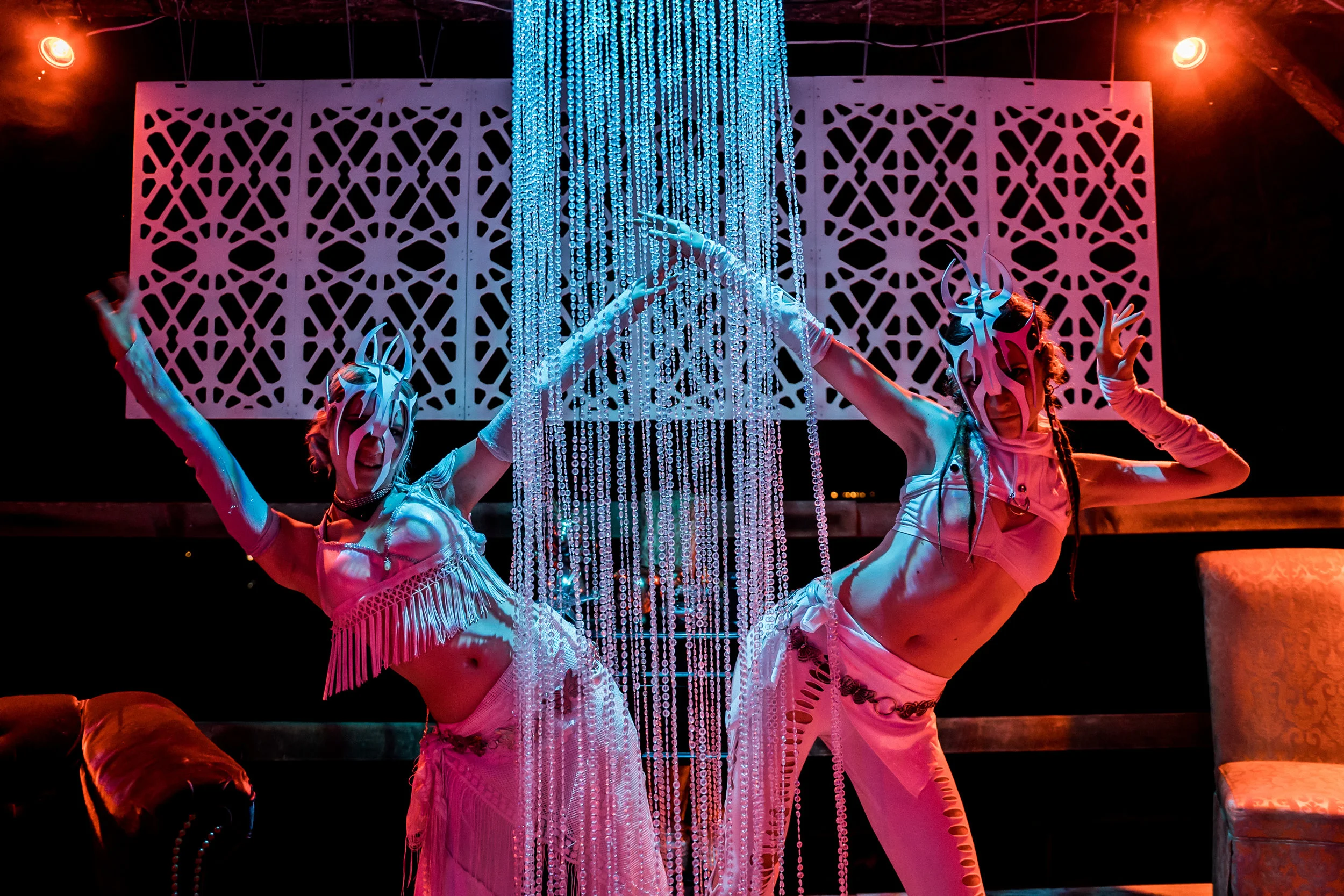
GNOSTiK performers at the Lounge. (Credit: GNOSTiK)
The music at Solasta once again leveled the crowd from start to finish. The lineup was a blend of top tier acts, rising stars, new and collaborative projects, and Solasta fan-favorites from across the electronic music spectrum, including Detox Unit, K.L.O, Ultrasloth, spacegeishA, MALAKAI, and Integrate. The order and pairing of the performers was especially well done. The prime time slots for Friday evening took the crowd on a journey through all things guttural and psybient within bass music. Base 2 brought the gears of the night into full motion, presenting a cultivated blend of original tracks that synced up with each other like a string of skeleton keys. Goopsteppa began the onslaught of surgical, fractalized synthesis that would persist through Charlesthefirst and Attya, charging the dance floor with permeable psychedelic energy.
Saturday afternoon began the festivities down on the shores of the lower lake, with a sultry blend of music to elevate the mood of the sun-soaked revelers. Rezinate co-owner Saltus initiated a serious dance-floor boogie, rinsing out salacious heaters for a specially curated funk set. Easyjack’s beloved side project, Frisk, channeled the echoes of the Chicago’s underground nightlife, with pulsing house and techno giving the festival a rare dose of steady-beat action. During the height of the afternoon sizzle, Nashville-based DJ Doyle reprised his role as the master of all ceremonies, sending the crowd into a glorified nostalgia frenzy with mid-2000’s club rap classics.
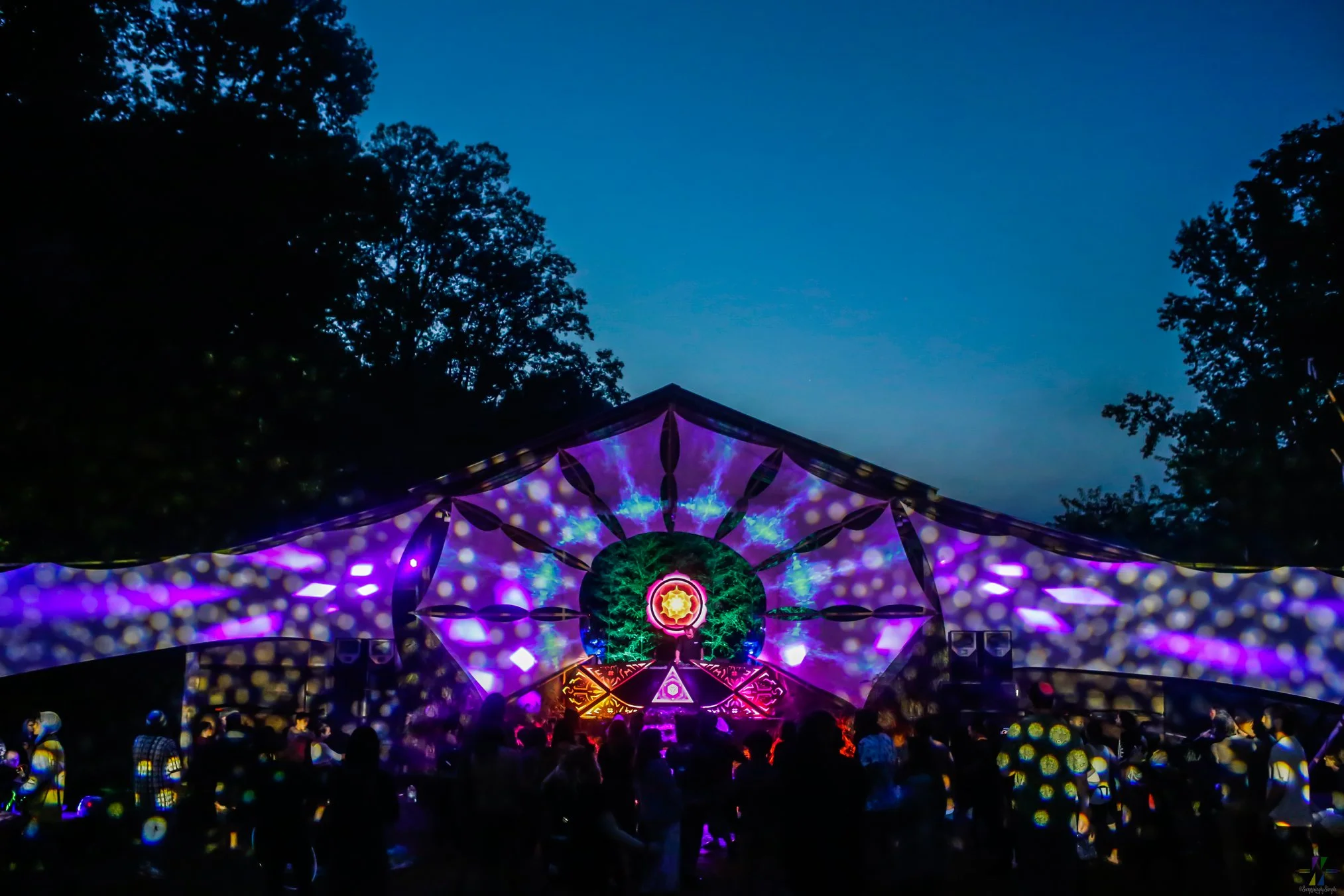
MALAKAI’s sunrise set (Credit: SurprisinglySimple)
Saturday evening saw the energy of Solasta launch straight out of the atmosphere, with a very tangible sense of excitement poking through the onset of a chilled dusk. Coalescing the energy output for Saturday’s prime run of acts, Integrate took the stage for their debut performance. A tag-team between the southeastern heavy hitters VCTRE and Black Carl, Integrate slung a bevy of original tunes and beefy selectors to mark their foray into the public eye. spacegeishA smashed her 11pm slot with a meticulously crafted exodus into the darkest reaches of sound, reverberating every inch of the dance floor. Detox Unit took the crown for crowd engagement, with every soul on the property engaged in an isometric group dance against a broken-beat flurry. K.L.O sliced and diced any remaining intact heads with their famously ferocious vinyl cuts and precision synthesis. Navigatorz claimed the spotlight as the second debut act of the weekend; Vinja and Sortof Vague brought their production and performance mindsets together for this new project, diving into the abyssal depths of synthesis. Bringing the last night to a spectacular close, MALAKAI spared no effort in executing a beautifully tailored sunrise performance. Original tracks and selections from his own archives morphed into an ultraviolet serenade of the senses, bringing the last bits of energy within the crowd to a resounding cadence of body and mind.
Sunday morning was a tired and joyous gathering for one last hurrah. The fabled pancake breakfast returned in it’s brightest form yet. Probe 1, Easyjack, and Detox Unit graced the stage for one last three-way break-beat performance, with organizers literally flipping pancakes into the mouths of their friends from behind the decks. It was an audacious and hysterical ending to a weekend filled with pure intentions and outcomes.
We left the grounds with that same sense of renewal and drive we felt last summer that made returning to Solasta Festival such a natural move. Powerful, communal undercurrents left this gathering through the thoughts and actions of everyone who came together for it, once again manifesting Solasta’s goal for inclusion and awareness. Given Solasta’s size and relative humility, it will undoubtedly continue to grow in the years ahead. We’re eagerly awaiting it’s return in the summer of 2020.
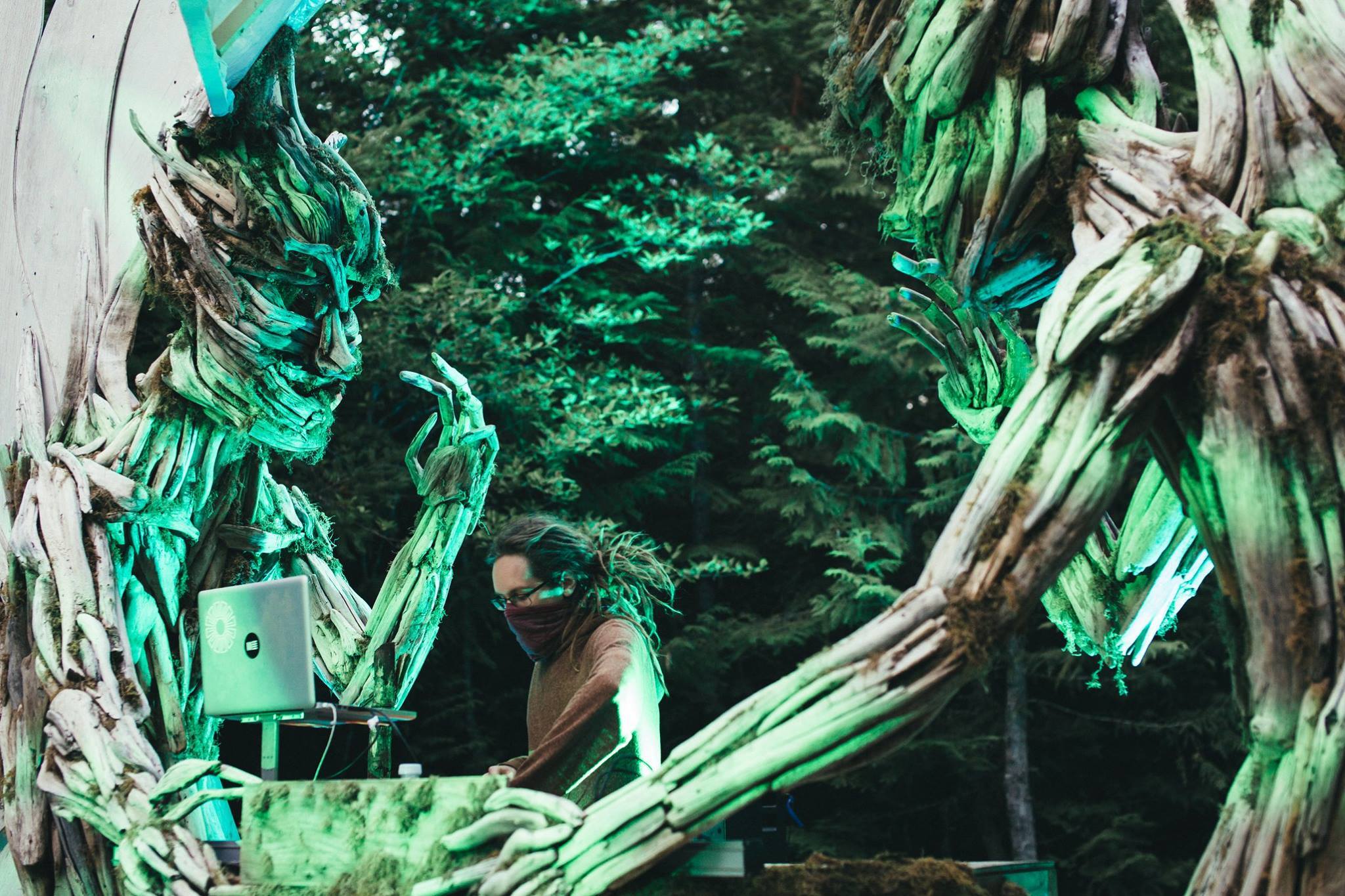
Sound of Solasta - Pathwey
Solasta Festival is leaving its original grounds in northeastern Tennessee for the misty, hill-bound Deerfields Retreat in southwestern North Carolina. The event is known for its niche curation, booking the cream of the contemporary crop in psychedelic broken beat music. Unlike their location, this ethos hasn’t changed. Our Sound of Solasta interview series investigates the back stories of artists on the lineup, and this year we’re focusing on the ascendant audio alchemist Pathwey from the nearby city of Asheville, NC.

Solasta Festival is leaving its original grounds in northeastern Tennessee for the misty, hill-bound Deerfields Retreat in the Pisgah National Forest in southwestern North Carolina on August 16-18. Now entering its third year, the event is known for its niche curation, booking the cream of the contemporary crop in psychedelic broken beat music. Unlike their location, this ethos hasn’t changed. Solasta draws crowds, performers and some of its organizers from Asheville, North Carolina, a fertile place for electronic music culture. Our Sound of Solasta interview series investigates the back stories of those performing at Solasta and for this installment we’re focusing on one of those Asheville artists, the ascendant audio alchemist Pathwey.
He is a diverse and persistent musician whose career creating art in multiple forms has taken him across the country and back again. Although he’s been playing all sorts of music his entire life, lately Pathwey has been working at 140 beats-per-minute, and he’s one of the only producers at this glitch hoppers’ paradise of a festival who does so. But he plays it like few others do, integrating psybass sound design, world instruments, organic textures, and themes of transcendence and appreciation for nature. Make no mistake, though, Pathwey will get you pitted. He’ll just lift you up on high afterward and perhaps tickle your pineal gland along the way.
Pathwey, who usually goes by Andy, expresses himself through visual art as well. All of his songs save for compilation tracks or remixes are accompanied by his own artwork. He’s fabricated stages and worked on projection mapping projects for some of the most enduring acts in electronic music. When he was living in the Boston area, he learned from his roommate, the visual jockey Zebbler (Peter Berdovsky), and became part of FractalTribe, the New England collective with a distinguished fabrication operation.
These experiences have given Andy a holistic familiarity the electronic music culture. When he ascends the stage to spread that culture through his music, a decade and a half of history stands behind him. His persistence was recently rewarded when Street Ritual’s booking agency picked him up in April, ensuring that he’ll be holding space in more clubs across the country soon. Ahead of his “hometown” performance at Solasta, we shot Andy some questions to learn more about him.
The Rust: How long have you been producing music as Pathwey?
Andy: It’s been about two years since I started going by Pathwey, but in my mind this project has been in motion since I started creating electronic music over 14 years ago.
The Rust: What do you try to communicate with your music?
Andy: Music is so intimately connected with the feelings and experiences of the person creating it. In that sense, all of my music is translating and reflecting on some thought, feeling, or experience I’m going through at the time. For me, making music is really the most potent way I know of to process my emotions and transform them into something positive. Sometimes I’m reflecting upon spiritual and philosophical ideas around life and death. Sometimes I’m trying to translate a deep psychedelic experience. Sometimes I’m expressing my frustrations regarding global issues like environmental and social justice. Other times I’m just simply having fun and fucking around with my friends. Whatever it happens to be in the moment, I think ultimately I’m just processing what is happening in my life and trying to create something from it that is beautiful and means something to me.

My greatest aspiration with Pathwey is to use it as a vehicle for positive environmental and social transformation. We are currently faced with so much fucked up shit in our world today. Not like that’s anything new to the human experience, but sometimes it’s hard not to get overwhelmed with sadness, anger, and feelings of helplessness just thinking about it; what effect I could possibly have as one individual? But I think that music can give us the ability to create positive change in a powerful way. That change could be as immediate as uplifting someone into a positive state of being or as lasting as generating funds to donate towards environmental relief efforts, social justice programs, or building communities. This is something that I’m currently working towards with Aquatic Collective and The Undergrowth. We’ve got a lot of really exciting ideas and projects in motion. I feel like as an artist, I have a responsibility to use my platform to promote projects, ideas, and issues that I think are important. Using the gift of music to make a positive impact on the world while simultaneously doing something that I love is the ultimate reward for me.
The Rust: Can you talk about some of the projects you’ve worked on in the past, particularly visual art?
Andy: I feel so blessed to have discovered art and music at such a young age because they’ve both been incredibly positive guiding forces and teachers in my life. Art and music are like an endless feedback loop for me. One is always inspiring the other and the two are intimately connected for me. All the artwork for Pathwey, with the exception of some of the compilations and remixes I’ve released on, has been my own work. The art to me is just another piece of the full expression and I plan to continue creating original artwork and video content through this project.
I’ve created art in all types of mediums; painting, graphic design, installation art, video, wood/metal working, etc. I love exploring new mediums and forms of art. I’ve created artwork for album covers, events, and festivals, I’ve created logos, artwork, and video content for other artists and businesses, I’ve received two grants for installation pieces that I created, and I’ve worked on the fabrication of installations and 3D projection-mapped stages for Shpongle, EOTO, Verizon Wireless, Burning Man, DEFCON, and many other festivals and events. I feel like I’ll be creating visual art and exploring new mediums for the rest of my life.

This piece of Andy’s original artwork was featured as the cover for Standing with the Waters: A Benefit for Standing Rock, a benefit compilation for indigenous rights organizations from the Aquatic Collective..
The Rust: Musically, what were you doing before Pathwey?
Andy: Music has always been a huge part of my life, ever since I was a kid. Growing up I was playing saxophones, guitar, bass, and drums throughout school and jamming in bands with my friends at home. I was recording shitty demos of our songs in the basement, playing local DIY shows, and making beats with Fruity Loops on my family’s computer.
Way before I was going by Pathwey, I was experimenting with genres like Dubstep, DnB, IDM, Glitch-Hop, Downtempo, Psytrance, Trap, House, Ambient or whatever else I felt like making. I think the only difference is that now I’ve finally come to a place with my productions where I think they’re good enough to release. Most people who know my music that aren’t close friends of mine would probably never know I’ve been making lots of different music because I never released any of it. Before Pathwey, the only stuff I ever released was downtempo, but I’ve always been experimenting with all sorts of shit.
The Rust: How would you describe Pathwey music?
Andy: To me, Pathwey is this kind of sonic bridge between the past and the future, merging sounds of cultures from across the ages of human civilization with unknown futuristic and alien sounds that have yet to be created or heard. Somewhere where the natural world and technological world meet in harmony and dark and light energies combine to express the full breadth of human emotion and experience. Sometimes it’s high energy and moves your body, other times it’s chilled out and moves your mind. Hopefully some of it will move your soul…
People can definitely expect to hear forthcoming music from me in a wide variety of genres and tempos. My forthcoming album will showcase more of the explorations in 140 bpm music that I’ve created over the last few years, covering the spectrum from heavy bass-driven bangers to deep atmospheric heart-melters. I also have forthcoming collaborations and works exploring all of those genres I just mentioned.
How long have you been in the Asheville area? What’s the underground electronic music community there look like?

Andy: I’ve been in Asheville for about three years now. The music scene here is so dope, man! I get to see and perform alongside artists I love all the time! There’s certainly no shortage of awesome events happening here. It’s not as big of a scene as somewhere like Denver, but it’s a special place with a great community. I just feel so blessed to live around such a supportive and active music community and I’m so grateful for all the ways in which moving here has been a catalyst for my own growth as an artist. There’s so much talent in Asheville and it’s super inspiring to be around! The community here is really welcoming and open to new people and new music as well. You’ll definitely have a good time if you come through Asheville. Big shout out to The Undergrowth, Harmonia, and Envisioned Arts for holding it down here and providing opportunities for up and comers like myself to play and for hosting events for the community to gather and enjoy the music that we love!
The Rust: Have you been to Deerfields Retreat before? What can you tell us about it?
When I first moved to Asheville, I went to Kinnection Campout at Deerfields. It was such an inspiring experience and my introduction to the electronic music scene in the southeast. All I’ll say about Deerfields is, for those of you haven’t been there, you are in for a real treat if you come to Solasta this year! It’s one of my favorite outdoor venues on the east coast for sure! It’s truly a magical place!
The Rust: Anything else you’d like to share?
Yea, I’d just like to express my infinite love and gratitude to both my parents, my nana, my family, my friends, and my fans for believing in me and supporting me all these years. I certainly wouldn’t be where I’m at today without you all and I just want you all to know that your support and encouragement really means the world to me. To all the people who’ve reached out to me over the years to appreciate what I do, it means more to me than you’ll ever know. There’s a lot of stuff that’s finally coming to fruition after years and years of hard work and I’m so excited to see how it all unfolds and where the journey takes me! Also, to anyone out there reading this that’s struggling to achieve their dreams and aspirations, DON’T GIVE UP! Just keep fucking doing it! Keep moving forward step by step and eventually you’ll get there!
FOLLOW Pathwey: Soundcloud / Spotify / Facebook
FOLLOW Solasta Festival: Tickets / Official / Facebook / Instagram
![Solasta Festival - Vinja [Interview]](https://images.squarespace-cdn.com/content/v1/59530136f5e2319eabb7d87f/1558498387804-U5DE6LQEU4N6CEXPJEPQ/Vinja_Solasta+Festival+The+Rust+Music+Interview.png)
Solasta Festival - Vinja [Interview]
The venerable Vinja is a stalwart of turntablism and high-octane electronic grooves. This summer, Vinja performed in Tennessee at the upstart gathering Solasta Festival. We were able to steal Vince Santora (Vinja) from the revelry for candid conversation covering the development of his tunes, Solasta itself, and the ever-evolving music social phenomena and his place within it.
Delivering everything from neck-breakers and 4x4 shimmies to brolic breakbeats, the venerable Vinja is a stalwart of turntablism and high-octane electronic grooves. Vince Santora (Vinja) picked up the decks for the first time back in 1998. So began a journey that would lead not to widespread acclaim, but to Vince setting down the project after several years of extensive gigs throughout the US. Come the turn of the 2010s, Vinja had put skin back in the game and caught the attention of Envisioned Arts. After partnering with EA, the Vinja project was reinvigorated and pointed towards new territories and audiences.
This summer, Vinja performed in Tennessee at the upstart gathering Solasta Festival, itself co-produced by Envisioned Arts. During the course of the weekend, we were able to steal Vince from the revelry for candid conversation covering the development of his tunes, Solasta itself, and the ever-evolving music social phenomena and his place within it.

Vince Santora (Vinja) performing at Solasta Festival 2018 (Credit: Anna Norwood Photography)
“It’s fun to have the kind of perspective that I’ve gained in seeing how the scene has developed from my beginning years until now,” Vince told me, as we watched the Sound System Cultures LLC team at work from behind the stage. “The culture has always been there. For me, it began a little bit differently, as I grew up raving in San Francisco, so the parties were a little bit different. The DJing was all vinyl, and it was dominated by this warehouse vibe all over. To see how much this culture has grown, and how passionate the people within it are, it just absolutely blows my mind. I’ve always really considered myself a hobbyist. I love making music, and I love DJing, but I never expected any sort of ‘touring-travel-around-playing shows’ dynamic to evolve out of that. I’m really just riding the wave that everyone else is riding.”
He’s speaking frankly on the paradigm shift that happened within electronic music here in the states almost eight years ago, wherein a few especially wild producers began to exert great influence on the gradual direction of our slice of audio culture. “It became apparent to me at the Tipper [Denver] Fillmore show. There were just thousands of people there. Meanwhile the first time I saw him was in a community center with some twenty-odd people. And that’s just one artist. There are dozens of them that started all in the same kinds of places, who grew to have a very visible and powerful influence over the scene as it has developed.”
While he spoke of these artists as pillars of inspiration for the community at large, I felt he didn’t immediately recognize his own impact. Being a true and tried practitioner of turntablism, Vince is in part responsible for influencing a generation of DJs who seek to bring their performances beyond just contemporary mixing. “I’ve always firstly enjoyed the ‘live’ aspect of all music. I started in a band like anyone else I knew at the time, but I don’t have any reservations against someone who is just a DJ without any conventional music background. It’s not the instrument, it’s the intent.”
The way Vince delivers this remark, it almost reverberates throughout Spirit Crossing and the wider valley surrounding us, as if he was echoing some greater ethos of Solasta as a whole. “As far as why I decided to scratch in my sets, I like the vulnerability of it. I like putting myself out there and performing something live, knowing it could go terribly wrong at any moment,” he said, chuckling. “It also comes down to having a hip-hop musical upbringing. I grew up seeing Mix Master Mike cutting it up onstage. What really brought me directly here was Krafty Kuts. I was a breaks DJ, and whenever I listened in to him or watched what he was doing, it became extremely apparent that what he was doing was not only overtly technical, but took me for an absolute loop around the fact that this wasn't hip-hop: it was dance music. I realized that I wanted to step into that dynamic as well, to begin creating a much more immersive concert experience.”
Considering that he was tapped to host a workshop on vinyl scratch earlier that afternoon at Solasta, Vince has without question stepped forcefully into that dynamic. Years of intimacy with waxy vinyl has granted Vince an indelible skill that sets him several cuts above the competition. To get a better feel for Vince’s vinyl skills, check out Rusted Rhythms 23, a new mix from Sortof Vague featuring cuts and scratches from Vinja.
The conversation naturally shifted gears towards his personal catalog. For someone who got their start 20 years ago, it’s remarkable that Vince stays up on relevant sound design and genre developments. His discography is indicative of a producer and composer who has a mind as malleable as a digital synthesizer. “I’m still rocking some 87 bpm half-time stuff, but lately my body of work is moving more into the 100 bpm golden-era hip-hop region. I’ve been really digging 110 bpm, and I find it can be really inviting to kids who don’t have a lot of experience with house or techno. Overall, I feel a very bouncy, Afrika Bambaataa-esque vibe to my whole catalog. Having been so influenced by classic electro and dance floor themes over time, I gradually began to merge the edgier grit of hip-hop with the repetitious design of dance music.”
Vince’s earlier productions were no less high-octane than now, but they were curiously devoid of any vocal work. Naturally, that thought begged for an answer. “I began very much opposed to the use of vocals, deciding instead that all emotive communication needed to happen at the instrumental level. As the years passed, and I opened up to new musical influences, I began to see where repetitive vocal lines and cuts could actually help further whatever emotional output I was trying to convey.” Throughout our conversation, he keeps coming back to this idea that so much of what he does is done for each and every person who follows the vibe he sets. “In my mind, a great gig is me doing my job, and you dancing your ass off and working up a sweat. That’s what I want out of this.”
As our time together came to a close, I asked him about his thoughts on Solasta Festival. He’s been on board with this event since its infancy, having performed there last year, and he was anything but coy about his adoration. “So Solasta this year looks like it has just quadrupled in size! Last year it was really just a bunch of producers partying out here. We didn’t quite have the numbers at the time that some people expect from a ‘successful’ festival, but right then and there I knew Solasta would be something special for all of us.” His voice betrayed his affection and high esteem for the operation.
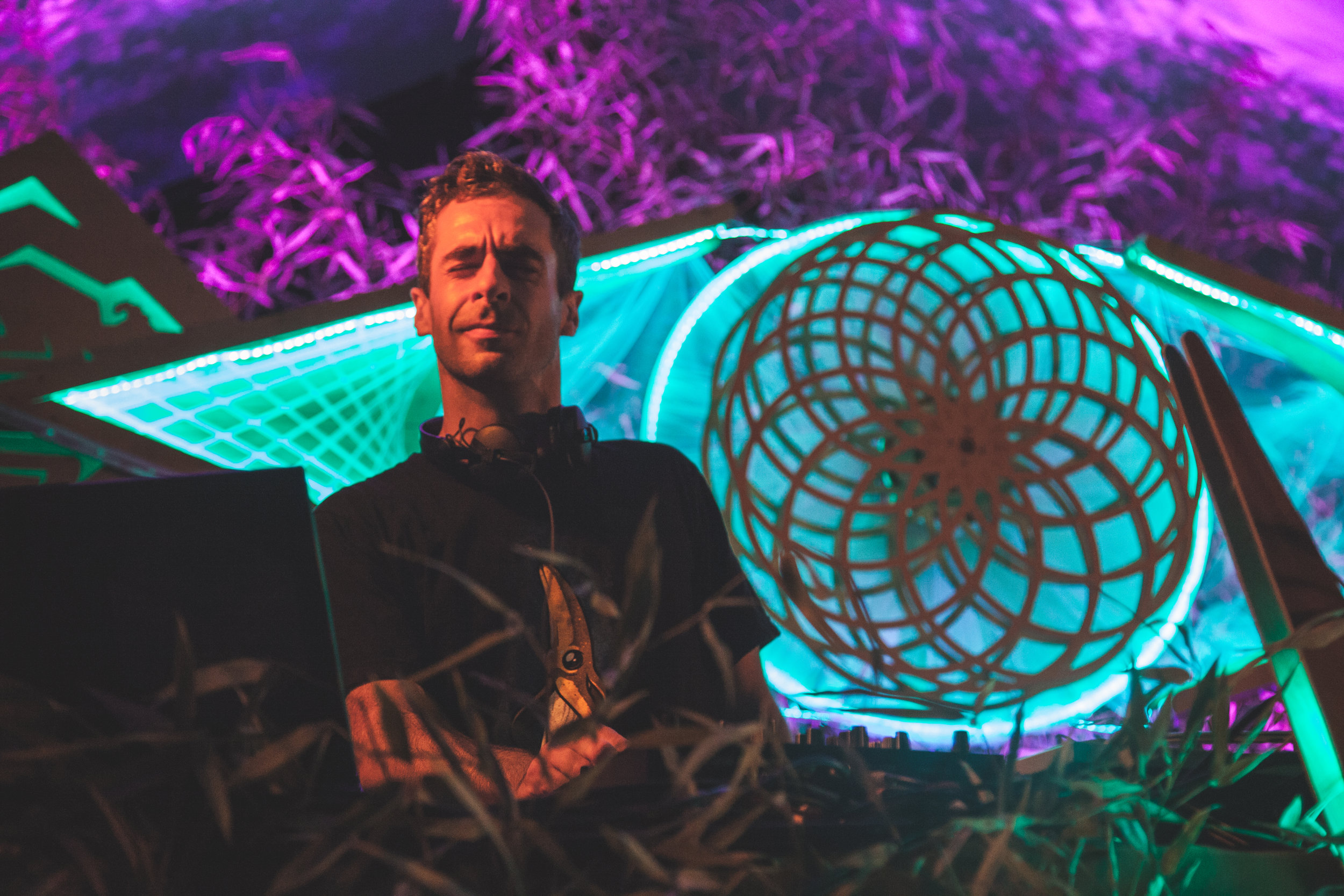
Vince Santora (Vinja) performing at Solasta Festival 2018 (Credit: Anna Norwood Photography)
“First and foremost, the convergence of the crews working here. I’m glad we have the Rust crew down here, bringing your slice of the musical pie with you guys. The Harmonia team from Asheville is absolutely essential to the ethos of this place. As for Envisioned Arts, what Hasan and that team are building is just amazing.” He hits the mark without a fumbled word. Envisioned Arts and Harmonia indeed encompass nearly every aspect of integrated, patron-first musical experiences. (For more about these organizations, check out our past interview with their respective founders here).
“The second thing that makes Solasta so inviting is the incredible level of intimacy that pours out of this little venue. You have one of the cleanest stretches of fresh water running right through the grounds. You’re nestled inside this gorgeous nook in the Appalachians. Once you’re out here, it just hits you square in your happy place. Furthermore, it’s especially appealing to me because it’s so specifically focused on the musical curation,” says Vince, who is himself a prime example of this curation. “For me as a performer, I sometimes struggle with the multiple-stage dynamic, wondering who and how many will show up to the time slot I’m given on the stage I’m placed at. Here, there is a single stage, with a top-tier sound system, ironically being operated by a DJ, who I suppose is DJing DJs (laughs).” His statement could not have been more on the money.
The overwhelming advantage to utilizing a one-stage dynamic in this setting was already making itself apparent, giving attendees a shared space in which communication and openness prevailed throughout the weekend. “I feel like this old-school approach, with one central gathering point and one ship to man, it really allows all of us as performers to get comfortable with the crowd, the atmosphere, one another, and it is certainly triggering a bit of nostalgia for me. The fact that the stage doesn’t even turn on until 3:00 or 4:00 pm each day is an absolute blessing. We’re all up partying usually until the sun is peeking up for a new day, and having a crowded lineup will quickly land people 8:00 am time slots where the whole thing is just a glorified zombie pit.”
As Vince finished regaling a love for Solasta shared equally by all in attendance, Hasan rounded the corner to grab him for some artist-to-manager business, bringing a succinct end to our conversation. I was left with the impression that we owe this man a thanks many aren’t aware of yet. Not only has he been a long-time player within our community, but he actively seeks to engage with it all these years down the road. From here out, all eyes are aimed straight ahead at Vince Santora and the Vinja project, as he’s sure to continue impressing the best and crushing the rest in his continued quest to energize the dance floor.
FOLLOW Vinja: Soundcloud / Facebook / Spotify
FOLLOW Solasta: Facebook / Website

Solasta Festival Levels Up in Second Year
The event was conceived with the intention to do something different. With just a single stage, a niche lineup full of rare international and coveted local acts, a dedicated lounge and performance theater, and a pervasive emphasis on health and self-care, Solasta didn’t stray from this conception.
When the sun rose over the lush, green fields of Spirit Crossing in Northeastern Tennessee on the first day of Solasta Festival, you couldn’t see it, shrouded as it was by Appalachian mountain mist and cool cloud cover. Volunteers and staff who worked through the night were putting finishing touches on modest infrastructures and installations in the quiet dawn. Campers who arrived the night before took prized real estate along one of the grounds’ lone tree lines, or on the bank of the Clinch River that flows lazily through the grounds. As morning turned to noon the sun began to peek on the festival. For the rest of the weekend - from logistics to music to the familial atmosphere - the presence of the sun was the only inconsistency at Solasta Festival.
Just over 1,000 people settled on the grounds that weekend. In its second year, the gathering quadrupled in size and exceeded the expectations of everyone besides perhaps its young and wily staff. The event was conceived with the intention to do something different. With just a single stage, a niche lineup full of rare international and coveted local acts, a dedicated lounge and performance theater, and a pervasive emphasis on health and self-care, Solasta didn’t stray from this conception.
Strolling and patrolling on Friday afternoon was Officer Larry of the Hancock County Sheriffs Department, the bulk of Solasta’s security force. A law enforcement presence at a music festival without the characteristic firearm or body armor was a rare sight, my colleague noted. He didn’t need that equipment with this kind of crowd, he suggested. His toothy grin stood out from his sun-weathered red skin as he asked, “how do you like Hancock County?”
“It’s different,” I responded. And indeed it was. Spirit Crossing sits on the outskirts of the county seat, Sneedville, home to approximately 1,200 people. The hills - steep, rolling, and frequent - break apart and condense cloud formations and create that unpredictable weather. Although the forecast called for constant rain, the festival saw just one brief, powerful storm and a series of scattered showers.

The GNOSTiK Lounge at Solasta Festival (Credit: Shots By Carl & GNOSTiK)
In the spirit of differentiation, Solasta partnered with GNOSTiK to establish the GNOSTiK Lounge and Performance Art Theatre at the center of the broad, flat festival grounds. This welcoming space hosted 22 performers doing about 15 acts on Friday and Saturday, from fire manipulation to less conventional fare like contemporary dance, poetry, kink, and burlesque. Our favorite act had to be Fire Circus for their combined acro yoga and fire-spinning act, “It’s a platform for performance artists to express fully realized visions in a cultivated environment,” according to GNOSTiK co-owners and co-creators Ali Khemi and Silv Era, who traveled west to Solasta from their base in Savannah, Georgia.
The Lounge captivated by creating an atmosphere apart from the rest of the festival, while simultaneously being an integral part of it. “Gnostik is not reliant on already existing spaces provided by the music culture,” Ali and Sliv explained, “but rather creates the vessel that invites performers, musicians and artists to create within the vision.” Other attractions and concerns faded fast as one became enraptured in the theatrical and sexual nightclub mystique of the Lounge. The decor was sophisticated but with a sharp edge, and heady teas and elixirs were served out of a Lounge bar.
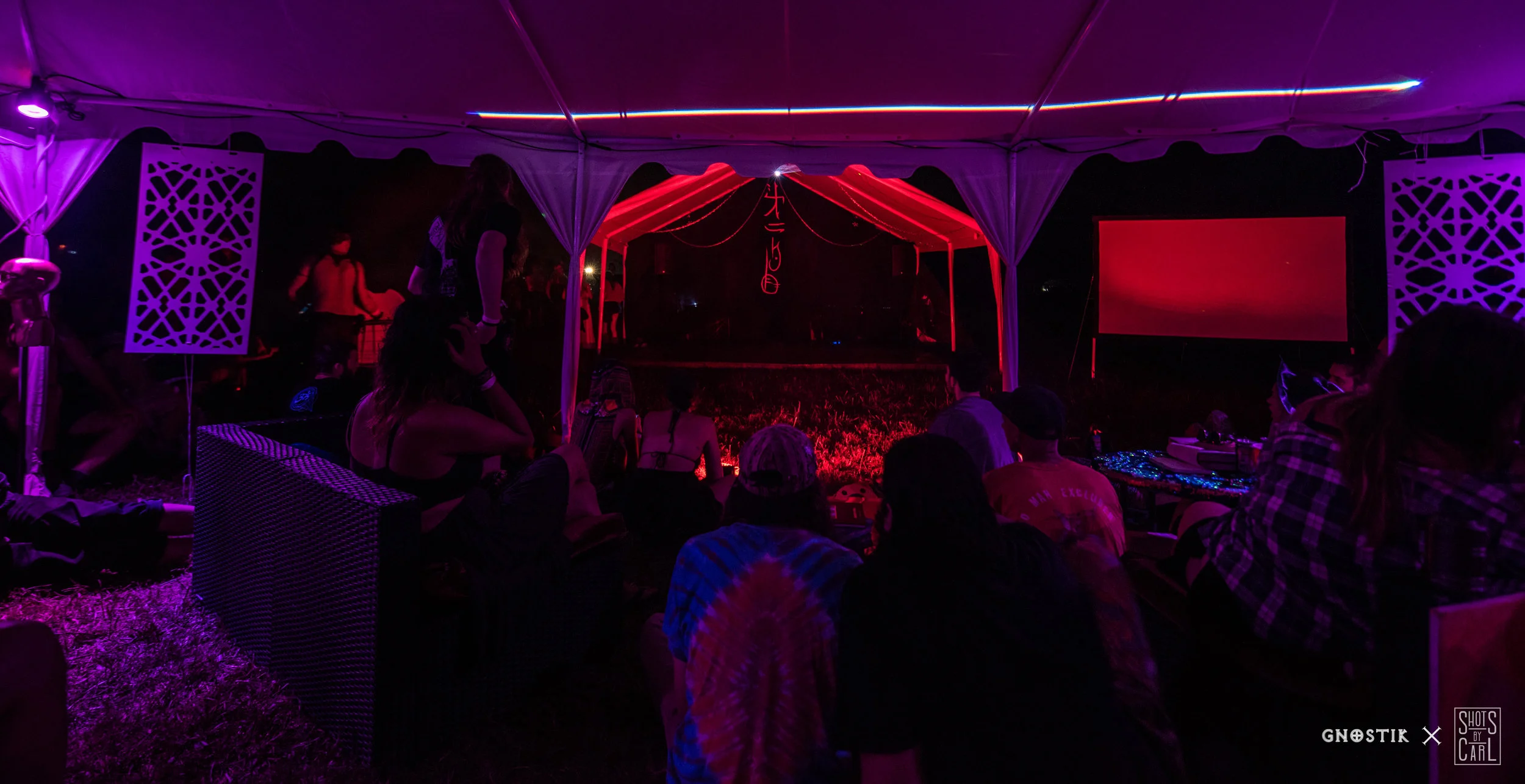
The GNOSTiK Lounge & Performance Theatre (Credit: Shots By Carl & GNOSTiK)

Molly Reed (Credit: Shots By Carl & GNOSTiK)

One-half of the act Fire Circus (Credit: Shots By Carl & GNOSTiK)

GNOSTiK co-creators Ali Khemi & Silv Era (Credit: Shots By Carl & GNOSTiK)
GNOSTiK “merges the lines between performers, musicians, and spectators,” according to Ali and Silv. DJs spun music from behind the theater’s curtain (this lent itself to secret sets from Detox Unit, Grouch in Dub during the theatre's off hours), performers hung out and served at the elixir bar, and cross-legged spectators in the grass inched as close to the fire manipulators as safety would permit. It was all too easy to get couch-locked in the Lounge, sinking into a plush cushioned seat with an arousing beverage as performer after dazzling performer floated and stomped across the stage. Your correspondent was nearly couch locked thusly were it not for the call of journalistic responsibility. Instead, I found myself ambling briskly between the Lounge and the stage to absorb the best of both worlds.
This walk between Lounge and stage involved frequent stop-ins with the Mermaid Oasis Hydration Station, a twist on the traditionally faceless festival water-fill up. Here ladies costumed as mermaids ran cold, fresh, plain or flavored with watermelon or cucumber or more. Pickles, the leader, humbly demonstrated her filtration system; the water is drawn on grounds from a well, sterilized for bacteria, and filtered for sediment. In the sporadic but consistently hot Tennessee sun, Solastafarians kept hydrated throughout the weekend.

Solasta's single stage was designed by Sacred Element Event Design (Credit: Lisa Diamond)
Down towards the river was the main stage - a fully encapsulated dance environment created by Sacred Element Event Design. Sacred Element’s founder Maurice Legendre is actively shifting away from manic, masculine, and overwhelming norms in stage and lighting design, and his creation at Solasta reflected this. “It offers but it does not demand,” he told me. Indeed the lighting was first and foremost atmospheric. Lights backing the stage and ringing the dance floor were subtle in their movement and usually featured no more than two colors at once.
The low stage was decorated with elements from the natural environment, with wood and rock creating a tranquil pond at the foot of the platform surrounded by mammoth hunks of quartz. Approaching the stage on Friday afternoon, Cameron Ingraham aka Mickman briefly dipped his hand into the pond, looking for a second like someone dipping into a vessel of holy water before entering a house of worship. The stage was flanked by two purple Funktion One speaker towers tuned to perfection by the Soundsystem Cultures, LLC crew which came north to Solasta from Chattanooga, TN. I’d later see Cameron on top of one towers pulling a tarp over the stack during a scattered shower, one of many small instances where the lines between performers, staff and attendees at Solasta were greyed.
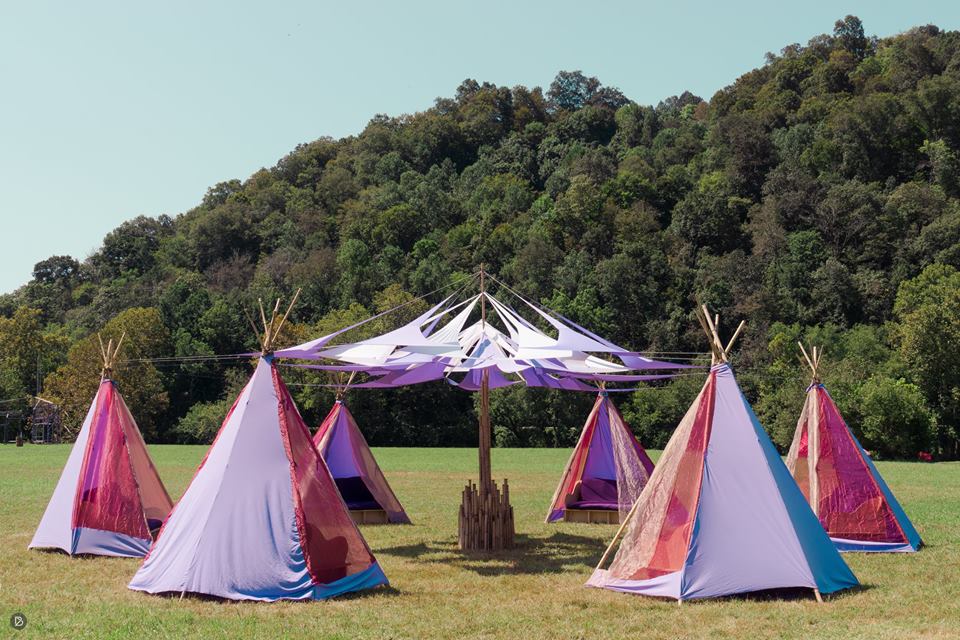
A ring of bamboo trussing and six or seven teepee-like structures encircled the dance floor. One could literally recline luxuriously with the crew in these structures filled with blankets and pillows without leaving the stage. Two terraced jungle gym like towers added greater dimensionality to the dance floor (“more of a West Coast thing” according to one of the sound techs). These spatial designs helped cultivate the kind of communal atmosphere at a stage that is prized by every festival, but truly achieved by few.
Solasta’s talent bookings offered rare artists in a rare setting, like Solar Fields from Sweden, Grouch from New Zealand, or Goopsteppa and AtYyA from British Columbia, Canada. It was the undercard, though, that provided some of the most endearing one-of-a-kind sets. There was a Saturday afternoon set from Doyle, making his first festival appearance ever after spinning for nearly a decade, most recently out of Nashville, TN. A swaggering Southeast crew swarmed the floor with unmatched enthusiasm as Doyle dropped a clean DJ set full of classic and contemporary heaters. spacegeishA brought a big time DJ set as well. She impressed folks who were unfamiliar with her seamless mixing style and unmatched track selection (informed by her position as director of the vanguard digital label Street Ritual). This packed primetime set (10:30pm) combined with the informative talk she delivered on "Living the Label Life" solidified spacegeishA aka Becca as a major presence at Solasta Festival.

Ali Khemi performing a synchronized geisha fan dance during spacegeishA's set (Credit: Shots By Carl & GNOSTiK)
As international dubstep deep head Leon Switch started spinning on Saturday night, a pair of bright red and green lasers suddenly began beaming out from the landowner’s house. The house sat on the property's high ground about 400 yards up a hill opposite the stage. The lights soared across the sky high above Spirit Crossing, tying a bow on the entire experience and creating one of those rapturous moments where you can perceive all elements in an environment as one beautiful, synchronous whole. My colleague, who was strolling up grounds nearer the house, said he saw a man in his sixties with long, thinning blonde hair perched on the porch above a control board. There, swinging the lasers back and forth with ecstasy in his eyes, was Wes, the landowner, apparently having more fun than anyone else at Spirit Crossing.
Additional stand out sets came from EasyJack, Mickman, Vinja, of course Jade Cicada, and Push/Pull aka Liam Collins, one of Solasta Festival’s three main organizers. As the sun began to set on Friday, Mickman, uncharacteristically enthusiastic on stage, led his performance with provocative downtempo before launching into 40 minutes of his spellbinding sine-wave bass and hard drum breaks. Push/Pull followed with earthy midtempo, channeling some of the energies he’d picked up while staging the grounds in the past week. After shaking up the vibes with some tasteful Techno as Frisk, Jack Whelan thrilled the crowd with raw yet intricate psychedelic breaks as EasyJack on Saturday evening. Every musician on site truly brought their best juice. At a certain point it became a matter of pure stamina for the crowd.
Even amidst this stellar lineup, the Clinch River was Solasta’s star attraction. Running slowly east to west along the border of Spirit Crossing it provided all sorts of relief and recreation. It was perfect for cooling down and connecting with new people or old friends outside the bustle of constant bass music. Although Solasta was billed as a one-stage event, a last-minute river party saw the festival add a modest “river stage” designed with humor by Illuminera. This little spot had a renegade vibe, as DJs and producers not part of the original billing including Deerskin and Soul Candy sent vibrations out across river for the utterly happy people cooling off in it.
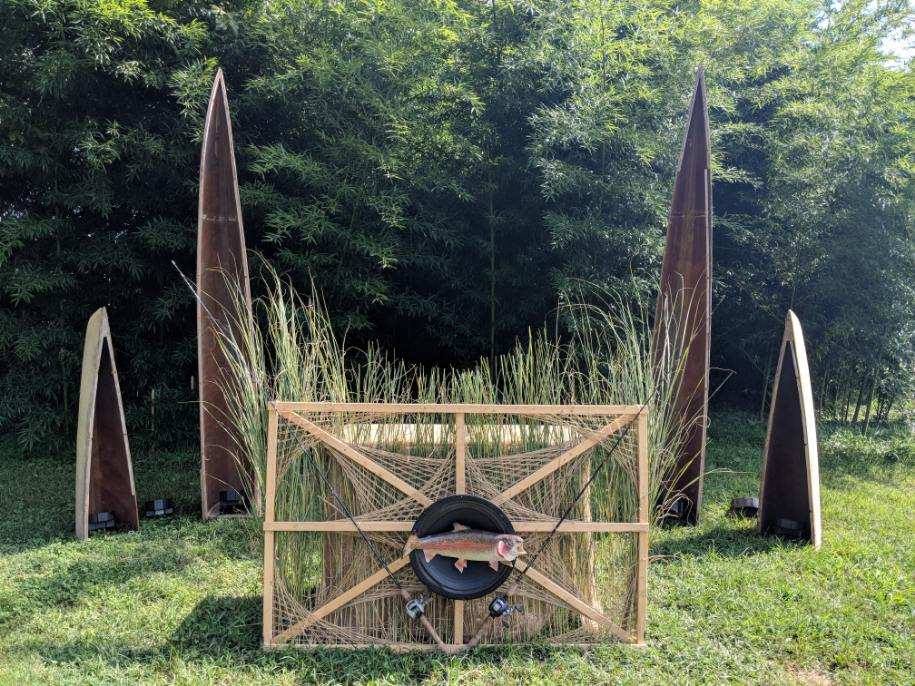
Not advertised before the event, the "river stage" designed by Illuminera had a renegade feel
Solasta Festival of course couldn’t conjure magic without the diligence and attention to detail of the producing entities Envisioned Arts and Harmonia. Each company brought their own production team which, joining with Collins, formed a dream team of young and excited event producers. On Sunday, Solasta Festival’s officially unofficial decompression day, as brunch was being served down at the stage I found myself in an administrative trailer sipping a strong mimosa stirred up by Dom Lu, the site lead at Solasta and a veteran of Envisioned Arts. We spoke about his early years in event production (“Anytime someone asks you to do something, just do it”) and the often unnoticed efforts that contribute to a safe, functioning festival.
“For me, I’m all about the attendees,” Dom said. “If you throw me in Artist Hospitality or something…that’s not my style. To me, everyone who’s on the dance floor, everyone who’s in the back with their friends who paid to be here, those are the artists to me. That’s who I care about.” As I felt my own forehead slowly begin to cook from a weekend in the sun, I noted that Dom had a permanent peel down along his nose. The skin under his eyes appeared raw with a pinkish hue; battle scars from many successful events, and likely a few failures. “Doing all the work, I don’t mind doing it. I’ve had those experiences where I’ve been to festivals and had the time of my life. I want to be able to recreate those experiences for other people.” Judging by the fixed smiles and strong auras of good will across the grounds all weekend, Dom and the rest of the event producers undoubtedly hit their mark at Solasta.
Much of what made Solasta special are those elements native to smaller festival environments. Replicating these elements on a larger scale while preserving the magic they deliver is challenging. Solasta’s growth was impressive in its second year. “A lot of festivals are still camp outs at their second or third or fourth year”, Dom noted with a bit of wonder in his voice. As this festival’s reputation grows, its organizers may have to balance a welcome increase in popularity and size with their ability to curate the intimacy that may earn the event its reputation in the first place.
The great takeaway from this kind of epic Appalachian sojourn gets back to one of those old lessons or cliches of transformational music festivals; take the knowledge and experiences gained on the grounds back out into the world with you. Whatever you learned about or reflected upon at this event; music production, friendship, stage design, romance, event production, sustainability, hummus-oriented brand partnerships - bring those reflections forward with you. Woven into the rest of the world, the atmosphere and attitude of the festival becomes less of an anomaly or some brief escape from life, but a greater part of culture and life itself.
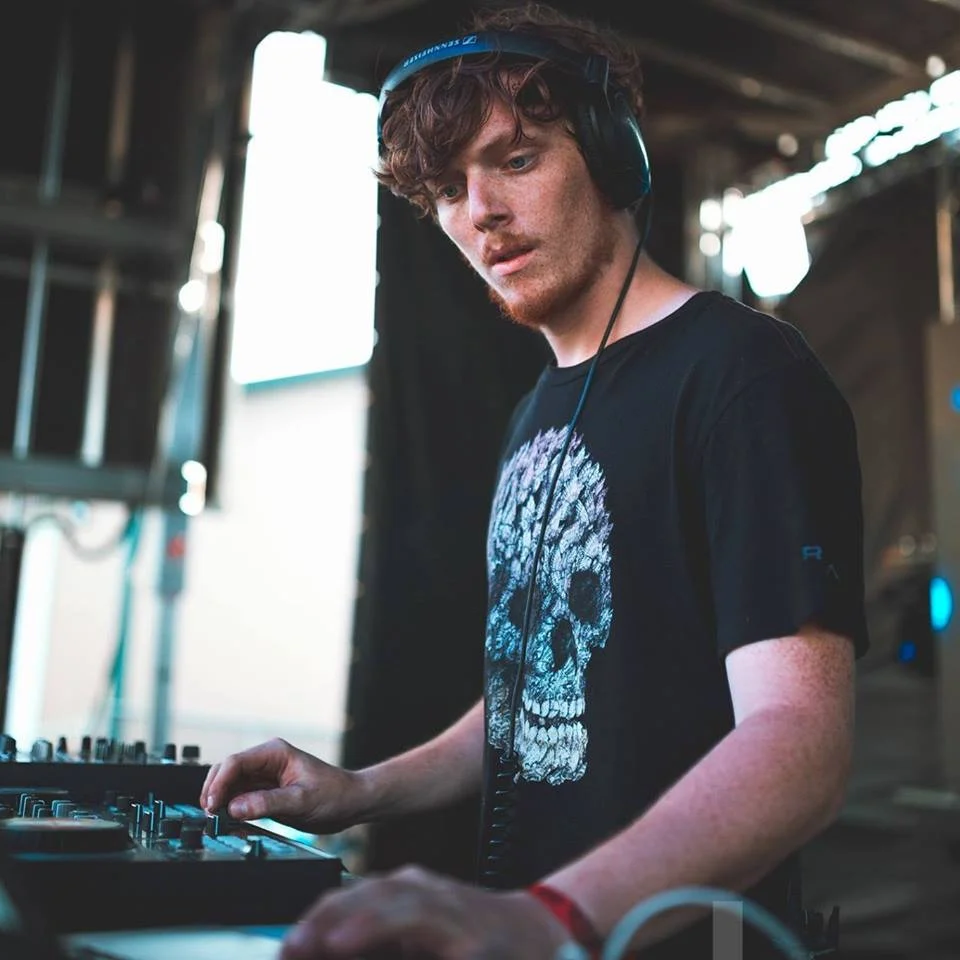
Sound of Solasta - EasyJack
For the last installment in our Sound of Solasta series, we linked up with a vital individual within the infrastructure of Solasta Festival, the producer/DJ and sound system connoisseur Jack Whelan. Known on the stage as EasyJack, Whelan the co-owner and lead engineer for Soundsystem Cultures LLC, an audio production and Funktion One sound system rental company based out of Chattanooga, Tennessee.

For the last installment in our Sound of Solasta series we linked up with another individual who is both on the lineup at Solasta Festival, and vital within the festival's infrastructure; the producer/DJ and sound system connoisseur Jack Whelan. Known on the stage as EasyJack, Whelan is the co-owner and lead engineer for Soundsystem Cultures LLC, an audio production and Funktion One sound system rental company based out of Chattanooga, Tennessee.
The EasyJack project stretches across a number of genres and tempos, but low-frequency is the common denominator. Many folks were first introduced to EasyJack and his diverse presentation when he performed during the Chicago Tipper run in August 2015. His released catalog numbers just below two-dozen tracks, including contributions to Oxidized Vols. 1 & 2, but the quality and intention of each does not go unnoticed. Jack and the Soundsystem Cultures crew have had a stellar rise since launching the company in 2015. They supply gigs with high-fidelity, properly-tuned Funktion One speaker systems. Northeastern heads would have heard them in action recently at the Camp Bisco Renegade Stage. They continue to push upward the benchmark for hi-fi sound system experiences, and they'll deliver that experience all weekend long at Solasta Festival on August 17-18.
The Rust: Tell us about Sound System Cultures. What is the ethos of your operation?

Soundsystem Cultures LLC was originally started by my business partner Philip Irwin. We met through Infrasound Music Festival and various mutual friends. Initially, I was assisting him in acquiring some of the needed equipment for his original set up and during that process we decided that joining together as parters was a much more effective solution so we could build a bigger system. Living in separate parts of the country had a natural advantage because we both had a good number of established connections for bookings in our respective regions. Things kind of fell into place naturally from there. We’ve never come up with any kind official ethos or motto, but our general goal is to provide the highest quality audio experience possible for our customers, no matter what it takes. We’ll go to any lengths possible to ensure that everything has been set up in the most optimal way for the system to operate in the given conditions of the show. If that means re-stacking the rig multiple times to achieve the perfect configuration for the environment, we’ll do it. If we have to dig a 100ft trench in the mud to hide cables so the dance floor is obstruction-free, we’ll do it, and so on… We cut no corners and take everything possible into consideration to truly take our clients' events to the next level.
The Rust: What drew you towards a career in curating sound? What drew you to hi-fi systems in general?
I was a producer/DJ and musician before I was doing sound professionally. Growing up being involved with underground events and playing in various bands, I always had an interest in the production and audio side of things. Eventually around 2012 I met Antoine Kattar who had been working for the Funktion One US distributor in Chicago for a number of years. He was looking for someone to fill an apprentice type position to help him with permanent sound system installs around the region. Antoine has served as the front of house engineer for Tipper and many other prominent acts. He was also a member of the team responsible for a number of well-known installs around the city including Chop Shop, The Mid, and Smartbar which has been referred to as one of the best dance floor systems in world. Through working with him I learned how to tune and maintain these systems. After the first time I experienced a proper Funktion One rig I was certain I only wanted to be working with extremely high fidelity systems and I’ve been hooked ever since.
The Rust: The EasyJack project seems to encompass a number of styles and tempos. Can you talk about your musical output, and the influences that shaped your production prowess?
My early influences came from video games like the SSX series and number of others that feature quality underground music. Later on, I discovered the world of glitch hop through the likes of Tipper, Kilowatts, Opiuo, Vent, (early) Griz, and many others. But the main influence on my own personal sound has always come from my love of Chicago house music. I love incorporating subtle elements of classic house into my glitch hop and dub sounds and I think thats been the main driving factor of developing my sound over the years. Another key influence for me is the idea of making “music for sound systems”… basically producing music that can really show off the capabilities of the high fidelity systems that we work with.

The Rust: Solasta has partnered with some top-tier organizations. What role does Soundsystem Cultures play in the Solasta infrastructure?
We basically handle all things sound for Solasta. We’ve been tasked with coming up with a rig that will compliment the sonic environment to the best of our ability while also working together with the stage design team to ensure everything will be a perfect fit. This year we will have a slightly bigger set up than year one and we hope to keep it evolving as the event grows. Last year the stage incorporated both a waterfall, fire elements, bamboo, and tons of other materials scavenged from the woods around the grounds. Making sure the footprint of our system can fit in within all of the beautiful deco, while still being optimal for sound quality, is crucial to delivering the best possible audio/visual experience for the crowd.
The Rust: What do you have in mind for the future of EasyJack?
Right now my main focus is my upcoming release with Addictech Records. It features some tracks I’ve put years of work into and will technically be my debut EP on an established label. Im also currently in the process of building my new studio which will serve as my creative space hopefully for years to come. On top of that I’ve also been developing a new side project called Frisk that will focus on a psychedelic mesh of techno and house. Most of that music will be four-on-the-floor and feature some pretty ravey vibes. My goal is to continue touring and keep growing both projects as much as possible.
--
Solasta Festival strives to nail every aspect of the attendee experience, and sound is arguably the most important aspect of all. Fortunately for anyone heading to Sneedville, Tennessee for this special gathering, Soundsystem Cultures will be running the boards all weekend. When Whelan takes the stage for a rare EasyJack set, and an even rarer Frisk set, he'll be flexing his handiwork in more ways than one.
FOLLOW EasyJack: Soundcloud / Facebook

A Conversation with the Organizers of Solasta Festival
On August 17 & 18, the homegrown gathering Solasta Festival returns to Spirit Crossing in Sneedville, Tennessee for the second year. The lineup is dreamy and the extracurricular activities include audio development workshops and a unique Sunday Brunch. The Rust Music has been corresponding with the festival’s three key organizers about their intentions and areas of focus for Solasta, as well as the festival's short history.

On August 17 & 18, the homegrown gathering Solasta Festival returns to Spirit Crossing in Sneedville, Tennessee for the second year. The lineup is dreamy and the extracurricular activities include audio development workshops and a unique Sunday Brunch. The talent bookings are ambitious, from the New Zealand psytrance legend Grouch to the Swedish ambient composer Solar Fields, who hasn’t performed in the States for nearly a decade. Top-billing is given to rising musicians like Jade Cicada and Detox Unit whose new sounds and young energy are invigorating the community’s collective nervous system.
Solasta is far from the only exceptional grassroots festival to pop up and spotlight alternative electronic music recently. However, strong intentions toward individual and communal growth, a risk-taking and rarified musical lineup, and an obsessive focus on safety and organization distinguish this event from most others. The Rust Music has been corresponding with the festival’s three key organizers about their intentions and areas of focus for Solasta, as well as the festival's short history.
Another steamy summer was approaching in the Southeastern United States in 2017 and lovers of alternative electronic music and culture were naturally excited. For the electronic community and culture at large, summer is when the magic - and the music festivals - happen. That summer, however, the intentional gathering and Southeastern anchor festival Kinnection Campout was taking the year off. The regional music scene was looking at a “very bleak summer” according to Liam Collins, a music producer known as Push/Pull local to Asheville, North Carolina.
Solasta appeared in this void. The event lasted two days and two nights in September in Sneedville, a town of less than 2,000 people tucked into the foothills of the Smokey Mountains in the northeastern corner of the state. The small but refined lineup featured rare international talent. Workshops offered included a sampling seminar with RJD2. The Clinch River ran slowly through the grounds, the sun rose with music, and campers left without a trace. The festival passed into the autumn quietly, although a foundation was set for the future.

Spirit Crossing, the grounds for Solasta Festival, as seen from the air
Electronic music thrives in a handful of cities scattered among the hills and hollers of the Southeast. Asheville stands out among them for its vibrance. On his first U.S. tour, the highly sought after UK producer Kursa is playing major cities like Denver, Atlanta, Boston, New York, and…Asheville. The city is also the home to Harmonia, one of the producing entities behind Solasta. Founded by Asheville resident and perennial festival worker Maegen Coral, Harmonia is one of a handful of companies worldwide dedicated to providing harm reduction and creating sanctuary spaces at music festivals.
Maegen and Liam linked through the greater Asheville electronic circuit over the years, particularly through Kinnection where Liam was a performer and Maegen a part of the festival crew. The gathering was formerly hosted just north of the city on the Deerfields Retreat, one of the only places in the Southeast apparently where one could play bass music through the night.
Also working Kinnection in years past was Hasan Zaidi, another perennial festival worker holding down the box office and going on about “high-density awesomeness”. Hasan had recently started the production company Envisioned Arts in the Bay Area. Today, Envisioned Arts is a leading provider of live niche electronic music, and the other key producing entity behind Solasta. Hasan and Maegen worked festivals together from California to Costa Rica and back to the Carolinas where another transformational event called Gratifly Music & Arts Festival roared with abundance for two years before fading away due to financial insolvency.
In this landscape where the cultural soil is fertile but the fruit of financial stability struggles to flower, Hasan, Maegen and Liam linked up to throw the first Solasta Festival. “The three of us definitely connect on the core principles of how people should be treated and how the experience should be facilitated,” Maegen told me while working her Harmonia sanctuary space at Elements Lakewood in Pennsylvania over Memorial Day weekend.

“It’s crucial for the organization behind an event to have a higher intention than money or just having a party,” Liam writes via email. “You can feel when there is real love and thought behind it versus when there is a disconnect between the organizers and the patrons…For me, Solasta is about keeping the musical lifeblood flowing in the Southeast, and stems from a very sincere desire to grow the scene and musical community.”
Maegen has seen much while working the festival circuit across the continent, and it’s not all good. Despite its fantastical atmosphere, the electronic music community isn't free from destructive behavior. “In this culture, what I’ve noticed, the cool thing is to not give a shit and to not care. Like ‘let’s eat all the drugs, let’s throw shit on the ground, who cares.’ It’s kind of self-serving. That’s the culture, so people are learning that as they come into it.” This is why Maegen started Harmonia, to empower through education, lead by example, and subtly push the cultural needle in the opposite direction. These same intentions undergird Solasta Festival. “What we’re trying to do is create the other culture, where it’s cool to take care of yourself and it’s cool to check in on people. It’s like a culture of compassion.”
As the head of a production company, a booking agent, and the initiator of the Bassnectar AmBASSadoor program, Hasan is uniquely positioned to comment on the micro-communities that are both a cause and effect of the rising popularity of alternative electronic music. For it’s part, Envisioned Arts has been helping to set the pace musically in the States for years now by booking rare talent, particularly in the psydub universe, before others began to.
“Our events are different because we’re all similar in these weird ways, and we’ve come together because of the music,” Hasan says. “But when we’re actually together we realize we share these certain qualities and characteristics.” Birds of a feather flock together. Music nerds have a great time hanging out with each other, especially if their favorite tunes are pumping through a top-of-the-line system under the bright light of the moon. “There’s a rampant sense of humor that tends to run through everyone, kind of a skeptical view of what is fed to us from a commercial perspective, and a desire for something more authentic and different.”

Goopsteppa performing at Solasta 2017 (Credit: Reston Campbell Photography)
Solasta is intended to be that something. It’s hosted by the community, for the community. The organizers believe this DIY approach is imperative. “We have all been to those larger corporate festivals,” writes Liam. “They throw up a big stage in a hot field and sell you bottled water and shove beer ads in your face.” Indeed, no one who’s ever bought an Aquafina for five or six dollars will soon forget the sting of that experience. “You’re herded through long security checkpoints and it just feels like the purpose of the event is to make as much money as possible while caring little about the experience. Unless we all create and support the kind of events that we want to see, they just won’t happen anymore.”
Creating an authentic, homegrown underground event within the framework of the festival market is like threading a needle. A group seeks to put forward their purest ideals, but it must bend with the force of a conscious-less machine market that doesn’t give a damn about ideals. “In a broader sense,” Hasan muses, “all grassroots movements that do something right will one day expand into something more. Being able to consciously monitor that growth and actually stand by the core ideals from outset, instead of just paying them lip service, is the actual battle.”
Community and grassroots are not just buzzwords for this crew. The organizers build a sense of community into everything they do, particularly by blurring the lines between performer, staff, and audience. “Our team for Solasta is very literally embedded in every aspect of the scene,” writes Liam. “We are booking the shows, managing touring acts, checking you in at the door, rocking the clipboard in the back, making sure that you are supported during tough experiences, on the four-wheeler keeping you safe, dancing right next to you in the crowd, and up on stage.”
There’s no VIP area at this festival. “We often joke that Solasta is a producer’s festival,” says Hasan. “Last year especially that's really what it was....All the artists we book are going to be on the dance floor ripping it up. Woah! Nice, we just sold five tickets,” he says over the phone, interrupting his own train of thought. Hasan loves to talk, but he doesn’t bullshit. There’s one stage and no overlapping sets at Solasta. It’s fortunate for attendees because every set on the lineup is worth catching. There’s no “check the box” bookings here. We’re sure the producers dig this, too. They miss sought after sets sometimes, too, you know. Solasta also lowers the stage towards the ground, bringing the performer closer to eye-level with the audience.

Born from the nerdy natures of each of the three organizers, one of Solasta’s most unique offerings is the full slate of audio development workshops. There will be sessions on vinyl scratching, integrating hardware synthesizers, piecing apart the frequency spectrum and more. Last year the focus was placed exclusively on the deep technicalities of production. This year’s workshops will be a bit more accessible, including seminars from “industry movers and shakers” about other aspects of the underground music community. Solasta intends to give people the knowledge to do it themselves, and do it properly. “A lot of the workshops we do allow the participants to become the people who will be on stage,” Hasan says.
Although Solasta is a second-year festival, expect a safe and highly organized experience. These folks know what they’re doing (at least when it comes to hosting events). “We are technically a startup but we do not have the organizational clusterf*#@ that most startup festivals inevitably have,” writes Liam. Sometimes one trades the six-dollar Aquafina in for a traumatizing porto-potty lineup or a botched musical schedule. Not here. “Our entire staff in every department is filled by one tight-knit community that has been doing this together professionally since before 2012.”
Spirit Crossing is nestled into the western foothills of the Smokey Mountains where the ground is soft, the fog settles early and often, and the sun splits through the hills at dawn. Running through Spirit Crossing is the Clinch River, one of the cleanest rivers in the Southeastern US and home to rare and diverse marine life. One can camp next to the river and wake to its bubbling rhythms each morning. Wes, the landowner, began hosting burns on the grounds years ago, but they were more like river clean-ups with music. “We try to impart on people, don’t just keep the land clean because we’re telling you to,” Hasan says. “Keep it clean because you genuinely want to.” Solasta intends to maintain the pristine conditions at Spirit Crossing by strictly adhering to a ‘leave no trace’ policy.
To sustain the festival and it’s growth, the organizers are partnering with other like-minded companies. “Solasta is a group effort,” says Hasan. “No event happens with just one community." Solasta has linked with Midnight Voyage, who for years ran the electronic circuit in Knoxville, Tennessee. They’ve brought on outfits from New Orleans, Chicago, Boston and New York City (The Rust Music is partnered with and actively promoting Solasta Festival) to spread word through the underground. “What I’ve found is that a lot of people are so competitive,” Hasan continues. “We can do cool shit without being competitive. We can collaborate and do something far bigger than any of us. I’ve always believed that.”

The Clinch River in the morning mist (Credit: Reston Campbell Photography)
Perhaps the most important area of focus for Solasta is safety, which according to Maegen reaches “almost to the point of paranoia.” Harmonia will establish its public sanctuary space on site (attendees of the Tipper & Friends 4321 event may recognize this serene, domed environment). They’ll also have isolation tents for those with augmented experiences who require individualized attention from a caring volunteer. “You have the best time at festivals when everyone’s smiling and looking out for each other,” says Maegen. “That inspires people and helps them connect in a potent way. So to make a statement and make it a critical part of the infrastructure changes the game completely.”
“All of us keep coming back to these festival experiences for a reason,” says Liam, who has himself been coming back to festivals for about a decade and a half. “Small, thoughtful gatherings are some of the most potent places for release, communion and connection that I know of. Amazing things happen when people of like mind gather to celebrate. Solasta is the newest attempt at growing one of these from within our community.”
Solasta tickets are available for a startlingly low price and special magic is already swirling around this event. If you’re traveling from far afield, Solasta has shuttles running from the Atlanta airport. If you’re driving, be wary of the switchbacks once you get into the mountains. Although the organizers have poured their own resources and intentions into the project, it’s the attendees themselves that make it all thrive. “We might be creating a central gathering point,” says Hasan, “but the idea is to empower each individual to their fullest, and allow them to spread the feeling they get at the event to others.” Noble intentions aside, “just get ready for some good old tomfoolery,” the organizers suggest.
FOLLOW Solasta Festival: Official / Tickets / Facebook
FOLLOW Envisioned Arts: Facebook / ATL
FOLLOW Harmonia: Official / Patreon / Facebook / Instagram
FOLLOW Push/Pull: Soundcloud / Facebook / Instagram / Visionary Magnets

Sound of Solasta - spacegeishA
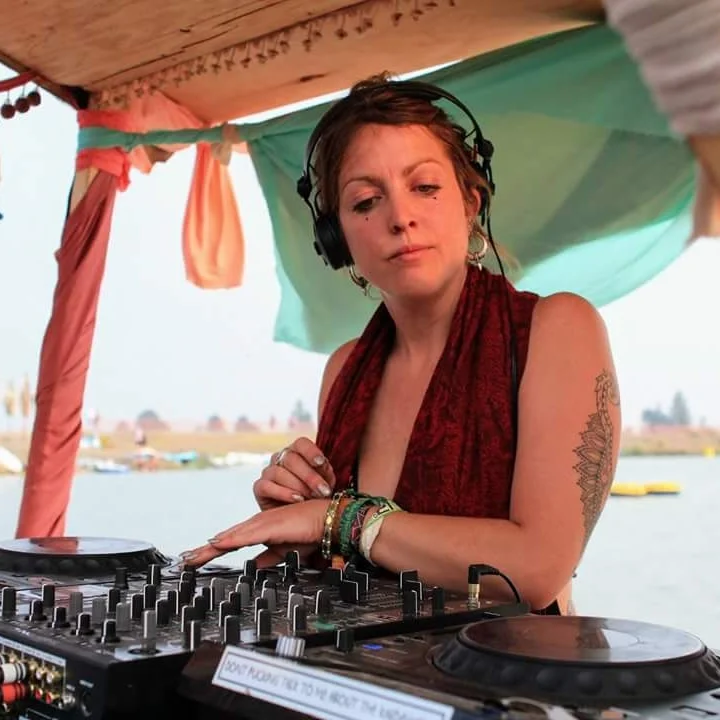
For the next installment of the Sound of Solasta series, we're tapping into another industry powerhouse who will bring a multiplicity of talents to Solasta Festival on August 17-18. Rebecca Drylie-Perkins, better known by her performance moniker spacegeishA, is a top-tier DJ and the co-owner and director of Street Ritual.

For the next installment of the Sound of Solasta series, we're tapping into another industry powerhouse who will bring a multiplicity of talents to Solasta Festival on August 17-18. Rebecca Drylie-Perkins, better known by Becca or her performance moniker spacegeishA, is a top-tier DJ and the co-owner and director of Street Ritual. Born in 2006 from burn culture and a pervasive west-coast influence, and officially launched in 2008, Street Ritual is a digital label that puts maximum focus on spreading glitchhop, IDM, psychedelic bass music, and their various offshoots.
Leading the pack in many regards, spacegeishA has cultivated clout from over a decade of DJ sets. She also tenaciously advocates for the more than 70 artists that Street Ritual has come to represent. When each time comes for her to get behind the decks, the bounty of the relationships she's forged presents itself in the plethora of unique tunes, both released and unreleased, that she chooses from her collection. Those relationships, however, provide more than just access to good tracks. She is positioned among similar industry players who focus on the communal nature of this widespread counter culture. With this in mind, her booking at Solasta is no coincidence, with “community” being no buzzword for the Solasta team, but the ethos of the entire event. Understanding the dynamism of Becca's career requires more insight than can be gathered from just surface-level digging, so we’re grateful she afforded us the opportunity to ask a few questions.
The Rust: You're the label director for Street Ritual. How did that journey begin? What challenges do you currently face in the position?

I am one of two co-owners of Street Ritual and have been the Director of the record label for seven years and booking agency for two years. As one might imagine I am also the accountant, marketing team, social media manager, merchandiser, staff liaison, artist scouting, and recruitment supervisor.
There are a myriad of challenges that record labels face; mostly that of the evolving trends of digital music sales, social media, and streaming platforms. Spotify didn’t exist when I began, and now it’s an integral part of our business. Initially Facebook was beneficial; not so much anymore. To combat this, I research and strategize to stay in line with current market and online trends. In regards to the booking agency; every artist wants more shows. Booking artists/tours successfully requires confidence, patience, and a vast understanding of the nation’s “scene.” I contend that HYPE is the driving success of a large percentage of artists and it begs the question; where did the hype originate and how has it sustained itself?
The Rust: How do you build relationships with the producers and other music professionals that you later work with?
I’m really happy you asked this, because I believe that ‘networks’ are the key to being successful in this industry. I come from a small town in NJ, so connecting with the top tier industry professionals on the west coast back in 2011 was a challenge. Initially I invested significant time reaching out to forge these connections with minimal results. I attended the Symbiosis 2010 Festival with only knowing my small group of friends. In just six years my network includes hundreds of patrons, musicians, artists, producers, directors, and fans in a dozen countries. My work in event production for festivals such as Lucidity, Enchanted Forest, Symbiosis, and even BOOM festival in Portugal afforded me the opportunity to expand my connections and build these lasting relationships. This endeavor entailed unpaid 16 hour shifts, angry artists, hot tents, flying to gigs all over, and a lot of miles on my car. The cool thing for me was, a lot of these sacrifices resulted in awesome releases, DJ gigs, or bookings for the artists I manage.
Relationships expand and grow to the next level when you attend an event and elevate your relationship from digital to physical. I recommend that you make sure you are not another email or unanswered facebook message. Get out there, be confident in what you are doing, and go talk to someone important. If you have to work for free to get your foot in the door it is *probably* worth it. Aside from reaching out to a stranger, solid relationships can be built online through sharing music, ideas, feedback, and more. The amount of access we have to our community through the internet has allowed me to make connections all over the country and world! If you really like someone's tunes, tell them; they'll be happy to hear.
The Rust: Your DJ sets showcase music from a vast cross-section of producers. Where do you look to find fresh inspiration for your sets?
I find inspiration from a variety of creative sources. I love to watch successful DJ’s and producers performing, and the growth of our fan base filling the dance floors. Another source of inspiration comes from following my favorite labels. I listen to tracks that may not be included in my own DJ set but are a perfect fit for our label, or vice versa. This requires patience, however I live for that feeling of surprising the fans on the dance floor with something they don’t expect or know yet. There is a lot of rinsing of well known tunes in this scene, and while I like to have one or two in each of my sets that are "hott rn", I mostly aim to go for the songs that no one on the dance floor knows yet.
The general vibe of the song is a crucial part of my inspiration for building sets. I wait for that scrunch-face reaction when I hear it. I look for the funky, sexy, deep, dark, hard, weird, minimal, scary, crunchy, and hard-hitting. I don’t genre-discriminate. I intentionally organize my catalog by my bpm and key instead of by genre (which a lot of people do) because I don’t want to DJ out of genre folders. I use Soundcloud, Beatport, Bandcamp, and DJ mixes to discover new artists; and can’t say it’s an easy task. There is extensive digging, organizing, and filing necessary to be a DJ. Your time on the decks is earned by time spent on the computer. I invest on average $100 a month on buying tracks, even with the benefit of all the unreleased goodies I have access to. I feel strongly that we need to contribute to digital music sales and the charting and online performances of artists and labels we support.
Lastly, I get a big rush of the go-get-em feels after I play sets and talk with people who were there. I still get a little shy when people tell me they’ve been following me for a while or they’ve listened to my mix over 50 times, but those moments humble me, stay with me, and ultimately reinforce that I'm on the right path. Without the community or communication; there is no success to be had!
The Rust: How did you begin DJing, and how has your attitude as a DJ evolved over time?
I have been a” selector” of music since I was young. My 8th grade gym teacher recognized this talent and chose me to provide the list of tunes for the school dance. My mom talks about my constant commandeering of the radio in the car when I was young to blast Busta Rhymes and Jay-Z. Fast forward to Philly with my college lacrosse team; I created a hip-hop mix every year for our pre- game warm-up. This helped intimidate teams (as if our field in West Philly didn’t already do that). When we threw big parties I’d be DJing from my IPod. Upon graduation I moved to Portland, Oregon and spent my free time DJing by myself and for after house parties (compliments of our fat living room sound system and serato station-- thanks DP). I got tired of hearing all the boys play tunes out that I would also play, so I decided to get more serious about it. Then, I went to Burning Man and found myself spinning on a few different sets at my camp since I had curating and was managing five full nights of the most badass bass music to be found on playa that year. I played my first real set after that at Wormhole Wednesday in Oakland when it was still at Era Bar, opening for the legend Digital Rust.

I don’t think my attitude ABOUT DJing has changed, however I continue to see an increasing value and importance in it as an art form. A lot of success in our industry comes from producers, but I feel DJ’s supporting their tunes (by buying them, playing them out, etc.) is a piece of that puzzle. DJ’s can pivot if a dance floor falls flat; producers don’t always have that option. DJ’s can spread the word on tunes, artists, labels, or genres and producers should be taking advantage of that as it is a symbiotic relationship. DJ’s are the vibe curators, where producers create a certain vibe. We are all in this together; and I’ll be the first to speak up for the importance of DJ’s in this rising underground movement.
The Rust: Solasta is set to offer a plethora of production, audio engineering, and industry-focused workshops. What are your thoughts on festival seminars like these?
It is important for our community to educate and explore various aspects of our industry through group discussion. When we examine the positive and negatives we face as musicians, promoters, and participators in this scene, we grow collectively. Bottom line is, we are all in this together so let's get together and talk about it more. Sets from a bunch of firey producers and DJ's are workshops on their own for me. However, being able to leave with more knowledge about bookings, production, management, or our culture in general is just a bonus. I had the pleasure of speaking on a ‘Women in Music’ panel at Lightning in a Bottle last year, and it served as a potent reminder for me about the challenges women face in this industry. I still reference that panel discussion frequently and would love an opportunity to continue that discussion again some day. The more education covering a wide variety of topics at festivals, the better. In regards to the above question about forging relationships, these can serve as a great opportunity to do that. I am scheduled to be speaking on a panel at Solasta; stay tuned to hear more about that as it develops. See you on the dancefloor!
--
As the weeks fly by and Solasta Festival grows ever closer, the excitement from all involved is palpable. With such an outstanding assortment of intelligent and meticulous organizers, producers, and DJs tapped for this year, it’s important to afford these individuals the proper spotlight for their actions and operations. If you plan to make the journey to Spirit Crossing in Sneedville, Tennessee for the weekend of August 17-18, be sure to find yourself front and center during the spacegeishA set.
FOLLOW spacegeishA: Soundcloud / Facebook / Street Ritual
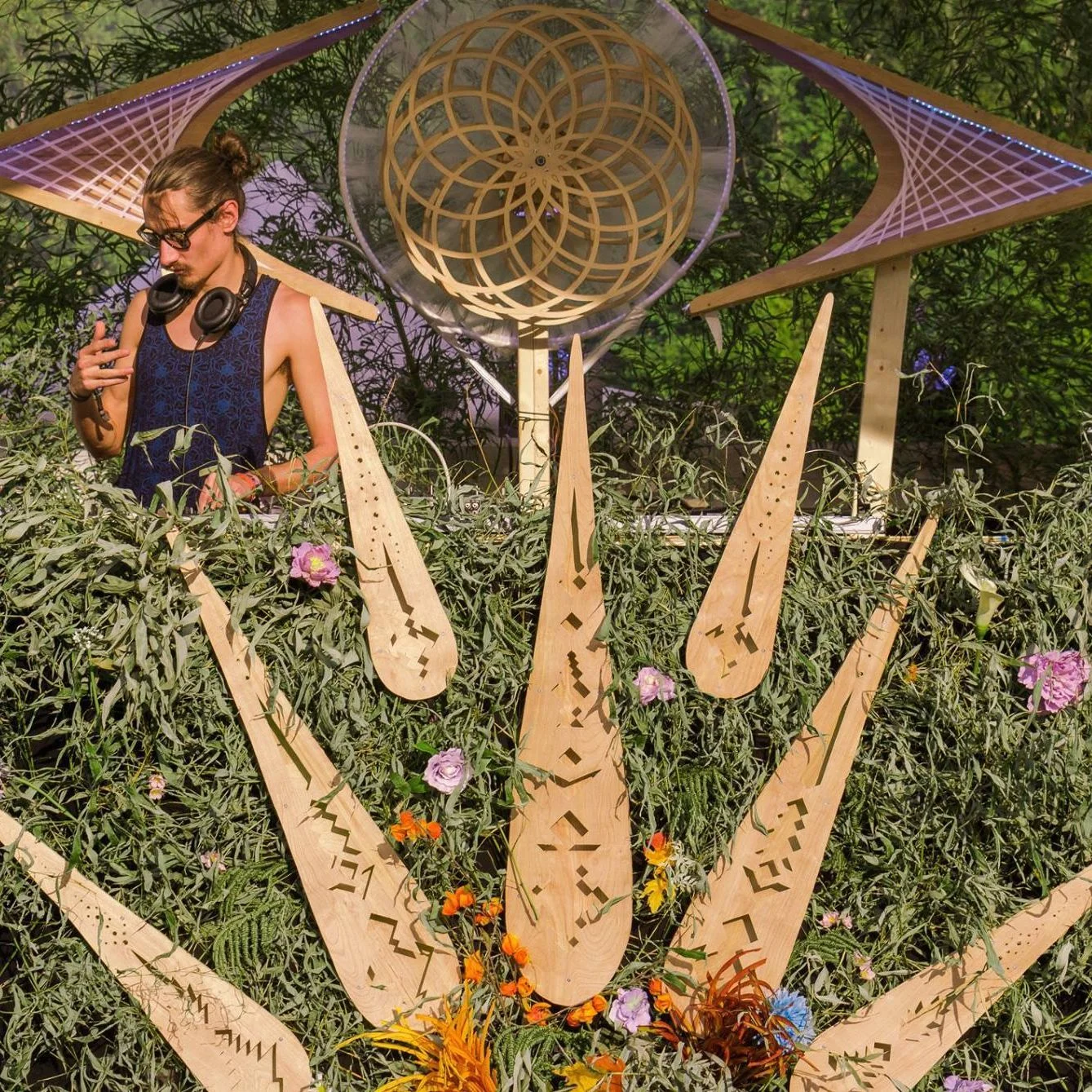
Sound of Solasta - Saltus
Come mid-August Solasta Festival is slated to return to its pristine stomping grounds of Spirit Crossing in the mountains of eastern Tennessee. It's being presented by a plethora of industry players who explore their own artistic expression within music, as well as curate and operate various audio-focused companies of their own. Through the Sound of Solasta series we'll explore the inner machinations of these multifaceted individuals and their outlets.
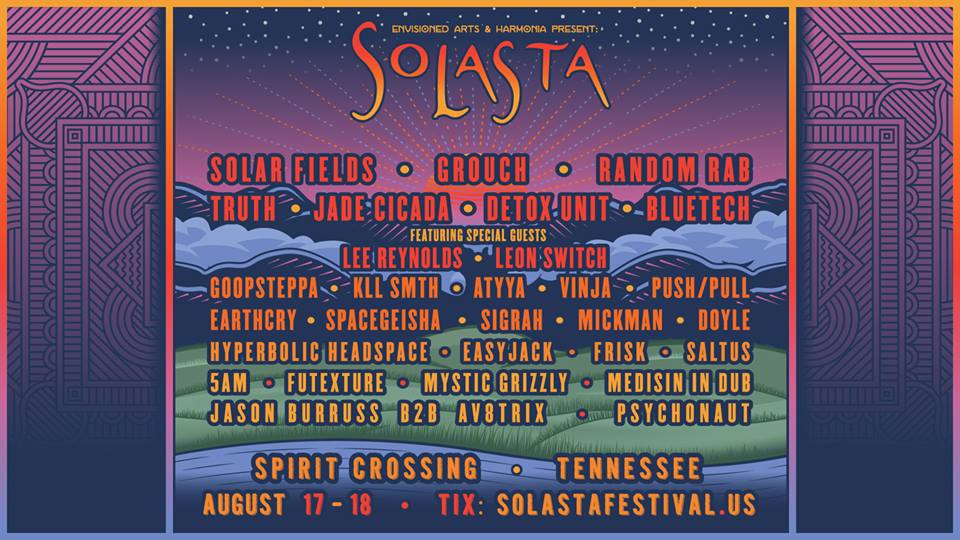
Come mid-August Solasta Festival is slated to return to its pristine stomping grounds of Spirit Crossing in the mountains of eastern Tennessee. Solasta has positioned itself amongst the ecosystem of transformative art festivals as a premier domain for conscientiousness and communal values. Its musical lineup is filled to the brim with major contributors to electronic music's past and present including Solar Fields, Grouch, Jade Cicada, Detox Unit, Bluetech and so many more. Above all else, it's being presented by a plethora of industry players who explore their own artistic expression within music, as well as curate and operate various audio-focused companies of their own. Ranging from labels and production companies to publications and professional audio crews, the talent undergirding Solasta in 2018 is no less than exemplary. Through the Sound of Solasta series we'll explore the inner machinations of these multifaceted individuals and their outlets. For the first installation we're casting a spotlight on the weighty northeastern producer Saltus.
Beyond his amorphous musical project, Will Saltus is the co-founder of Rezinate, a Boston-based label and production company. Rezinate has been providing New England with top flight electronic artists for the last four years steady with no slowdown in sight. They've been brought onboard the Solasta team to assist in the operation at hand. On top of being graciously provided his smashing set from Solasta 2017, The Rust had the opportunity to prod a bit at the brainwaves of Saltus, and he most certainly responded in kind.
The Rust: Tell us about Rezinate. What’s Rezinate’s position within the Solasta infrastructure?
Will: Rezinate is a bass music focused brand & community, cultivating deep, full, reverberating sound for a discerning audience. Based in Boston, MA, we host a range of international acts in town on the Hennessey Sound System, and curate music and original content from guests & residents.
We had been doing MASS EDMC (est. 2007) for a while and growing that brand. Always digging for new, unfamiliar and forward-thinking sounds however, we felt the need for a project that more closely represented our musical interests and the direction bass music was going in. Adam and I then came up with the idea for the Rezinate brand & concept at Envision Festival in 2014. That is Rezinate: music which resonates with us - innate, second nature, deep, and psychedelic.
As to our connection to the festival - Hasan of Solasta is actually my good friend from high school and college. Ironically enough, in High School we were both ‘the guys who were really into music'. I remember when he told me about Bassnectar back then and I was like “who?” I think thats when 'Mesmerizing the Ultra' was out and that sent me for a crazy trip.
We’ve been close ever since & remained in touch as we progressed through our respective music journeys - and as our roads began to cross more frequently after college, whether it be through booking artists Hasan represents, Bassnectar related activities, or in the jungles of Costa Rica, we increasingly spoke of collaboration.
We are proud to lend our support to Solasta Festival through our marketing & the Rezinate community. We love what Hasan has put together with Solasta - it’s mission, musical curation and all - and it feels like a collective network of our friends, creatives, and peers. Our values are closely aligned and we’re thrilled to be a part of the festival’s growth.
The Rust: What were your impressions of Solasta last year? What are you looking forward to this year?
Will: Aw man, it was the last festival of the summer for me and it was so beautiful and the perfect way to cap off the season. About a half hour out on the drive I knew it was going to be special. Wait until you see these grounds: a pristine stretch of land surrounded by woods and a river that runs through it - which I believe is actually the cleanest in the United States! The Funktion-one system was incredible of course. That paired with a small fest of friends & family and a curation of amazing international talent made for one of my favorite festivals from last year, for real. Can’t wait to see how they step things up this year. I actually really look forward to hanging out with the owner of the grounds again. He’s a really cool guy. I spent some time exploring his crazy array of instruments and learning from his history rooted in Nashville guitar culture. Aside from that, there are too many artists on the bill to mention that I’m excited to see!
The Rust: Talk to us about your gradual evolution with tempo. Where did you start, and what pathways did you eventually follow?

(Credit: Nachturnal Images)
Will: The Saltus project began with exploring 85 & 140 tempos, and still today those are the two main tempos I focus on & play in my sets. Recently, most of the music I’ve been writing is 85. I don’t know, I am so fond of the tempo and I find there to be so much room for me to grow in it.
I will say though, when I began playing gigs in the past two years or so, I became more drawn to write music that moves people & dance floors. Before, I was just writing to write and for any listener who may want to tune in on the other side. So now it depends on my mood, sometimes I want to write a banger, and sometimes I just want to express myself or an abstract idea.
The Rust: What’s the ideal environment to experience a Saltus set?
Will: Where people feel the most comfortable and lucid to experience music, so probably the outdoors. Somewhere you can kick off your shoes and really let loose and immerse your spirit into the music. Don’t get it twisted though, I also love rocking renegades, house parties, and basements where it's dark and people loose sense of time & everyday bullshit.
The Rust: The Saltus project seems to be rife with experimentation and you don’t seem to have boxed yourself in to any one style. Can you speak on some of your influences with your own musical endeavors, and your personal vision for Saltus?
Will: Well, to tell this story I’ll have to rewind it to the beginning, when my Dad put me onto the classical guitar in the third grade. He’s been a guitar player most his life, with a focus on blues, bluegrass, & folky kind of stuff. I might have been drawn to the guitar anyways but he had a major influence on me and that was my introduction to music. He would always play my sister and I Jazz to fall asleep.. and lot’s of Bob Dylan. So yea, I was nine at the time and once a week I’d go to the classical music school and take lessons (I did this until I was 18). I began writing some original stuff onto sheet music and learning basic music theory. In Middle School I bought an electric guitar and learned some tablature and the classics. Shortly after I started jamming regularly with my friends. Fortunately one of them, who is in a talented family of drummers & musicians, had a jam room that we could practice in whenever. We started a band that was inspired from the Red Hot Chili Peppers, I was really really into them. Our band evolved into another group in High School and that’s when we started writing a bunch, playing gigs, and learning how to record and mic ourselves. We were jamming every day, and looking back I realize how profound an impact this had on me and the way I approach my music. Searching for that peak riff or chord progression and that synchronistic moment when the music takes you deeper and your eyes start to roll to the back of your head.. and then you hit the record button and try to capture it as best you can.
Ironically I got kicked out of the band for not being good enough and I dropped music completely for the rest of that year. The next Summer I went to Italy, my first international trip without my parents to visit my cousins in Rome. I was 16 and we got drunk on Sangria one afternoon. I had somewhat of an epiphany watching an Iron Maiden Live DVD at the apartment afterwards. I had heard them in Guitar Hero 2 and it totally blew my fucking mind (I’m a big gamer, which I’ll touch on later). I picked up my cousin's guitar which was missing a string, fixed it up, and that night learned their song "The Trooper”, which was by far the most complex electric guitar piece I had learned at the time. Iron Maiden can be considered “Neo-classical”; they play mostly in minor and are rooted in classical influence. I think their music appealed to my musical background and eagerness to rock out. This moment really kicked my passion for the guitar and music back into gear and soon lead to exploring more old school metal and then metalcore, most noteably As I Lay Dying. This was when I realized I loved dark & heavy, yet beautiful & emotional music. Contrasting energies. During this same time Electronic Music was growing on me. My friends and I wanted to throw a ‘rave' for a birthday party, and we downloaded a “Top 50 Techno / Trance Anthems” compilation from iTunes. I’m pretty sure we just typed 'Techno’ into iTunes. That record changed my life for good too. I remember the first time smoking weed to it in the car (we had just gotten our drivers permits) and it was a big kapow. I distinctly remember beatboxing & humming where the beat was going and my friend said, “How did you know it was gonna go there?” That definitely made me reflect, “Huh? Do I have a knack for this?"
When I got to UMass Amherst it escalated of course. I found Pretty Lights, Rusko, Deadmau5 and rode that Skrillex, Zedd, Porter Robinson Electro & Circus One Records phase like a lot of other people. I actually had Pro Tools & Ableton in High School, but didn’t dive into it all that much. But when Skrillex started releasing music, I was in my Sophomore year at the time, it really inspired me and I began spending time in Ableton and writing Electro & Dubstep. I spent many late nights writing in College and watching Youtube tutorials during lecture halls. Soon after I was introduced to MASS EDMC and met Adam & Bobby. MASS EDMC and its story/role in my life is its own entire conversation - Adam and I still dedicate a lot of our waking hours to the company. But yeah, I remember feeling how exciting it was to be able to share music and talk about it for hours with people who were even more passionate about it than me. Bobby heard that I was learning Ableton and wanted to trade production lessons for DJing. I learned a lot from his philosophies and general energy as a human being. He taught me all the basic 101 about DJing and pushed me to begin playing at house parties. I will never forget when he suddenly left the decks mid-party after a MASS EDMC event to go chase a girl. He said, “you’re ready” and put the headphones on me and took off and left me to keep the party going. He really believed in me and my music and that meant a lot to me. The next year (my Junior year) my beats reached a point where they were at least somewhat enjoyable and had a few minutes of an arrangement. I was essentially jamming on my guitar, and then transposing the melodies and progressions I liked to Ableton. I started playing some open mic nights on campus and sharing my music. I had an idea to keep my guitar on my back while I was DJing and then I’d mix in some of my tunes and shred a bit, and then back to the decks. This was definitely the first foundation & ‘vision' of the Saltus project; classical & metal influence, live instrumentation, and dark and emotive soundscapes.
(Credit: James Coletta)
Mr. Carmack, Emancipator, and similar producers were a huge influence for me in this era - showing me further how beautiful and expressive music can be. I always imaged Mr. Carmack to be writing music on the beach in Hawaii, pouring his heart & feelings into his music. His work was so beautiful... I listened to it on repeat. Writing has always been a form of self-therapy for me, channeling my emotions into the music, so I really resonated with what they were doing. When I moved to Boston after graduating college, I finally had a creative space that I could call home. I increased my focus on collecting gear and putting intention into my room. I was still writing music based mostly on my guitar, but I knew I had to learn real sound design & engineering in order to take it to the level I wanted to reach. I started to put my head more into audio effects, processing, mixing, collaborating & learning from others, etc. and my guitar took the sideline for a bit.
I think the next influential turning point for me was discovering Synkro and seeing him perform at Shambhala in 2015. I had never heard anything quite like it - dark, dubby, industrial, inexplicable sound design & quality, ridiculous percussion & break beats, and above all how deep & intelligent his music was. I gained a profound respect for him, Indigo, Samurai records, Cosmic Bridge, and half time drum & bass as a whole. These cats weren’t afraid to push the limit on abstract & emotive boundaries and it was crazy inspiring. They are still some of my favorite producers, and this realm of sound is one of my primary focuses in my productions & performances. After Shambhala I became more passionate about producing; I was writing more frequently and started to find a balance of working it into my daily schedule. I was determined to express a deeper-self through my music. This translated into my first body of work, “inhalexale," which I am still very fond of. It was the first time I was recording my own samples and blending them with pads & ambient soundscapes. I had purchased a Tascam DR-40 and was recording samples on my travels. I grew a sentimental connection to these recordings and my ear for catching sounds was improving. This definitely inspired my music further, it was exciting to be forming an original palette & direction. Generally today, every song I write incorporates field recordings. I always have my Tascam or phone with me and recently I’ve been honing which recording devices to use when, to capture a specific result. To be honest for a long time I considered producing to just be a private hobby. I feared sharing it with anyone or anywhere (outside of quiet releases on Soundcloud) and didn’t really care to unless you were a close friend or came to my room one night after a party and caught me jamming. Fortunately I have amazing friends, and they pushed me to begin releasing my music and share it with people. After snowboarding one day I was showing my friend my music, and he said, “My mom once told me, live life with no regrets. If you don’t go for it and at least try, you’ll regret it for the rest of your life.” That hit me hard.
The last piece I’ll share of my ‘vision’ for the Saltus project is that I’m a big dreamer. I’ve been reading fantasy books & playing video games since I was really young and developed a bit of a habit for lucid dreaming in college. I find that there’s an intense cross-over between our imaginations, dreaming, and creative endeavors like writing music or any sort of art form. When I write, I try to take the flow as deep as possible to reach a place where I’m no longer present, totally lost in the music and focused on exploring the visuals in my head and the feelings the soundscapes give me. It's kind of like daydreaming I guess. In the past year or so I’ve been trying to hone this skill more explicitly. For example, my song “Arrival” was inspired from watching the movie Arrival; I looped certain scenes from the movie while I wrote the track to preserve my imagination & inspiration from the film as long as I could. To summarize... deep & emotive bass music with a focus on field recordings, experimental resampling, organic sound design, live instrumentation, and classical music influence.
--
Understanding the people behind Solasta is in and of itself part of the ethos of Solasta. Behind the speakers, the decks, the sound pits, the lineup and the logos are individuals answering their own personal calls to action. They're finding ways to give back to a community that empowers everyone involved. Saltus was more than generous to provide such articulate insight into the noosphere of his art and business, but it's just the tip of the spear. Be sure to catch Saltus perform at Spirit Crossing this August 17-18 if you make the expedition to Solasta, as he's sure to deliver a most unique interpretation of bass-weight.
FOLLOW Saltus: Soundcloud / Bandcamp / Spotify

![Seppa - Interview + Boosted [EXCLUSIVE PREMIERE]](https://images.squarespace-cdn.com/content/v1/59530136f5e2319eabb7d87f/1626113208781-BZ7C6B7E3LCECV7UD4CS/Boosted.jpg)

Amongst the incoming generation of artists having finally found their bite, not yes exemplifies the modern paradigm of electronic production; there are no hard boundaries, no clearly defined destinations, and unbridled compositional freedom. There’s a refreshing whim to their choice of direction, and the result is a fast-growing, dynamic catalog that takes us through virtually every space in low-end territory.