
Shambhala 2022: Looking Back on Community at the Salmo River Ranch
Driving off a modest Canadian highway and onto the Salmo River Ranch, 2 years after the pandemic-induced break, was the first time anyone in the “farm-ily” had laid eyes on the newest iteration of the globally-beloved grounds. In the professional fashion that their reputation is built around, the organizers took every opportunity possible to give patrons the chance to experience the best parts of what Shambhala Music Festival is, and to show what they are inspired to do moving forward. Shamabala 2022 was the people falling in love with the music and the culture all over again.
Authored by Alyssa Barnhill
Driving off a modest Canadian highway and onto the Salmo River Ranch, 2 years after the pandemic-induced break, was the first time anyone in the “farm-ily” had laid eyes on the newest version of the globally-beloved grounds. The festival organizers outwardly expressed their devotion to fans through their exhaustive work; additions included impressive woodworking decorations and large-scale additions to The Village stage, cosmetic upgrades to the event grounds and paths that showcased the craftsmanship and devotion of the stage crews and volunteers. The teams that worked on the buildout wanted to honor a festival they have incubated since its infancy, and challenge the limits of their decades-long labor of love. In the professional fashion that their reputation is built around, they took every opportunity possible to give patrons the chance to experience the best parts of what Shambhala Music Festival is, and to show what they are inspired to do moving forward. Shamabala 2022 was the people falling in love with the music and the culture all over again.
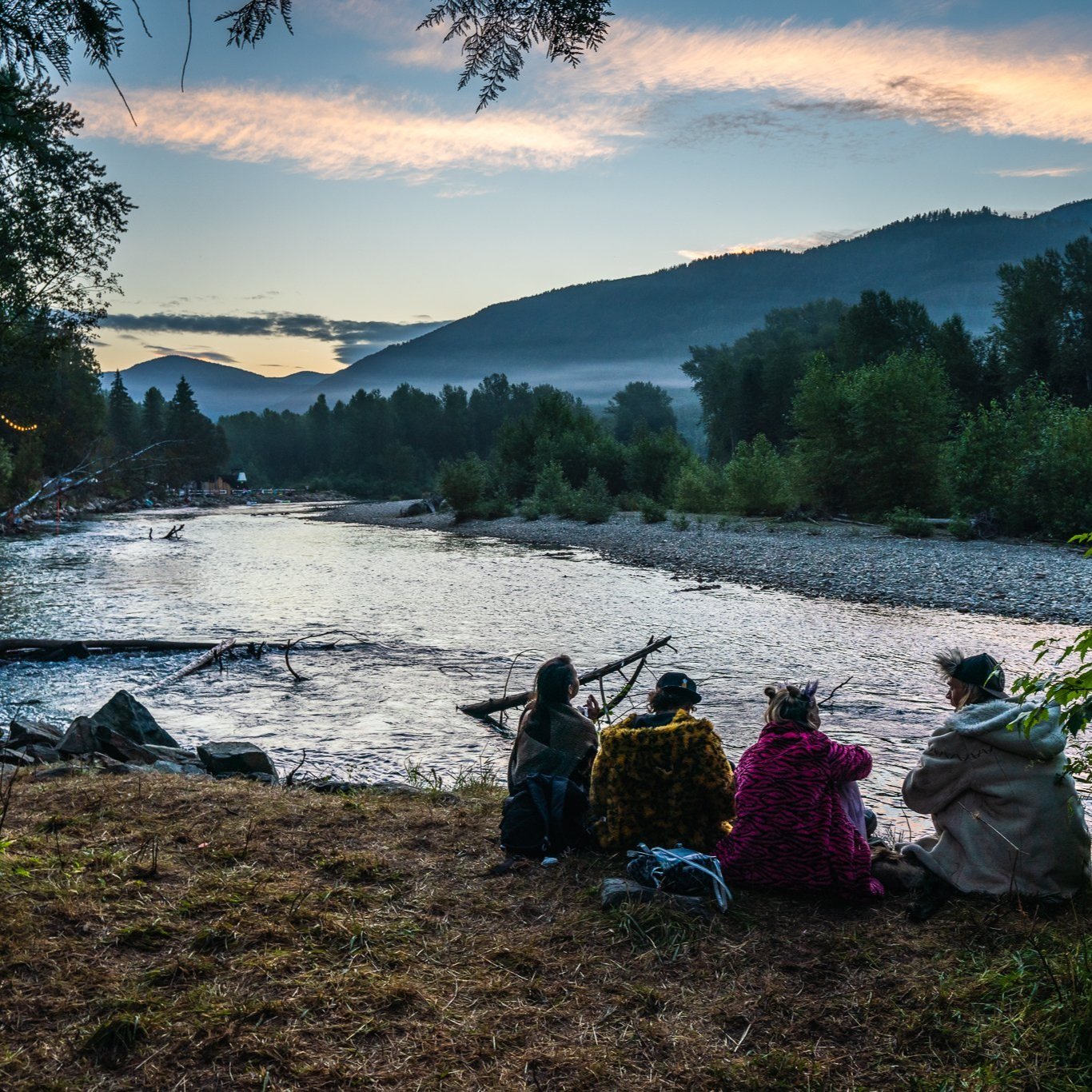
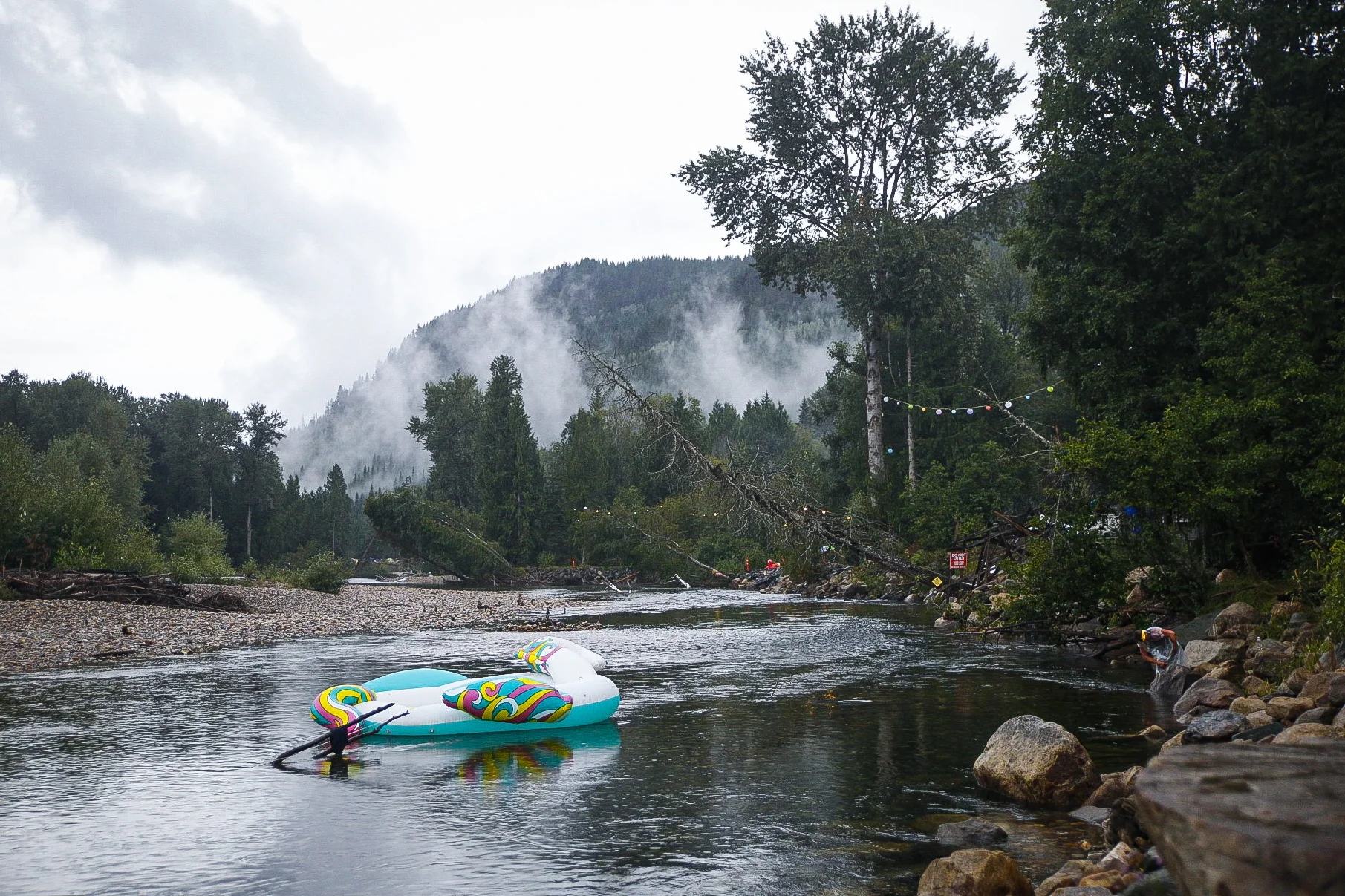
When arriving at the Shambhala grounds, you’re met with massive, looming trees, the cascading West Kootenay Mountains, and strong, mint-green rivers. A tangible energy can be felt in the breeze as you inch closer and closer to the entrance. The greeting from volunteers was simply, “Welcome. You have made it.” Whether traveling from the US, other parts of Canada, or from across the pond, no one escapes the nomadic trek out to this remote enclave in British Columbia . Remotely placed, about 2 hours from the city of Nelson and equidistant to the closest airport, performers, volunteers, staff, and attendees must ultimately burn rubber, or kick dust for those feeling especially adventurous, to get anywhere near the event. For each and every traveler, that journey ends in the undeniable charm that Shambhala has cultivated since its inception. It has nothing to do with hype, nor fanfare towards the culturally relevant. The only focus is you, at your most comfortable, immersed in sound and community.

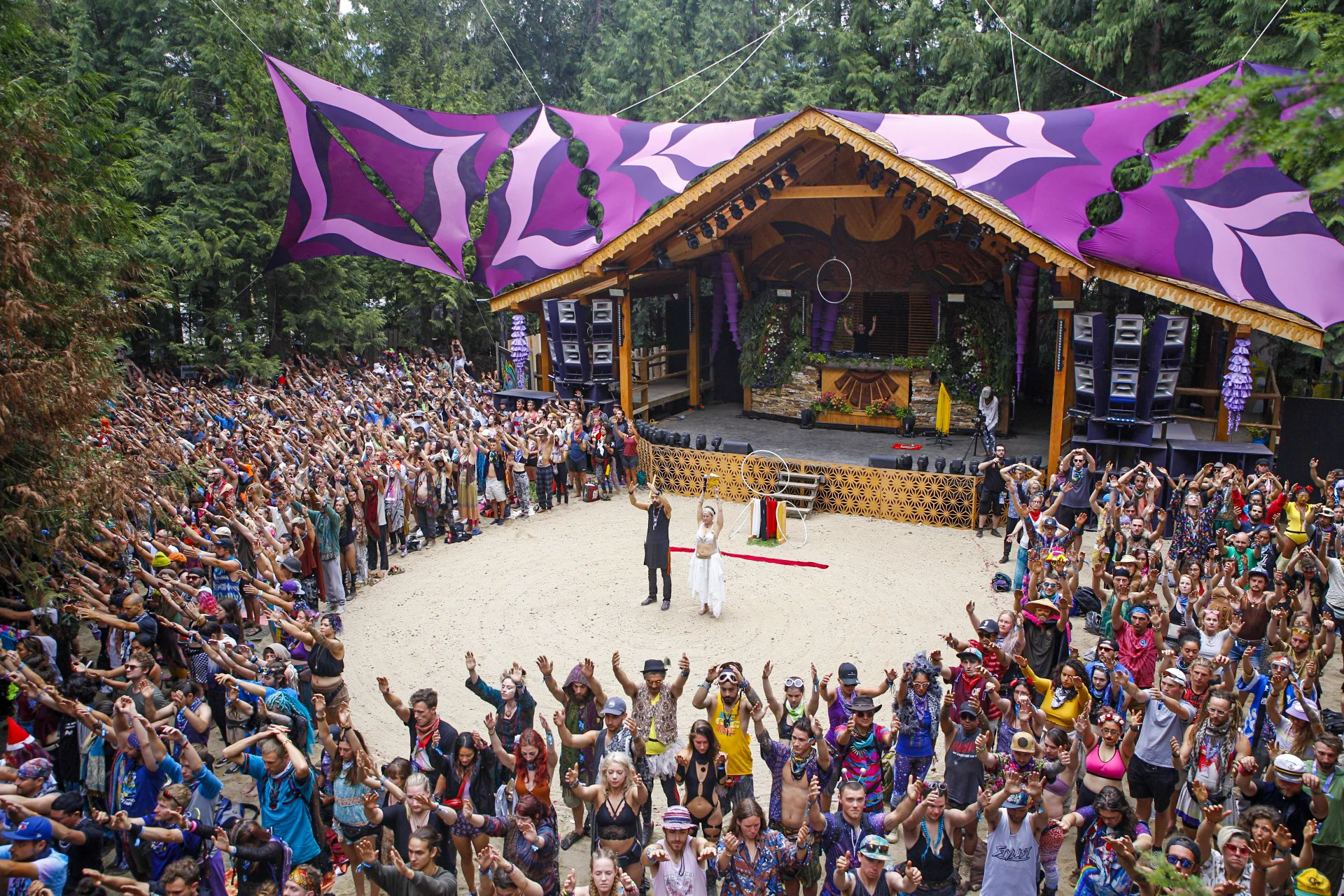
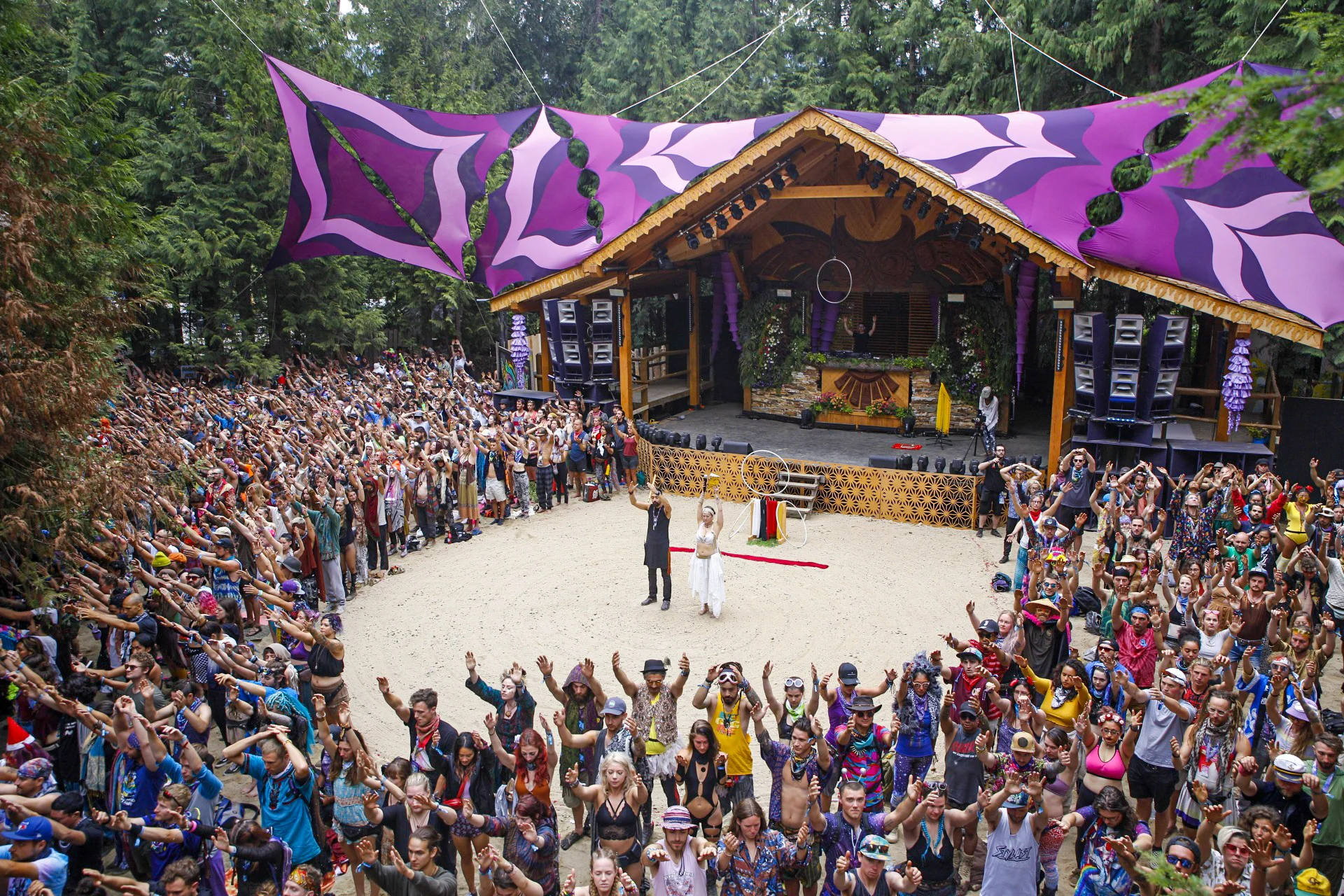
The Village by day. Photo courtesy of Digital Anthill Photography.
With every difficulty the wooded lands and remote location must present, on property that simultaneously functions as an active family farm, the individuality and scope of each stage is breathtaking. The craftsmanship of the decorations, the murals, and the complexity of it all is notably intentional, adorning the remote woodland with familiar and fantastic trinkets like carved speaker boxes and hand-painted signs. Each stage pays a unique homage to the movers and shakers of the electronic music scene, bringing internationally renowned acts in house, system music, and psychedelic bass music directly to revelers with discerning precision. Shambhala’s organizers make a firm point of showcasing diverse acts on multiple stages, affording patrons the choice of lush, quality experiences at each stage, while often centering attention during prime-time hours to names that may be unfamiliar to wider audiences.
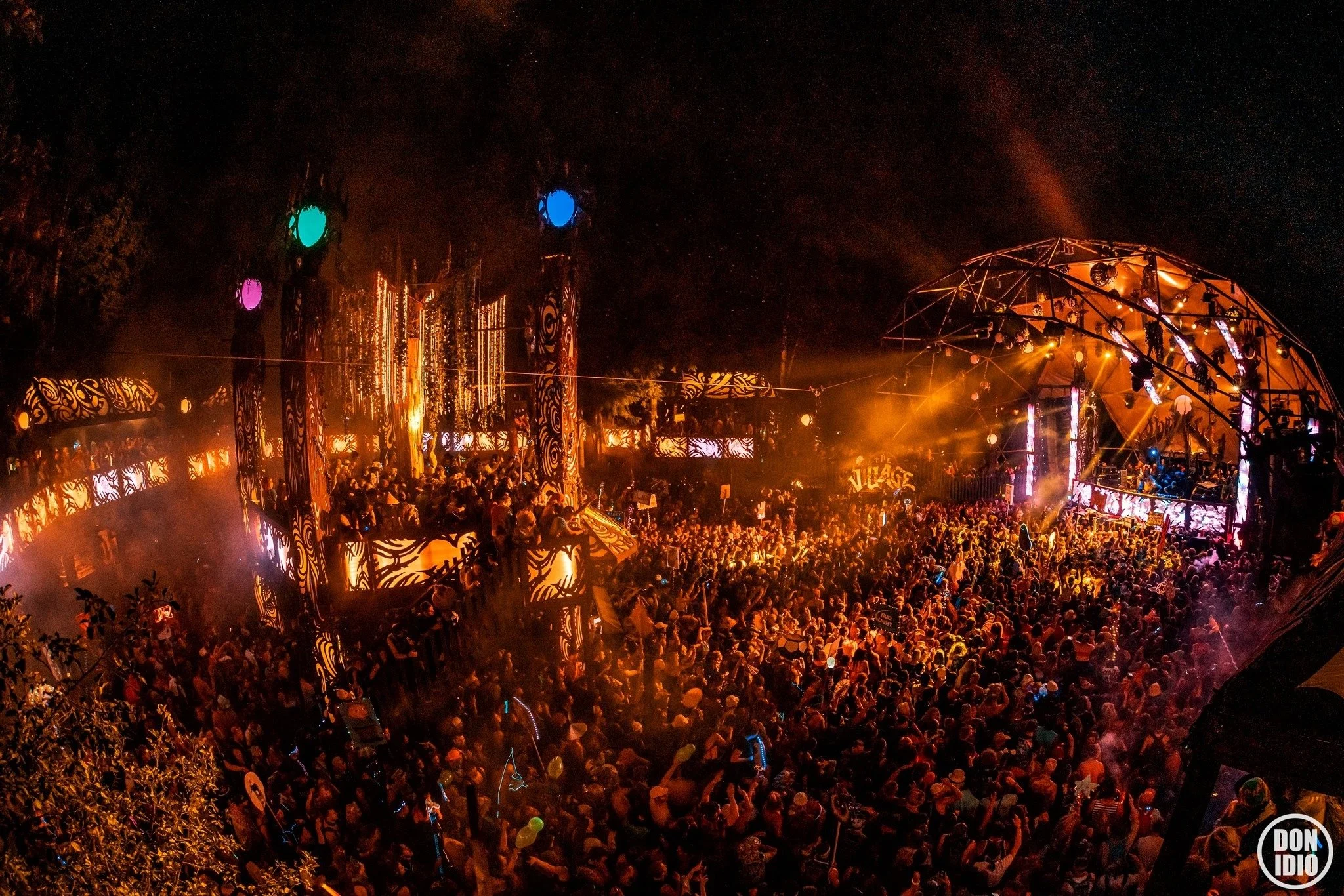
When given a chance to walk through The Village during its quietest moments, one can’t help but get the impression that it is a kind of church devoted to sound. The new additions to the area include towers that soar at over 100ft, with intricate wood-carved embellishments and bright, multihued LED housings. The surrounding dance-floor was larger than life, intertwined with staircases and cat walks, allowing listeners to venture to whatever vantage point they so desired. The center of emphasis during the weekend’s opening ceremony, professional acrobats and fire spinners captivated early revelers with a stirring performance, regaling a mystifying origin story of the first moments dance met music. Visually powerful and emotionally moving, these interpretations set the tone for a transformative weekend steeped in the natural bond between sound, body, and movement.

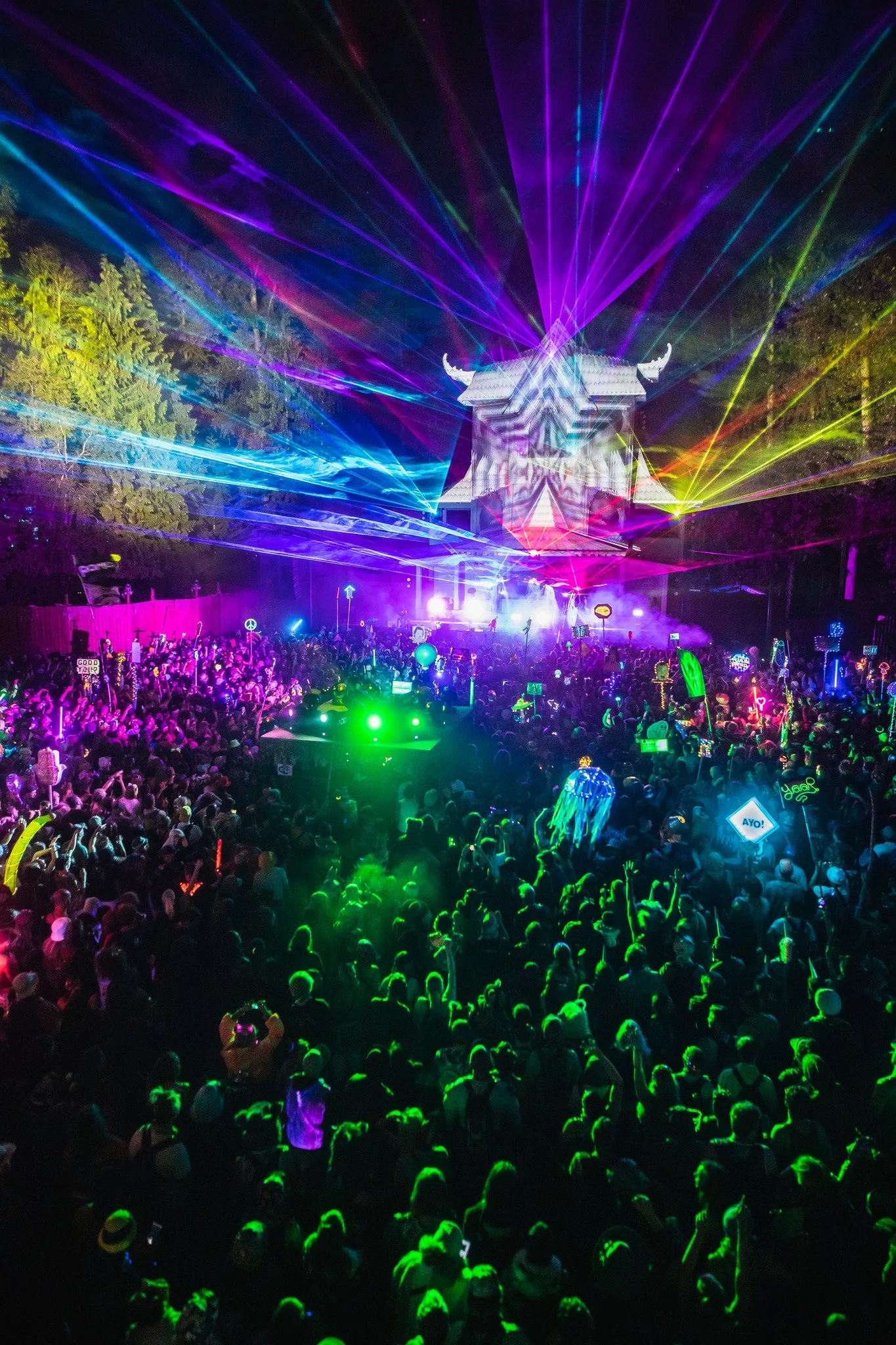
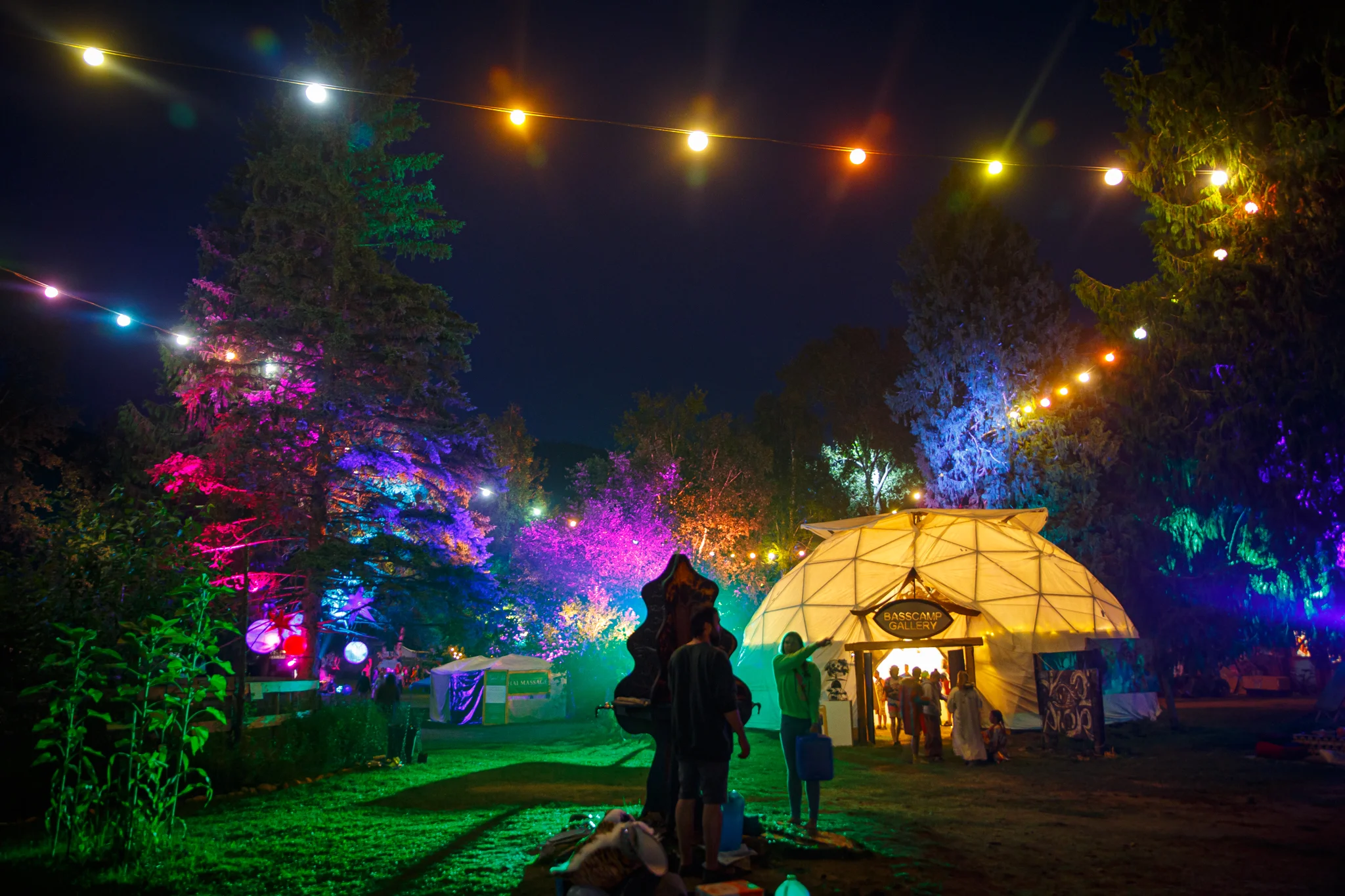
The Grove by night. Photo courtesy of Shambhala Music Festival Official Facebook page.
If The Village is a church to sound, then The Grove is the garden; Naturally decorated with native old-growth trees, and surrounded by masterful murals, it is a calming space to center the headspace and nap among the hammocks. With the only Funktion-One rig, The Grove’s environment provides an ambiance that encourages and suffuses the dynamic range of the system across the scope of the installation. Light and heavy, deep and expressive, The Grove masterfully blends set and setting to provide a listening and unwinding experience that is both climactic and serene. Sitting casually in my hammock along the treeline, I could not have asked for more of an honest example of music catered to its environment.
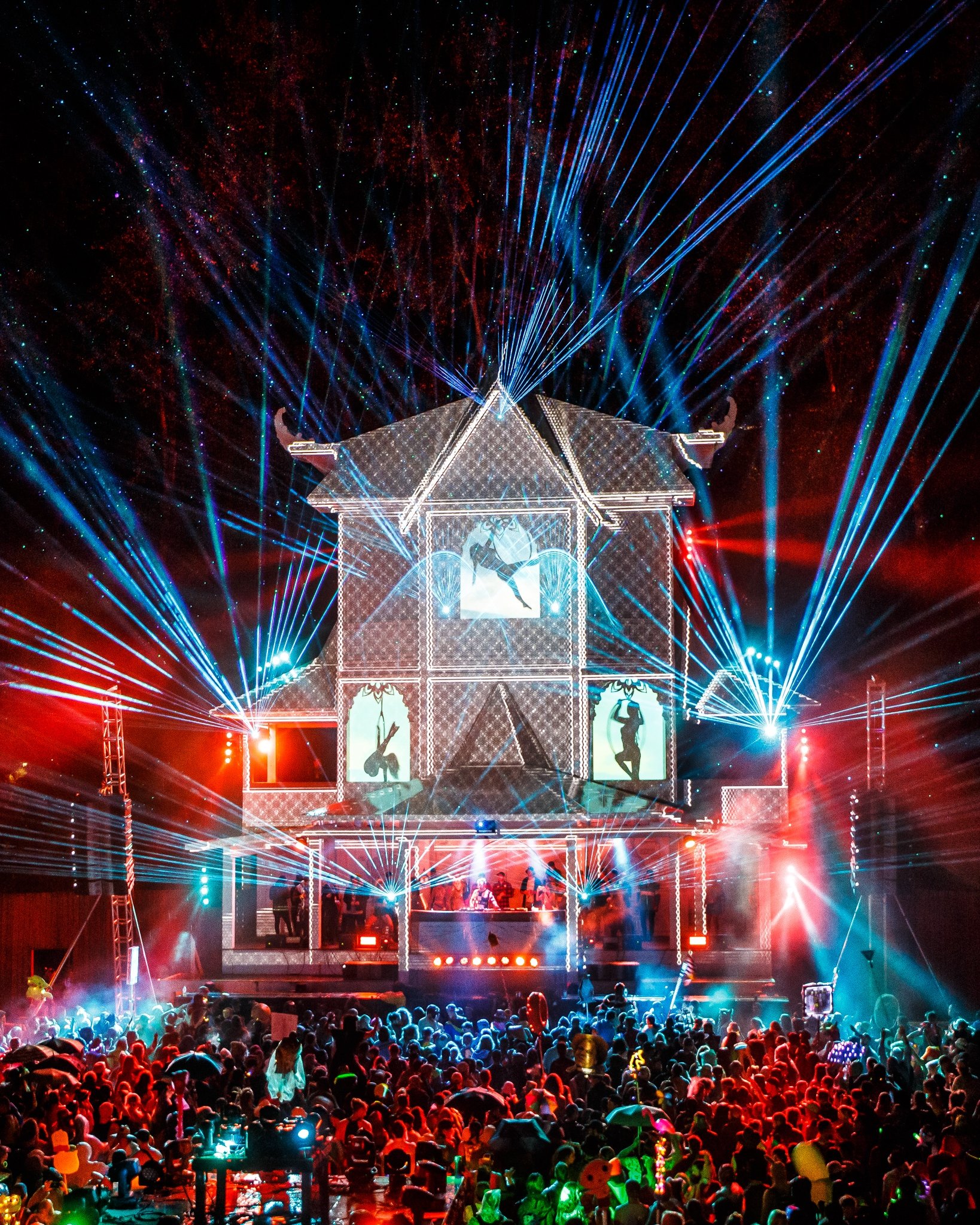
Inspired by asian architecture, The Pagoda is a three-story layered tower that houses a stage on the large front egress, as if a party exploded on the front lawn of an ancient fortress. The Pagoda was created to be an after-dark delight. Stationed right outside the main entrance and easily accessible, it is one of the first stages fans meet when entering the venue, introducing new faces and old to the first of many artistic veneers superimposed over the property. Walking past in the daylight, the stoic building seemingly illuminates with neon white against the treeline. Once the sun sets, 3D-rendered figures cascade and transform across the grooves and trusses featured on the forward face of the stage, shifting and evolving with the long arc of the night. Cutting edge visual art, projection mapping, and laser performance have become a staple of The Pagoda’s image, making it Shambhala’s primary one-stop shop intersection of top tier musicians and visual masterminds.
The Pagoda by night. Photo courtesy of Shambhala Music Festival Official Facebook page.
In talking to the staff members, we learned that there has never been a time across the last 25 years that Shambhala or the family farm has accepted corporate sponsorship; handmade with love and compassion, that ardent and head-strong grassroots ethic bleeds through to the audience. The brainchild of the stage curators and the vision of the volunteers, the festival was built from the ground up by the people who love it most. These people, some of whom have attended for 15 plus-years, echo every positive sentiment about the event and the property in tandem. On the other side of the coin, the audience at Shambhala comes with an eager readiness to be moved by the music, by the experience, and the collective catharsis found in this nook of the West Kootenay Mountains. It's in those moments that our relationships feel most resonant, with the focus not on the tickets we buy, nor the wristbands we collect, but the times in which we fall in love with being people all over again.
Shambhala Returns to the Fold in 2022
Shambhala is to some a tradition, to others a bucket-list destination, and to a select few – a pilgrimage home. This magical event is a refuge for the different and the strange, where one is accepted no matter their differences or how weirdly they dance, and we’re incredibly excited to return to this premiere massive for 2022’s guaranteed weekend of iridescent festivities.
Shambhala, in concise language, is a transformative music and art festival in the dense woods of Canada’s steep Rocky Mountains. 30 minutes outside Nelson, British Columbia on the banks of the Salamo River; this considerably massive event is held on a fully functioning, picturesque, 500 acre family farm. Over the past 23 years, for 6 days every summer, Shambhala has evolved into the largest town for 400 miles, with an estimated 15,000 people in attendance. Some festivals are a community; this is closer to a municipality.

The Bundschuh Family Land
In the height of the 90s rave scene, a young Jimmy Bundschuh approached his parents with an idea: throw a music festival on their family’s land – not just any run of the mill show, but a large curated festival that would attract some of the best musicians and artists to their little sanctuary in BC. Beginning in 1998, Jimmy and his family set off to capture the communal vibe that attracted them to music so much in the first place. This goal has now stretched over two decades, and has regular patrons from every corner of the world. The festival is run by the children of the land, Jimmy, Corrine, and Anna Bundschuh. Shambhala has never had any type of corporate sponsorship, and is rightfully proud to be completely self-sustained by the family farm and ticket sales. The team of visionaries go above and beyond to incorporate the local township into their dream. Donating regularly to local infrastructure, food banks, and local soup kitchens, their ethics and follow-through are a shining demonstration of community-centric mutual aid. There is even a performance hall at Selkirk College, in Nelson, BC that proudly wears the Shambhala name, espousing the indelible ties that the Bundschuh family has curated with their surrounding neighbors across the stretch of their grand experiment.
Shambhala has been a consistent epicenter for those looking for more than just a good time. Touting five independently curated stages with associated and thematic decorations, these impressive dance floor environments would be non-existent without the artist, volunteer, and musician contributions.The unique, one of a kind stages and sound systems have long been the core destinations inside the festival, for both music producers and music lovers. As a standing rule, the musicians are offered an open invitation to drop the pressures and expectations of modern industry and asked to play their best sets; performances that speak to their artistic dream and vision. All but one stage features full arrays of high quality PK Sound cabinets, with the Grove Stage featuring a full-service Funktion One system. This year, the AMP stage is packing a particular punch, featuring acts such as Amon Tobin, Truth, and many more to set your watch to.
Credit: ConcertSocks
Additionally, the Shambhala team have been unapologetically spearheading the use of cutting-edge harm reduction techniques, such as free substance testing, for many years. Ankors, the free drug testing facility, boasts a massive list of substance testing and accountability practices. Information on safer sex, partying, and harm reduction is avaliable at the onsite at the Option tent as part of Canada's largest non-profit provider of sexual health services. These safe, non judgemental spaces are a calm oasis from the bright lights and excitement, and provide helpful information to anyone who asks. The original “Safe Space” was first designed as a space for women only, but has now opened up to all genders and non-binary travelers looking for a moment or two of reprieve. The facilities carry free condoms, staffed stations for helpful information, and offer emergency contraceptives for those in need. After all, the overarching mantra to Shambhala is “We care about people.”
After basking in the sun and all the glory that is Shmabala, artists, patrons, and musicians are asked to contribute year after year and to bring their best selves back again and again. Shambhala is to some a tradition, to others a bucket-list destination, and to a select few – a pilgrimage home. This magical event is a refuge for the different and the strange, where one is accepted no matter their differences or how weirdly they dance, and we’re incredibly excited to return to the fold for 2022’s guaranteed weekend of iridescent festivities.
FOLLOW Shambhala Music Festival: Official / Facebook / Instagram
"It Was Really About the People & the Land" - A Weekend At Shambhala
As the climate, laws, music, people, and the popularity of the entire electronic music enterprise has changed, Shambhala Music Festival has preserved and grown. How? It’s run by an enduring crew that comes back year after year. It’s become part of Western Canadian culture. And It’s centered around ideas that don’t lose value with time or trends; respect for the Earth and oneself; independence from corporate influence; reverence for higher powers; passion for good music.
(Credit: ConcertSocks)
Flipping through my notes from Shambhala Music Festival, a few sloppy, scribbled lines stand out:
We’ve got what it takes
To make this world a better place
And make our children safe
It’s all up to me
It’s all up to you
That’s a vocal sample from soundcheck before A Tribe Called Red’s Sunday night performance at the Ampitheater, one of six stage environments at Shambhala, which ran from Thursday, August 8 through morning on Monday, August 12 at the Salmo River Ranch in British Columbia, Canada for the 22nd year in a row.
This Ottawa-based act blends all sorts of electronic music - house, hip-hop, dubstep, drum and bass, hardstyle, Jersey club - with First Nation drumming and chanting to initiate an “electric pow wow”. Participating was liberating yet chilling (“My people will sell our bracelets by the roadside. Your people will play golf, and eat hot hors d'oeuvres.”)
Their heavy performance said “dance like you mean it, but don’t forget what’s happening behind the music.” It was like a microcosm of Shambhala as a whole. The event hosts many of the best electronic acts in the world, but the music can also be seen as a means to an end. Music is just the centrifugal force around which a community, decades in the making, gathers to celebrate its renegade culture.
(Credit: ConcertSocks)
A British Columbia local named Osprey and perhaps others conceived the idea for Shambhala in the late 1990s. Osprey came from the psychedelic trance scene of Goa, India during its heydays, where interactions between western counter culture and Hinduism embedded eastern spirituality into the rave scene. He would tragically pass away in a car accident, but his vision for a music festival in the Kootenay Mountains would live on through the several hundred local fans, promoters, and musicians who started it.
During the Vietnam War, draft dodgers from the United States hid out in the Western Kootenays. At the turn of the 20th century, the Dukhobors, an anti-state Russian Christian sect, settled there after being exiled for their unorthodox beliefs. There’s always been a durable marijuana culture. It’s fertile ground for a party like Shambhala, which built upon the existing counter culture in this isolated region.
“The surrounding area is sort of a fortress. It’s not near any major highways, there’s mountains in every direction, deep valleys, big mountains all around. It’s not on an interstate or even a big provincial highway.” That’s Tall Brian, who for over a decade has managed Shambhala’s artist lounge and accommodations, an “outdoor hotel” as he calls it. “The event is kind of a pilgrimage in that way. You have to go there.”
Naasko is a DJ whose performed at every Shambhala since 1999 besides a few when he worked and performed at Boom Festival in Portugal. “There’s a pursuit of freedom that exists here at Shambhala,” he said. That first year he came from Vancouver, worked a food stand, talked his way into a set, and would move to the nearby city of Nelson not long afterwards. “A giant inflatable buddha like 40 feet tall out on the highway brought people into this little mystical enclave here in the woods,” he recalled.
I spoke to both of them on a rainy Sunday in a big, twisting tree house lounge before Naasko’s 6:00pm set. “It started really humbly,” said Brian. “Just local people putting stuff together. I mean the early stages were just really rudimentary tarps and small systems. I have a photo of the Living Room when it was two speakers and a tarp.”
The Grove (Credit: ConcertSocks)
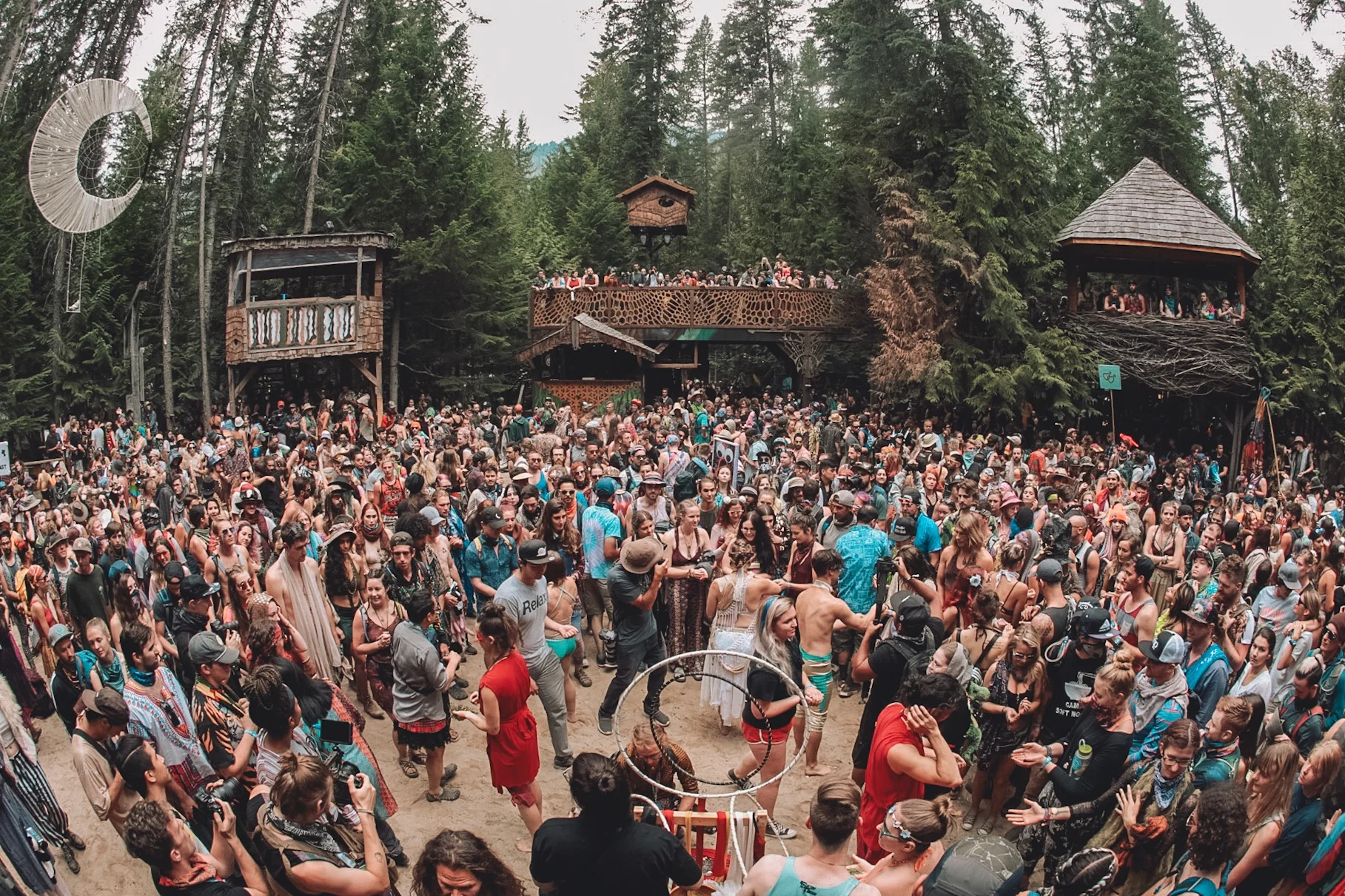
The Grove (Credit: ConcertSocks)
As the climate, laws, music, people, and the popularity of the entire electronic music enterprise has changed, Shambhala has changed, too. But it’s managed to preserve that special something. “I think the essence is still there. That’s what sustains its popularity. The festival embodies a lot of the freedom essence that’s not found in other places. That’s the appeal to the working masses in Calgary and Edmonton and Saskatchewan. When they think about coming here, it means so much to them.”
How? It’s put on by an enduring crew that comes back year after year, it’s become part of Western Canadian culture, and it’s centered around ideas that don’t lose value with time or trends; respect for the Earth and oneself; reverence for higher powers; independence from corporate influence; passion for good music.
People take care of the 500-acre ranch. Beside the river in the early morning sun, Jack Elliman sweeps his arm out across the pristine riverbank. “There used to be trash all along here. Now when people come to Shambhala they are educated by Shambassadors, the GRC and festi veterans pretty quickly. They learn how important it is to respect the land, the river, and each other, and that mind frame is contagious.”
Jack volunteers with the Shambhala Green River Collective which has been cleaning the Salmo River since 2011. He also runs the event’s cigarette butt disposal and recycling operation and invented the Pocket Ashtray (yes those pocket ashtrays), a Shambhala staple. There’s butt buckets all over the grounds, the Grove has a smoke-free dance floor, and nature’s abundance is itself a persuasive reminder not to litter. “Then they take what they learn here and bring it back to wherever they're from,” says Jack. “That's the true transformational festival."
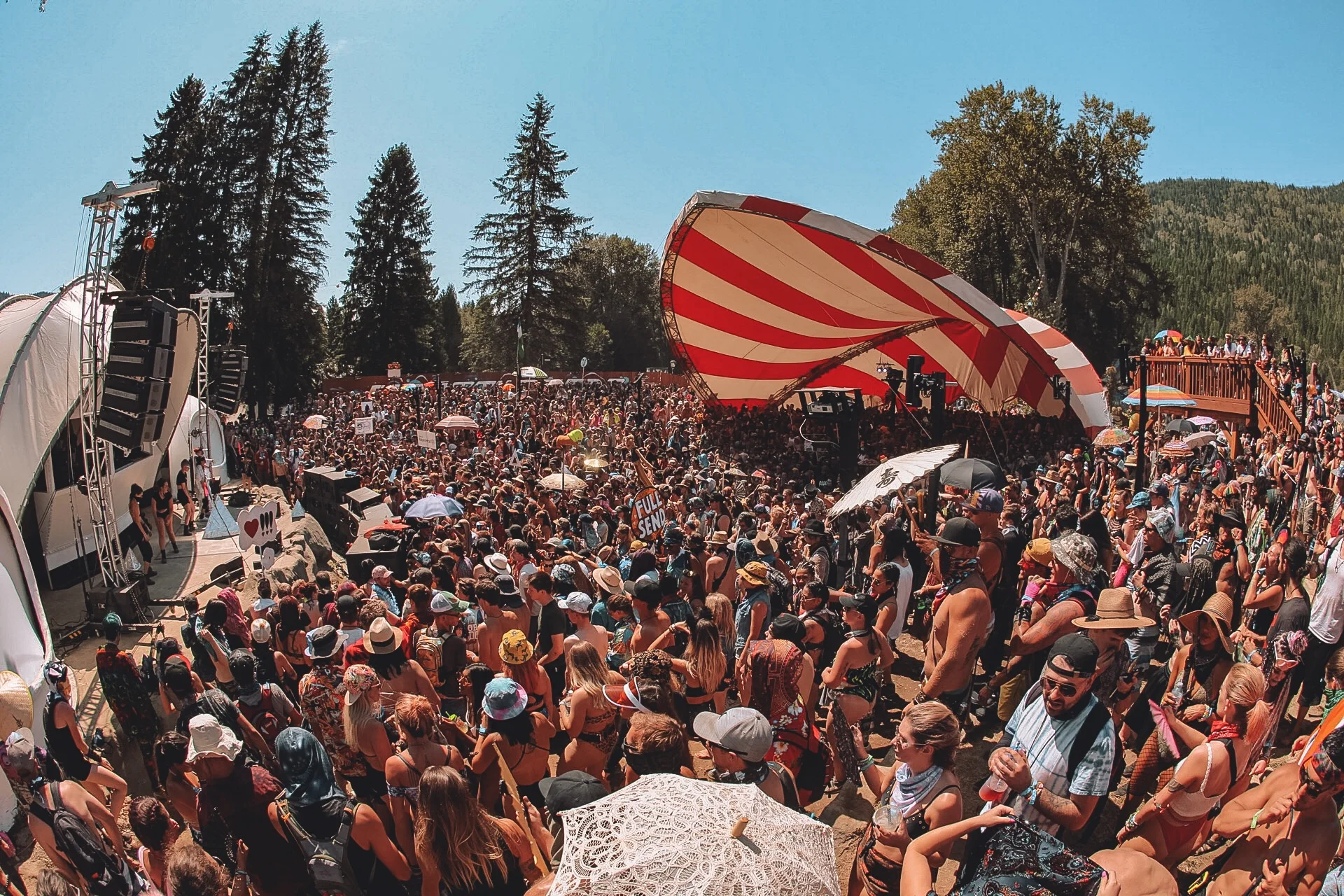
The Amphitheater (Credit: Banana Cam)
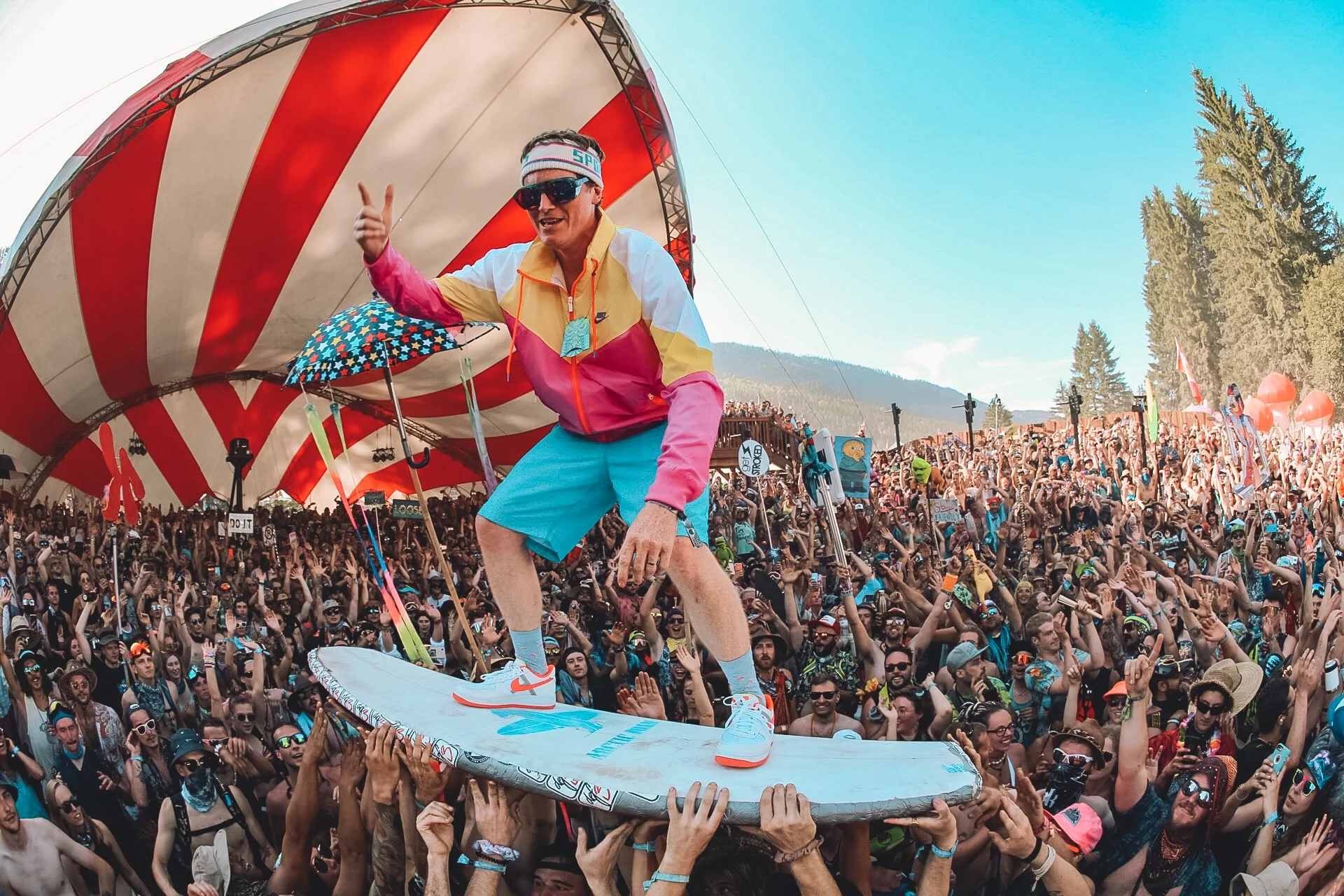
The Amphitheater (Credit: Banana Cam)
There’s Camp Clean Beats, a camping area sober festival goers who are sober or in recovery. Shambhala is perhaps most famous for its harm reduction work, from free drug testing to sanctuary spaces for women. Select weekend workshops encouraged attendees to respect themselves and party responsibly like “Cannabis: Gateway or Exit?” and “Psychedelics and Intimate Relationships.” A woman approached me during the Saturday night thunderstorm and handed me a sticker with the Shambhala SOS telephone number on it. “If you’re in trouble or you see someone who needs help, just call.”
Festivals, especially transformational festivals, are often seen as departures from the “default world” and Shambhala is no different. But it has also become part of the regular culture around those parts. The province of British Columbia actively sponsors the event. A woman named Celia from Vernon, BC, where producers JPOD and ATYYA grew up, first came to Shambhala 15 years ago and has volunteered several times since. During ATYYA at the Grove on Saturday, her son emerged from the crowd to her delight with his totem, girlfriend, and wide electric eyes.
I camped on a rented property in Nelson after the event. Lo and behold, the owner DJed at Shambhala twice and went to high school with lead organizer and Salmo River Ranch owner Jimmy Bundschuh. “Everyone around here knows the Bundschuh’s,” she said. In Calgary, I stayed with a friend who I know through channels completely unrelated to Shambhala. “But you know that pond in the woods behind the Labyrinth [now the Grove],” he asked me. “I built that one year when I was curating ambient music on the side stage back there [now the Cedar Lounge].”
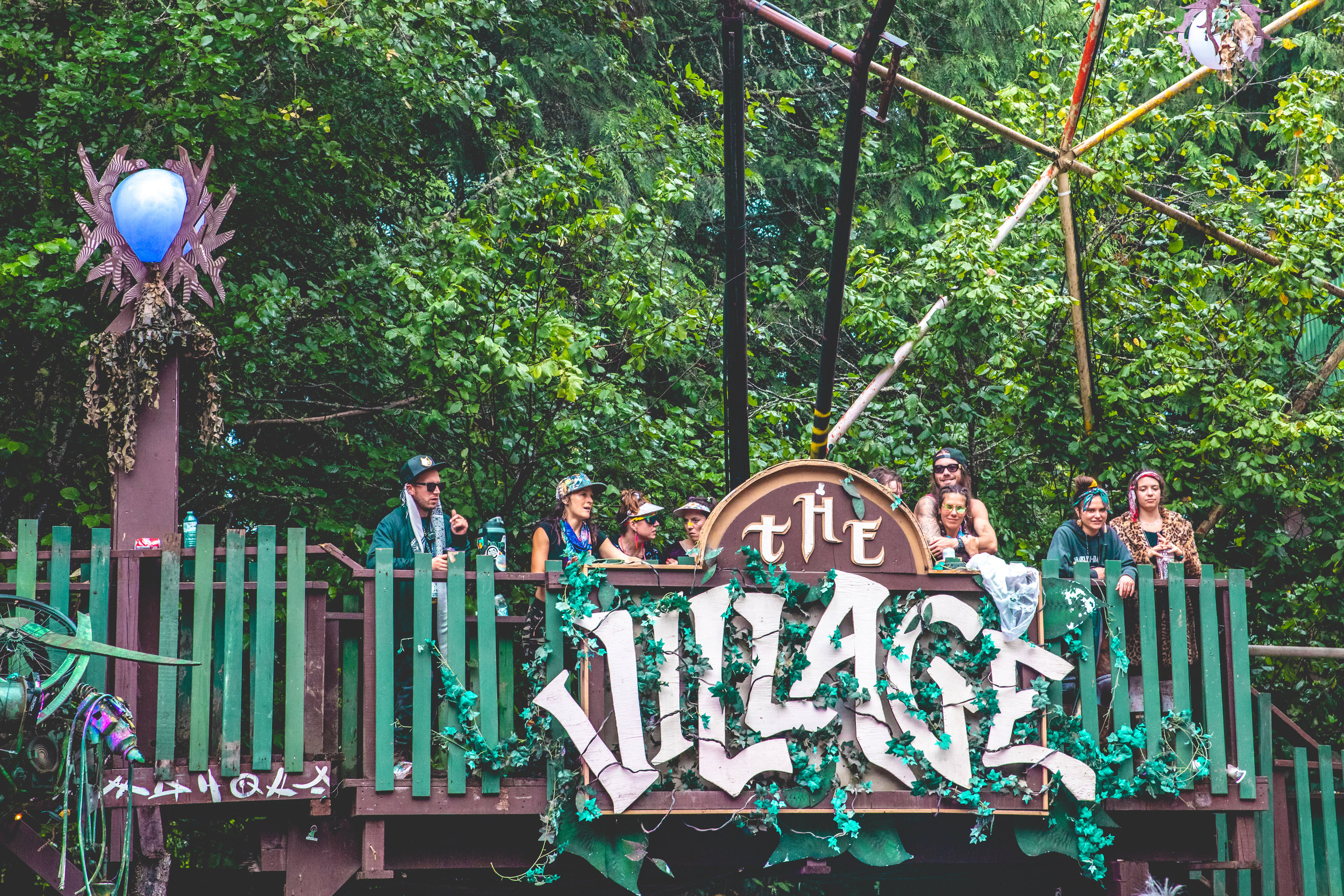
The Village (Credit: ATS Photography)
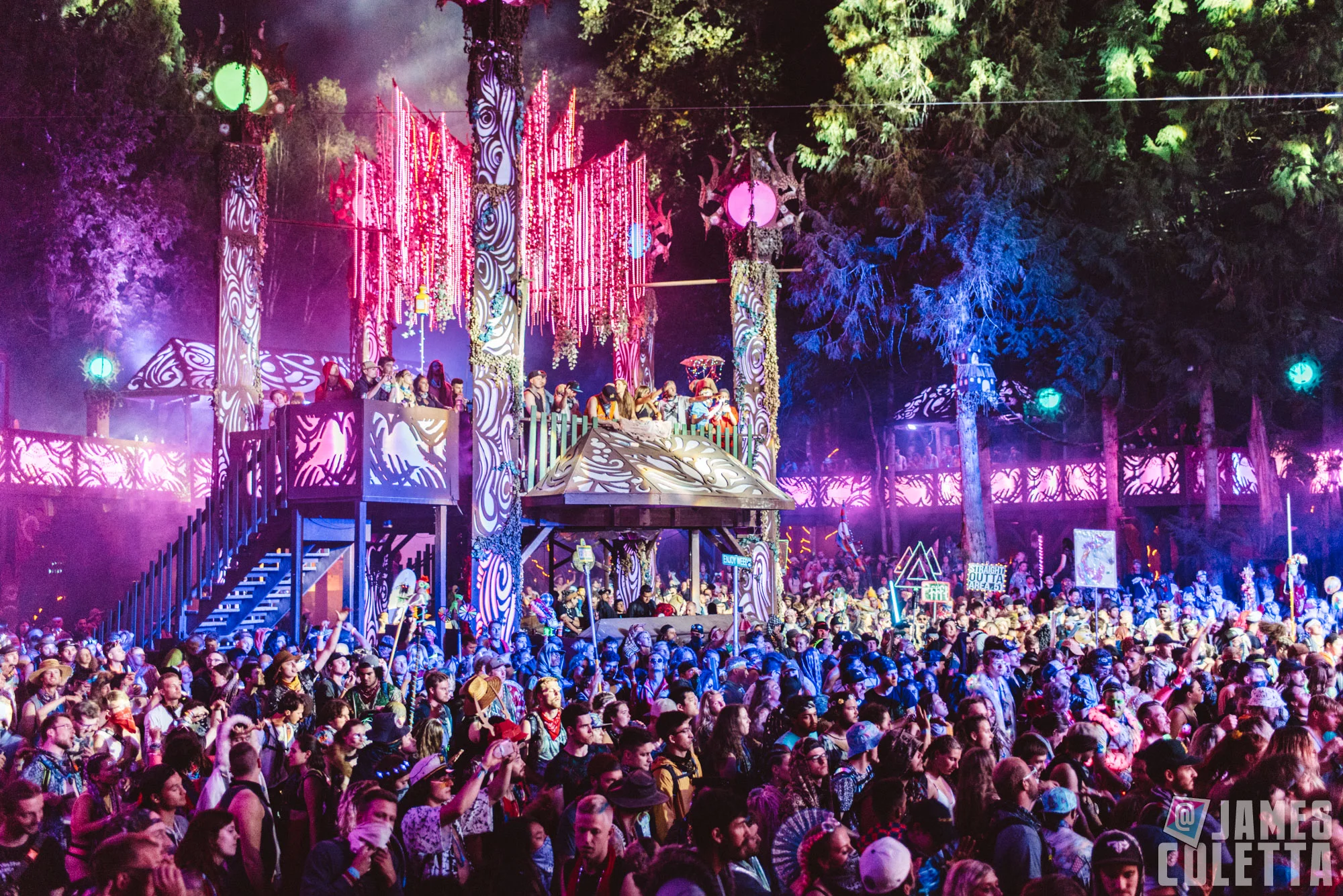
The Village (Credit: James Coletta)
The Shambhala crew, including volunteers, numbered about 2,500 people this year. That’s about 15-20% of everyone on site, an unusually high number. From long-serving stage managers down to first-year Australian volunteers, there’s an elaborate credential system for the crew. I saw a dog that was more credentialed than I was. A man with a blue beard who must be at least 75 years old sits guarding a gigantic pyramid in the Fractal Forest. A man with one eye and sharp teeth guards the entrance to the stage. So much of the crew clearly returns year after year, and most are Canadian. The infrastructure at Shambhala - world class stage, lighting, and sound infrastructure, tree houses, terraces, villages, pathways, gardens, fences, nooks and crannies - was built by generations of teams. I met at least six dudes throughout the weekend who “cut and strip wood”.
“It was really about the people and the land,” Naasko recalled as he unpacked twenty years of memories.
“Same,” I thought to myself. But I’d be remiss if I finished this piece without hitting on musical highlights from that interdimensional weekend.
After a flight cancellation and a pedal-heavy haul from Calgary through plains and peaks, I pulled in at sunset and walked into the Fractal Forest for the first time during the Westwood Recordings takeover. New Zealand producer K+Lab was landing the mothership, playing keytar on stage in that old-growth 360-degree sound garden. Coming from Kelowna, BC just west of Shambhala, Stickybuds followed and practically looked like a gigantic tree the way he dominated the energy of that space. After starting with wicked drum and bass he ran through his signature electro funk selectors including “Crooked Politicians” off his first album, which he dedicated to all the crooked politicians around the world.
The magnitude of Shambhala hit hard Sunday night. During one time slot Rusko was playing at the Village, Troyboi the Amphitheater, Bonobo the Grove, Zeds Dead the Pagoda, and Silk City (Diplo and Mark Ronson) at the Fractal Forest. The entire grounds were saturated with mud and the energy was beyond feverish.
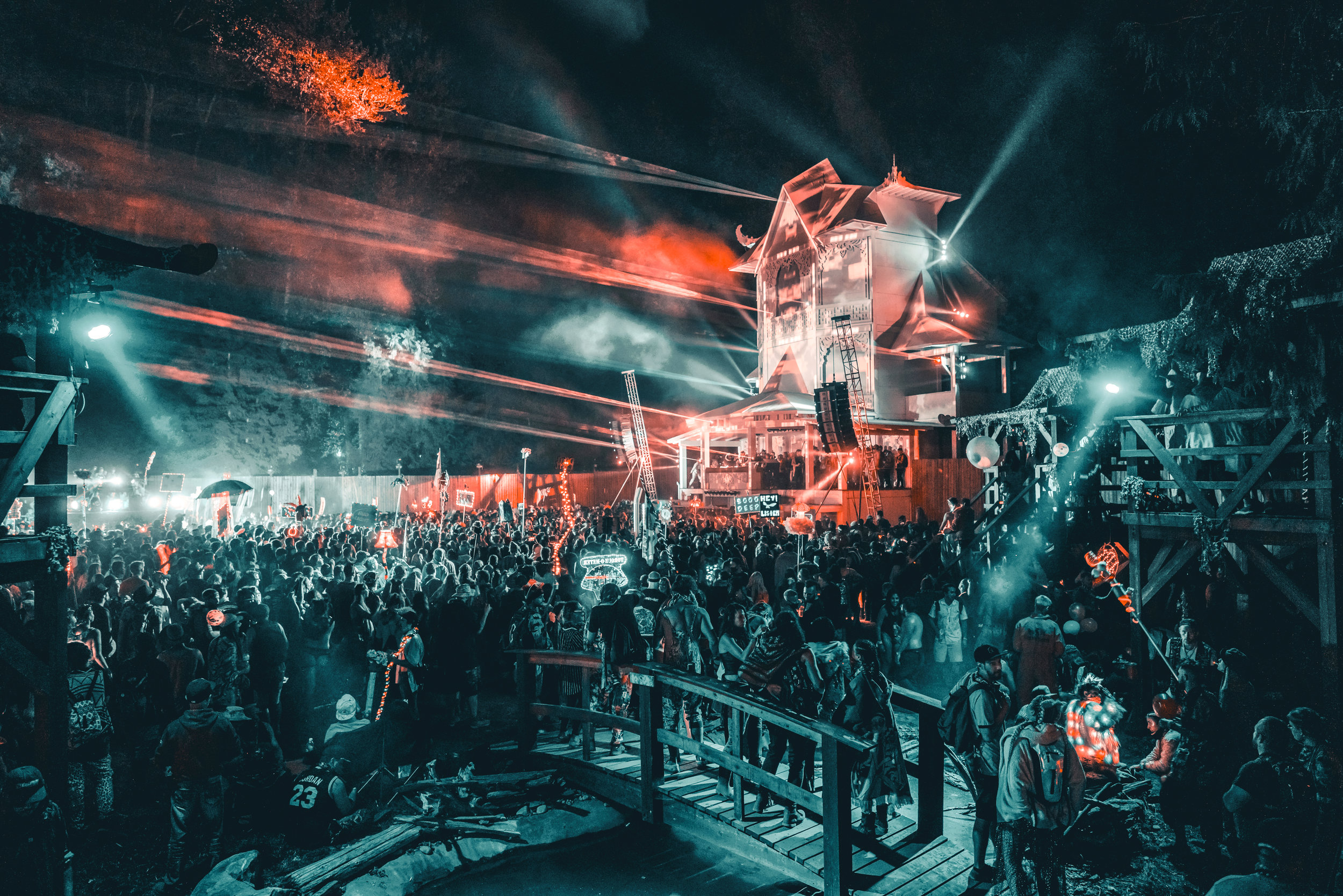
(Credit: DIVISUALS)
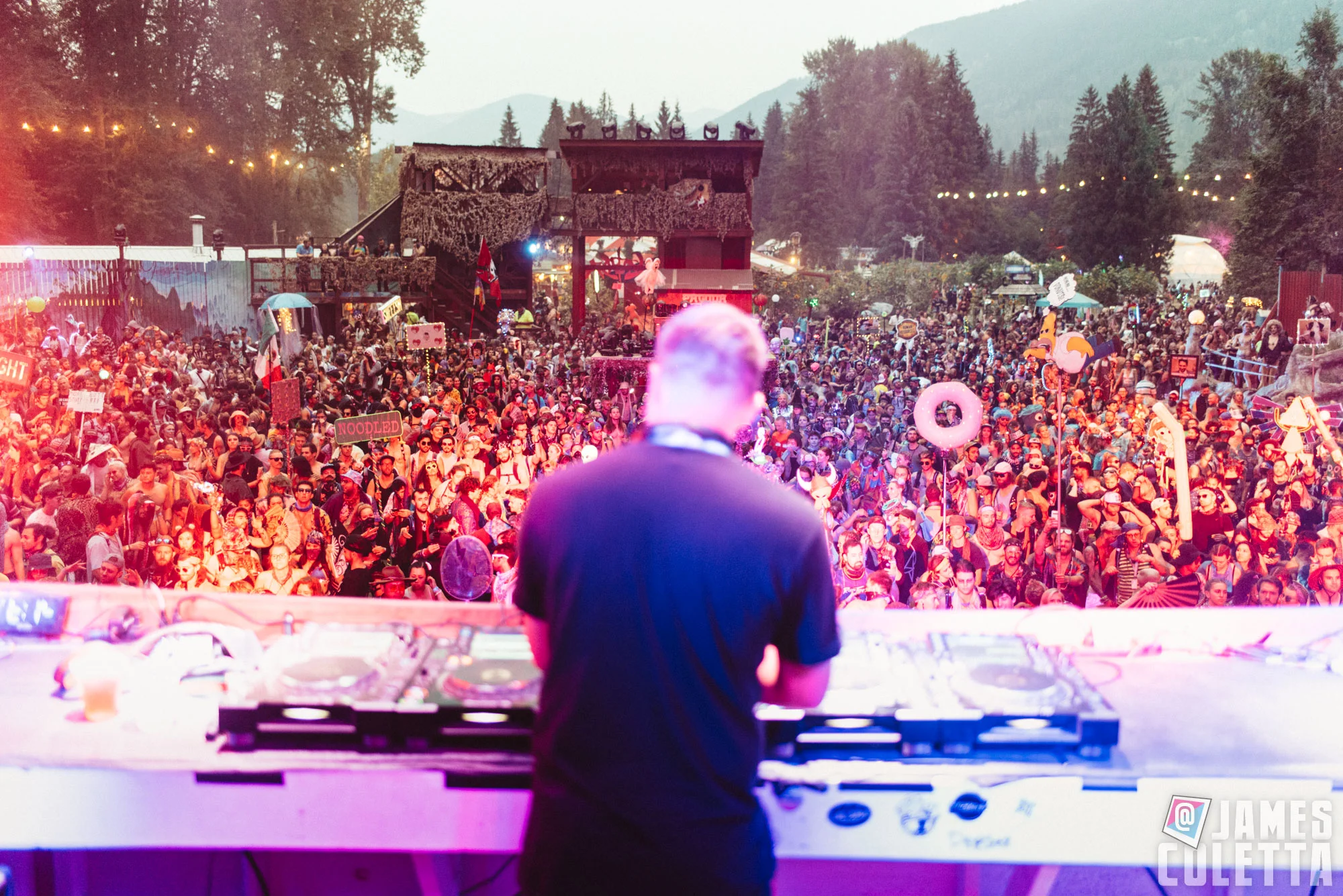
The Pagoda (Credit: James Coletta)
Late that night I found a deep heads’ delight. kLL sMTH absolutely wrecked the Ampitheater and spun me down to the Grove for Stray (one half of Ivy Lab). He was laying it in there, drilling dark drum and bass but pausing now and then to express gratitude to the audience’s for their openness. “You’re a pretty open lot. This is some of my favorite music, and it’s been years since I’ve played it.” Tor from Vancouver followed him with a perfect, grounding sunrise set for a bright, colorful capacity crowd. By that time, only the strongest psychedelic sound warriors were still kicking. But at Shambhala, that’s like everybody.
One more story from Brian is worth sharing.
When I arrived at reception today I saw this super average looking young kid, Alberta license plates. He was by himself but was clearly so stoked. I was bringing in my work crew for like the thirteenth time and was like, “yea whatever this is gonna take a long time to get these credentials.” But the guy was just so excited to see us. I think there’s something that happens as people enter. Barriers break down and there’s this whole spirit that’s there; a friendliness, a genuineness that’s contagious. It takes on different forms and qualities. For us, it was a very different experience. But for, say, a young Albertan it can feel very transformative. And this kid was like, “what’s up Shamb fam?!” And he wanted to hug us all - total strangers.

The Living Room (Credit: Banana Cam)
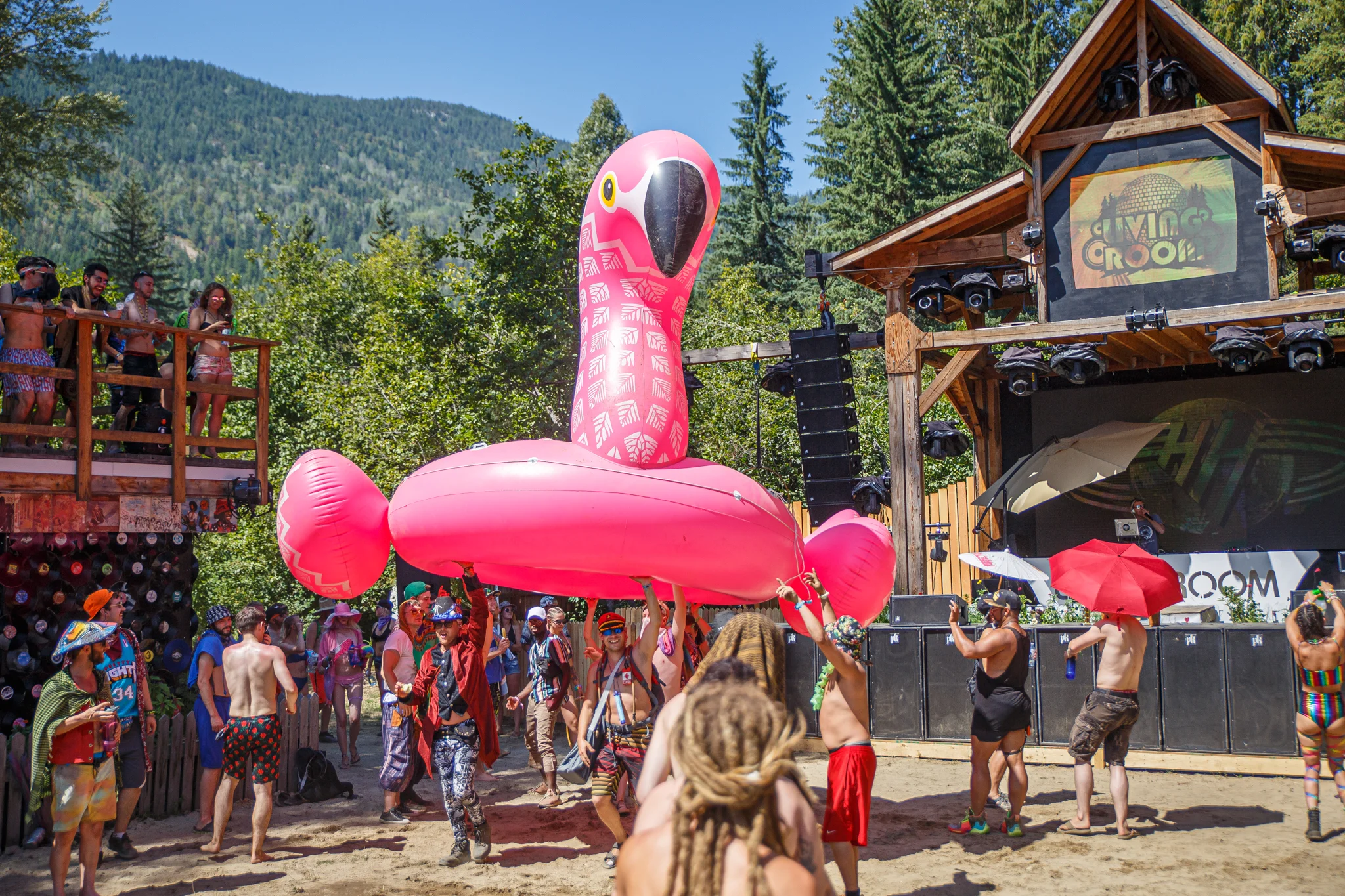
The Living Room (Credit: ConcertSocks)
Shambhala is probably the best that the electronic music culture has to offer right now, and that’s pretty damn impressive. DJ Mag recognized this by awarding Shambhala as the best festival in North America in 2019. If you’re part of this culture, and you have the means, experience it at least once. “I’m curious to see what will happen,” said Brian. “22 years going strong. I really feel that Shambhala could sell out in perpetuity. If they kept the numbers and kept the quality. It would be interesting to see where it’s at in 25 or 30 years.”
“If we’re still alive then,” Naasko chuckled.
FOLLOW Shambhala Music Festival: Official / Facebook / Instagram
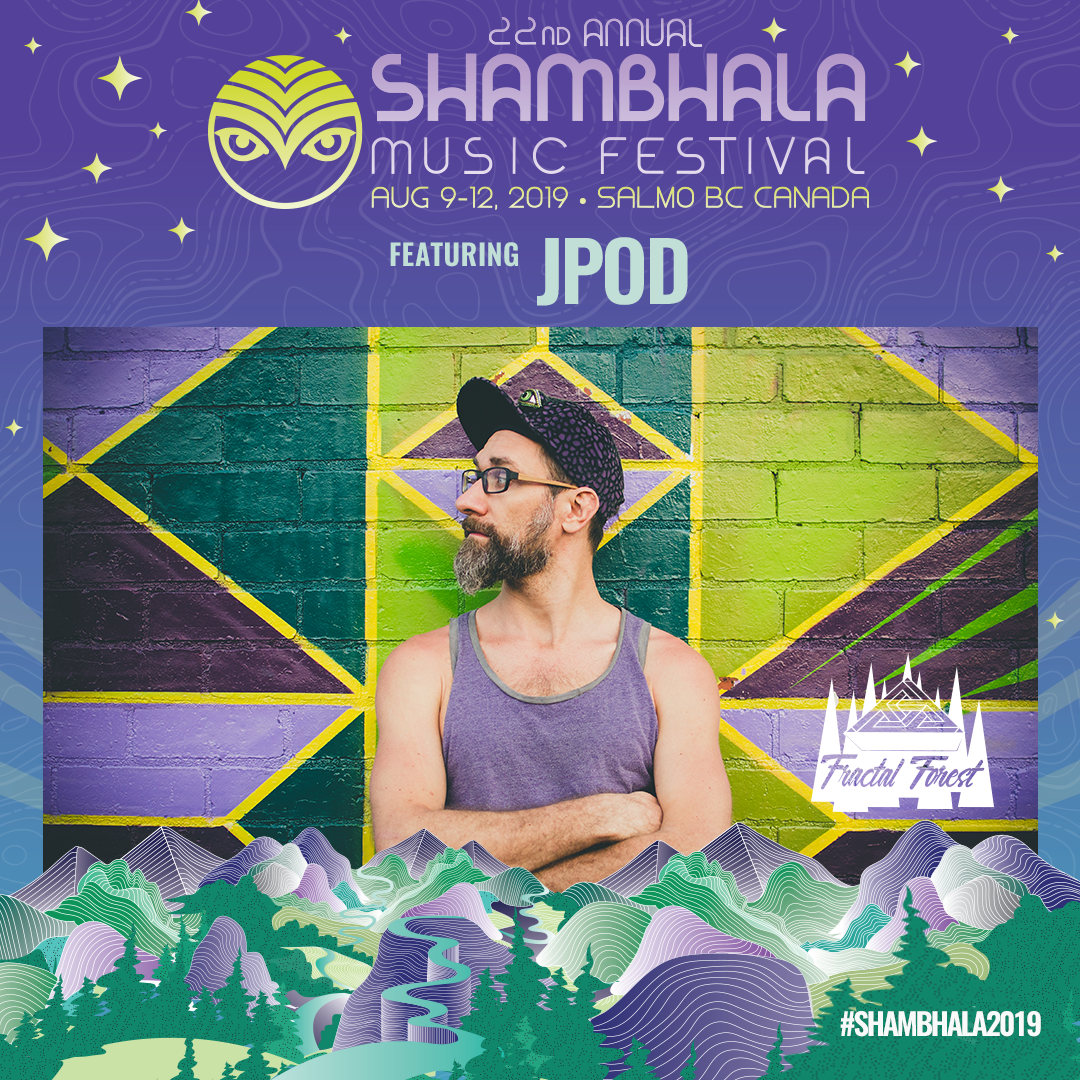
How JPOD the Beat Chef Became a Shambhala Favorite
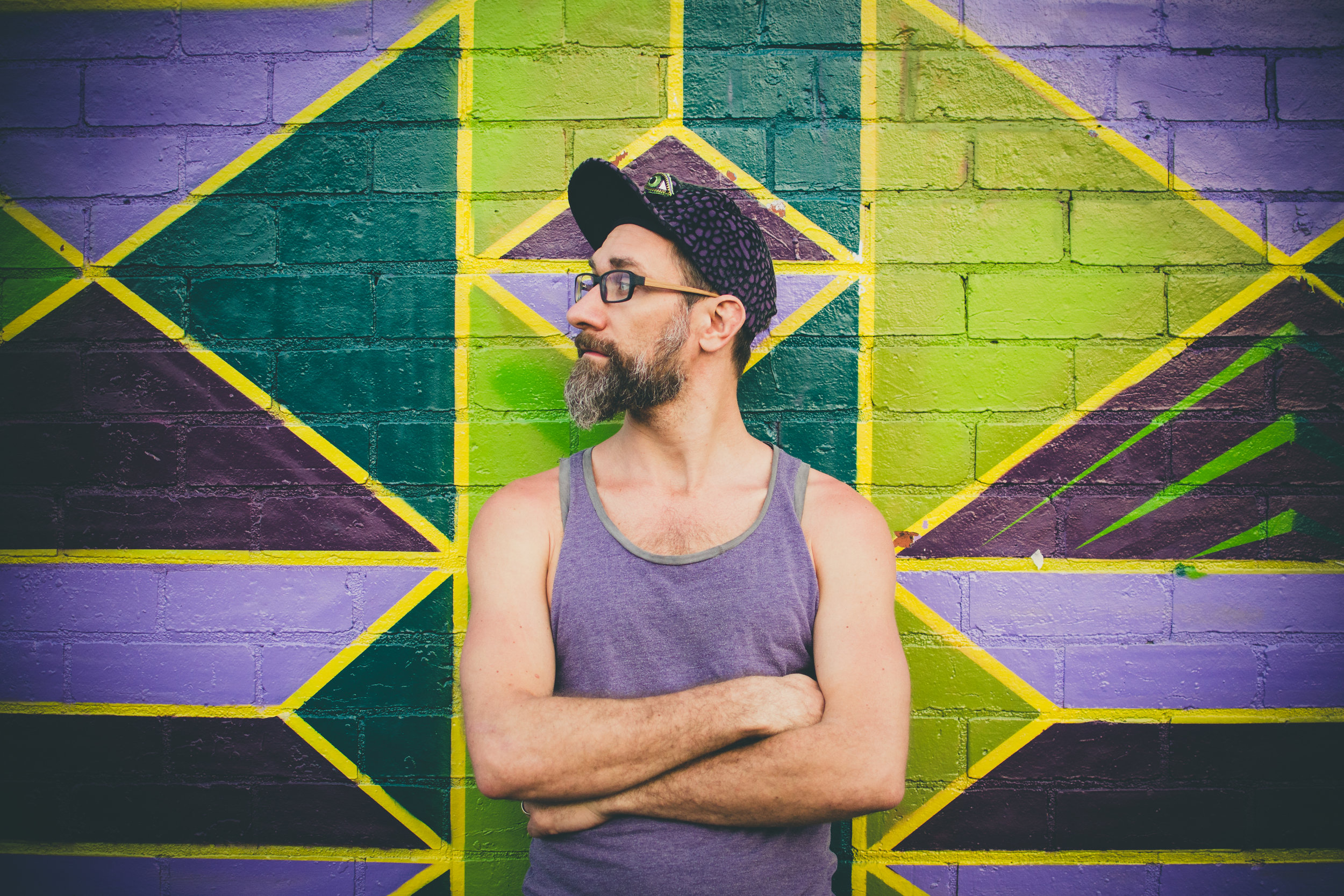
JPOD aka JPOD the Beat Chef aka Jason is a fixture of the Western Canadian electronic music scene. This year from August 8-11 on the Salmo River Ranch in Salmo, British Columbia, Canada will be his fifteenth at Shambhala Music Festival. It’s only right that we end our “Shambhala Favorites” interview series by learning about the beat chef and how he first made his way to Shambhala.
JPOD aka JPOD the Beat Chef aka Jason is a fixture of the Western Canadian electronic music scene. This year from August 8-11 on the Salmo River Ranch in Salmo, British Columbia, Canada will be his fifteenth at Shambhala Music Festival. It’s only right that we end our “Shambhala Favorites” interview series by learning about the beat chef and how he first made his way to Shambhala.
All those years ago, he was playing trip-hop vinyl in clubs in Kelowna, British Columbia when he was first recognized by the crew which runs the Fractal Forest stage at Shambhala. He’s since established himself as one of the premier glitch hop DJs in the world - barnstorming across Australia year after year, held down a residency at Bass Coast Electronic Music & Arts Festival, become a father, and remixed everything from Amy Winehouse to Al Green. Although he’s spent the last four years playing different tones and hues of his signature sound to fit the vibe at the Grove, Amphitheater, and Living Room stages at Shambhala, he returns this year to the Fractal and the classic funk and breakbeat stage that spawned his career as a DJ
Discerning ears around the world recognize his sound. He remixes roots music like blues, reggae, soul, bluegrass, African choir music, and more and produces originals that travel through different dimensions of glitch hop. His foremost desire is to get himself and his audience dancing and smiling. Accordingly, he most often plays during the day at festivals when the vibes are easygoing. His music has a playful and laminar mindset that’s accessible to new listeners, drawing in a crowd that will begin the swell of the night to come. That’s exactly what he’s doing again this year, performing at 8:00pm in the Fractal, marking a decade and a half at Shambhala.

Jason absolutely feeling it at What the Festival in 2015
The Rust: After a few years of playing at the other stages, how does it feel to return to the Fractal Forest
Jason: I've always known I would come back to the funky Fractal. My sound has a range of styles and I like applying them in different places. However, the classic JPOD sound evolved in the Fractal Forest and will always have a place there. I'm excited to start Friday night off the way that so many Fractal friends want!
The Rust: Did you attend your first Shambhala as a patron or as a volunteer?
Jason: My first year was 2004 and it is the only year I attended as a punter. It was good to experience the line fiasco and general camping rush but of course back then it was probably half the size as now, so a little bit less stressful. I attended and camped with some Whistler friends (the Cook brothers) and I was definitely THAT guy - bare feet all weekend, sleeping all day, partying all night, crying for no reason by Sunday (ok maybe because 3rd Eye Tribe really hit me with the feels at the Living Room), repeatedly forgetting what I was just talking about, mind blown by Bassnectar and generally dancing my legs right off. Recovery that year was brutal and I learned to take some time off before going back to work.
The Rust: The funky, glitched-out breakbeat sound has become a signature of Western Canadian electronic music. You credit much of this to the Fractal Forest. Can you elaborate on how this stage has influenced the region’s electronic music and yourself?
Jason: Shambhala clearly has the reputation for being the region's first and probably most influential event for cutting edge dance music. All the local aspiring DJs and producers were attending or performing as well as getting heavily influenced by all the music. The Fractal Forest may have been one of the first stages to really establish its sound and has since been the home for funky breakbeats. Those of us who were being influenced by this music were naturally going to try to make our own flavor of it back home. I have always tried to differentiate myself. Since there was almost no one doing mid-tempo funky breakbeats back then, I took the chunky funk I was hearing in the Fractal and combined it with the hip-hop and trip-hop roots I established through DJing for over four years prior. What began to emerge was that funky bassline remix and at the time it was very fresh and inspiring.
The Rust: We read that when you met Rich-e-Rich, stage manager at the Fractal Forest, you were spinning hip-hop on vinyl in your hometown of Kelowna. Can you take us back and describe that moment in time?
Jason: My hometown has always been Vernon but after my first Shambhala I discovered the LiquidBeat community and Toddy Rockwell promoting Higher Ground events in Kelowna. I started playing funky hip-hop and trip-hop on vinyl at shows there for both LiquidBeat and Higher Ground events and my unique style spread pretty quickly via word of mouth. It was at one of LiquidBeat's shows at the Rusty Buckle that Richie attended when he basically told me straight up he wanted me to play at Fractal. If I recall correctly, he didn't even catch my set because the roads were pretty bad and he arrived late. However, other people kept telling him to book me and he took their word for it. I remember being in a state of complete disbelief. I assumed that the process of getting booked would be much more involved. I don't even think I knew who he was until we started talking and he basically told me right there that he wanted me to play. It was a very surreal experience.
The Rust: Speaking of your early years, how did you meet Todd, and what was Higher Ground like? Was it always at the same club? Is there still a scene for that in Kelowna?
Jason: When I first joined the LiquidBeat forum, I think I made a post about being a DJ and described my style. I caught Toddy's attention for good reason because at the time, there weren't really any DJs doing funky hip-hop or trip-hop anything. We setup a meeting and I gave him my latest mix which he absolutely loved, and he had me open at the very next show he was throwing. I was instantly a Higher Ground resident and it was an amazing time. Higher Ground was typically in the upstairs of Level and it was a great intimate room that, along with the Rusty Buckle, was the home for our Okanagan scene for a while. Just before that time, Thistle held the reigns doing a night at Oasis nightclub but that was before I joined the scene.
Lately the Kelowna scene has been a combination of Arcade's late-night shows, Footwerk's Sapphire shows and Habitat's variety of electronic events. However, Arcade is taking a well-deserved and likely permanent hiatus (save for bike raves and maybe one-off small events) and Habitat closed down last year. So as far as I know, Footwerk is the only remaining entity throwing consistent, quality events.
The Rust: How did your relationship with Tyler “Stickybuds” Martens form and develop? Can you tell us about the Stickypod Connection? And will it ever happen again?

The Stickypod Connection featuring a short-haired Stickybuds (left) and Jason (right) in the mid-2000s.
Jason: Back when I first found LiquidBeat and Higher Ground events I had all the energy to DJ just for fun. I was involved in a church in Vernon (VCF) and invited friends and DJs to come hang out in the building after hours and DJ together. Tyler was all about it and we quickly connected with complementary styles. At the time, he was a little into hip-hop and more into nu skool breaks. Because I had Vestax PDX 2000 decks I was able to ultra-pitch my hip-hop acapellas up to the nu skool breaks tempos (125-135 bpm). Of course, most voices sounded pretty chipmunkey pushed that far but one voice - the renowned low tones of the "verbal herman munster" aka Chali 2na - worked better than others.
Since this was such a fresh and unexplored concept, we started jamming out together and doing live acapella and scratching combos. We developed a pretty simple strategy of trading off the responsibility of holding down the instrumental foundation while the other did the vocal / sample / scratching flair on top. We scienced out several three-hour Shambhala sets along with many other club bookings and definitely influenced any other funky remix DJ duos who emerged from Western Canada since then. That's right folks - we did it first! (And best!) Our communication and categorization skills obtained during those days allow us to jam with relative ease pretty much any time we want. When the right opportunity arises, we usually do.
The Rust: You've mentioned someone named Trevor Refix as a connective force that lead to your initial booking at Shambhala. Who is he, and how did you meet him?
Jason: Trevor Refix was one of the LiquidBeat DJs and moderators. As far as I know he along with Toddy Rockwell were the artists most influentially chirping in Richie's ear about booking me at Fractal. However, I could probably assume that Joseph Martin (another Fractal resident) had something to do with it. By the way, Trevor is now the main creative force behind the Canadian indie band Texture and Light, so check that out.
The Rust: So your new album Circadian Rhythms comes out in a couple days. What can you tell us about it? Great choice of album artist by the way, Sebastian Berto is an absolute maniac.
This album is an attempt at something deep and meaningful. This is the hardest kind of music to originally produce. The thing about funky remix music is that I find it a very surface kind of music and a much easier formula to follow. It's great in certain contexts and really serves a purpose on the dance floor but I never listen to it at home. Of course the holy grail of music is the kind that works great at home and on the dance floor and that is very hard to make. But ultimately my goal with original music is to make something that is truly timeless. Lots of what we hear at festivals ends up being very specific to a time and place but the really good stuff will always last well beyond a specific date. I won't claim to have fully achieved this with Circadian Rhythms, but there are definitely certain songs that stand out as great every time I listen to them. I can only hope that everyone who listens will feel the same way.
The Rust: While we're at it, want to hip us to the theme of this year's Bliss Coast mix?
This year I simply tried to find any music that has the space I need to be workable and the feels that I want these gushy sets to have. I picked a strong variety of styles including swing, funk, latin, blues, hip-hop, reggae, and mostly modern R&B. This year things went differently at Bass Coast as my Sunday afternoon set was rescheduled to a Saturday evening Main Stage set. [The Bliss Coast mix series was born from JPOD’s consistent Sunday sets at Bass Coast.] I was able to make the necessary rearrangements but ended up cutting two songs that didn't fit that time of day. However, I will be releasing Volume 8 as it was written and not as it was performed.
—
This Friday, head on over to Addictech to check out JPOD’s new album. Given that Jason has such a penchant for remixes, it’s always special to hear new original music from him. This concludes our Shambhala Favorites interview series. Catch up by checking our chats with Slynk and Fort Knox Five & Qdup, and we’ll see you on the farm.
FOLLOW JPOD: Official / Bandcamp / Spotify / Soundcloud
FOLLOW Shambhala Music Festival: Official / Facebook / Instagram
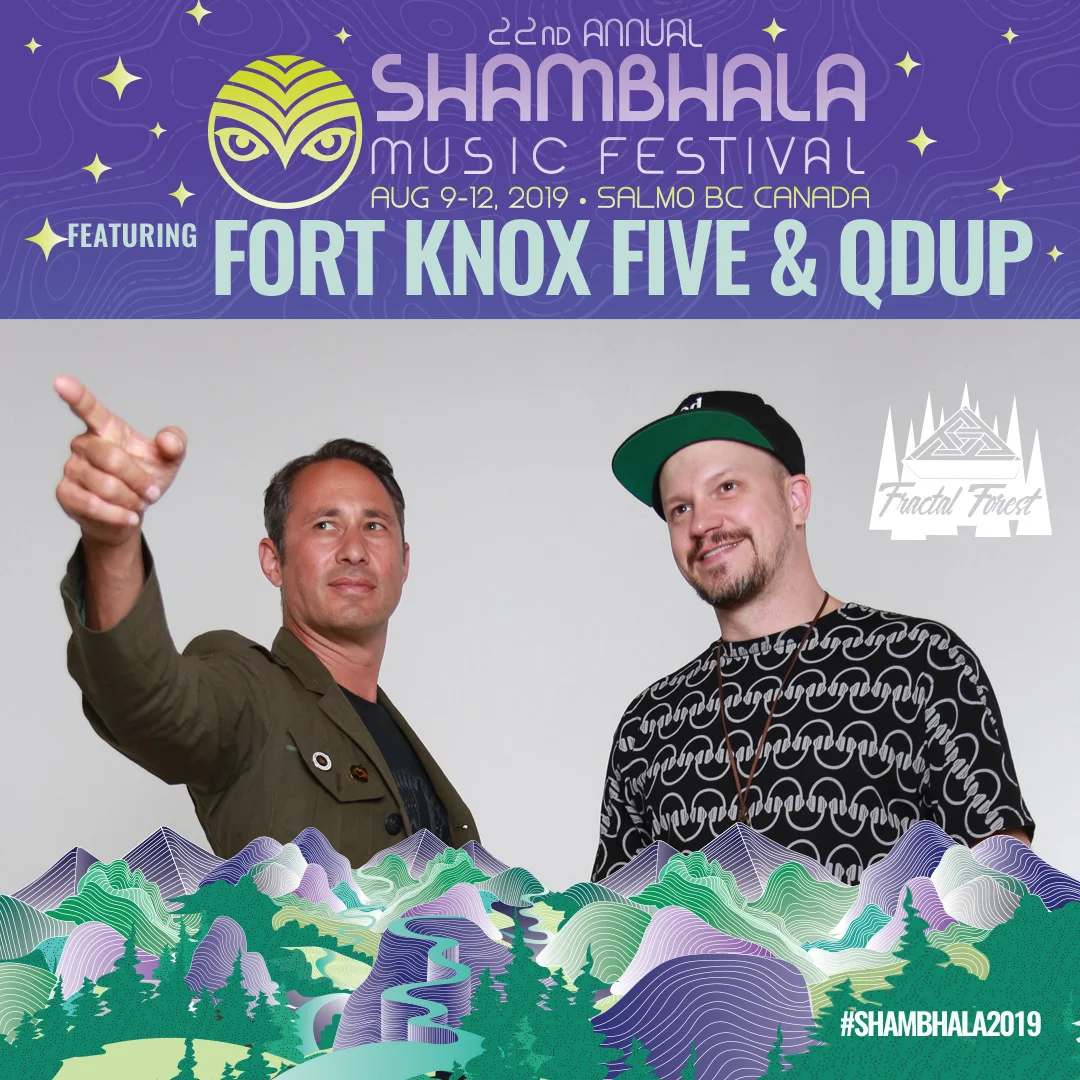
Get to Know the Shambhala Favorites Fort Knox Five & Qdup
If you trace back the career of the Fort Knox Five, you’ll also discover the evolution of the musical style commonly known as electro funk. Almost 15 years ago they found their way from Washington D.C. to British Columbia, Canada and Shambhala Music Festival, and they’ve made it their home ever since. More recently, Fort Knox Five began performing with fellow DC DJ Qdup, and soon the duo will funk Shambhala for the fifth year in a row.

Steve Raskin of Fort Knox Five (left) and Jason Brown aka Qdup (right) in 2018 (Credit: VIB Visuals)
If you trace back the career of the Fort Knox Five, you’ll also discover the evolution of the musical style commonly known as electro funk. At the beginning of the group’s journey almost 15 years ago, they found their way from Washington DC to British Columbia, Canada and Shambhala Music Festival, and they’ve made this place their home ever since. More recently, after trips around the world and twists, turns, arrivals, and departures worthy of a book, Fort Knox Five began performing with fellow DC DJ and longtime friend Qdup. This August 9-12, the duo will funk Shambhala together for the fifth year in a row. They’re two of 20 artists on this year’s lineup labeled as “Shambhala Favorites” in recognition of their deep ties to the festival. Fort Knox Five is one of the only artists in that grouping, however, whose history is nearly as old and storied as the event itself.
Fort Knox Five formed in Washington DC’s humming rave scene in 2003. Founding members Sid Barcelona, Jon Horvath, Rob Myers and Steve Raskin found their way to that scene from different starting points, from indie and art house to hardcore hip-hop. They coalesced around an eclectic sound which could only have formed at that moment in time around the turn of the millennium. It was a sound composed of funk, soul, jazz, hip-hop, and breaks sequenced and programmed through electronic techniques. They seamlessly combined live instrumentation with electronic break beats, like so many acts who would follow. The group’s influences were deep and broad, but they took many cues from another eclectic DC act, Thievery Corporation, whose live performances featured Myers on the guitar and sitar. Like Thievery Corp, Fort Knox Five would found its own label. They called it Fort Knox Recordings and described it as a means to “break down all the artificial barriers established by the ‘System’ that keeps all ‘Good’ music down.”

Fort Knox Five in 2007 (from left to right: Jon Horvath, Steve Raskin, Rob Meyer, Sid Barcelona)
“The ‘System’ is really the old music system in which you would have to compete and sell out your ideas to even be noticed,” according to Steve Raskin, the only member of Fort Knox Five still performing consistently. “To get around that, we started our own label to be a home for our scene in DC and like-minded funky artists.” The group was never overtly political, but they were always subtly separatist. “In the same way, Shambhala is that kind of home for like-minded artists,” Steve continues, “and it exists outside the ‘System’ of Live Nation and other corporate festivals and venues.” It’s not hard to see why Fort Knox Five has performed at Shambhala every year but one since 2005. But among other electronic acts on the lineup, let alone other Shambhala Favorites, few have moved through the '“System” as much as Fort Knox Five. Just two years after forming, Gwen Stefani tapped the group to open on her nationwide tour in 2005. They played arenas across the country with the Black Eyed Peas and Stefani, who encouraged the group to lean into their eclectic, do-our-own-thing sound.
Still, they’ve consistently positioned themselves outside of the mainstream and without pandering they’ve consistently distinguished themselves as innovators, even to those high places. In a DC record store in the mid-2000s Jon H slipped Afrika Bambaataa a handful of tunes, including a CD. Bam “never listened to CDs” according to a jeering onlooker, but the hip-hop pioneer apparently popped the disc into his car’s deck after he left the store. He called up Jon H and asked Fort Knox Five to produce his next album, describing their sound as “the next “Planet Rock””. Since then, they’ve performed across Europe, Australia and Asia and even held a residency at the Mandalay Bay in Las Vegas (that one year they didn’t play Shambhala). But if you ask Steve Raskin, and we did, one place has got the rest beat; the Fractal Forest at Shambhala.
“Of all the shows I’ve played in the last two decades I have never been to a comparable location. The Fractal Forest is special. It's a combination of the space - a 360-degree experience in an old growth clearing - the insanely crystal clear sound, an amazing crowd, and that BASS! For funky bass music there literally is no place better in the world. And as an artist, there is no greater feeling than performing there.” Fort Knox Five has performed at the festival’s other stages. There’s a neat video of them rocking the Pagoda with hard breaks in 2009. In 2015 when Qdup (“cued up”) first joined Steve, they played at the Living Room. But for the electro funk pioneers it all goes back to Fractal, which will host Fort Knox Five once again this year.
There’s a sense of poetic justice (not to mention alliteration) when Fort Knox Five plays the Fractal Forest. “The funk is strong at Shambhala and the Fractal Forest is at its heart. [Stage Manager] Rich e Rich has been cultivating all the top funky performers from around the world since the beginning of the stage. At its core, most of the music played there has its roots in funk,” Steve says. “For some reason all the funky music has been evolving and getting cultivated in the woods and hills of the left coast. The scene that we helped start in DC has created a thriving one here that continues to grow, and in return inspires us as well.”
Like Fort Knox Five, Jason Brown aka Qdup held down the DC scene for many years, functioning as a resident DJ about town and the host of a funk night that moved between U Street Music Hall, Tropicalia and other venues for four years. His feelings on the funk mirror Steve’s. “It seems to me that a large part of the Fractal Forest’s allure and what sets it apart is the music curation that’s been going on for 20+ years now. Its reputation has grown through electronic music in Canada and beyond. It’s the stuff that legend is made of if you love funky dance music. The talent booked…they are the DJs DJ’s.” Why is funk-based, big-break electronic music so popular at Shambhala? It’s the most common denominator among the Shambhala Favorites and the anchoring sound at the festival’s oldest continuously-running stage. “I’ve wondered that about how well the funk is received at Shambhala and Western Canada in general,” says Jason. “I think perhaps it’s something they put (or don’t put) in the water!”
But how did these DC old heads link up on stage at Shambhala? “For years,” says Steve, “Jon Horvath and I had been traveling the world as a DJ duo playing our four deck set. In 2015 right after playing at Basscoast, Jon fell ill and was hospitalized and even in the most difficult of emotional times, there was no way we were not going to perform at the Fractal Forest. We needed to be there to feel the love and strength from our Shambhala family to get through that hard time.” So Jason, who plays with the same funky breakbeat flair and who cut his teeth in the same DC clubs and warehouses as the Fort Knox Five, was naturally chosen to step up.
In more ways than one, their collaborative sets bring things full circle. “I met Steve & Jon in the late 90’s when I was a teenager,” Jason says. “We all basically learned to DJ together and were in a DJ crew before Fort Knox was a thing. Steve also gifted me the first Mac that I used and was a mentor to me as a music producer. Sitting in the back of the room on some of Steve’s early Thunderball recording sessions was my first real experience of music production and helped launch me into production.” The four-person Fort Knox Five always fancied that their fifth spot was reserved for whomever they were collaborating with at the time, be that Bambaataa, a series of drummers and percussionists, or MCs Mustafa Akbar and Asheru. The performances with Qdup are part of this legacy of collaboration.
Their four-deck set is a technical wonder. “We’re doing live mash-ups essentially and playing versions of songs that in some cases will never be played again,” says Jason. “It can be challenging at times as we’re often playing off the cuff with no sync and there’s the extra acapellas and effects going on. To do it effectively, you need the right partner.” It’s not too far off from some of Fort Knox Five’s original live configurations, when they would jam as much musical material as possible into sets featuring drums, guitar, bass, vocals, sitar and more all sequenced live by Jon H and Sid Barcelona. Improvisation and true performance is one of the common threads from then to now. “There’s a sort of unspoken communication. We just get where the other is going and it makes magic when it’s done right.” Today, the sounds differ but the style remains the same.
Besides the group’s pioneering sound, what distinguishes Fort Knox Five is their sheer longevity. This comes in large part from an unwillingness to compromise their authenticity. Take it from Jon H speaking backstage during a 2011 show in the United Kingdom. “The music scene goes from being really underground, then the commercial scene becomes completely different to where they’re one and the same. When that happens, it’s time to re-find the underground.”
Moving with the times, staying tuned into the underground, and perhaps absorbing vibrations from other Shambhala Favorites like Slynk, Stickybuds and JPOD, Fort Knox Five and Qdup integrate a healthy dose of synth bass and well-designed sound into their performances these days. And so again their history can be seen as parallel to the story of Shambhala itself. “The vibe that I experienced so many years ago is still there,” Steve says of the festival. “People come and go, and then come back, but at its core it is the same magical place - with the best music on earth.”
FOLLOW Fort Knox Five: Fort Knox Recordings / Official / Spotify / Soundcloud / Facebook / Instagram
FOLLOW Qdup: Spotify / Soundcloud / Bandcamp / Facebook / Instagram
FOLLOW Shambhala Music Festival: Official / Facebook / Instagram
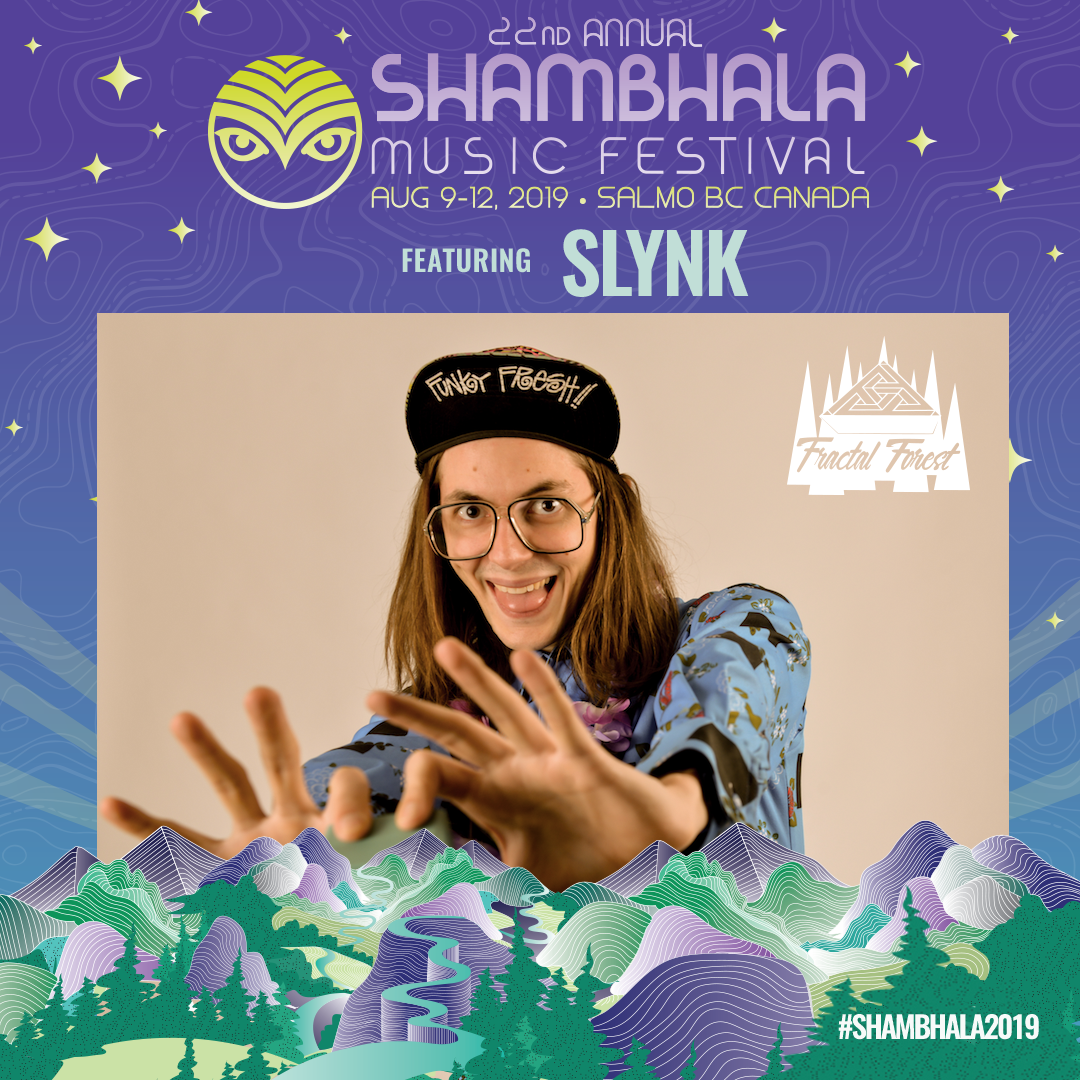
Get to Know the Shambhala Favorites Starting with Slynk
Hailed by some as “the funkiest DJ on the planet”, the Australian-born Vancouver-based DJ/producer Slynk has been performing at Shambhala Music Festival for nearly a decade and returns this summer as one of several acts labeled on the 2019 lineup as “Shambhala Favorites”. Shambhala has chosen to recognize this group of artists whose roots run especially deep with the festival, so we decided to see what the buzz is about, starting with the fun-loving and funky Slynk aka Evan Chandler.
Hailed by some as “the funkiest DJ on the planet”, the Australian-born Vancouver-based producer/DJ Slynk has been performing at Shambhala Music Festival for nearly a decade and returns this summer as one of 20 acts on the 2019 lineup labeled as “Shambhala Favorites”. For the first time, Shambhala has chosen to call out this group of artists whose roots run especially deep with the festival. To recognize this unique curatorial decision, we’re speaking to some of the Favorites as the festival approaches, starting with the fun-loving and funky Slynk aka Evan Chandler.

One of the many unique aspects of Shambhala is its booking process; the stage managers themselves book the talent. These individuals, like Rich-E-Rich, stage manager of the Fractal Forest and one of Shambhala’s original contributors, are obviously huge music fans themselves. So in addition to holding down logistics, these folks are able to exercise their fandom through these bookings. The Shambhala Favorites concept could be an outgrowth of this, as the stage managers surely had some input into the Favorites roster. The artists chosen have performed at Shambhala again and again. There’s British Columbia native and Bass Coast organizer The Librarian and Los Angeles dubstep producer Stylust. There are bass funk pioneers like Stickybuds, A Skillz and JPOD. There’s Mat The Alien, at whose Shambhala set many years ago the concept of totems (or “signs” as they’re known at Shambhala) is said to have originated with a piece of cardboard, a spray can, and the words “Really Good”.
They all have history with the festival and some of it goes beyond performing. Every year they pack out the stages and generate wild excitement, which is even more impressive when you realize how many are local to western Canada. For some, their fan bases and careers have grown in tandem with the festival. To a degree, this can be said for Slynk, who has been releasing his Fractal Forest sets on SoundCloud to wide acclaim since 2011. Slynk is completely self-taught and first began producing on the Playstation game “Music” before moving to Fruity Loops and eventually Ableton. He can also scratch up a storm, after teaching himself on two old decks a friend gifted him in his hometown of Brisbane when he was 18 or 19. He combines top-tier glitch sound design with big, bold breaks and a bottomless library of samples spanning all genres but especially funk, hip-hop, r&b and reggae.
One of the most memorable Shambhala moments for Slynk and for his fans was his surprise set at the Fractal Forest in 2012. Evan was at the event as a patron that year when he ran into Rich-E-Rich who told him a headliner had cancelled and asked if he, Slynk, would be up to throw down. Evan didn’t hesitate and today that set (below) has a good bit of folklore surrounding it. We asked Evan about his first Shambhala set back in 2009, his sound design, and his mutual love affair with this legendary festival.

The Rust: You’ve said that as humans we all crave a sense of community. What’s your community at Shambhala look like?
Evan: It's like a family reunion. It feels like it's my birthday and all my friends from all over the world have made the journey to the forest to reunite and celebrate. Some friends I haven't seen since last Shambhala, we pick up the friendship exactly where we left off last year. It's just love and laughs. You are very aware that this is a festival wide feeling too. In normal society, we're afraid to talk to one another. We put up walls and push away strangers. We avoid community and prefer isolation. But at Shambhala, these walls are torn down. You are everyone's friend and everyone is friends with you. I don't know how or why this happens. But I crave it. Who wouldn't?
The Rust: Shambhala was the first festival you ever played in 2009. Can you take us back in time to that moment?
Evan: I'd never been to a festival like Shambhala before. It's on a completely different level than anything else I had experienced. I was overwhelmed as an attendee, but I was booked to play as well! I remember spending probably too much time on my laptop at the campsite rethinking my set. Going over it in my head. Listening and planning again and again. I was nervous, really nervous! The staff in the VIP area at Shambhala were so accommodating and friendly. Tall Brian actually recommended I get a massage to relax. Hang on, you guys give the artists massages? And it's free? I got what was probably the best massage I'd ever had in my life to date. I was feeling much more centered and calm.
Evan: If memory serves me right, I was playing Friday night and as you guys know, the Fractal Forest doesn't open ‘till Friday. So I'm experiencing all the quirks and personality of the stage for the very first time, and setting up my gear at the same time. I remember playing a song in my set which had a little vocal sample that said "make noise". The whole crowd lit up with noise. For a moment I was wondering what was going on! I'd played this song many times before at other shows and never really noticed the sample until I played it there. The crowd was truly listening to my music. It was electric. It was the best moment of my life, and it's the moment my entire life changed forever.
The Rust: You’ve performed on at least four continents. What can you find at Shambhala that you can’t find anywhere else?
Evan: I can't tell you what you will find at Shambhala, but I can tell your what I found. I found a purpose. I found a home. I found a community. I found inspiration and drive. I found love and acceptance. I found my flaws and strengths. I found out who I am and I found out who I want to become.
The Rust: We’ve read a ton about how your sampling skills developed. How about your sound design? When did you first start creating sounds you were actually impressed with? What sort of sounds do you want to create in the future?
Evan: I think I'm just a nerd. Or a scientist. I do experiments, record the results and then review the data. I taught myself everything in this way. I would turn a knob and hear the way the sound changes and make a mental note. That's really the core of understanding synthesis. Eventually you're able to hear a sound in your head and then move the knobs in the right way to make that sound.
But what's more fun is to ask my music software to generate "happy accidents"; something that takes an input, and uses that to output something transformative, random and unexpected. This is where the collaboration between you and the computer really begins. I've come up with some great ideas in this way. Lately I've been experimenting with neuro style sounds. I'm learning how to use distortion without completely breaking the sound beyond recognition. It's something I haven't really messed with before. Most of my typical sounds are subtractive. I'll start with a big sound and carve away at it using filters. Neuro style sounds seem to be more additive in a way. You start with a simple sound and slowly build up harmonics and texture with distortion.
The Rust: I love how you described the relationship between performers and audiences as yin and yang. Can you elaborate on this?

Evan: It's like a feedback loop. I'll spot someone in the crowd really getting down hard and it makes me smile. They like my music! I'm proud and honoured to be giving this person a reason to get down. It makes me wanna shake it around a little bit myself. The audience sees me grooving and they can tell I'm enjoying myself. I'm smiling and boppin’ around and that makes them smile and they get their boogie on a little more, too. It just goes around and around until everyone in the room is glowing and jamming. But this isn't an exclusive relationship between crowd and performer. As a person in the audience, you have the power to lift the area vibe yourself! Put on your crazy costume, shake your butt and make people smile. It's contagious.
The Rust: What’s one thing about Shambhala that may surprise someone who’s never been?
Evan: It's strictly a non-alcoholic event. I enjoy the occasional beer but I learned a long time ago that you don't need to get hammered to have a good time. Your true personality is deep down inside you, and I think if you learned how to unlock it, you'd really enjoy yourself! Come to Shambhala and we'll teach you how to come out of your shell. Knowing how to let go of your inhibitions sober is a valuable skill to possess for all walks of life.
—
As we described last year, Shambhala is arguably the most successful music festival in North America. There’s 1,001 reasons behind this that we’re still unpacking, but the concept of the Shambhala Favorites highlights one of the key reasons; Community. This group of artists is more than a grouping of impressive talent to help sell tickets; they’re part of the Shambhala community, an integral part of the festival’s fabric. It’s impressive but not surprising that Shambhala would recognize its community with this special section on their 2019 lineup. As the festival approaches, stay chooned to The Rust Music for interviews with more of the Shambhala Favorites.
FOLLOW Slynk: Official / Bandcamp / Spotify / Soundcloud / Facebook / Instagram
FOLLOW Shambhala Music Festival: Official / Facebook / Instagram
![Shambhala Music Festival - Chord Marauders [Interview]](https://images.squarespace-cdn.com/content/v1/59530136f5e2319eabb7d87f/1558498342947-E0S88JFH4PLNPVMDWEMU/Chord+Marauders_Shambhala+2018+The+Rust+Music+Interview.png)
Shambhala Music Festival - Chord Marauders [Interview]
Gaz Frost, one half of the producter/DJ duo Congi our of Nottingham, UK, agreed to sit down for an interview representing the Chord Marauders at Shambhala Music Festival 2018. The jazz-infused 140 bpm record label has been pushing one of the most original sounds in dubstep since forming in 2012. Shambhala, which rarely curates spotlights or showcases on its lineup, booked the Chord Marauders for a label showcase at The Grove stage on Sunday.
Gaz Frost, one half of the producter/DJ duo Congi out of Nottingham, UK, agreed to sit down for an interview representing the Chord Marauders at Shambhala Music Festival 2018, but was too exhausted from travel on Saturday to sit down with us. The Chord Marauders, a jazz-infused 140 bpm artist collective and record label, have been pushing one of the most original sounds in dubstep since forming in 2012. Shambhala, which rarely curates spotlights or showcases on its lineup, booked the Chord Marauders for a label showcase at The Grove stage on Sunday.
Looking for Gaz Frost that Saturday, I ran into Jafu, one of the Marauders’ four founding artists, and learned a bit about him (James) personally in the process. Not only does Jafu not play many shows, he also doesn't attend many shows either; Shambhala 2015 was not only the first actual “show” (certainly festival) he'd ever played, it was also the first show he ever attended, and the first time he ever flew on a plane.
With that kind of magic relationship with Shambhala, it felt appropriate that he too sit down for the interview, which we were able to conduct on Sunday morning. Eager to investigate the hows and whys of the fantastic burgeoning sounds of their unique dubstep, I got on well enough with them to learn about some of their early influences, the place Shambhala held in their development, and the next steps the label wanted to take to push their sound further into the North American scene.

The Chord Marauders' first signee FLO, performing while Congi sets up at the Grove Stage at Shambhala Music Festival 2018 (Credit: JoeyRootPhoto)
The Rust: Chord Marauders began forming in 2012. What were those early years like, what was the culture amongst yourselves, what was the energy in the air?
Gaz Frost: When things in dubstep started to get big, there was a trickle down of subgenres. I remember a time when George [Geode] would send music to James [Jafu], or we would send music to him, or Travis (B9) in Australia would receive music; we kind of a built like a little network literally sending tunes to each other, and it was kinda like a sound that wasn't really...
James: There was a little bit of lacking in that department.
Gaz Frost: Absolutely! It was kinda unheard in a way.
James: Yeah, I always liked tracks like “Alicia” from Mala, “Show Me” from Von D, stuff like that. Just a more soulful sound.
Gaz Frost: Sure, like drawing on the jazz influence and the more RnB stuff as well. And I think that's where we honed in, kinda made that area our own.
The Rust: Did George mostly find you guys?
James: Yeah, George was the one who got us all together in a group and pitched the idea that we should all form a collective.
The Rust: What's the culture between producers? Do you send each other tracks early on? Is there much collaboration or do you mostly share completed work?
James: These days we've been doing everything pretty complete. Especially with the Groove Booty compilations, we'll source stuff, feed off each other, see what's good, what's going on.
Gaz Frost: There is a lot of times where we'll swap half-finished tunes. Like the tune you [Jafu] sent me just the other day; there's always some stuff kinda floating around.
James: Tons of unfinished bits.
Gaz Frost: Absolutely, there's also tons of stuff that each producer finishes on their own, and stuff we work on together. I guess it's really just the cohesion of the sound [of the label] that makes it possible.

The Chord Marauders' first signed artist, FLO, performing at the Grove Stage at Shambhala Music Festival 2018(Credit: JoeyRootPhoto)
The Rust: How are the curated artists for the Groove Booty compilations found, and who decides what makes the cut?
James: Usually it'll be a group decision who makes the cut; if we all really like the artist, they'll probably make it on there. And usually we get sent a lot of stuff and we'll source things from SoundCloud (we love SoundCloud).
Gaz Frost: Yeah, we get sent a lot of music from up-and-coming artists.
James: And a lot of those guys send great stuff.
The Rust: How did FLO become the first artist to be signed to Chord Marauders?
Gaz Frost: I don't really know, it's mad! I think George was being sent bits from FLO, shared it with us.
James: It's cohesive enough.
Gaz Frost: Yeah like, it fits, but it's got a different edge to it. But he's got the thing, you know...
The Rust: Gels with the aesthetic?
Gaz Frost: Yeah, absolutely, for real!
The Rust: With this Shambhala showcase, Chord Marauders is getting more attention in the North American market. Any upcoming tours on the horizon or plans for breaking the wave?
James: We can't say for sure, but they’re definitely possibilities we're looking at in the US and overseas.
Gaz Frost: I think the US is the next one we want to try to occupy, because there's quite a demand out there for this. We just need to arrange it.
James: Yeah, there's St. Louis area and Denver so far.
The Rust: Really, St. Louis?
James: Yeah, do you know a guy named Yo Adrian? That's what he goes by on Facebook, he's an event coordinator in the area. Does lots of EDM stuff, some IDM stuff, he's a big event coordinator we've been in touch with.

Jafu performing at the Grove Stage at Shambhala Music Festival 2018 (Credit: JoeyRootPhoto)
The Rust: What's next for Chord Marauders as a releasing label?
Gaz Frost: I think Flo's got an EP ready to go. We've been working with a guy named Soma, he's got some amazing stuff; just got an EP from him. Hopefully will be releasing that this year. Other than that, just looking to stack for the next compilation.
James: And we're all always working on getting our next releases out. I've got an LP I'm working on right now.
The Rust: How did you guys first start listening to electronic music, and dubstep specifically?
James: I had always imagined electronic music to be a specific sound. When I was growing up, it was all just techno/rave/hardstyle, so my opinion on it was completely filtered through that. After I discovered Aphex Twin, I was more open to organic sounds being used in electronic music, for a different approach. In 2009, I was introduced to the song “Skeng” by The Bug, and that song was the one that changed it for me. It was a different sound than I'd been hearing, turned me onto the scene massively.
Gaz Frost: For me, it was all about early grime music. When grime music first started being made, everybody was listening to it. Everyone had it on their phone, everyone was an MC, that was just the time that it was. That was how I grew up, you know what I mean? I was like 13, 14, Dizzee Rascal came out with Boy in the Corner, I thought that was the sickest album. That was my first taste of electronic music, like “what are these sounds, how are these sounds being made?!” That was like 2003-2004, somewhere in there.
The Rust: How did the Congi project start? Where did you and Tulip meet? What was the scene like in Nottingham?
Gaz Frost: We've got a friend called Ninja who produces lots of beats, he's a mutual friend of ours, met at his house. I didn't know Tulip, Tulip didn't know me, but we actually went to school together. He [Tulip] and I got to know each other, started to mix together. He'd always bring his vinyl around, he taught me how to do that kind of thing. Yeah, we just started meeting up and making music together. It was fun, like we didn't plan it or nothing! From there we started to get, like, quite serious with it, find an outlet to release. The scene in Nottingham was really interesting, there was a lot of guys doing dubstep. Like there was this one guy, Geome, he's massive. For me, he was really important at the time, [representative of] the really good stuff that was going around. And that's also sort of how we [Tulip and I] became friends, mutual friends recommending the same nights to us, stuff like that.
The Rust: What are some inspirations for the Congi project?
Gaz Frost: God man, it's vast. Like, there's a lot of influence. There's a jazz project out of the UK called the Ezra Collective, a lot of really young jazz players. I've got a friend called Yazmin Lacey, she's an amazing singer. A lot of hip-hop, early grime, so like early Dizzee Rascal. That's the kinda stuff that really sculpted our sound. And there's a lot of R&B as well, like we both really like Destiny's Child and Jagged Edge, that kinda stuff.
The Rust: Best shows you've played? In terms of crew, crowd, production value, whatever.
Gaz Frost: Denver was sick. Also last year here [Shambhala], man! I'd never played in Canada before, last year was really fun. The overseas ones are always the best ones. I've played a little in Europe (Portugal a couple weeks ago), but the vibe over here is definitely different. From home, especially, home's a little bit weird! It's more appreciated out here, I feel.
The Rust: Interesting! When did you feel that shift occurred?
Gaz Frost: I don't know! I dunno how it happens, but at festivals like this, you can play what you want, and you don't have to worry about making people dance. That's the best part, you can try something out that you're not too sure about, and the crowd's really receptive to what you want to play. That's the big difference, I feel.
--
We spoke about Shambhala this year and what was different (the lack of bridge at the Living Room shocked both of them). They were stoked to see Joe Nice, who was the “the undisputed dubplate king of America” according to these two. James mentioned the Jafu sound had evolved since his first Shambhala three years prior, based largely on said prior experience, saying he wanted to get the audience to skank more this time. Gaz Frost spoke about playing out in Brooklyn and a small show in York, Pennsylvania, which he felt was noteworthy for have a really strong, tight-knit community vibe. These are the only places besides Denver where Congi has played in the US, but Gaz maintained that Cervantes' Masterpiece was the best one-night show he'd ever played, ever. Overall, they both gave big ups to the dubstep following in the US and at Shambhala. How encouraging it is, they said, to be able to play for and interface with some of the most stoked fans and engaged audiences they've seen.
FOLLOW Chord Marauders: Official / Soundcloud / Bandcamp
FOLLOW Shambhala Music Festival: Official / Facebook / Instagram
FOLLOW Congi: Soundcloud / Bandcamp / Facebook / Twitter
Shambhala Music Festival Enters Third Decade in Style
With 21 years at the same location, seven stages of music, event direction handled by the landowner's family, no corporate sponsorship, and now the purchase of a mass spectrometer, Shambhala Music Festival at Salmo River Ranch, British Columbia, Canada is perhaps the most successful music festival in North America.

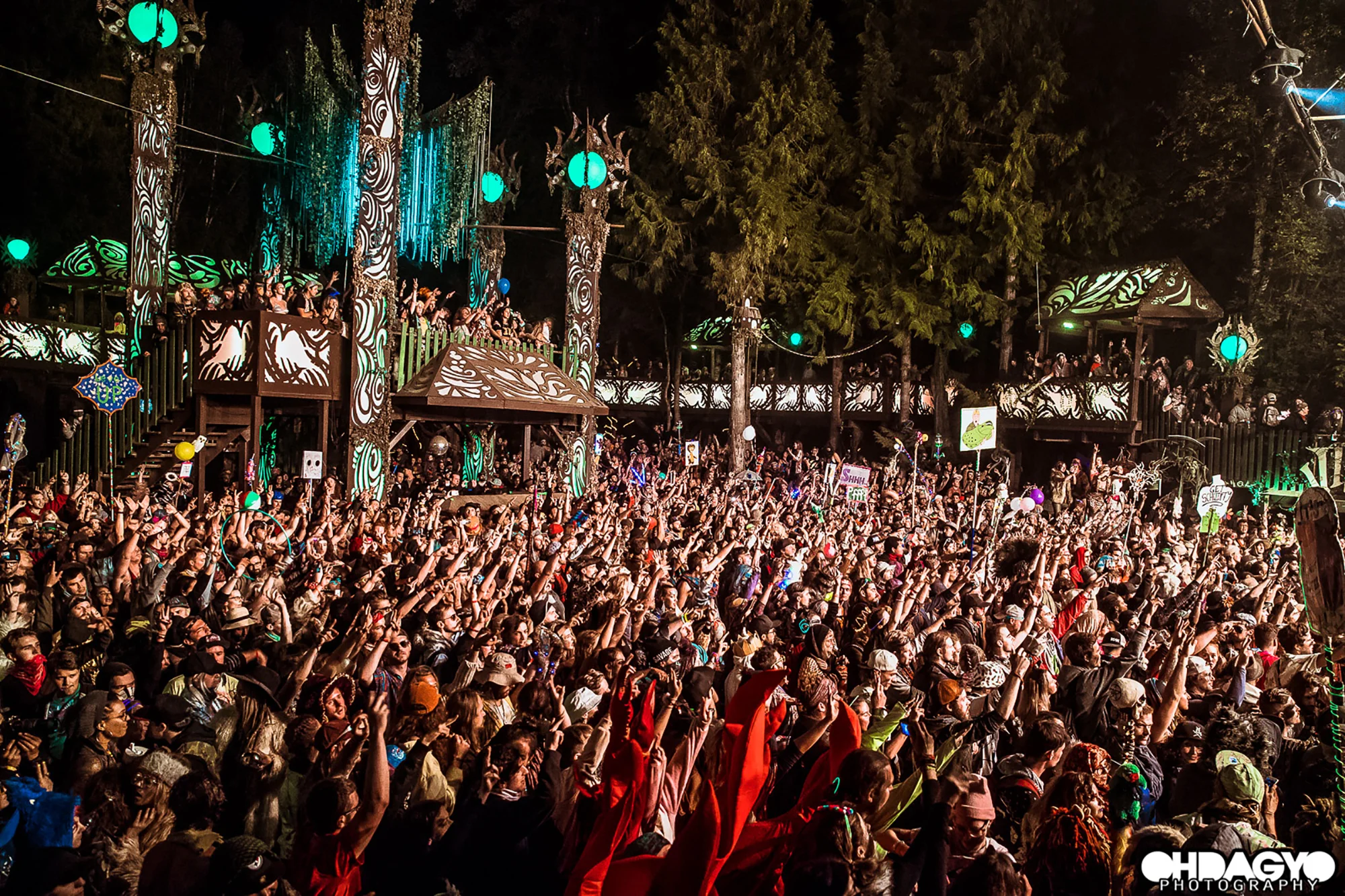
The Grove stage (Credit: Oh-Dag-Yo)
With 21 years at the same location, seven stages of music, event direction handled by the landowner's family, no corporate sponsorship, and now the purchase of a mass spectrometer, Shambhala Music Festival at Salmo River Ranch, British Columbia, Canada is perhaps the most successful music festival in North America. Its powerful grasp over the breadth of dance music culture has enabled it to create a diverse following with a high potential for cross-pollination of sonic ideals and outlet discovery. To say I was shocked and awed by what I saw upon my first attendance to this festival would be a sad understatement of the kindness, generosity, and care that I experienced. Shambhala Music Festival and its attendees are quite attentive to the general experience of the festival, and quite in touch with one another.
Shambhala's two-decade rise has been marked by slow and careful growth, and each new increase in size is met with vital infrastructural improvements. The increase to some 20,000 attendees in recent years caused the two outlets to the Salmo river (the Living Room stage and Muscle Beach) to become overcrowded. Increasingly, people began walking across the footbridge at the Living Room into the neighbor's property to make use of the opposite bank. As a result, that bridge has been removed, and a new path eased out along the riverside with many outlets for squadly activities. The dance floors are now watered by the stage workers. The Village is especially noteworthy for incorporating a large waterfall installation. When last year's nearby wildfire caused an emergency exodus that demonstrated the need for additional egress in stressful situations, the landowners installed a new bridge made of steel to split the herd near the exit. Major moves like this demonstrate the dedication the Salmo River Ranch owners have for the safety and wellbeing of their attendees.
Shambhala has also been a vital germinating force for the growth of original sounds. The festival hosts yearly performances from now-confirmed Big Deal acts like Stickybuds and Stylust (formerly Stylust Beats), and has helped raise underground success stories like Goopsteppa and CharlestheFirst (whose Big Deal-ness appears imminent). Then there’s the blooming of burgeoning dubstep label Chord Marauders, for whom Shambhala was the biggest show they've ever played. For Jafu, Shambhala three years prior was his first time ever playing a show that wasn't “something small, for friends, to get myself comfortable playing music for people.” As a rare-to-Shambhala label showcase act, the collective received more attention than ever before, even spotlighting their first signed artist FLO.


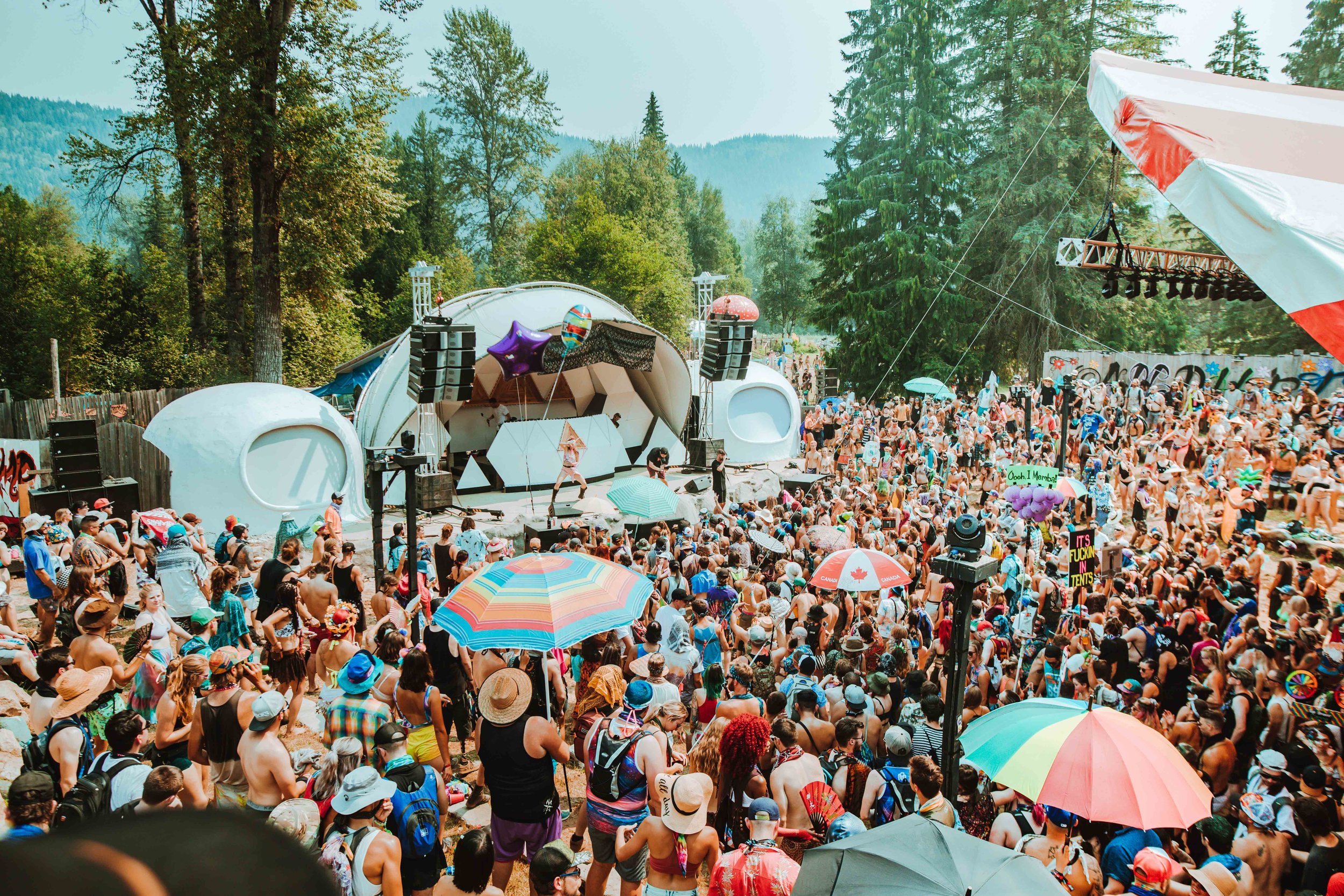

Between the funky basslines at the Fractal Forest, the hard-hitting powercore of the Village, and the soothing atmosphere of the Grove, there could exist a serviceable underground dance music festival. Between the live acts of the Living Room, the intimacy of the Amphitheater, and the “Main Stage” appeal of the Pagoda, there could exist another strong, more mainstream music festival. That the organizers chose to combine all of these thematic feelings and managed to keep attendance low enough to support a comfortable amount of breathing room at each stage is nothing short of miraculous. The result of this miracle is felt in the joy of constantly finding new music and new areas of the culture to discover, and experiencing the curiosity from others towards the rituals and artifacts of one’s own section of dance culture. The myriad of people passing by and sharing themselves with one another is the hallmark of any successful festival. Shambhala takes it further by creating comprehensible territory for the growth of distinct, microcosmic “scenes” in greater numbers than I've ever seen, both in terms of attendance and in number of stages. The stage-to-attendee ratio is easily twice as high as most festivals, and the resulting experience is immersive and enrapturing.

The Village stage (Credit: Oh-Dag-Yo)
The talent curation at each individual stage is extremely attentive to detail. When Joker couldn't make it to his set at the AMP stage, the stage staff rustled up a set from the intentionally rare Shadow People, aka TRUTH and Youngsta. TRUTH was performing that weekend without Youngsta, who wasn’t booked for Shambhala at all but was at the Ranch anyway since the two were on tour together (and Youngsta was playing a Shambhala pre-party). They were playing only a handful of Shadow People festival dates in North America, so the organizers found not only a replacement, but a spur-of-the-moment set that their attendees likely couldn't have caught otherwise. Similarly unique, while most of the dubstep of the Grove was beautiful, somber, and deliciously spare, there was also a rare grime set from D-Double-E and a set from Joe Nice; two grizzled veterans who'd become kings in their own right, playing alongside the next generation. Such was the power of Shambhala that the entire motion flowed smoothly from one act to the next, never causing any disruption in the crowd.
Perhaps the most impactful aspect of Shambhala was how distinctly I could observe my past, present, and future as a listener of electronic music. I caught the entirety of Koan Sound, remembering how next-level their sound design and beat structure appeared before I ever learned to describe such things in words. Performing prior to the boys from Bristol was Adventure Club, who I had last seen in those same baby raver days. There was Dirtwire, who I'd seen grow over the last three years from a small two-person project to a three-person band with matching outfits and a developed sonic aesthetic. Then there was Kursa, who pushed the boundaries of what I considered danceable. Each laid out how I, as a listener, have developed my tastes, how I'd been spending my time and energy since I went to my first show, and what I wanted to see more of in the future. Shambhala’s unique spread is truly appropriate for anyone at any point in their journey through bass music.
The infrastructure of Shambhala grows and improves every year. Even if you feel that only one stage speaks to your booking tastes, there will undoubtedly be acts you enjoy on other stages. I found myself having the time of my life at the Fractal Forest most mornings despite not once catching an act that I recognized or that was recommended to me (damn me for missing Skratch Bastid), simply because the stage design was so incredible. Shambhala exists to provide its attendees with the smoothest experience possible, from the drug testing to the Shambhassadors - Info Hub volunteers who roam the festival spreading information, sharing their experiences, and generally raising the vibe (as far as I know the only festival job that encourages smoking cannabis with the attendees). Without a doubt, there is something for everyone at Shambhala, and a thriving culture that wants to show you every facet of its being besides. Well, no psytrance, although that's a whole other article altogether!
FOLLOW Shambhala Music Festival: Official / Facebook / Instagram
Shambhala Music Festival - Chord Marauders Showcase
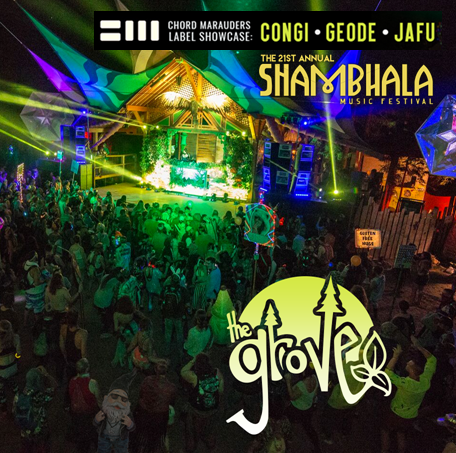
The Chord Marauders are London-based, jazz-infused label that is a collective between artists Geode, Congi, B9 & Jafu, and a beacon of originality in the dubstep universe. They’ll hit Shambhala Music Festival on August 10-13 for what appears to be one of the only label showcases in this legendary festival’s history.

For the Chord Marauders, 2017 was an important year. The London-based, jazz-infused label is a collective between artists Geode, Congi, B9 & Jafu and a beacon of originality in the dubstep universe. The year saw label head Geode's first full-length release Beluga, as well as Jafu's first LP Second Impressions, making him the last of the four founders to release on the label. All of this solidified their label as a major force on the heels of Groove Booty Four, their most successful compilation release to date, which featured a release with Ago of Innamind/Blacklist, a groovy lounge track from circula (sic), and coverage in Vice's THUMP. The compilation was also their first vinyl release, a trend they have kept up with that's put them on the radar of the crate-diggers and audiophiles which frequent any genre that traces its roots back to Jamaican sound system culture.

2017 was also the first year Congi played in North America outside of Denver, the most hipster place to live in North America if you like bass music. He was booked for Shambhala Music Festival at the Salmo River Ranch in British Columbia, Canada where B9, Geode, and Jafu (a native Canadian himself) played in 2015. Since then, the label has only achieved greater success. As a result, Congi, Geode, and Jafu will hit Shambhala Music Festival on August 10-13 for what appears to be one of the only label showcases in this legendary festival’s history. They’ll play at "The Grove", an intimate stage much favored by dubstep-heads. Vigilant fans of Shambhala's dubstep culture have had the privilege of watching the slow build of Chord Marauders unfold before their very eyes. This year, their showcase will likely be one of the most enchanting and brilliantly original blocks of music all weekend. As each of the label’s members continues to ascend in their career paths, this unique moment will likely become the most monumental achievement yet for the jazzy and melodic sound they champion.
In 2012, when Chord Marauders began to form, the word “dubstep” had gone through major upheaval. What was once a small but solid underground sound that had slowly grown from UK garage, 2-step, and other hardcore fuzzy bass noises in London (particularly the Croydon area), transformed into an aggressive genre of EDM, and become an international sensation in the meantime. Scarcely more than a decade after the creation of Forward>> - a club night that was the incubator for the fledgling new noise - the whole concept of “dubstep” had undergone a shift from the hush-hush darkness and grit of deep bass culture in London to the bass growls and high screeches of what dubstep purists call “brostep”. This new evolution paid more lip service to the neurofunk (an offshoot of techstep, itself a drum n bass concept) era of London bass music, encouraging less atmosphere and more big snares, often with a jumbled arrangement of speedy drums.
The vibe had died and been replaced with more of the soulless junk that had inspired movements towards the dubstep sound in the first place. In this brave new world of dubstep's mainstream acceptance and coopting by EDM culture, the phrase “melodic dubstep” can all too easily signal songs you'd find reposted by Suicide Sheep on Youtube: popular feelings in easily consumable verses, glossy drops for the smiling dancers, and dramatic frequency shifts to drive home the “heavy metal” (read: pop-emo) influence. It means wide-eyed proclamations of “feels”, it means a community more into progressive trance than dub reggae, and it means Chord Marauders faced (and faces) an uphill battle to market their sound. This was the state of affairs when the Marauders began to connect to each other, trading project files and contemplating a go at their own music label to breathe new life into the stagnant dubstep community.
Each of the four projects under the label's banner (Geode, Congi, Jafu, and B9) has a distinctively melodic bent, usually using the synth keys to drive the mood, but there is rarely a time where the mood is uplifting, making it unsuitable for highly commercialized “raves”. Trapped in the “melodic dubstep” box, they would each have a low likelihood of both succeeding as artists and retaining their unique voices without one another's support. With their unity, each have been able to release a full-length LP without losing sight of the goal of pushing the now-antiquated dubstep sound back into a new and challenging territory. They lead this effort alongside the slick badmen of Deep Medi and the cerebral technicians of Innamind/Blacklist. Indeed, their leadership has netted them a release by FLO, an up-and-coming artist from Slovenia, so it is safe to say they are actively changing and challenging bass culture with their association.
Having built such rapport with Shambhala as to be able to promote their label through the festival, Chord Marauders is slated to totally redefine “melodic dubstep” and bring listeners back to the roots of the sound. We've seen Shambhala lift the appeal of acts that refuse to neatly fit a populist mold, with Stylust and Stickybuds as great examples. The Chord Marauders showcase suggests that Shambhala’s attentiveness to dubstep purity will be like steel in the face of the festival’s ever-rising popularity. In other news, Skream still plays house.
FOLLOW Chord Marauders: Official / Soundcloud / Bandcamp
FOLLOW Shambhala Music Festival: Official / Tickets / Newsletter
![Elements Lakewood Music & Arts Festival - Stickybuds [Interview]](https://images.squarespace-cdn.com/content/v1/59530136f5e2319eabb7d87f/1558498291934-42YP6LNTPQE9XMH094DS/Stickybuds_Elements+Lakewood+2018+The+Rust+Music+Interview.png)
Elements Lakewood Music & Arts Festival - Stickybuds [Interview]
Stickybuds usually has one goal in mind when he takes the stage - to give the audience an opportunity to dance, connect with friends, and have a great time. While he’s a household name in Western Canada and a low key legend the world over, Stickybuds doesn’t come to the Northeastern U.S. often; his last performance here was in Boston in 2014. Elements Lakewood Music & Arts Festival has done the region an extraordinary service by hosting this mighty vibe conjurer for Memorial Day Weekend in Lakewood, Pennsylvania. Ahead of his rare Northeastern get down at Elements Lakewood, we were privileged to correspond with Tyler about music, careers, health, and reggae music.
Stickybuds usually has one goal in mind when he takes the stage - to give the audience an opportunity to dance, connect with friends, and have a great time. Tyler Martens aka Stickybuds the glitch funk pioneer hails from Kelowna, British Columbia, a small city known for leisure and recreation. While he’s a household name in Western Canada and a low key legend the world over, Stickybuds doesn’t come to the Northeastern U.S. often; his last performance here was in Boston in 2014. Elements Lakewood Music & Arts Festival, itself a space dedicated to recreation, dancing, and connecting, has done the region an extraordinary service by hosting this mighty vibe conjurer for Memorial Day Weekend in Lakewood, Pennsylvania.

He’s among a rare class of DJ producers whose sound is accessible to almost anyone. He’s performed at Burning Man and in Ibiza clubs, in Hong Kong and across Australia. His singles have hit #1 on Beatport’s Glitch Hop charts almost a dozen times. Though Tyler has brought the glitch to a worldwide audience, perhaps his proudest achievement hits closer to home. Stickybuds has been a resident performer in the Fractal Forest of Shambhala Music Festival in his native British Columbia for thirteen years. Despite all these accolades, Tyler has astonishingly never released an album; that's about to change. Today marks the release of his first single - "Crooked Politicians" (video below) - off his first album "Take A Stand".
Stickybuds has a smoother step than your favorite hip-hop and breaks DJ. His sound design cuts as deep as that of any premier glitch hop prism splitter. He’s got enough dub, drum and bass, and reggae gems in his bag to impress even the baddest bush doctor. Tyler bundles these elements into a signature sound that isn’t replicated anywhere in the world. His performances feature obscenely good stem mixing, as he seamlessly stitches together tunes while repurposing everything from James Brown and Rare Earth to Burro Banton and Cypress Hill. Tyler’s utilizes turntables, too, and generally pans between Stickybuds originals and remixes, contemporary glitch hop heaters, and some of the nicest drum and bass this side of the Atlantic Ocean. Ahead of his rare Northeastern get down at Elements Lakewood, we were privileged to correspond with Tyler about music, careers, health, and reggae music.
The Rust: How did you first engage with bass music?
Tyler: I started going to raves in Kelowna, which is the town I grew up in. I was in high school, and I believe the first one I attended was in 1999. From then on I really enjoyed the music, and eventually decided to teach myself to dj about 5 or 6 years later.

The Rust: What do you feel was the most pivotal moment(s) in your career?
Tyler: There have been a lot of little things along the way. Sometimes a very small encounter or interaction can snowball into something so much bigger down the road. Learning how to collaborate with people has generally been a very big part of my career; producing tracks, sharing stems between friends, getting dubplates cut, making these complicated and awesome relationships along the way has all really helped sculpt the direction of my music in so many different ways. Just reflecting on that, it's pretty profound to me how much joy and how many amazing things have happened from these relationships. I produced a track with my friend K+Lab called "Clap Ya Hands Now" last year. It was picked up by Sony and put on the Spider Man: Homecoming movie trailer and broadcast literally around the world to millions of people. That was wild and just completely came out of nowhere. Another pivotal moment was playing my remix of Mista Savona's "Clean Air Clean Country" at Shambhala in 2011. That song was such a passion project for me and took 2 years of bugging Jake (Savona) for the stems so I could remix it. That was the start of a long relationship that has really transformed who I am as a person and a musician.
The Rust: How did you come to know and love reggae music?
Tyler: It's been a gradual transition over the last 15 years I guess. I loved just listening to it - the feel and positivity that is encapsulated in a lot of the reggae music is infectious, combined with an unmistakable style of musicianship and lyricism. Then when Jpod and I used to dj together as Stickypod Connection (circa 2006 - 2009) we found this torrent that had hundreds and hundreds or various reggae acapellas that we started dj'ing with during our mashup sets. That also led to a deeper understanding of the music and culture as we started to pay attention to what some of the artists were talking about. There are definitely some messages amongst certain artists that promote hate against certain groups of people, so we made sure to not play any of that. We made sure to focus on the vocals and artists that promoted unity and positive messages. Then from there I started to work with people like Mista Savona and Ed Solo, and doing remixes for world class reggae artists like Sizzla, Burro Banton and Blackout JA.
The Rust: Have you ever played a BangOn! event before? Is there anything about Elements Lakewood that you’re particularly stoked about?
Tyler: It's pretty rare that I make it out to the East Coast United States so I'm really looking forward to seeing the scenery, meeting some new people, and playing a festival I've never played at before.
The Rust: How does the practice of harmonic mixing guide and impact your sets?
Tyler: To me it's just such an important part of the equation. Especially for the style of dj'ing where acapellas and stems are used to transition through multiple genres throughout a set. Mixing music harmonically helps keep people engaged as you move throughout tracks and genres. You can take the vocals from the track you were playing, or are about to play in four tracks and bring them in for a second, and it sounds cohesive because it's all in the same key signature. You can do so many tricks, but it also takes a lot of prep work beforehand, at least for how I do things.
The Rust: I read that you're very goal-oriented. What are your goals at this point in your life and career?
Tyler: I'm finishing my first album right now, so that's at the top of the list. It's been a lot of work, but now that the deadlines are in place and the singles are coming out right away it's really pushing me to get everything done. I've been learning a lot, and I'm stoked to focus on singles again when I'm done this, but it's been a very fulfilling project. Another goal that's been nagging on me was taking control of my health. I've quit smoking and have been trying to exercise more and drink a bit less alcohol. It's tough being in a party scene but I feel like I'm starting to be able to control that part of my life more and become better at saying no, or not giving into temptation, and embracing a more healthy and balanced self.
The Rust: An interview from five years ago in your hometown newspaper said you plan to retire in six years to a tropical beach and just dabble in music production. How do you feel about that now?
Tyler: Haha, well.... If I really wanted to I could go live on an island now and retire, but that's not what I want to do at all, at least not right now. I have a wonderful girlfriend, two cats, and a really happy home since we just moved to Calgary recently. There are tons of opportunities to explore, and for the most part I feel free to do whatever I want, and to me that's becoming a better artist. I don't want to remove myself from Canada or the scene here, but there will come a point where I want a secluded and chilled out life out of the rat race. So whenever I hit my threshold I'll be pursuing that at some point. I know my partner isn't ready for that yet, so, I'm happy and grateful to be doing what I love here in Canada still.
The Rust: You’re electro reggae funk sound (“ghetto funk”) is truly one of the coolest, most original things in electronic music. Can you describe how you cultivated this sound, in the beginning, and over the years?
Things have just organically culminated into what they are now. Harmonic mixing allows me to take all sorts of different musical influences and combine them as long as they're in the same key. This opens up an endless amount of possibilities for me to combine any sort of music I love. Then combining that with the relationships I've made over the years, my producer friends and music partners, as well as my own push to try unique things...it's just a big mixed bag. There isn't a name for it. Ghetto Funk is a label that a lot of us released tunes on back in the day and they are dear friends of mine, but I have never called the music I play that. I don't know what to call it. It's just music, party music. I know it's easier to sell yourself when people can easily sum you up in a few words, but I don't really care.
--
Neither do we. If there's one thing Stickybuds has proven, it's that you don't need to sell yourself to be successful and have an impact. We encourage all dancers and denizens at Elements Lakewood be they wobble chasers or four-on-the-floor fiends to peep Stickybuds on the Earth Stage at 9:00pm on Saturday, May 26. If you don't have tickets, single day tickets and weekend passes are still available.
FOLLOW Stickybuds: Official / Soundcloud / Facebook

![Seppa - Interview + Boosted [EXCLUSIVE PREMIERE]](https://images.squarespace-cdn.com/content/v1/59530136f5e2319eabb7d87f/1626113208781-BZ7C6B7E3LCECV7UD4CS/Boosted.jpg)

Amongst the incoming generation of artists having finally found their bite, not yes exemplifies the modern paradigm of electronic production; there are no hard boundaries, no clearly defined destinations, and unbridled compositional freedom. There’s a refreshing whim to their choice of direction, and the result is a fast-growing, dynamic catalog that takes us through virtually every space in low-end territory.