
![The Rust One-Year Party - Rumpistol [Interview & Mix]](https://images.squarespace-cdn.com/content/v1/59530136f5e2319eabb7d87f/1530055826500-DZ8NJKN8VH07BXSU93F1/Rump+square.jpg)
The Rust One-Year Party - Rumpistol [Interview & Mix]
The Rust Music is honored to host Rumpistol aka Jens Christiansen for our One Year Anniversary Party on July 6, 2018 in New York City. Ahead of this performance, Jens has provided an exclusive 50-minute Rumpistol mix. He's also given The Rust an opportunity to correspond with him about inspiration, composition, performance and homeland.
Pure beauty and deep, fearsome mystery collide in the music of Rumpistol. For 15 years the Danish musician Jens Christiansen has been composing experimental electronic music and earning the utmost esteem from the global electronic literati. Jens was an early innovator, working with organic downtempo aesthetics that are popular today but well ahead of their time. His work helped establish archetypes for what is today referred to as IDM.

Hailing from Denmark, Jens performs frequently in Europe but rarely in the United States. His recent stateside performances have taken place within the Tipper & Friends infrastructure, introducing Rumpistol to new audiences and invigorating those audiences who were already hip to him. The Rust Music is honored, then, to host Rumpistol for our One Year Anniversary Party on July 6th in New York City. Ahead of this performance, we had the good fortune to correspond with Jens about his inspirations, compositions, performances and homeland.
Jens has also provided an exclusive 50-minute Rumpistol mix to help everyone choon into his vibrations ahead of July 6th. Within it one can hear how Rumpistol epitomizes that rare and prized balance between intellectual and physical appeal. His music can be equal parts lush and abrasive, stoic and manic. His sound is appropriate for both a dance floor and a sitting den.
The Rust: What influenced you to choose music as your full time career?
Jens: I guess I always knew I wanted to work with music somehow. From early on I wasn’t interested in anything else, but I was uncertain about choosing it as a career. When I reached my early twenties I decided like most people do at that age to “grow up” and keep the music as a hobby. So I went to university and studied comparative religion for two years, which was pretty interesting. The problem was that I was really bad at doing my homework because I was too busy making tracks. I was still at university when the first album came out and suddenly I experienced all this interest and positive feedback from around the world. This eventually led me to leave university and follow my lifelong dream.
The Rust: How do non-western traditions and sounds influence the Rumpistol project?
Jens: I think the most avant-garde or ”unheard” sounds today comes from non-western traditions. In the west we're still obsessed with re-experiencing our own past and I'm definitely also a victim of that, but still it's always possible to step out and go somewhere else. So I try to look for inspiration outside of western pop culture, and always enjoy listening to a new Soundways or Finders Keepers compilation or play around with Ethiopian jazz scales etc. The bridge in “Forest Drops” actually has some Ethiopian jazz scales in it, and features the West African instrument Kora played by the great Dawda Jobarteh. Check out my Kalaha Crates playlist on Spotify if you’re curious on more global sounds.
The Rust: Please tell us about your other musical project.
Jens: I play synths and produce for Kalaha which is keeping me quite busy these days. We are two electronic musicians and two jazz musicians and we tour quite a lot in Europe and Asia. I really love playing with these guys because of the collective feeling we have. We bounce ideas off each other, an element I often miss as a solo artist. I started my musical endeavors in various bands as a kid and it’s definitely something I’ve been missing. I also have other projects. I produce for different artists who likes my sound and I do a lot of commissioned work as well. Last year I did a score for a modern dance piece, a short film, a documentary, a podcast and a score for a video game called Trailmakers.
The Rust: Is there a specific meaning or idea behind the latest EP? What inspired the concept of ‘drop’?
I live in a country surrounded by water. Denmark consists of more than 100 Islands and we have 180 days of rain each year in average. I also started swimming during the process which inspired me a lot; the mental break it gives you and the feeling of immersion you get. Of course drops can be so many other things: teardrops, bass drops, liquid medication, and of course to unload something - to release something.
The Rust: What is it like to be a musician in Denmark? Can you tell us about music culture in your country?
Even though we’re experiencing a lot of cutbacks these days, Denmark is still extremely kind to it’s artists compared to other countries. What many people don’t know is that we actually have a pretty decent minimum wage for musicians which I think is a non-existent concept in most countries. We also have organizations for composers where we can get free legal help and apply for grants. Plus all of the educational system is free. All this has helped creating a super fertile musical environment with high levels of talent for such a small country. Many people think that because of the small size of the country, we all know each other, which is partly true. However it’s not always too easy really getting to know a Dane! We’re generally a very disciplined but also a bit shy and slightly anxious bunch, obsessed with little details which I think explains why we also love to party. We simply have to let go of all this control sometimes.
The Rust: Can you describe the process behind putting together Drops Remixes? How did you involve other producers?

(Credit: Tobias Wilner)
The remixers are all people I met during the last couple of years of touring. An aspect I really appreciate about traveling with music is how new creative collaborations emerge out of just hanging out with people you meet. Often you learn that you share the same taste in music or whatever and you realize that you can create amazing new things together. The remix can be a good way of trying out a collaboration.
The Rust: Are there any other artists or musicians you have been feeling motivated by recently?
When I’m not working on music myself I try to give my ears a break. At the same time I have to admit that I'm seriously addicted to music and often get obsessed with certain artists and genres so it’s really hard for me to turn it off sometimes. Still I believe that it makes you become more balanced and creative if you allow yourself some silence at least a few hours each day. I do enjoy listening to audiobooks and podcasts like Soundtracking and I often have these phases where I dive into a certain artist or genre. Neo classical stuff like Jóhann Jóhannsson (RIP) and early IDM like Future Sound of London & April Records for instance. When we’re on tour with Kalaha we listen to a lot of music from around the world: African music, Middle Eastern music, electronic music and jazz, which keeps us going for those long road trips. Sometimes we also plug in the laptop to the sound system of the car and work on tracks while we drive. So much fun! Last I love the fact that we're finally seeing more women break through within the experimental electronic scene: Holly Herndon, Laurel Halo, Smerz and my fellow Dane SØS Gunver Ryberg just to name a few. We definitely need more female role models within this scene!
What fuels your creativity?
It can be many things but generally, I think boredom and silence is the best starting point for me. Being swamped in work or overwhelmed by too much stimuli doesn't work for me. It's already hard to find the energy and time having two kids and playing shows every other weekend.
--
We thank Jens for squeezing us into his schedule and sharing his words and music. Two kids, two musical acts, and one record label, Rump Recordings, surely make for a busy man. Rumpistol has become one of those rare musicians that creates while his contemporaries and the generation proceeding him takes cues. But he is himself taking cues from the most disparate of places. He’s like a prism catching the light and reflecting it outward in varying colors. Jens follows his ears and his heart, not what’s popular. By doing so, he’s less a part of mainstream conversations. But he’s arguably leading a dialogue of greater weight and purpose on his own.
At the outset, he was placing arrhythmic or obscure sounds within minimal, melodious arrangements. His innovations created space for future artists, including some of the supporting acts at the One Year Anniversary Party, to step outside traditional frameworks of electronica. We hope that electronic enthusiasts from far and wide can come enjoy his rare New York City performance at on July 6th. If the light is just right and one watches from a fortunate angle, one may catch a simultaneous glimpse of the past and future. Grab tickets HERE, and enjoy the this exclusive Rumpistol mix for years to come.
FOLLOW Rumpistol: Spotify / Soundcloud / Rump Recordings / Facebook
Co-Written by Jenny Suh & Mark McNulty
![Elements Lakewood Music & Arts Festival - DeeZ [Interview]](https://images.squarespace-cdn.com/content/v1/59530136f5e2319eabb7d87f/1558498223525-QV9STHAOM2YQTZ48PKH7/Deez_Elements+Lakewood+2018+The+Rust+Music+Interview.png)
Elements Lakewood Music & Arts Festival - DeeZ [Interview]
Despite dreary early afternoon rain Andy Widdecomb aka DeeZ did at Elements Lakewood Music & Arts Festival what he always does - throw down. For the second straight year Andy helped lead a thorough cast of bass musicians into Lakewood, Pennsylvania or BangOn! NYC's raucous camping festival. Elements Lakewood was the first in a string of festival performances for DeeZ. It caught him fresh off his second annual tour with Mickman, which saw the the pair of producers lug a Funktion One sound rig from city to city, into and out of basements and venues, to play their unique roughneck bass music.
Despite dreary early afternoon rain Andy Widdecomb aka DeeZ did at Elements Lakewood Music & Arts Festival what he always does - throw down. For the second straight year Andy helped lead a thorough cast of bass musicians into Lakewood, Pennsylvania or BangOn! NYC's raucous camping festival. Elements Lakewood was the first in a string of festival performances for DeeZ. It caught him fresh off his second annual tour with Mickman, which saw the the pair of producers lug a Funktion One sound rig from city to city, into and out of basements and venues, to play their unique roughneck bass music.

Andy grew up in Maine and now resides in Boston. He’s known for hard beats in the dubstep and drum and bass wheelhouse and vicious side-swiping sound design. Beyond the crisp color and sheer edge of his music, what distinguishes DeeZ is his work ethic. He’s what you would call a producer’s producer, admired by his peers for doing all the little things right. His mix-downs are meticulous, his mastering skills continue to improve, and he pays acute attention to detail. “He’s got it going on, and people are going to get hip to it soon,” says Jake Maxfield, a fellow bass producer and Bostonian. “He needs a tipping point. But its going to happen. He’s writing great music and he's working harder on it than anyone I really know. And thats what it really takes.”
DeeZ is indeed one of the hardest working dudes in bass business, and he brought brought the fruits of labors to Elements Lakewood for all to enjoy. Highlights from his set included cuts from his latest EP Strange Matter, fat remixes of Beardthug, Phers and Smigonaut, and an unreleased remix of Tsimba’s “Sendai”. He also brought a killer attitude and left with a great appreciation for the event. “I love the different vibes that are cultivated here,” he said in the cool shade of his campsite canopy as we rested before a much anticipated set from Stickybuds. “This morning going down to the Water Stage it’s drinks on the beach, people are boating around, house music, it’s early and everybody’s vibing. Then you go down a little further to the Air Stage in the woods and people have their hammocks set up. Such good vibes.”
Andy’s been at the production grindstone for years. Besides his talent with the decks and DAWs, he’s got a nascent desire to be involved in event production. “There’s talks in the future of collaborating [with Mickman, whom DeeZ grew up with] on some land, and getting a stage installed there with some Funktions and doing an intimate festival.” The Air Stage was his preferred setting at Elements Lakewood. “Just that little area alone is almost the size of an event that I would like to start off with. Something in the woods; dancefloor, treehouses, installations. That’s where I grew up, in Maine in the woods, so that’s my vibe.”
The producer's appreciation for Elements Lakewood wasn't limited to the stage designs and the diverse vibes. “All the house music at the Fire Stage is so cool. House was the first thing that I really got into. Before I know about bass music, dubstep, or anything like that it was just house music; tech house, minimal house, pretty much anything.” Elements did well to merge different audiences from the house and bass music worlds; two communities that interact less and less these days. “That was uncommon in Maine. I think the scene’s a little smaller there so it’s not big enough for those sounds to separate."
Much to our surprise, Andy floated the idea of a house music side project in the future, or at least a couple house tunes under the DeeZ project. Indeed, four on the floor music with DeeZ sound design would be formidable. But how does he achieve the vicious broken beat grooves that he’s currently rocking with? For one, he’s been utilizing a technique lately that many premier sound designers are keen on, which is to separate sound design sessions from composition. “It’s a game changer,” Andy says. “It allows you to transcend the boundaries of your own imagination. You basically make these long audio samples of bass patterns and filter movements. Then you have this random stuff and you build out the structure of your tune and start placing the chunks of that big audio file. Almost like pieces to a puzzle. Scrolling through these audio files and arranging these little bits, you find things that you would have never thought of.”
We were close to wrapping up our long conversation under Andy’s EZ-Up in the shade of evening outside the West Village at Elements Lakewood when he almost jumped off the inflatable couch to communicate some news he almost forgot. Andy’s been collaborating with Smigonaut on a set of new tunes which the producers anticipate releasing under a new project name. Smigonaut is a bass wizard in his own right whose strength lies particularly in his melodious and learned approach to composition. A fusion of Smigonaut song writing and DeeZ sound design, or vice versa of course, as these gentleman are multi-talented, is a tremendously exciting prospect. What could their combined energies sound like? Time will certainly tell.
Perhaps the simplest but most profound pleasure of Elements Lakewood for Andy was the simple fact of being there. The man works tirelessly and spends countless hours in the studio. Getting out to the music festival is as refreshing for him as for any attendee, he implied. “I always liked music festivals even before I was a producer. But now that I’m getting older and becoming more resistant to going out and partying, it’s good to be booked for something like this and sort of force myself to enjoy the weekend, relax, and see friends. We all need that.” Indeed we do. “We all want to work really hard and achieve our goals, but if you just grind yourself into the ground….” His voice tails off for a moment as a quad rumbles past on the dirt road behind him followed by the voices of happy people. “The breaks are important.”
FOLLOW DeeZ: Soundcloud / Bandcamp / Facebook / Instagram
FOLLOW Elements Music & Arts Festival: Elements Lakewood / Elements NYC / Facebook / Instagram
![Elements Lakewood Music & Arts Festival - Stickybuds [Interview]](https://images.squarespace-cdn.com/content/v1/59530136f5e2319eabb7d87f/1558498291934-42YP6LNTPQE9XMH094DS/Stickybuds_Elements+Lakewood+2018+The+Rust+Music+Interview.png)
Elements Lakewood Music & Arts Festival - Stickybuds [Interview]
Stickybuds usually has one goal in mind when he takes the stage - to give the audience an opportunity to dance, connect with friends, and have a great time. While he’s a household name in Western Canada and a low key legend the world over, Stickybuds doesn’t come to the Northeastern U.S. often; his last performance here was in Boston in 2014. Elements Lakewood Music & Arts Festival has done the region an extraordinary service by hosting this mighty vibe conjurer for Memorial Day Weekend in Lakewood, Pennsylvania. Ahead of his rare Northeastern get down at Elements Lakewood, we were privileged to correspond with Tyler about music, careers, health, and reggae music.
Stickybuds usually has one goal in mind when he takes the stage - to give the audience an opportunity to dance, connect with friends, and have a great time. Tyler Martens aka Stickybuds the glitch funk pioneer hails from Kelowna, British Columbia, a small city known for leisure and recreation. While he’s a household name in Western Canada and a low key legend the world over, Stickybuds doesn’t come to the Northeastern U.S. often; his last performance here was in Boston in 2014. Elements Lakewood Music & Arts Festival, itself a space dedicated to recreation, dancing, and connecting, has done the region an extraordinary service by hosting this mighty vibe conjurer for Memorial Day Weekend in Lakewood, Pennsylvania.

He’s among a rare class of DJ producers whose sound is accessible to almost anyone. He’s performed at Burning Man and in Ibiza clubs, in Hong Kong and across Australia. His singles have hit #1 on Beatport’s Glitch Hop charts almost a dozen times. Though Tyler has brought the glitch to a worldwide audience, perhaps his proudest achievement hits closer to home. Stickybuds has been a resident performer in the Fractal Forest of Shambhala Music Festival in his native British Columbia for thirteen years. Despite all these accolades, Tyler has astonishingly never released an album; that's about to change. Today marks the release of his first single - "Crooked Politicians" (video below) - off his first album "Take A Stand".
Stickybuds has a smoother step than your favorite hip-hop and breaks DJ. His sound design cuts as deep as that of any premier glitch hop prism splitter. He’s got enough dub, drum and bass, and reggae gems in his bag to impress even the baddest bush doctor. Tyler bundles these elements into a signature sound that isn’t replicated anywhere in the world. His performances feature obscenely good stem mixing, as he seamlessly stitches together tunes while repurposing everything from James Brown and Rare Earth to Burro Banton and Cypress Hill. Tyler’s utilizes turntables, too, and generally pans between Stickybuds originals and remixes, contemporary glitch hop heaters, and some of the nicest drum and bass this side of the Atlantic Ocean. Ahead of his rare Northeastern get down at Elements Lakewood, we were privileged to correspond with Tyler about music, careers, health, and reggae music.
The Rust: How did you first engage with bass music?
Tyler: I started going to raves in Kelowna, which is the town I grew up in. I was in high school, and I believe the first one I attended was in 1999. From then on I really enjoyed the music, and eventually decided to teach myself to dj about 5 or 6 years later.

The Rust: What do you feel was the most pivotal moment(s) in your career?
Tyler: There have been a lot of little things along the way. Sometimes a very small encounter or interaction can snowball into something so much bigger down the road. Learning how to collaborate with people has generally been a very big part of my career; producing tracks, sharing stems between friends, getting dubplates cut, making these complicated and awesome relationships along the way has all really helped sculpt the direction of my music in so many different ways. Just reflecting on that, it's pretty profound to me how much joy and how many amazing things have happened from these relationships. I produced a track with my friend K+Lab called "Clap Ya Hands Now" last year. It was picked up by Sony and put on the Spider Man: Homecoming movie trailer and broadcast literally around the world to millions of people. That was wild and just completely came out of nowhere. Another pivotal moment was playing my remix of Mista Savona's "Clean Air Clean Country" at Shambhala in 2011. That song was such a passion project for me and took 2 years of bugging Jake (Savona) for the stems so I could remix it. That was the start of a long relationship that has really transformed who I am as a person and a musician.
The Rust: How did you come to know and love reggae music?
Tyler: It's been a gradual transition over the last 15 years I guess. I loved just listening to it - the feel and positivity that is encapsulated in a lot of the reggae music is infectious, combined with an unmistakable style of musicianship and lyricism. Then when Jpod and I used to dj together as Stickypod Connection (circa 2006 - 2009) we found this torrent that had hundreds and hundreds or various reggae acapellas that we started dj'ing with during our mashup sets. That also led to a deeper understanding of the music and culture as we started to pay attention to what some of the artists were talking about. There are definitely some messages amongst certain artists that promote hate against certain groups of people, so we made sure to not play any of that. We made sure to focus on the vocals and artists that promoted unity and positive messages. Then from there I started to work with people like Mista Savona and Ed Solo, and doing remixes for world class reggae artists like Sizzla, Burro Banton and Blackout JA.
The Rust: Have you ever played a BangOn! event before? Is there anything about Elements Lakewood that you’re particularly stoked about?
Tyler: It's pretty rare that I make it out to the East Coast United States so I'm really looking forward to seeing the scenery, meeting some new people, and playing a festival I've never played at before.
The Rust: How does the practice of harmonic mixing guide and impact your sets?
Tyler: To me it's just such an important part of the equation. Especially for the style of dj'ing where acapellas and stems are used to transition through multiple genres throughout a set. Mixing music harmonically helps keep people engaged as you move throughout tracks and genres. You can take the vocals from the track you were playing, or are about to play in four tracks and bring them in for a second, and it sounds cohesive because it's all in the same key signature. You can do so many tricks, but it also takes a lot of prep work beforehand, at least for how I do things.
The Rust: I read that you're very goal-oriented. What are your goals at this point in your life and career?
Tyler: I'm finishing my first album right now, so that's at the top of the list. It's been a lot of work, but now that the deadlines are in place and the singles are coming out right away it's really pushing me to get everything done. I've been learning a lot, and I'm stoked to focus on singles again when I'm done this, but it's been a very fulfilling project. Another goal that's been nagging on me was taking control of my health. I've quit smoking and have been trying to exercise more and drink a bit less alcohol. It's tough being in a party scene but I feel like I'm starting to be able to control that part of my life more and become better at saying no, or not giving into temptation, and embracing a more healthy and balanced self.
The Rust: An interview from five years ago in your hometown newspaper said you plan to retire in six years to a tropical beach and just dabble in music production. How do you feel about that now?
Tyler: Haha, well.... If I really wanted to I could go live on an island now and retire, but that's not what I want to do at all, at least not right now. I have a wonderful girlfriend, two cats, and a really happy home since we just moved to Calgary recently. There are tons of opportunities to explore, and for the most part I feel free to do whatever I want, and to me that's becoming a better artist. I don't want to remove myself from Canada or the scene here, but there will come a point where I want a secluded and chilled out life out of the rat race. So whenever I hit my threshold I'll be pursuing that at some point. I know my partner isn't ready for that yet, so, I'm happy and grateful to be doing what I love here in Canada still.
The Rust: You’re electro reggae funk sound (“ghetto funk”) is truly one of the coolest, most original things in electronic music. Can you describe how you cultivated this sound, in the beginning, and over the years?
Things have just organically culminated into what they are now. Harmonic mixing allows me to take all sorts of different musical influences and combine them as long as they're in the same key. This opens up an endless amount of possibilities for me to combine any sort of music I love. Then combining that with the relationships I've made over the years, my producer friends and music partners, as well as my own push to try unique things...it's just a big mixed bag. There isn't a name for it. Ghetto Funk is a label that a lot of us released tunes on back in the day and they are dear friends of mine, but I have never called the music I play that. I don't know what to call it. It's just music, party music. I know it's easier to sell yourself when people can easily sum you up in a few words, but I don't really care.
--
Neither do we. If there's one thing Stickybuds has proven, it's that you don't need to sell yourself to be successful and have an impact. We encourage all dancers and denizens at Elements Lakewood be they wobble chasers or four-on-the-floor fiends to peep Stickybuds on the Earth Stage at 9:00pm on Saturday, May 26. If you don't have tickets, single day tickets and weekend passes are still available.
FOLLOW Stickybuds: Official / Soundcloud / Facebook
![Seppa [Interview]](https://images.squarespace-cdn.com/content/v1/59530136f5e2319eabb7d87f/1529894274791-AOF81XHYI06CAQCPZUCK/seppalogo.png)
Seppa [Interview]
Within every ripple and wave of emerging musical currents, there are inevitably a few stalwart figures gripping the torch of creativity; a few true bandits of aural experimentation and execution. Sending such permeable waves from across the pond, Sandy Finlayson, under the moniker Seppa, is perched squarely at the forefront of arhythmic modern sound design and aggressive, visceral arrangement. The Rust took the opportunity to pick at the mind of this tenured low-end crusader. Peeling back the layers revealed a producer and musician who is meticulous with his choices, while maintaining an impressive level of creative malleability.
Within every ripple and wave of emerging musical currents, there are inevitably a few stalwart figures gripping the torch of creativity; a few true bandits of aural experimentation and execution. Sending such permeable waves from across the pond, Sandy Finlayson, under the moniker Seppa, is perched squarely at the forefront of arhythmic modern sound design and aggressive, visceral arrangement.
In a decade’s long journey through the undiscovered sounds of our time, Seppa had once gone under the moniker “Duskky”, though the aspirations of his musical development remained much the same as they do now. In the pursuit of gaining a more appreciative understanding of the man behind the sound, The Rust took the opportunity to pick at the mind of this tenured low-end crusader. Peeling back the layers revealed a producer and musician who is meticulous with his choices, while maintaining an impressive level of creative malleability. Upon listening to nearly anything within the existing Seppa catalog, the very first conclusion that can be drawn is that the man has a penchant for eclectic audio research and development.
The Rust: Your sound design and production process has become more or less the benchmark for the most current iteration of high-octane, aggressive bass music in the western hemisphere. Could you possibly delve into your synthesis and overall design process for us?
Seppa: Broadly speaking, it comes from experimentation. One of the biggest eureka moments was realizing that sound design and music writing are very separate things and should be treated as such. The sound design process is an idea generator, and is completely unconstrained by the limits of genre. It’s basically a freeform game of “what’s the coolest/weirdest noise you can make?”. It’s from all that messing around that the core sounds to write tracks appear. Having said that, there is some planning that goes into the sound design phase. Ideally almost every sound that goes into a track has been processed or synthesised beforehand, so that means every element has to be covered - basses, textures, drums, incidental sounds. If you’re doing it right, more time goes in to making the sounds than building the actual track.
The designing, processing, and construction of Seppa’s music relies heavily on experimentation, but also takes cues and influences from more conventional styles of electronic music. He is one of the progenitors of a contemporary sound that fuses half-time DnB with hip-hop rhythmic motifs and neuro textures, but this intelligent combination wasn’t just born in a vacuum.
The Rust: With regards to the current soundscapes you and your contemporaries are after, can you describe some of the stylistic influences that drew you towards such an experimental and generative approach in your synthesis and direction?
Seppa: I guess in part I’m a byproduct of the UK underground, which is a kaleidoscope of dark and intense electronic music, certainly the bits i’m interested in anyway. That informs some of the sound choices, the emphasis on the drums and bass over everything else. When it comes to the experimental approach to the sounds used, i think that’s just a matter of keeping things interesting. I’ve been creating bass music of some sort for at least 10 years so the standard sounds don’t really interest me anymore. I’m always looking for sounds that catch me by surprise and give me that goosebumps feeling. Every sound gets too familiar after a while so I’ve got to keep looking for something fresh to get back there.
Along the course of one’s musical career, there are sometimes other issues to deal with beyond just the scope of musical design and composition. While it certainly isn’t an everyday occurance, there are more than a few situations where artists took up similar names. In such situations, someone eventually has to relent, sometimes for the better.
The Rust: A few years ago, you underwent a rebranding from "Duskky" to "Seppa". Can you speak on the difficulties and benefits of altering your moniker? Were there stylistic or emotional reasons behind the change, or did you feel it was simply time for a new title?
Seppa: So I was releasing music under the ‘Duskky’ moniker since maybe 2009/2010 (maybe even a bit earlier I can’t quite remember now). It worked well as a moniker until maybe 2014/2015 when a Deep House duo named ‘Dusky’ appeared and pretty much took over that whole burgeoning commercial house scene. Despite the obvious difference in the music, it started to cause some confusion, and frankly i didn’t really want to even be fleetingly connected to that snoozefest. It threw up the idea of switching to a different alias. It was an interesting challenge since it meant pretty much starting again in terms of the fan base. Initially the thought was to keep the connection a secret, which worked really well in terms of getting people interested, but eventually it made sense to draw the link since I felt like the music was very much a continuation of what I was doing with ‘Duskky’. Ultimately it was a great idea, since it allowed me to start fresh in terms of presenting my music (the ‘Duskky’ stuff went all the way back to when i literally had no idea what I was doing). I could present it all in a more professional and polished way. It did also allow me to change direction slightly and absorb some new influences without feeling like i needed to call back to older material.

"What are genres? Can we eat them?"
Pushing the creative limits on established musical tropes is by no means a new trend. Often times, the breaking of such barriers is the result of collaborative efforts amongst musicians who just can’t stay satisfied with the current state of affairs. Alongside Seppa, Kursa stands as another heavyweight champion in the world of underground music. Combining their musical visions and veritable knowledge of audio engineering, there is an undoubtable dynamism between the two that never fails to deliver on the promise of being fresh, cutting-edge, and swelling with sub frequencies.
The Rust: In conjunction with Kursa, the two of you put out releases non-stop, and you appear to share a mutual approach to your composition and design process. Could you speak on your relationship between the two of you?
Seppa: We’ve been making music together for quite a few years now, and pretty much always had a really similar goal with it. We wanted to make something new, and we wanted to do it as quickly as possible. Spending months on a track just doesn’t make sense considering how much your ideas can progress in that period of time. Ideas can and will go out of date, at least in your own head, so best to get them into something concrete asap. That’s basically informed the compositional process a lot. We do work in an almost identical way when it comes to the mechanics of building a track. In terms of what sounds we choose and how we put them together, there’s differences, and that’s why it’s always been good to collaborate on music together and to release music alongside each other.
As creative collaborators, their work extends well beyond just producing and releasing tracks together. The year 2017 saw the emergence of their label Slug Wife, a platform from which they dispense the highest quality goods in the half-time and neuro markets. One year on, the label has become a household name for aural adrenaline junkies who can’t seem to sink their teeth into enough crunchy bass chunks and absolutely smashing compression.
The Rust: In the past year, Slug Wife has managed to ride a tremendous wave of its own making. Can you speak on the genesis of the label? How does the current landscape in our slice of the world affect the operation of Slug Wife?
Seppa: The label really came about because we wanted to push a sound that nobody else was doing. The Half-Time thing kicked off a few years back, but pretty much as a sub-genre of Drum and Bass. We’d already been making music that could be called that for years, and never really saw it that way. We saw what we were doing as a Hip-Hop thing, and more closely related to Dubstep and half-step music. Coupled with that, due to being attached to DnB, the whole presentation of Half-Time has been the really austere and serious greyscale vibe which seems really self defeating since parties are supposed to be fun, right? It’s pretty much thanks to the USA that the label has picked up as quickly as it has. People seem to take it for what it is, and have jumped on the vibe immediately, to get us to the point where the majority of our fan base is in the United States and they really keep us going!
Seppa and Kursa released a collaborative EP on April 24th entitled Eos Platform. The three tracks smack home like one sledgehammer after another, taking no mercy along a route riddled with fills, breaks, turnarounds, high-produced polish, and endless amounts of low-end modulation and saturation. Idealistically, the tracks are distinctly the children of their creators, and follow the sonic motif the Seppa and Kursa catalogs. For those unfamiliar with such adventurous sonic choices, Eos Platform will bring one you up to speed, and long-time fans will find a great fix to keep them satiated until the next release.
Understanding the human behind the face and name of a musical endeavour is a one-way bridge to getting caught up in their unique maelstrom; the violent collision of ideas, sounds, and imaginative compositions is a deeply personal aspect in the life of an audiophile. Thankfully, Sandy is generous enough to have provided both this interview, and an entire careers’ worth of neck-breakers that allow us to make the dive into his maelstrom at our own behest. Given the lightning paced turnaround time for his work ethic, it can be surmised that even more Seppa music is just waiting in the chamber to be fired off all along the rest of 2018. For those who need a bit more kick from the speakers when enjoying Seppa’s catalog, keep your eyes peeled for a long-awaited Slug Wife tour looking to smash the sound barrier this summer in the US.
FOLLOW Seppa: Soundcloud | Bandcamp | Facebook
FOLLOW Slug Wife: Soundcloud | Bandcamp | Website | Facebook
![Wax Future & ZONE Drums [Profile]](https://images.squarespace-cdn.com/content/v1/59530136f5e2319eabb7d87f/1529892134690-E6XG776A0KZF3Y995PMV/Wf+logo.jpg)
Wax Future & ZONE Drums [Profile]
As electronic music continues to flourish in the new millennium in the U.S., a momentous resurgence finds more and more artists presenting their music accompanied by live instrumentation. But how does an electronic act incorporate a drummer? What sort of challenges arise? How much elbow grease is required, and where is it applied? How is a group rewarded for taking such a risk with its performance? We spoke with Aaron Harel aka Zone Drums and Wax Future to find out.
As electronic music continues to flourish in the new millennium in the U.S., a momentous resurgence finds more and more artists presenting their music accompanied by live instrumentation.
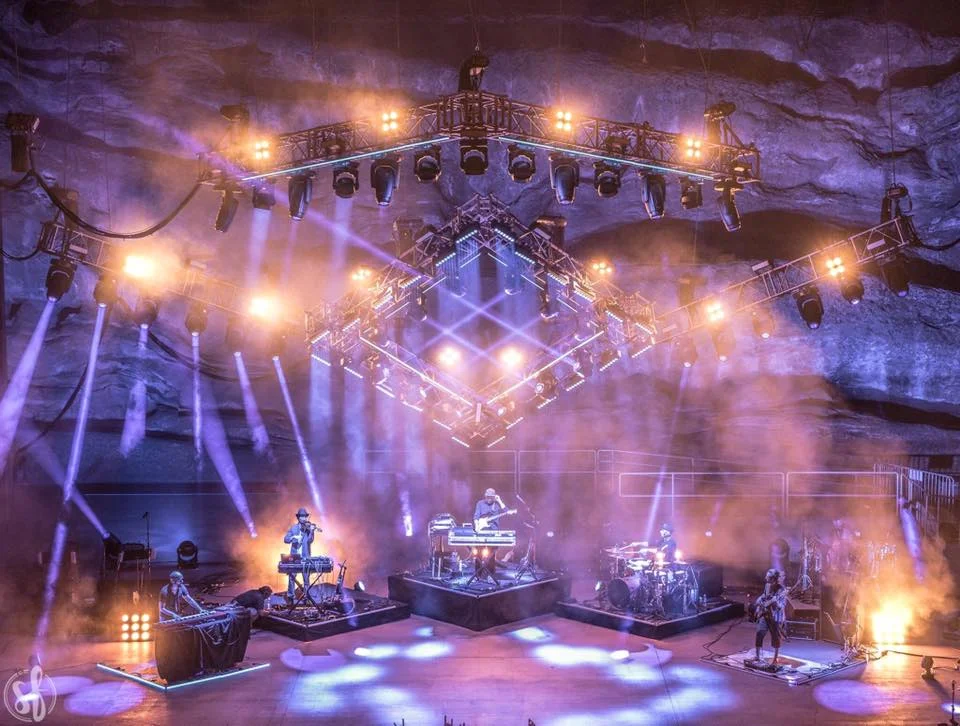
Acts like the Emancipator Ensemble (pictured) have carved out new space for instruments in electronic music. Ensemble drummer Colby Buckler is a major influence for Aaron Harel, who now performs with Wax Future.
Sure, the universe of acts encompassed by the “Jamtronica” label has arguably always been holding down the intersection of instrumental electronica. Then there’s those artists who were just ahead of their time (see Infected Mushroom, Younger Brother, Bloody Beetroots). But what we’re seeing today is different. Jamtronica is born from the world of rock and roll. The performers who embody this new trend are born from the world of electronica, writing and performing music that is electronic first. If instrumental music makes an appearance in the form of jazz, blues, rock, swing or otherwise, it’s secondary and deferential to the electronic song structure. From this starting point, then, artists are now reaching back into the world of instrumentation and American roots music for inspiration.
It’s hard to put a timeframe on it, but the rebirth of this method of performance in American electronic music has taken place, arguably, within the last five to ten years. In 2013, Pretty Lights released the Grammy-nominated A Color Map of the Sun, recorded with a massive potpourri of instrumental base material. Not long afterward, the Pretty Lights Analog Future Band was born. Gramatik began performing with a blues guitar player. Griz had just released Mad Liberation and was earning a reputation for his performances with saxophone. Emancipator started touring with his Ensemble.
For audiences, this live instrumentation was not attractive because it was novel or hype. The music just sounded great with instruments. When mixed and tuned in properly, the delivery became more powerful. Instruments began to enhance and elevate the sound. Fans from other realms found they could relate to this new electronica. Old head audiences began to realize they love the way the music swings with a drummer or a horn section or a string instrument. Performers began to innovate and improvise and all of the sudden the music was partially instrumental, but still electronic in style.
In recent years, the style has exploded, as have the possibilities. New faces are stepping into the spotlight today who began as instrumental electronic acts, as opposed to adopting the style as an enhancement. Such faces include Wax Future, a duo from Philadelphia whose name hints at their modus operandi: to blend the old with the new. With Keith Wadsworth on guitar and Connor Hansel as the production powerhouse, Wax Future has released two more EPs and a treasure chest of singles, collaborations, and remixes since their debut in 2015. They’ve hit festivals across the country, aligned themselves with the Pretty Lights Music (PLM) crew, and pressed their music to vinyl for the first time. In the summer of 2017, the group took another step towards synthesizing electronic music with traditional American genres by integrating drummer and fellow Philadelphian Aaron Harel aka ZONE Drums into their live performances.
A drummer since the age of eight, Harel has quite a resume in his own right. He’s performed with 5AM, Brightside, CloZee, and members of the PLM crew. In a past life he owned a snare drum company with a patent-pending internal acoustic enhancement system for snares, and his drums were utilized by Lotus, Rebelution, Soja, Thievery Corporation, Wilco, Zoogma and more. He held down a two-man electronic group called Mr. Sampson, and came to know the Wax Future guys through several collaborative “Wax Sampson” performances in Philly. Harel envisions electronic music in his future, and when Wax Future drops their next EP, every song will feature live drums.

For seven years Aaron ran a company which enhanced the internal acoustics of snare drums. After he began working for a full-scale drum company named SJC, he decided it was not the path he wanted to go down.
But how does an electronic act like Wax Future actually incorporate a drummer? What sort of challenges arise? How much elbow grease is required, and where is it applied? How is a group rewarded for taking such a risk with its performance?
“When I began playing with electronic artists I had to re-learn how to play drums in many ways,” Aaron says. Electronic music is often driven by emphatic kicks and snares, and producers are not anxious to replace these elements with live drums, “reasonably so,” says Aaron. “I was a little stubborn at first, but quickly began to appreciate the challenge of providing producers with what they wanted from a drummer as opposed to what I wanted to play. So when playing live and on record I have to focus on what I'm doing with my hi-hats, cymbals, side snare, and fills. Most of what I add as a live drummer are the subtleties and details that come from finessing these elements.”
“You can really get a great relationship between electronic drums and a drum kit,” says Connor. Until Aaron’s introduction to the group, Connor programmed all of Wax Future’s drums himself. “The electronic drums provide a consistency and a weight to the drum mix and ensure that the kick and snare hit nice and hard. When timed and blended well, live drums and programmed drums can give you the best of both worlds.” Timing is everything. Connor’s drums are tempo synched, so Aaron has to play along to a click track so that he’s not sliding even one split-second out of time. In a rock band’s performance, the drummer is the click track.
Depending on what Connor has programmed, certain songs have just a kick, others a snare, and some have both when Wax Future performs. Building his live drumming into these layers is a unique challenge for Aaron, especially when it’s time to transition from one song to the next. Transitioning tunes is a skill every electronic act must obtain, but with two drum tracks rolling it’s not like beat matching and crossfading. “Speeding up is usually something I can pick up on, slowing down, on the other hand, is damn hard,” says Aaron. “The best way that we have found is just to practice a ton. It feels like nothing else in the world when a transition comes and I hit the downbeat into the next track just perfectly. I feel like a million bucks.” The audience probably feels like two million.

(From left to right) Aaron, Connor and Keith at Camp Bisco 2017 where Wax Future debuted with a live drummer (Photo: Wook of Wall Street).
“Having live drums alongside us has me jonesing to crack these songs open even more onstage,” says Keith Wadsworth, the group’s candid guitarist. He recalls the moment he realized the potential for live instrumentation in electronic music. “I made shitty Garageband tracks and borrowed my buddy Kevin’s Apogee jam interface and played guitar over them. Boy were they terrible but they were a proof of concept.” Wax Future is that concept borne out. Keith is a fan of acts who push the envelope with live instrumentation, groups like Sunsquabi and Pretty Lights Live. “I admire those who take risks with their craft,” he says. “If you’re trying new things as a group of people leaning on each other’s musicality, I am all about it.”
He speaks to the most important aspect of instrumental electronic music. You must lean on, depend on, synch with and trust your fellow performers. When the music is coming from three or four individuals as opposed to one, everyone has to interlock, and in this regard, it’s not always rainbows and sunshine. “Spontaneity and attempting new things requires us to learn through doing, and sometimes messing up,” Connor says. “I have to be okay with things not being perfect.”
But there’s a tradeoff. While a group gives up the ability to be perfect, it gains the ability to generate that one-of-a-kind intangible magic - felt by performers and audiences alike - when musicians spontaneously synchronize with each other and drive home the sound. “I love music that is created in the moment,” says Connor, “so I am learning to embrace human error and grow from it.”
After almost a year of “open-ended” traveling in the Far East, Aaron returned home last Spring because he was “fiending” to play music again. “A couple weeks later” the three performers were tearing up The Office stage at Camp Bisco. “I feel at home on stage”, he says. “I want to push the boundaries of drumming and electronic music specifically. Its a relatively new field and there is so much room for innovation and creation as it develops.” Where one generation of performers has set the pace for instrumental electronic music, another will determine where the sound travels next. We anticipate substantial innovation from Wax Future going forward, particularly this Friday, January 19th as the group headlines Sauce Sessions 002 at Sunnyvale in Brooklyn, NY presented by the Saucy Monster.
The undercard for this session boasts multiple instrumentalists. DMV don Choppy Oppy frequently performs live with a guitarist and brings a trumpet of his own into play. Philly native The Business is all about that live bassline business. Rust artist Tygris from Western New Jersey will blend his tracks and turntableism with “the oldest instrument” aka the human voice in the form of five-borough lyricist Rasp 5. It’s shaping up to be an inventive evening with great potential for spontaneous musical combustion.
They say there's nothing new under the sun; that it's not what you do but how it's done. Who knows if this expression is valid, but words don't become expressions for no good reason. The name "Wax Future" invokes a paradox - that the past may be the future. If so, by developing a sound in which instruments are fundamental, and adding an airtight and ambitious percussionist to that mix, this group from Philadelphia at the very least has itself a head start.
FOLLOW Wax Future: Soundcloud / Facebook / Bandcamp / Spotify / Instagram
![Smallprint Recordings [Interview]](https://images.squarespace-cdn.com/content/v1/59530136f5e2319eabb7d87f/1529893077215-BCLRL7LSOIZLN5R154O4/smallprint.jpg)
Smallprint Recordings [Interview]
Reaching the ear canals of sonic explorers from the home base of Brighton, UK, SmallPrint Recordings has been pushing an ecosystem of eclectic compositional motifs and musically affluent producers since its birth in 2014. Specializing in jazz & soul influenced electronic music, SmallPrint is an archetype in directed curation; each of the nine artists featured on the label share in their influences and choices of avant-garde musical phenotypes. Humble beginnings are a common staple of underground labels, and Smallprint is no different. We had the opportunity to speak to Joe Vince, a co-founder of the label who produces under the moniker Primate, about SmallPrint’s origin and inner workings.
Reaching the ear canals of sonic explorers from the home base of Brighton, UK, SmallPrint Recordings has been pushing an ecosystem of eclectic compositional motifs and musically affluent producers since its birth in 2014. Specializing in jazz & soul influenced electronic music, SmallPrint is an archetype in directed curation; each of the nine artists featured on the label share in their influences and choices of avant-garde musical phenotypes. What materializes is a comprehensive and cohesive catalog of music and successive releases that can all on their own or in tandem be used to accurately portray the vision and direction of SmallPrint Recordings.
Humble beginnings are a common staple of underground labels, and Smallprint is no different. We had the opportunity to speak to Joe Vince, a co-founder of the label who produces under the moniker Primate, about SmallPrint’s origin and inner workings.
The Rust: What brought the three of you together to create such a particularly defined label?
Joe: The three of us met studying for a music production degree in 2011. In the beginning, we were all making more “dance-floor” style music, like dubstep and d&b. We definitely all had a shared interest to try and find something new which hadn't been established too much already. We all began to be interested in more ambient styles, as it seemed like the scene for that still had a lot of room for originality and hadn't necessarily been pushed very hard through other labels. Now and again we do still like to incorporate some of the heavier music that we used to make, but we generally like to still try and put a bit of a twist on it when we do.
--
Together with Vince, Mark Aidallbery (Marka) and Luke Wightman (Effluent) spearhead the label and its efforts, as well as set a standard for the aural environment they want to propagate. The nuances of jazz are effervescent throughout their productions, between organic shuffles and turn-arounds, to subtle chord dissonance and instrumental dialogue. It is a territory still ripe for exploration in the realm of electronic music, and while other artists have strived to integrate the jazz spirit into their own music, SmallPrint Recordings and its affiliate musicians have set a bar of magnanimous heights.
The Rust: Were there particular innovators/inspirations you turned to as efforts were coalesced to bring Smallprint to life?
Joe: There have been quite a few different artists and labels we've taken influences from over the years. Artists such as Geode, Jafu, Mercy, Gerwin, and all the other people on the Chord Marauders team really inspired us with the potential of more low key and slightly jazzy bass music. Then there’s also influences from hip-hop instrumental artists like Moods, Birocratic, and Flamingosis. There's also more new styles of electronic music appearing now from producers like Tennyson and a lot of people from Night Owl Collective, which helps keep things interesting and unpredictable with the kinds of things we're hearing in electronic music. Aside from that, there's a load of bands and musicians who really inspire us with what they're doing; People like Snarky Puppy, Hiatus Kaiyote and Vulfpeck, who although are very different from what we do, are all really good examples of how the jazz scene is generally growing and developing in new ways.
The Rust: Why the jazz influence? Is it a shared commonality amongst the founders? Do you feel there is a particular emotional landscape that you’re trying to curate?

Joe: The jazz influence is strong in our releases because it was a sound that we were all initially attracted to. The way the chords can sound slightly off, but then when done well, fits a track nicely is something we all found interesting. There seems to be a big rise in jazz influenced music in lots of different styles, but we feel that it hasn't had a chance to reach its full potential in the “bass" music scene. There are also a number of really good other artists pushing the Jazz sound at the moment - the majority of the music we listen to is heavily jazz/soul influenced, but it generally seems to have a slightly different vibe to most of the stuff we've released. Jazz isn't our only influence though. We take lots of rhythmic influences from genres like Hip-Hop, Dubstep, House and Garage. And then sometimes even some kind of melodic styles and textures from other genres like Progressive Rock and Funk.
--
The cumulative rhythmic influences are pervasive throughout their catalog. While the compositional influences remain consistent from artist to artist, the tempo and stylistic direction of the tracks released through the label vary greatly. It is a measurable milestone that sets SmallPrint Recordings apart from other labels, where tempo and sound may begin to fall stagnant in variation.
The Rust: Do you intend to maintain the jazz/soul focus on the productions you propagate?
Joe: Jazz and soul will always be apart of our influences, so those genres are most likely to be featured in quite a lot of our future releases, but it's hard to judge what kinds of things are going to happen next. Tastes can change and there might be a new kind of sound which emerges and becomes something we're interested pushing on the label as well.
The Rust: The individual stylizations of all the artists on the label are incredibly specific; do you ever feel there is a difficulty propagating electronic music that does not fit more popular molds?
Joe: It is difficult sometimes because there often doesn't seem to be a huge scene for the music we're pushing, but that's one of the reasons we enjoy what we're doing. We're attempting to try and bring something a bit different to the table. Also, it is an amazing feeling to have people on the other side of the world who are inspired by the same music as us, even if it hasn't become fully established in one place yet. We can always hope that one day it turns out that we were on the right side of history by pushing this kind of music now, but we'll have to wait and see.
--
Following musical trends is an exhaustive endeavor that can often feel like “chasing the purple dragon”, so to speak. Diving into less popular, more eclectic sounds, however, can yield notably more organic results. Actively promoting alternative electronic productions has made SmallPrint Recordings a one-stop-shop for those who find themselves attracted to less saturated circles of artists and content creators. On December 17th, SmallPrint released it’s third installment of the Smallprint Volume series, a compilation of 35 artists from the UK, Portugal, Spain, Germany, Sweden, Italy, Syria, the US, Canada and Russia. Some are SmallPrint labelmates, but many are artists who have been uncovered in much deeper musical rabbit holes from across the globe, putting on the table the powerful influence this label has in propagating a sound that they feel must be heard and digested.
The Rust: What is your ideology behind whose music you choose to release through the label, and who you sign onto the team?
Joe: We're always on the look out for more talented artists to release with SmallPrint. We try to work with as many artists as we can, even if it doesn't fit with exactly what we've done before. As long as we like the music and it doesn't seem completely out of place, we still incorporate it. Our general aim is to use SmallPrint as a platform for who we consider to be the upcoming artists of the future, so we'll always try and find a place for the music we're passionate about.
The Rust: What are your future intentions for SmallPrint Recordings? How do you see the organization growing from this point?
Joe: We've got a fair few ideas and plans for SmallPrint in the near future. There are EP's and singles lined up for the start of next year and we're about to get into making more music videos. Also, we've gained another member of SmallPrint, Nick. A really talented designer and photographer who's now leading the design side of things. We've got a selection of merchandise which we're just about to launch such as, 4 different designs and will all be available soon through our website. We will also have CD's of Vol. 3 on there very shortly. As well as that, we're about to launch SmallPrint Ingredients. This is going to be our sample pack platform with our first sample pack release very soon.
--
For those who are in search of intelligent design and musicality to wet their palate, SmallPrint Recordings will provide the absolute finest in left-field, off-kilter sonic servings. Dipping their hands in as many aspects of the electronic music industry as possible, casual listeners and passionate producers alike must keep their ears privy to everything coming out of this label, or risk missing out on indulging in the development of an aural enterprise unlike the vast multitude of their contemporaries.
FOLLOW Smallprint Recordings: Website / Bandcamp / Facebook / Soundcloud / Spotify
![79 Ancestors [Profile]](https://images.squarespace-cdn.com/content/v1/59530136f5e2319eabb7d87f/1529891207151-MKQ0OZZSOJIP6LWB1KDI/79+Ancestors.jpg)
79 Ancestors [Profile]
Last week we put out a spotlight on the duo A.M. Architect, who just released Color Field, an audiovisual album composed of 10 tracks and accompanied by a 15 minute short film, released through the interdisciplinary label 79Ancestors. Today, we want to take the time tell you some more about what the label is up to and those involved behind the scenes.
Last week we put out a spotlight on the duo A.M. Architect, who just released Color Field, an audiovisual album composed of 10 tracks and accompanied by a 15 minute short film, released through the interdisciplinary label 79Ancestors. Today, we want to take the time tell you some more about what the label is up to and those involved behind the scenes.
79Ancestors is a record label that was launched in 2016 by Benjamin Wynn, Anthony Ciannamea and Yaniv De Ridder. In their words, “79Ancestors is a hybrid label focused on the production of highly-personal objects and experiences, designed by artists working at the intersection of music composition, performance, cinema and code”. Their first LP release, A Soundtrack to Imaginary Landscapes is a compilation album of eight different musicians including Shigeto, Telefon Tel Aviv and A.M. Architect. If one purchased the vinyl early, it was bundled with a customized 79A Cardboard Virtual Reality viewer (that is now sold out). The goal is that, eventually, each of these songs will have an accompanying visual element to be viewed in virtual reality. Thus far, there is one released for Shigeto’s song (watch here), and four other “episodes” are in the works.

Benjamin Wynn aka 'Deru' by Tim Navis
Anthony Ciannamea is both a filmmaker and designer, and currently runs the design and motion studio EFFIXX. Ciannamea has an impressive history of work in the creative field and has collaborated with many artists, including Prefuse 73 and members of Ghostly International. Ciannamea and Benjamin Wynn have worked closely together on many projects and 79Ancestors is just the latest from these two.
Commonly known as Deru, Benjamin Wynn is a musician who wears many hats. His life of music began in college where he earned a degree in music technology at the California Institute for the Arts. Since then, he has scored for film and television, composed for a ballet called Genus, and released a plethora of albums. Wynn is constantly pushing boundaries, and the more one delves into his work, the more this becomes evident.

The flyer for the third installment of The Echo Society. March 12, 2015
Benjamin Wynn has released four LPs under his Deru project, and there is word that the next album will be released in early 2018. Avid fans of Deru will tell you that his music leans towards atmospheric-based beats with a keen edge for sound design, infused with elements from a multitude of other genres, including trip-hop and IDM. The emotion, texture, clicks, and glitches within his ethereal beats simultaneously uplift and catalyze a longing for the past. It is this dichotomy in Deru’s music that makes it so unique and fascinating.
Beyond Wynn’s personal projects, he is also a founding member of The Echo Society, a non-profit collective of seven Los Angeles-based composers. Anthony Ciannamea as EFFIXX is also a member of The Echo Society, and serves as a lead visual designer. This collective presents one-night-only performances of visual and sonic art, both orchestral and electronic. So far there have been six installments in this series.
The creation of 79Ancestors was inspired by Deru’s concept album, 1979, which also alludes to the name of the record label. It was this project that convinced the founders that listeners are willing to engage more deeply with music, whether that is through visual reality, through a tangible artifact, or through a different lens. This is the intention of this label, to take the idea of an album and to elevate and expand it.
It is clear that 79A is pushing artistic boundaries and will continue the marriage of sonic art with other forms. 79A values the magic of collaboration and the potential of a collective of creative and passionate minds. We are excited to follow along and see what this label has in store; this is only the beginning.
FOLLOW: 79Ancestors / The Echo Society / Deru - Website & Listen / EFFIXX / Color Field - A.M. Architect

Who is the Precise Electronic Producer Detox Unit?
On a steamy August night in a dark space bursting with Brooklynites and other humans, a DJ steps to the decks. It’s the third installation of the Lights Out series at the Knitting Factory, and Detox Unit is about to blow minds. Ascending into the corner of the room, Joe Roberts knows what’s cranking inside the spanking Hennessy Sound System before him. He knows forwards and backwards the material he’s prepared - detailed, meticulous, dirty, and deep. He knows when the music meets the medium, sound speeding through wire and circuitry, he’ll ignite the sell-out crowd like a tinderbox.
On a steamy August night in a dark space bursting with Brooklynites and other humans, a DJ steps to the decks. It’s the third installation of the Lights Out series at the Knitting Factory, and Detox Unit is about to blow minds. Ascending into the corner of the room, Joe Roberts knows what’s cranking inside the spanking Hennessy Sound System before him. He knows forwards and backwards the material he’s prepared - detailed, meticulous, dirty, and deep. He knows when the music meets the medium, sound speeding through wire and circuitry, he’ll ignite the sell-out crowd like a tinderbox.

"Adam Psybe who runs Psybe Industries designed my logo. My only input was that it had to be abstract, minimal, and kinda sci-fi. The bit at the bottom translates to 'noise' or 'sound'." - Joe Roberts a.k.a. Detox Unit
Detox Unit is returning to New York City this Friday, November 10th to headline the anticipated Sauce Sessions at Sunnyvale in Brooklyn, a new series of shows conceived by the The Saucy Monster. Joe Roberts a.k.a. Detox Unit actually grew up just north of the city in Scarsdale, NY before moving to Austin, TX in 2013. “I really miss the snow, proper bagels, great Chinese takeout everywhere, as well as the urban sprawl of NYC, but the scene here is rad,” says Joe, who was generous enough to speak with The Rust amidst a hectic schedule of shows from Portland, Oregon to Miami to West Virginia.
“I think Detox Unit is easily the breakout artist of 2017,” says Kyle Miller a.k.a. The Saucy Monster. “Dude’s been on a steady path of destruction, releasing all original mixtapes while simultaneously touring across the country.” Kyle is a photographer and producer (Indobeats). As the gracious host and founder of Sauce Sessions, he’ll be seeing Detox throw down for the first time on Friday.
Many in the community got their first taste of Detox at Tipper & Friends (T&F) events, which have been a modest launching pad for Joe and a handful of other artists. In 2016, the community left the gathering at Spirit of Suwannee Music Park in Florida mad for Jade Cicada. This year, Detox Unit were the words on everyone’s lips.
!["I have so much love for both the Daves [Dave Tipper & manager Dave "Lobotomy"] and what they do." - Joe Roberts a.k.a. Detox Unit (Artist: Android Jones)](https://images.squarespace-cdn.com/content/v1/59530136f5e2319eabb7d87f/1529889819630-881H6ZXGZV7UD9VJB3FS/TnF.png)
"I have so much love for both the Daves [Dave Tipper & manager Dave "Lobotomy"] and what they do." - Joe Roberts a.k.a. Detox Unit (Artist: Android Jones)
“In the summer of 2016, I got a message to my artist page on Facebook from Tipper's manager along the lines of ‘You doing anything in October?’.” Joe's first T&F performance transpired during the October, 2016 Denver get-down. “Needless to say, I proceeded to freak out and run around the room, then did my best to respond in a calm and collected manner. Tipper's music has been a huge influence on me." Some said they enjoyed Detox more than the headliner himself at Suwannee this Spring. This may be a minority opinion, but among the Spanish moss dripping thick with humidity Detox made his name known.
This come-up has been propelled not by a few spectacular sets nor a groundbreaking release, but years of dedication to a craft. “I met Joe in 2013 through a mutual friend while living in Austin” says Sofia Raisanen, a current writer for the knowledge-sharing platform ProducerDJ.com founded by ill.Gates. Sofia brought Detox Unit into the fold at Street Ritual in Summer 2015 while working as the A&R rep and PR Director for the West Coast conscious music label. “Joe was really focused on his DAW (digital audio workstation). His full motivation is unlike anything I’ve ever witnessed; it’s straight up hard work.”
"I began producing music in 2012, initially with a program called Reason but then I switched to Ableton Live. The early stuff was pretty abstract, ... kinda beat-less stuttered out sequences of odd synth sounds. In 2014 I dropped all other pursuits and put my focus on music. Haven't looked back since.
Joe is an audio engineer with a sophisticated home studio that includes modular and analog synthesizers, keyboards, old-school effects units, a controlled mess of circuitry, and a separate room for mixing. While some individuals including the author are driven to madness by the slightest technical difficulty, since childhood Joe has derived satisfaction from fixing and tinkering with electronics.
According to Oxford researcher Simon Reynolds in his history of electronic music titled Historia Electronica Preface and published in “The Pop, Rock, and Soul Reader” in 2005:
'Electronic music is driven by a quest to find the most radical or futuristic-sounding potential in brand-new technology. And that involves essentially (re)inventing the machines: producers are always claiming the first thing they do after acquiring new gear is to throw away the instruction manual and start messing around. Often creativity entails abusing the machines, employing them incorrectly.'
As a gear head and someone who has loved electronic music “since day one”, Detox Unit embodies this ethos. “Most of the audio gear I own I've taken apart and messed about with the insides at some point in time,” Joe says. This obsession can be a double-edged sword, however. “I find sometimes this fascination can lead to a never-ending cycle of tinkering with this or that and never actually writing any music. I am constantly rearranging how everything is plugged in, never satisfied with just one particular signal flow.”
Joe incorporates his technological fascination into the aesthetic of Detox Unit, believing the imagery juxtaposes well with his sound design. Take for example the visual associated with the “Recent Works, Vol. 3” mix. “I used an image of an old Turbosound cabinet, the TMS-4 to be exact. I had been reading up on the history of Tony Andrews and his time at Turbosound prior to Funktion One; the image seemed appropriate.”
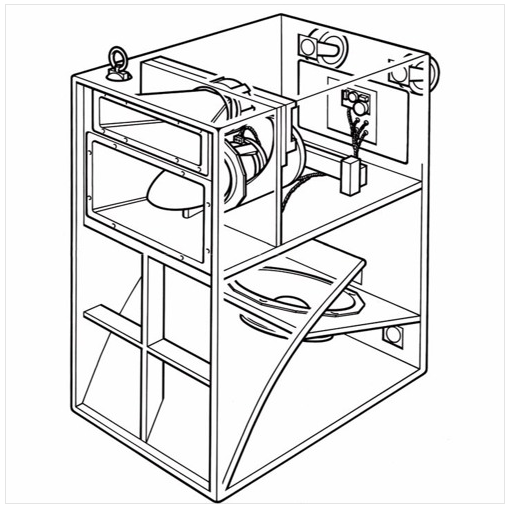
"The picture from "Recent Works Vol. 3" is a continuation of the theme of using technical, document-inspired images with the music" - Joe Roberts a.k.a Detox Unit
Generally, with more than three self-acclaimed sound heads in a room, and it becomes nearly impossible to find a consensus about what music to bump. For the last month, however, virtually every time I gather with friends one person will advocate for the new Detox mix to the immediate and unanimous approval of others. “I made ‘Recent Works Vol. 3’ at around 8:00am in a makeshift studio I had setup in Denver after staying up all night writing the third tune in the mix, the 808 heavy one with the vocal bit saying ‘this is my real life’,” Joe tells us. “Admittedly I probably should have slept and then made the mix but inspiration is fleeting so I think it's important to strike while the iron is hot.”
Detox Unit music is mental and physical. Glitches woven into intricate patterns twist the mind in comfy little knots, while thunderous but carefully placed bass vibrates the room and everyone in it. Space is key. Empty space in his mix casts sounds into dramatic relief, sharpening their edges and drawing acute attention to every noise. Brief pauses give greater force to the fusillades of bass that follow, and the details of sound design which can be so easily missed become the center of attention within Detox Unit music.
This caught the attention of Blake Oakes from Together At Last Promotions out of Atlanta. Rust readers may remember that Blake conceived the Lights Out series to create a party focused on sound and little else. “It’s completely about the sound with him,” says Blake, who recently booked Detox Unit for another Lights Out set - his second - in Chicago. “He matches the concept to a tee.”
While Joe appears to spend most of his energy crafting new music, he’s found time to focus on his live performance, too. “Lately I've been mixing on the Pioneer CDJ platform using flash drives and it's been a lot of fun. My old setup featured Ableton, and I used a controller to play my tracks. Now with my new setup I've been focusing on how to string together different tracks to make the whole set one cohesive journey that keeps the dance floor moving.”
It's rare to be intellectually engaged by music while simultaneously getting down, but this is what Detox can deliver. Friday at Sunnyvale the dance floor will indeed be set in wild motion, but not just by Detox. Supporting him is the rising Rust artist MALAKAI along withgifted instrumentalist and producer 5AM, and local low-end lurker Yakooza who’ll spin back-to-back with a special guest. If you’ve never seen Detox Unit perform, prepare for an immersive experience. Check out any of his Recent Works mixes, his latest EP SubPlatter Splatter, or his set from Tipper & Friends Suwannee.
FOLLOW Detox Unit: Soundcloud / Facebook / Bandcamp
![Whitebear [Interview]](https://images.squarespace-cdn.com/content/v1/59530136f5e2319eabb7d87f/1529889411199-D4O0WZ3B15NQPM8LOW7O/Whitebear.jpg)
Whitebear [Interview]
The hammer, the bat, the boxing glove; we as humans use these tools for literal smashing, but sometimes we need a more proverbial smashing. With Arthur Song behind his quickly rising nom de guerre, Whitebear pounds the ground with a visceral harmony of melody and discord, symphony and cacophony. A Malaysian native based out of Melbourne, Australia, he's made his way all the way out to the States for a massive tour alongside Kalya Scintilla, and is headed straight for NYC this weekend. We had the opportunity to sit down with Whitebear and pick apart his brain just enough to satisfy the suspense of a long awaited face-to-face blessing with the man, and see what really makes this production powerhouse tick.
The hammer, the bat, the boxing glove; we as humans use these tools for literal smashing, but sometimes we need a more proverbial smashing. With Arthur Song behind his quickly rising nom de guerre, Whitebear pounds the ground with a visceral harmony of melody and discord, symphony and cacophony. A Malaysian native based out of Melbourne, Australia, he's made his way all the way out to the States for a massive tour alongside Kalya Scintilla, and is headed straight for NYC this weekend.
We had the opportunity to sit down with Whitebear and pick apart his brain just enough to satisfy the suspense of a long-awaited face-to-face blessing with the man, and see what really makes this production powerhouse tick.

The Rust: Your music has been described as “tribal”. Much electronic music from Australia has tribal or aboriginal influence, at least when heard by American ears. What effect can place have on music? Feel free to answer the question in relation to Whitebear music, or in general.
The environment most definitely plays a huge role when it comes to influencing the feel/mood of the music, although I don’t think that it is entirely dependent on it. Most of my music was written in an apartment in the middle of Melbourne city 12 stories above the ground, I guess which is why peppered amongst the “tribal” elements are dashes of inorganic sounds.
The Rust: The infrastructure of the music industry has undergone great change, and musicians, labels, collectives have to get creative to make a living off their music, with Shanti Planti being an example of a successful model with artists helping artists. How can artists help each other succeed? How, if at all, would you like to see the processes behind the publication, distribution, and sale of music change?
We need to stop viewing this as a competition, use the success of others to inspire you rather than depress/discourage you. Stop complaining about how someone else is doing better and level up. That and the sharing of knowledge amongst artists, most of us wouldn’t be where we are today without the help of online tutorials, tips from mates or whatever else it took us to learn the skills we needed to be the artists that we are today. Regarding the sale of music, I definitely would like to see more labels go down the collective route, much like Shanti Planti, and now Enig’matik as well since their rebirth not long ago. It’s a win-win for the “label owner” and the artists- most of the work has been offloaded or at least the weight is now equally distributed because the individual artist is now taking care of their own mastering, artwork, social media etc. with a few exceptions of distribution and promo still being taken care of by the label (depending on the label/collective). Too many labels have been discontinued purely due to the fact that there was too much of a workload and not enough financial gain to warrant that amount of work, which is a shame because we’ve lost some good ones!
The Rust: You told Lost in Sound that there’s a symbiotic relationship between “mainstream pop shit” and tasteful underground music, with the former forcing people to search for deeper, more meaningful music. I’ve been starting to see “edgy” electronic music used in television ads pretty frequently. Can the line between mainstream pop music and underground bass music become blurry at times?
Sure.
The Rust: You’ve said that in Australia, more people are flocking to the underground music scene, but bringing with them the attitudes and morals of the conventional world. The same could be said in American scene, which has exploded in popularity in the last five years. Can we welcome as many people as possible into the community, while preserving the unique attitudes, morals, and customs that have made the community so attractive?
I’m not too familiar with the evolution of the scene in the US so can’t speak for the scene here, but in Australia, there has definitely been a rise in outdoor festivals that are being run by companies that used to put on one-day raves. As long as we work to educate but more importantly inspire the newcomers, we’re sweet.
The Rust: You said you’ve been asked to play hip-hop here in America, which could in a way be described as the indigenous music of the United States. Are you influenced or inspired by hip-hop?
I never listened to much hip-hop growing up, I appreciate it, but it has never been a huge part of my musical life.\
The Rust: With your recent EP, Dialectics, you retain certain elements of archetypal psybient music, but also develop a darker tonality and sonic direction than previous works. What triggered the inspiration to tackle this shift in sound design and composition?
I didn’t want to be pigeonholed into the “tribal bass” thing, I’ve always been influenced by the darker forms of music with techy sound design so it was natural for me to explore that side of my musical palette.
The Rust: Can you walk us through your workflow? What digital tools do you use to flesh out your music? Do you have any affinity for hardware instruments in conjunction with conventional production methods? (Preferred DAWs, VSTs, Mastering software, etc)
Ableton Live is the main workhorse, everything else is software. Workflow is pretty much- get excited about writing music, start doing sound design, get more/less excited depending on success of sound design session, start sketching out track, whine about how track is not working at all, keep banging head against wall until something works or breaks, repeat until track is done.
The Rust: Do you have a vision for the future of the Whitebear project and of your performance? Are you satisfied with your current methods for performing live, and are you experimenting with any unconventional ways of presenting your music? What does the ideal Whitebear show look like to you?
At the moment the vision is a bit clouded. If you had asked me six years ago if I saw myself doing what I do now, I would tell you- yeah nah. So I’ve been winging it this whole time with no solid plans except to write the best music I can write and to be stoked about what comes out as much as possible. I have some soul searching to do over the next six months. I would definitely like to collaborate with visual artists to create an immersive experience with synced visuals and maybe even surround sound type stuff, but to be honest it isn’t really a priority right now, more an idea I’ve been toying with.
The Rust: Do you have your hands in any other artistic content beyond music? Do you take inspiration from non-musical art forms?
Navigating this human thing meat ship is an art in itself, that’s probably up there with the music. Inspiration comes from everywhere and everything, it's hard for it not to.
--
If you're in the tristate area this coming weekend, then we're sure you'll be piloting your human meat ships straight to Brooklyn for a tango amongst maestros. Make sure you grab your tickets HERE
FOLLOW Whitebear: Soundcloud / Facebook / Bandcamp / Spotify / Instagram
Kalya Scintilla on Progress and the Perils of Pop Music
If ever a musician was rooted in the past, acting in the present and looking to the future it is Kalya Scintilla. Scintilla, real name Yaegon Lamagaia, is a pillar of psychedelic electronic music and culture. Since the late aughts this Australian producer has pioneered a now popular sound - a juxtaposition of earthy, instrumental world beats with squelchy, spacey synths in a psybient mid-tempo mold. Scintilla takes great care to draw listeners into the thematic world beyond his sounds, one of ancient energy, myth, intention and alignment. Ahead of his Back to Roots tour stop at Knitting Factory Brooklyn, supported by Whitebear and The Rust Music artist MALAKAI, we were fortunate enough to speak briefly with Yaegon about his music and ideas.
If ever a musician was rooted in the past, acting in the present and looking to the future it is Kalya Scintilla. Scintilla, real name Yaegon Lamagaia, is a pillar of psychedelic electronic music and culture. Since the late aughts this Australian producer has pioneered a now popular sound - a juxtaposition of earthy, instrumental world beats with squelchy, spacey synths in a psybient mid-tempo mold.

Scintilla takes great care to draw listeners into the thematic world beyond his sounds, one of ancient energy, myth, intention and alignment. Ahead of his Back to Roots tour stop at Knitting Factory Brooklyn, supported by Whitebear and The Rust Music artist MALAKAI, we were fortunate enough to speak briefly with Yaegon about his music and ideas.
As the NYC tour stop draws closer we’ll also share a conversation with Whitebear, the other half of the Back to Roots tour, who for the last few years has been carrying the mid-tempo torch lit by Scintilla and others into deeper and darker territory to illuminate new sonic spaces.
The Rust: You’ve said the drum is the oldest instrument and that its ancient rhythms unlock ancient mysteries within us. How about the synthesizer? As a new instrument with a digitized soundscape, what can the synthesizer potentially unlock within us?
The drum is ancient and the synth is future. The synth can carve out new and different unexplored worlds, propelling our imagination into something unseen. That's why I love the fusion of the two world. It's like having your feet in the earth, your mind in the universe and your emotions everywhere between.
The Rust: You purchased your first computer to make beats in 2005. What was it like to make a beat on the computer over a decade ago? Is there anything you miss about the composition process back then?
I do miss the simplicity of a decade ago. There is such a heavy saturation in the digital music technology market now... and the crazy thing is that most of it is amazing. So it's a challenge now to keep a simple palate of sounds and textures and explore them intensely. I always recommend to artists just starting out to keep it simple. When you keep you setup simple, your focus and thirst for learning and pushing the limits of what you have is greater. Slow down with getting new tech and learn what you have... this is also a reminder to myself HA!

(Credit: Derek Rickert)
The Rust: As the head of Merkaba Music, are there any new artists or sounds that you admire right now?
The sounds that push boundaries for me are not necessarily ones that are trying to be the next new sound but sounds that are a true expression of an individual's soul. As each soul is different, when a soul shines through music it's always a magical and unique feeling.
The Rust: As a leader in psychedelic sound design and composition, what’s next for Kalya Scintilla’s sound? Do any musical challenges still lay before you?
Art and creativity is infinite and inspiration can be found everywhere so while I feel I have accomplished so much I feel in some ways that I am just beginning. I have visions and more creations on the way for both Merkaba and Kalya Scintilla and a few other secret things I am flirting with at the moment. I see art and the creation of something truly original and profound as a deep and infinite exploration. A fun one!
The Rust: You once said a great awakening took place within you when you listened to Herbie Hancock’s “Manchild” on vinyl when you were younger. What will the next generation be awakening to? Is it problematic that the next generation will likely be listening on mp3, youtube, or a streaming service instead of the organic wax?

(Credit: Derek Rickert)
I have come to know that the feeling, intention and story of a piece of music can be experienced regardless of the tuning or bit rate. But why not quest for the most detailed representation of a piece of art? I feel that with the way digital storage is becoming, and with a push from many in the industry to always have the best quality possible, we will evolve away from MP3 and towards a higher quality standard. But you can’t beat the feeling of a good vinyl! To anyone reading this I recommend taking that voyage [“Manchild”] in a dark room by yourself.
The Rust: If sound is much more powerful than most people realize, and I believe we agree on this, is the power of sound being used for negative purposes? If so, what does this look like?
MTV pop music! This is the best example of music being used to ill effect. Sound is creation and destruction so it goes without saying that there is some truly destructive sound on our planet. How much destructive music is created intentionally? Probably not a lot. When money, bitches, guns, 'satan', death, ego, etc. are fed to a society as the norm and as status symbols, it's natural that humans would mimic and imitate that in their own art. The question is who planted the seed in the first place?
--
Who indeed? Kalya Scintilla certainly knows how to plant a seed or two of his own with his transcendent, mid-tempo music, seeds which soon sprout roots, roots which we may eventually come back to. We’re extraordinary grateful to Yaegon for taking the time to share his thoughts with us, and with the world.
Don’t forget to check back with The Rust as Back to the Roots at the Knitting Factory Brooklyn draws closer. We’ll be diving a bit deeper in our conversation with Whitebear, so stay chooned!
FOLLOW Kalya Scintilla: Soundcloud / Facebook / Bandcamp / Instagram / Spotify
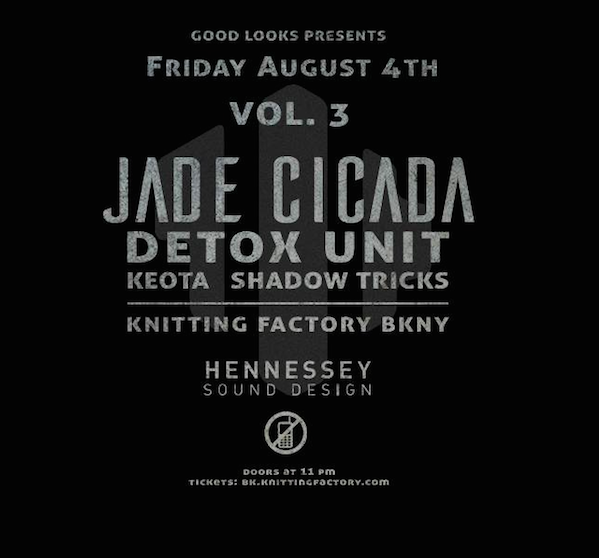
Jade Cicada Speaks Ahead of 'Lights Out' Show in Brooklyn
On Friday, August 4th, Jade Cicada, Detox Unit, Keota, and Shadow Tricks take over the Knitting Factory in Brooklyn, NY, for Lights Out NYC 003 - Jade Cicada, brought to you by Good Looks Collective. Thus far, each Lights Out has strived to amplify levels of excitement and engagement amongst concert goers, and has consistently brought a much needed, refreshing vibe to the electronic music collective in and around NYC. We had the opportunity to query Skyler Golden, the man behind the arthropod, a bit about his thoughts on pushing his musical endeavors forward.

On Friday, August 4th, Jade Cicada, Detox Unit, Keota, and Shadow Tricks take over the Knitting Factory in Brooklyn, NY, for Lights Out NYC 003 - Jade Cicada, brought to you by Good Looks Collective. Thus far, each LightsOut has strived to amplify levels of excitement and engagement amongst concert goers, and has consistently brought a much needed, refreshing vibe to the electronic music collective in and around NYC.
We had the opportunity to query Skyler Golden, the man behind the arthropod, a bit about his thoughts on pushing his musical endeavors forward. We also sat down with Blake Oakes - Skyler’s manager and the creative mind behind the LightsOut series.
JADE CICADA - Q & A
Hey Skyler, thanks for the opportunity to pick your brain a little bit. We’ve got a few questions to ask to get a better perspective on the Jade Cicada project:
The Rust: What other mediums of art interest you? Do you practice any art form other than music?
I’d say movies/tv shows and video games (the soundtracks and sound effects) interest me the most. I’m intrigued by all forms of art but those are definitely the ones I gravitate to for inspiration. I was never really one to be inspired by a piece of still art or anything, but I think it would be something worth trying out some time. I have a ton of respect and admiration for illustrators and graphic designers because I’m pretty useless in that category haha. Guys like Beeple and FuniLab and Kilian Eng are a few examples of still art artists that I really admire. I mess around with illustrator and photoshop from time to time (that’s how I made my logo and font) but that’s more of a hobby.
The Rust: What are some non-musical influences that have shaped your musical direction + musical career?
I mean, I think every life experience you have ends up being an influence in one way or another. The loved ones I’ve lost are a huge influence for example. The hardships I’ve endured and the happiest moments of my life are influences. Byte Evaders is an anagram for “Best Day Ever,” and I made that the day after I opened for one of my favorite all time producers, Tipper. On the other side, I made the song Lost Again in memory of my Father who passed away which is an anagram for “Nostalgia.”
The Rust: What kind of capabilities would you like to program into your live sets in the future? Do you have a particular vision for how you would like to present/perform your music?
I’m relatively inexperienced when it comes to live performance. I’ve only been doing this about two years and I’ve only done about 50 shows. Right now I’m just trying to get really good at constructing great sets. I think I’m getting better at it and like to think each show I do is better than the last. In terms of the future, I’m planning on incorporating stem mixing to some degree in my sets, and possibly even controlling my own visuals. These things take a lot of time, especially on top of trying to produce new music, so don’t expect to see any of that soon, but it’s definitely a goal of mine.
The Rust: Are there particular styles/soundscapes you would like to pursue musically other than your current direction?
It’s not a popular one, but I love ambient music. Tipper’s sunrise set at his festival in Suwannee was my favorite set of the weekend and I’d love to explore that style of music more. I’d love to see my peers explore that style more as well. I think we all need a break from slamming kicks and snares from time to time and just focus on the atmosphere and textures possible in more mellow music. The only problem is that the average listener falls asleep to this stuff and nobody dances to it haha. It’s definitely an underappreciated artform that has so much room for experimentation and development. I’d also love to mess with some more “IDM” style stuff, but damn that drum programming can be such a pain haha.
The Rust: Do you have a concept in mind for a full Jade Cicada Production? Anything you might be particular towards in curating the best rendition of a Jade Cicada concert?
Not really a concept, just some ideas. The thing I care most about now is playing shows with good speakers (Funktion One, Hennessey Sound Design, Danley Sound Labs, etc), and playing venues that are acoustically treated properly. Sound is everything to me, and I want my listeners to hear my music the same way I hear it in my studio. I think the obvious things like some dedicated notable live projection visual artists would be great. I love Amon Tobin’s ISAM 2.0 stage setup. Something like that might be really cool but if/when that happens is questionable. I think what we did in Atlanta was a good starting point in terms of visual mapping, projection, and stage construction, but a solidified concept is a little ways down the road.
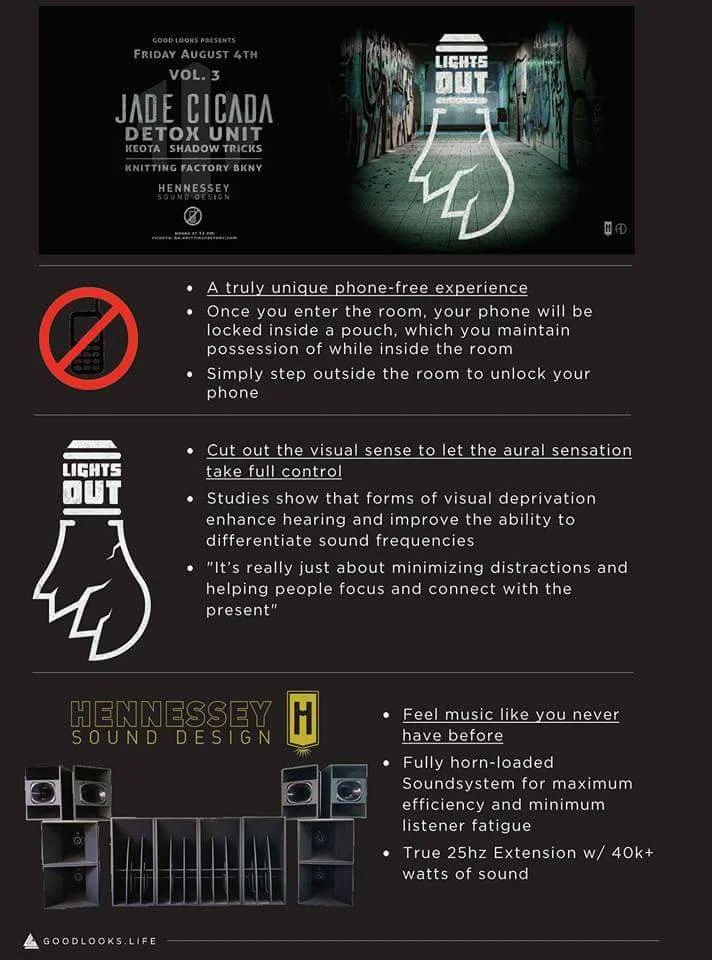
BLAKE OAKES - Q & A
Blake, thanks for taking the time to chat with us and give us some insight on the Lights Out concept. We've got a few questions for you:
The Rust: So, can you tell us a little bit about the idea behind Lights Out, and what inspired it?
The inspiration to the concept of LightsOut i guess was inspired by the whole UK dubstep “basement vibe” in the mid to late 2000s. Packed rooms, A lot of dancing bodies, and big Sound Systems. At that time digital culture was not so present. So taking phones away was not really “something” that grabs your attention. In the end that’s what that concept derives from - we want your full attention and attendance. I think adding this aspect really allows you to disconnect and actually BE PRESENT at the event. Shout out to Yondr.
The Rust: Do you have intentions to bring this concept to other locations (cities, states), provided there is enough interest?
100% interested. Right now I am really focused on Atlanta & New York and getting the concept nailed down. but in the near future - Most definitely, yes.
The Rust: Is this the full iteration of your concept currently, or do you have further ideas you’d like to implement to the experience as the opportunity presents itself?
I think there are plenty ways to build on the LightsOut concept. Creating a real vibe in the room is something i want to work on. I do not think it has to be completely blacked out either so there are plenty of ideas to really get that across. I’ve got plenty more to work on.
The Rust: Do you feel there are particular styles and directions of music that the Lights Out concept works best with? What other artists/styles of music would you like to be able to showcase through this medium in the future?
Absolutely, I think doing the Jade Cicada LightsOut really kinda shows that the concept can be represented by multiple styles. In the end, that’s what the concept is derived from. A focus on sound. I think the music just has to be really dope, and sound even better on a really dope Sound System.
--
If you’re worried about the fidelity of the sound, ease yourself to the tune of a full Hennessy sound system; a veritable beast, capable of projecting all frequency ranges with top of the line clarity and ferocity. If you’re worried about the “no cellphone policy”, also relax; the entire experience is designed to help immerse and integrate the listener fully, removing all distractions so as to maximize your aural sensitivity. Make sure to hit up the venue as early as can be, as Keota, Shadow Tricks, and Detox unit are slated to bring their own killer tastes to the table and help curate an excellent party, top to bottom. To everyone making the trek this weekend: I’ll see you in there.
Purchase tickets to LightsOut here.
FOLLOW JADE CICADA: Web / Soundcloud / Facebook / Bandcamp

![Seppa - Interview + Boosted [EXCLUSIVE PREMIERE]](https://images.squarespace-cdn.com/content/v1/59530136f5e2319eabb7d87f/1626113208781-BZ7C6B7E3LCECV7UD4CS/Boosted.jpg)
