

Psy-Fi Festival Brings Best of International Bass to Netherlands
On one stage this Summer you can catch some of the best in American bass music from Jade Cicada, CharlestheFirst and Bogtrotter, international OGs like Hedflux, Rumpistol and Ott, and a living legend like Solar Fields; the Chill Out stage at Psy-Fi Festival: Seeds of Science, returning in its seventh year to Leeuwarden, Netherlands this weekend, August 28 to September 1.

Psy-Fi Festival main stage seen from above (Credit: Mushroom Magazine)
On one stage this Summer you can catch some of the best in American bass music from Jade Cicada, CharlestheFirst and Bogtrotter, international OGs like Hedflux, Rumpistol and Ott, and a living legend like Solar Fields; the Chill Out stage at Psy-Fi Festival: Seeds of Science, returning in its seventh year to Leeuwarden, Netherlands this weekend, August 28 to September 1.
As one of the larger transformational psytrance festivals in Europe, Psy-Fi has drawn people from 114 different countries. They come for good reason. According to the festival’s website, Psy-Fi invites “most of the best known live acts and dj's” to perform. That’s absolutely true of the Chill Out stage. They’re hosting the worldwide vanguard in psychedelic bass from Bluetech and Hedflux to Kalya Scintilla, Kaya Project, Bumble and ATYYA. Most of the performances from artists based in the United States, including MALAKAI and Schmoop, are European debuts.
Fully developed, highly produced chill out stages are less common stateside than they are internationally. They’re really a product of the trance scene, but there’s few psytrance festivals in the states. How does it work from a booking perspective or from an experiential perspective? The UK producer Steve Young aka Hedflux, one of the more well-traveled Chill Out stage performers at Psy-Fi, breaks it down this way:

In the trance world, chill essentially means “anything but trance.” Sometimes it's referred to as the "alternative" stage since it's not necessarily always chilled out. As a DJ you generally have free license to play whatever you want, whether it’s more sit-down chill music, or more deep dance vibes. There's no pressure to get the party rocking, but you can still get it rocking if you want to. Obviously the idea is to keep it psychedelic…but take artistic advantage of the great musical freedom you have to explore different rhythms, tempos and energy levels, and bring in musical influences from elsewhere. At the trance stage, there is a universal sense of expectation among the crowd that the next drop will be a trance beat, and if you mess with that, they'll get annoyed (understandably so). At the chill stage however there is no expectation, people are more fluid and you can take them from an ambient cuddle puddle to a frenzied ecstatic dance and back again without anyone shouting "where's the drop?".
Hedflux is a great representative of the groundbreaking global glitch at Psy-Fi. His Eclectic Psychedelica mixes arguably curate and mix through the best midtempo psychedelic music in the world. His appreciation for Itay comes through as well. “He is an amazing agent, producer and DJ and a curator of the finest psychedelic chill-out line-ups,” Steve says. “For me now, the chill stage IS the main stage.”
Itay of Feel Life Music, with his selective taste and a global roledex of bass musicians, is the mind behind the Chill Out stage. He’ll also perform there through his Kukan Dub Lagan project. While the lineup may astound someone seeing it for the first time, those who know Itay say it’s par for the course for this sommelier of psychedelic music. “I was certainly surprised, but at the same time, I’m not surprised Itay would pull something like this off,” writes Søren Thygesen, the Danish producer Bwoy De Bhajan. “I remember seeing the lineup for the first time. One act after the other made me raise my fists in joy.” This will be Søren’s fourth year at Psy-Fi. “They dare to take some chances with the lineup and not recycle the same group of acts year after year. It’s very refreshing, and i'm starting to see more festivals in Europe taking risks. You don't forget those moments where an unfamiliar act takes you by storm.”

The Chill Out stage at Psy-Fi Festival (Credit: Dutch Review)
“The amount of North American acts making their way over here is great, this rarely happens, if ever,” says Søren. Psychedelic electronic music started and first rose to prominence outside of the states. The states has its own robust electronic community, Chicago house and Detroit techno, plus the countercultural mecca Burning Man. But in the popular imagination, UK clubs, Goa beaches, Australian doofs or blowouts like Boom Festival in Portugal or Shambhala Music Festival in Canada have always eclipsed the stateside scene. Psy-Fi’s bookings recognize though that theres a growing group a forward-thinking producers from the States that’s worth integrating onto the international circuit. “I hope we keep that trend up for years to come, and build a foundation for them to come back and make their way around the European scene.” He’s excited about Schmoop in particular, producer Will Russek from the Dallas-Fort Worth area in Texas. “I met the young dude in Florida back in April, where he told me he's playing his first set abroad at Psy-Fi. The sheer excitement from his side was just amazing.”
We asked Will how he’s planning to approach his first international set. “The plan is top secret,” he wrote, but he’s playing a little bit of everything (check out his destructive single “Charge”). One thing you won’t see at Psy-Fi is a set from Wonky Llama, his collaboration with Jade Cicada. “Saving that for the future,” he wrote.

(Credit: Mushroom Magazine)
We’ll be on the lookout for feedback from this thoughtful event. It’s enabling cross pollination between producers from every corner of the world, and that’s encouraging. Speaking of pollination, what of the name “seeds of science”? From the festival’s website: “The quote from Ralph Waldo Emerson ‘men love to wonder and that's the seed of science’ shows that our imagination and our curiosity are at the base of all that men has ever created. We encourage you to find out how science can help you and others to create a better and more sustainable world.” For the full Chill Out stage lineup and more details on the festival, visit their website.
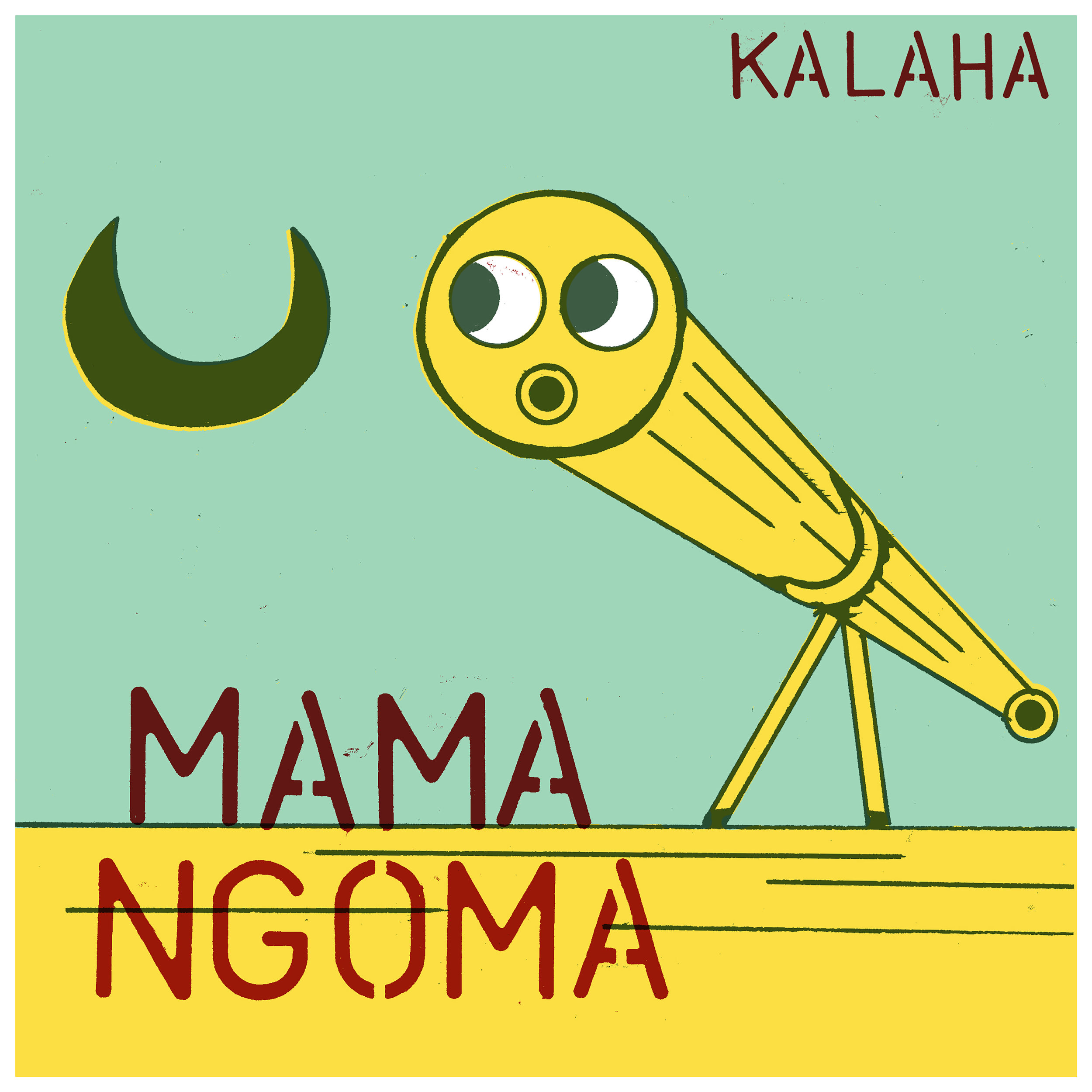
Kalaha - Mama Ngoma
Sometimes bands combine seemingly disparate music styles into one cohesive sound. In doing so, they remind listeners that styles which may seem far apart either physically, stylistically, or both, are actually closer to one another than they appear. The Danish group Kalaha allows us to experience this phenomenon through their new EP Mama Ngoma.
Sometimes bands combine seemingly disparate music styles into one cohesive sound. In doing so, they remind listeners that styles which may seem far apart either physically, stylistically, or both, are actually closer to one another than they appear. The Danish group Kalaha allows us to experience this phenomenon through their new EP Mama Ngoma. As the group’s first release in almost two years, Mama Ngoma paints a dreamscape of energetic electronica from a foundation of traditional West African music.
Kalaha was born as a live act at the Strøm Festival in Copenhagen where the band members - Rumpistol (Jens Christiansen), Spejderrobot (Mikael Elkjær), guitarist Niclas Knudsen, and drummer Emil de Waal - came together in haste to offer a “supergroup” performance to enliven the festival. Since then, Kalaha has recorded four studio releases and taken the stage together more than 100 times, where they’re acclaimed for whipping audiences into dance-driven frenzies. “All of the band members have very strong knowledge in at least one of the musical styles/genres mentioned,” Emil writes via email. A prolific percussionist, he’s described as the “backbone” of the band. “Nevertheless, we have very different ways of approaching the music…Somehow we respect each other´s approaches in a way that allows the diverse music styles to flow and blend freely.”
The EP pays homage to West African musical styles, particularly highlife, which earned its name because performances originally took place in exclusive, high-society settings where musicians played traditional Akan (a West African meta-ethnicity) rhythms and melodies through amplified instruments. These motifs are jumping-off points for Kalaha, but not ideas to be emulated “I don't think of Kalaha as a band that aims to recreate tradition,” Mikael writes. “We are more into being inspired by music we know and like. The different genres and traditions are more of a inspirational framework that allows us to make and play music we love.”
The two electronic musicians in the group, Rumpistol and Spejderrobot, are also its producers. In this role they are absolutely dialed-in, no pun intended. They mix electronic and acoustic material masterfully. The drums, rich and organic in timbre, shuffle and strike like a strong dance beat while synthesizers shine in colorful contrast to electric guitar licks. Kalaha has no traditional bassist, and usually Jens and Mikael mix synthesizers with different characteristics to create driving bass rhythms. On Mama Ngoma, however, they invited Danish bassist Flemming Muus and Louis Winding to track basslines.
“Dragon Jenny”, the first single from Mama Ngoma, is also its most plainly beautiful song. At just over six minutes long, “Dragon Jenny” moves through different atmospheres that are first inviting, then disorienting, but ultimately euphoric. Tonal percussion and a deep, twanging bassline by Muus (“We bring the bass part with us live in Spejderrobot´s computer,” says Emil) combine to create an undulating pocket groove. Just past the four-minute mark, one of Knudsen’s most choice guitar licks rings out, and one can’t help but smile upon hearing it.
“Malaika” demonstrates a natural psychedelia, a feeling of mind exploration that’s not schmaltzy or forced. “When we did the very first two rehearsals of ‘Malaika’” Jens writes, “we tried it with a straight up disco beat but also with a 'Higher Ground'-like funk shuffle. None of them really worked, so I suggested the idea of turning the tempo down 30 bpm and making it into a kind of G-funk track for the first part merging into afro-beat on the last part. Niclas came up with the talk-box and the little catchy afro-funk riffs, Louis provided the bass, Emil the drums and in the end it became something entirely different than originally intended, which I think is the magic of working collectively.”
On his “anagram” remix of “Malaika”, the New York City-based producer (and co-founder of The Rust Music) MALAKAI picks up on the psychedelia and delivers a digitized, spaced-out reimagining. The swing and hip-hop influence in MALAKAI’s drum pattern is a nice change of pace among the EP’s galloping afrobeat style. The “Cape Star” remix from fellow Danish producer Bwoy De Bhajan is the sleeper song on Mama Ngoma. If you’re not actively listening to it, the striking minimalist beauty may pass over your head. But get cued in for this cut, and you’ll find yourself immersed in a refreshing psychological swim across the meditative musical spaces that Bwoy de Bhajan creates. “I find it very enjoyable when the personality of the individual remixing is clearly present in the remix,” Mikael writes “I think both remixes share that quality.”
By bridging gaps across geography, time and style, Kalaha continues to make the music of the future in the present. The band’s own future includes a full-length release in 2019 titled Mandala, to which Jens calls Mama Ngoma a “prologue”. If you enjoy the vibe of Mama Ngoma, you already know to stay chooned until then.

![Seppa - Interview + Boosted [EXCLUSIVE PREMIERE]](https://images.squarespace-cdn.com/content/v1/59530136f5e2319eabb7d87f/1626113208781-BZ7C6B7E3LCECV7UD4CS/Boosted.jpg)

Amongst the incoming generation of artists having finally found their bite, not yes exemplifies the modern paradigm of electronic production; there are no hard boundaries, no clearly defined destinations, and unbridled compositional freedom. There’s a refreshing whim to their choice of direction, and the result is a fast-growing, dynamic catalog that takes us through virtually every space in low-end territory.